Baby-Led Weaning vs Purees: How to Choose (or Do Both)

This post may contain affiliate links. Read our policy.
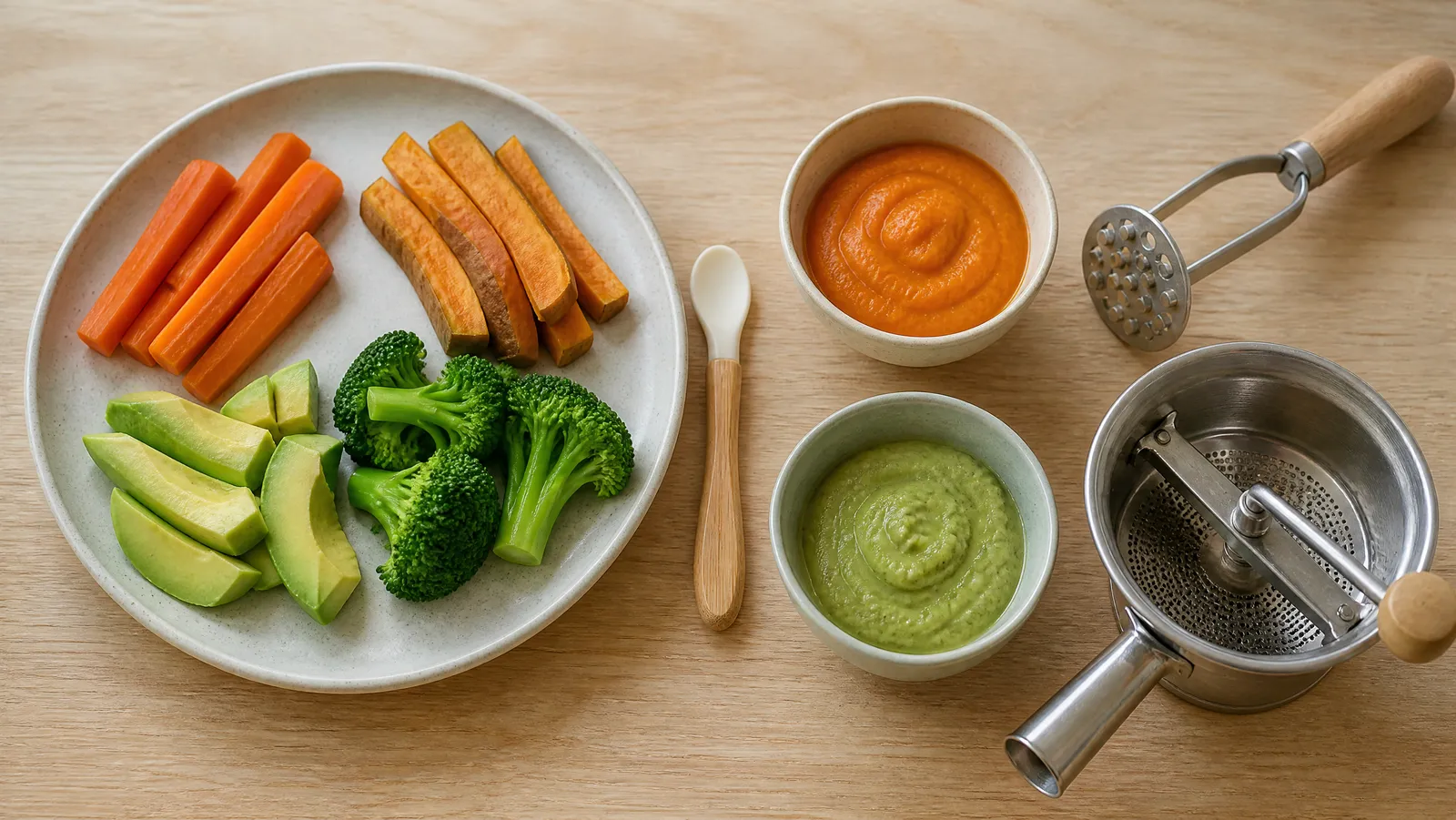
Baby-led weaning means handing your baby soft finger foods and letting them feed themselves from the first meal. Purees mean you hold the spoon. That is the entire difference — texture, and whose hand does the work. Neither route has been shown to be safer, neither reliably produces a less fussy eater, and both land in the same place by about nine months. Some of the links below are affiliate links, and we may earn a small commission, at no extra cost to you, if you buy through them.
I spent an embarrassing share of my daughter's fifth month on this and came away with an identity — I was going to be a baby-led weaning parent — and no practical information. Three weeks in she was gumming a carrot stick at lunch and taking pear puree off a spoon at dinner, because the puree was in the fridge and it was 6pm and I was tired. I felt like I had failed a test. I had not.
So here is the baby-led weaning vs purees question with the ideology stripped out: what each approach is, what the three claims with real evidence behind them actually say, and how to run both at once. The full walk-through of starting solids is a separate guide. This one is about picking a route.
What Baby-Led Weaning and Purees Actually Are
Baby-led weaning, usually shortened to BLW, skips spoon-feeding entirely. From the first meal your baby is offered soft pieces they can pick up themselves — a spear of roasted sweet potato, a strip of omelette, a rib of well-cooked broccoli. You put food on the tray. Your baby decides what, how much, and whether.
Traditional weaning starts with smooth puree on a spoon held by an adult, then thickens and lumps up over the following months until your baby is eating soft chopped food from the family meal. You aim the spoon at first; your baby takes over by degrees.
Both start at the same point on the calendar. HealthyChildren.org, the American Academy of Pediatrics' parent site, says "usually, babies are ready to introduce solids into their diet at around 6 months of age." But BLW leans harder on readiness, because a baby who cannot sit upright and steer a hand to their own mouth cannot self-feed at all, whereas a spoon can be aimed for them. That makes the signs your baby is ready for solids more load-bearing on the finger-food route, not less.
Baby-Led Weaning vs Purees: The Comparison Table
| Compare on | Baby-led weaning | Purees |
|---|---|---|
| Who holds the food | Your baby, from meal one | You, at first |
| Starting texture | Soft pieces you can squash against the roof of your mouth | Smooth, thickening over weeks |
| Choking evidence | No significant difference between groups in BLISS | No significant difference |
| Iron | The AAP's stated concern — can run low unless iron is deliberate | Fortified cereal and pureed meat are easy to deliver |
| Mess | Substantial, daily, on the floor | Mostly bib and sleeve |
| Kit, cost and prep time | A way to soften food; cook once for everyone | A mill or blender plus storage; batch cook and freeze |
| Daycare and grandparents | Some providers will not serve finger foods | Accepted almost everywhere |
| Where you are at 9 months | Mashed and chopped family food, plus finger foods | Mashed and chopped family food, plus finger foods |
The last row is the one people miss. Whichever door you walk through, the room on the other side is the same.
Is Baby-Led Weaning Safe? What the Choking Evidence Shows
The best trial available found no difference in choking between baby-led and spoon-fed infants — but it tested a version of BLW in which parents were explicitly taught to reduce choking risk. The coaching about food may be doing much of the work here, and the trial had no unmodified-BLW group to compare against.
That study is BLISS, a randomized controlled trial of 206 healthy infants in Dunedin, New Zealand, published in Pediatrics in 2016. In its own words: "A total of 35% of infants choked at least once between 6 and 8 months of age, and there were no significant group differences in the number of choking events at any time." Baby-led infants "gagged more frequently at 6 months (relative risk [RR] 1.56; 95% confidence interval [CI], 1.13-2.17), but less frequently at 8 months (RR 0.60; 95% CI, 0.42-0.87)."
Its conclusion deserves quoting whole rather than clipped: "Infants following a baby-led approach to feeding that includes advice on minimizing choking risk do not appear more likely to choke than infants following more traditional feeding practices. However, the large number of children in both groups offered foods that pose a choking risk is concerning." At the 12-month three-day diet record, 94% of infants were offered a food posing a choking risk, with no significant difference between groups.
That clause about advice is the whole ballgame. Per the BMC Pediatrics paper describing how BLISS was developed and pilot-tested, parents were told to "test foods before they are offered to the infant to make sure they are soft enough to mash with the tongue on the roof of the mouth," were given a list of foods to avoid such as raw apple, and were steered away from hard foods, small foods, coin-shaped foods and anything that forms a crumb in the mouth. That is not BLW as absorbed from a Facebook group.
The AAP's phrasing on HealthyChildren.org matches the evidence exactly: "some studies suggest baby-led weaning does not pose higher choking risks than traditional feeding." Some studies suggest. Not settled.
One thing to settle before your first meal either way — gagging is not choking. The NHS calls gagging a baby "learning how to deal with solid foods and regulate the amount of food they can manage to chew and swallow at one time." Our explainer on gagging and choking covers telling them apart in the moment.
Does Baby-Led Weaning Make Less Fussy Eaters or Leaner Toddlers?
Here the marketing outruns the data. The claim is that self-feeding teaches appetite regulation, producing a child who eats more widely and weighs less. It has been tested properly once, and it did not hold.
The BLISS cohort was followed for two years for growth, published in JAMA Pediatrics in 2017. BMI z score was the primary outcome, and it "was not significantly different at 12 months (control group, 0.20; BLISS group, 0.44; adjusted difference, 0.21; 95% CI, -0.07 to 0.48) or at 24 months." At 24 months, 6.4% of control infants and 10.3% of baby-led infants were overweight — a gap inside the noise. The verdict: "A baby-led approach to complementary feeding did not result in more appropriate BMI than traditional spoon-feeding."
The fussiness finding is real but smaller than its reputation. Parents in the baby-led group reported "less food fussiness (adjusted difference, -0.33; 95% CI, -0.51 to -0.14) and greater enjoyment of food" at 12 months — questionnaire scores from parents who knew their group. The same trial found "lower satiety responsiveness" in baby-led infants at 24 months, which runs against the self-regulation theory it was built to test.
Everything else is observational, and people who choose BLW are not a random sample. A review in Current Nutrition Reports notes that "mothers who follow a baby-led approach have a higher level of education and/or age compared to those following a traditional approach." Any of that could produce the outcomes credited to the method. A systematic review in the Italian Journal of Pediatrics pooling 12 articles, 10 of them cross-sectional, put it plainly: "Both randomized trials have potential bias; therefore, the quality of the evidence is low."
Choose BLW because it suits your kitchen and your baby. The long-term outcome argument cannot bear weight yet.
Does Baby-Led Weaning Risk Low Iron?
This is the AAP's actual objection and the most substantive point on the table. HealthyChildren.org states it directly: "Many self-feeding diets are rich in vegetables and fruits but low in iron, vitamins, minerals and other essentials."
Iron matters at this age because the supply a baby is born with runs down. The AAP's position, published on HealthyChildren, is that infants who are partially or completely breastfeeding should be given supplemental oral iron from four months of age, continuing "until appropriate iron-containing complementary foods (including iron-fortified cereals) are introduced in their diet." Whether your baby needs a supplement, and how much, is a question for your pediatrician rather than something to work out at home. Demand then jumps — Nemours KidsHealth puts it at 11 milligrams a day for infants aged 7 to 12 months — and the CDC is blunt: "once your child starts to eat foods around 6 months, it is important to give foods with enough iron to meet nutritional needs."
BLISS measured iron too, and the results in BMJ Open were reassuring: no significant difference in median dietary iron intake at 7 or 12 months, and none in plasma ferritin, body iron, or the prevalence of depleted iron stores or iron deficiency anaemia at 12 months. Read the conclusion twice: "A baby-led approach to complementary feeding does not appear to increase the risk of iron deficiency in infants when their parents are given advice to offer 'high-iron' foods with each meal."
So the finding is not that BLW is fine for iron. It is that BLW plus a deliberate high-iron food at every meal was fine for iron, once. Purees get no free pass — pear and sweet potato from a pouch has the same gap. Health Canada names the fix, recommending "iron-rich meat, meat alternatives, and iron-fortified cereal as the first complementary foods," and our guide to first foods to offer covers which ones carry it.
Combination Weaning Is What Most Families Actually Do
Almost nobody runs a pure version of either method, including people who say they do. The review in Current Nutrition Reports reports that "21% of mothers who identified as baby-led were not 'adherent', e.g. they used purees and spoon-feeding," and that inside BLISS only about 64% of the baby-led group counted as adherent at 7 months.
The AAP gives explicit permission on HealthyChildren.org: "if you choose to feed your baby with a spoon for a few days or weeks, don't worry—they will still learn to eat independently! Pureed foods can be nutritious, too." The NHS frames it as your baby's preference to express: "Some babies like to start with mashed, lumpy or finger foods. Other babies need a little longer to get used to new textures, so may prefer smooth or blended foods on a spoon at first."
Four things keep combination weaning from becoming chaos:
- One texture per meal, not two. Offering both at once can produce a baby who wants whichever is not in front of them. Pick a format per sitting and alternate.
- Put the iron in first. Lead with the iron-rich item while your baby is hungriest, in whatever format they handle that day.
- Hand over a pre-loaded spoon. That is self-feeding with a puree — the direct bridge between the two camps.
- Mash instead of cooking twice. Soften a portion of what is already on the stove, at the table.
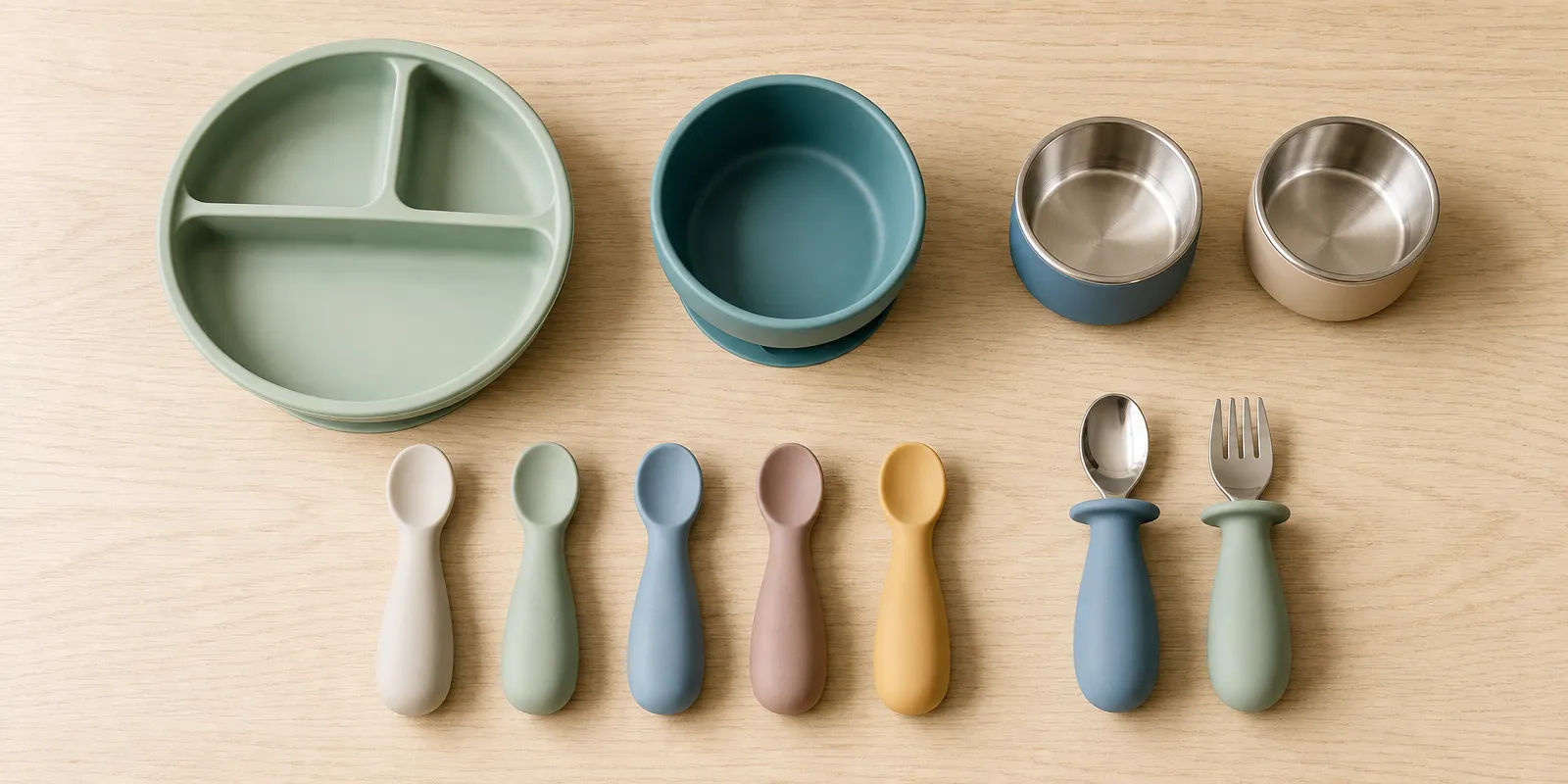
How much they need at each stage — how much solid food by age — is a separate question, and so is the kit for it, baby plates, bowls and spoons.
Which Route to Lean Toward, Given Your Constraints
Match the method to your circumstances rather than a philosophy, and take anything medical to your pediatrician.
- Your baby fights the spoon. Some clamp shut at the sight of one and do fine with food they can hold. Lean to finger foods and stop treating refusal as a battle.
- Your daycare requires purees. Then purees happen there and finger food happens at home — combination weaning on a timetable.
- You have no time to cook. BLW is the faster option: a portion pulled from the family dinner before the salt goes in beats batch-cooking and freezing.
- Reflux, a swallowing problem, or a history of feeding difficulty. Talk to your pediatrician before you choose. Guidance written for typical babies may not fit yours.
- A premature baby. Get individual advice. A 2020 editorial in Nutrients notes that "no evidence-based guidelines are available regarding the most appropriate time and method of weaning preterm infants."
- A late starter at eight or nine months. You can skip much of the smooth stage. HealthyChildren.org says to "let your baby try feeding herself as soon as she's ready — usually around 8 or 9 months old," using "very small pieces (smaller than a dime)."
- Your baby slumps in their seat. Fix that first. Self-feeding needs an upright back, a snug harness and supported feet, which is what the best high chairs for starting solids is about.
Both Routes Converge by About Nine Months
The debate has a short shelf life. The CDC describes one arc for everyone: "at around 6 months old, it's easier for your child to eat mashed, pureed, or strained foods that are very smooth in texture," and then "you can introduce thicker and more lumpy foods as your child's ability to eat develops." It tells every parent to "encourage your child to pinch or pick up food with their fingers."
HealthyChildren.org puts the crossover at "usually around 8 or 9 months old" and notes in the same breath that "you can still feed your baby pureed, mashed, and jarred food, too." Both at once. That is where both routes end up.
There is a deadline on the puree side, and it is the one real argument against staying smooth. Health Canada advises that lumpy textures be offered "no later than nine months," because "delaying the introduction of lumpy textures beyond the age of nine months is associated with feeding difficulties in older children and a lower intake of nutritious foods such as vegetables and fruit." The risk worth worrying about is not picking the wrong method. It is still serving smooth food at eleven months.
The Gear Each Route Genuinely Needs
Less than the internet implies, and the middle item does both jobs.
For the finger-food route, a book beats a shape chart. Baby-Led Feeding covers preparing food for a baby with no teeth and no pincer grasp, and sets the meals in the context of what the rest of the family is eating. Useful even if you end up mostly spooning: the texture progression is the same problem either way. About $12.13 as of September 2026.
For doing both, buy the masher. The OXO Tot Food Masher is a masher and a ridged bowl that work against each other, so a piece of what you are already eating becomes a baby portion at the table. It comes apart and stores inside its own lidded bowl. No second dinner, no machine. About $13.99 as of September 2026.
For purees, skip the appliance and get a mill. The Green Sprouts Food Mill is hand-cranked, with a built-in serving bowl and a strainer that holds back seeds and skins — the thing a blender does badly at small volumes. No cord, no batteries, top-rack dishwasher safe, small enough for a diaper bag. About $24.99 as of September 2026. It also answers whether you need a baby food maker: for one portion at a time, mostly not.
Baby food storage containers and baby food pouches can wait until you know whether you are batch-cooking.
So, Baby-Led Weaning or Purees?
Whichever one you will actually do at 6pm on a Wednesday.
That is not a dodge. The randomized evidence says the two routes produce similar choking risk when the food is prepared safely, similar iron status when the iron is deliberate, and similar body weight. What survives scrutiny is practical: mess, cooking style, what your daycare will serve, whether your baby tolerates a spoon.
So pick the route that fits your week. Put an iron-rich food in front of your baby at every meal, make sure anything you hand over can be squashed against the roof of your mouth, and get lumps in well before nine months.
And if you are three weeks in with a carrot stick at lunch and a spoon at dinner and a quiet sense that you are doing it wrong — you are not. That was me, and it was also a good share of the trial participants. When you want the rest of the picture, our starting-solids guide covers portions and schedules in order. You've got this.

Baby-Led Feeding: A Natural Way to Raise Happy, Independent Eaters
The book to own if the finger-food route appeals and you want more than a shape chart — it covers how to prepare foods for a baby who has no teeth and no pincer grasp, and it puts the meals in the context of what the rest of the family is eating. Useful even if you end up doing mostly purees, because the texture progression is the same problem either way.
- Brand
- HarperCollins
- Category
- Our Pick
What it fixed for us was the cooking, not the philosophy. Roasting a tray of vegetables for everyone and pulling a baby portion out first is the whole trick.
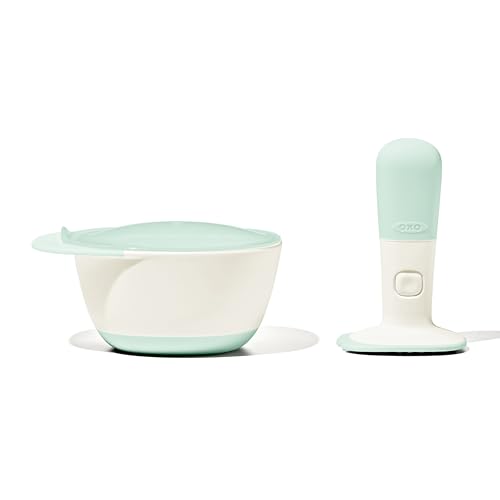
OXO Tot Food Masher
A masher and a ridged bowl that work against each other, so you can turn a piece of what you are already eating into a baby portion at the table. It comes apart and stores inside its own lidded bowl. This is the tool that makes the combination approach cheap: no separate cooking, no machine, just a softer version of the same dinner.
- Brand
- OXO Tot
- Category
- Best for Both
The ridges in the bowl do half the work. Mashing in a flat dish means chasing food up the sides.

Green Sprouts Fresh Baby Food Mill, Manual Puree Maker
A hand-cranked mill with a built-in serving bowl and a strainer that keeps seeds and skins out — the thing a blender does badly at small volumes. No cord, no batteries, top-rack dishwasher safe, and small enough for a diaper bag. It also answers the question of whether you need an electric baby food maker: for one portion at a time, mostly not.
- Brand
- Green Sprouts
- Category
- Best for Purees
Quiet matters more than we expected. Running a blender next to a hungry baby at 6pm makes an already loud moment worse.
- 01HarperCollinsOur PickBaby-Led Feeding: A Natural Way to Raise Happy, Independent Eaters
- 02OXO TotBest for BothOXO Tot Food Masher
- 03Green SproutsBest for PureesGreen Sprouts Fresh Baby Food Mill, Manual Puree Maker
Is baby-led weaning safe, or does it cause choking?+
Can I do baby-led weaning and purees at the same time?+
Does baby-led weaning give a baby enough iron?+
Do babies who do baby-led weaning become less fussy eaters?+
When can my baby start finger foods if we began with purees?+
Our daycare only accepts purees. Does that rule out baby-led weaning?+
Sammie Seelbach
Sammie is a mom of two and the lead reviewer at Smart Baby Reviews. Since becoming a parent she has become obsessed with researching the safest, smartest baby gear on the market — testing thermometers at 2 a.m., wrangling baby gates, and sterilizing more bottles than she can count. She shares what actually works so other parents can make confident, informed decisions for their little ones.