The Best Baby Food Storage Containers and Freezer Trays

This post may contain affiliate links. Read our policy.
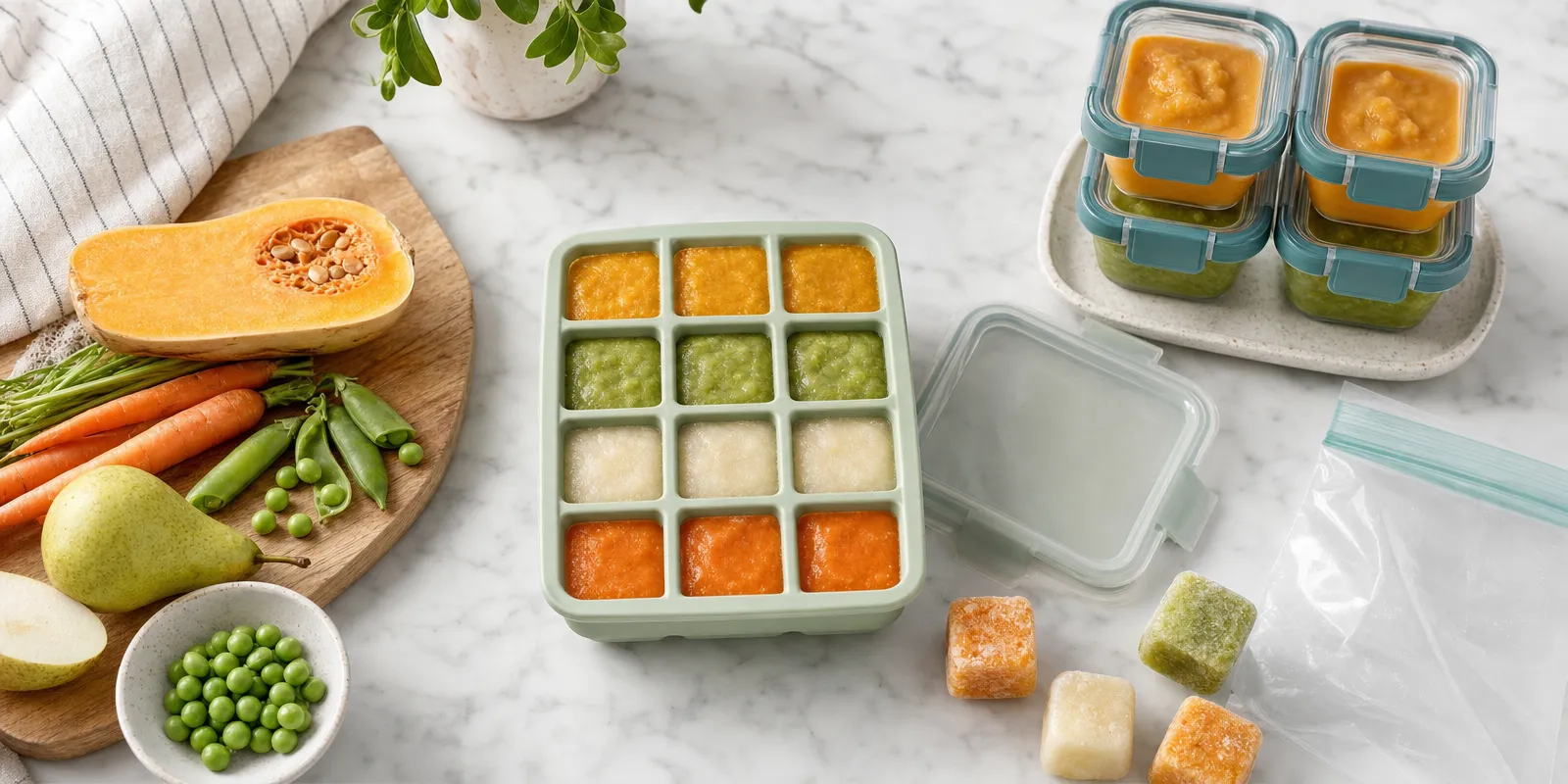
The best baby food storage containers are the ones sized to what your baby actually eats, in a material that goes from freezer to heat without cracking. For most families that is one silicone freezer tray for making a batch plus one set of 4-ounce glass containers for storing it — about $46 for both. Some of the links below are affiliate links, and we may earn a small commission, at no extra cost to you, if you buy through them.
Our freezer, in month two of solids, held forty cubes of orange puree in three unlabelled bags. Sweet potato, carrot and squash are the same colour frozen, and nothing was dated, so I binned the lot.
The containers here are close to interchangeable: a cup with a lid, glass or silicone, markings up the side. What is not interchangeable is knowing how long a puree keeps, and those numbers are shorter than most parents assume — pureed meat gets one day in the refrigerator, not three. The table below is the real product of this guide; the containers are how you act on it.
This assumes you are already starting baby on solids, or watching the readiness signs, and that batch cooking looks like the only sane way to produce a tablespoon of dinner. It is. It comes with rules.
How Long Homemade Baby Food Keeps, by Food Type
Homemade baby food keeps 1 to 2 days in the refrigerator and 3 to 4 months in the freezer, according to the FDA — but that row hides the detail that matters. Purees have different windows depending on what is in them, and the meat ones are shortest by a wide margin. The FDA's chart for solids, opened or freshly made, from its guide to food safety once baby arrives:
| Puree or baby food | Refrigerator at 40°F | Freezer at 0°F |
|---|---|---|
| Strained fruits and vegetables | 2 to 3 days | 6 to 8 months |
| Strained meats and eggs | 1 day | 1 to 2 months |
| Meat and vegetable combinations | 1 to 2 days | 1 to 2 months |
| Homemade baby foods | 1 to 2 days | 3 to 4 months |
Meat is the one-day food. A strained meat or egg puree gets one day in the refrigerator; a meat-and-vegetable combination gets 1 to 2 days. Chicken cooked on Sunday belongs in the freezer on Sunday.
The same chart covers opened jars and pouches, since those rows are for solids "opened or freshly made." An opened jar of strained carrot gets 2 to 3 days; strained meat, one.
Where sources disagree, take the shorter number. The chart allows homemade food 3 to 4 months frozen, but the FDA's own ice-cube-tray instructions say to store up to three months and discard unused food after that, and the Academy of Nutrition and Dietetics allows only "one or two days in the refrigerator or one to two months in the freezer."
Two hours is the room-temperature limit. The FDA says not to leave baby food out longer than that, and the Academy's instruction after cooking is to serve it or refrigerate it right away.
Breastmilk has its own rules, and they are not these. The mushie tray below is marketed for milk too, and none of the numbers above apply: the CDC allows up to 4 hours at room temperature, up to 4 days in the refrigerator, about 6 months in the freezer with up to 12 months acceptable, and no refreezing once thawed. Work from the CDC's human milk storage guidelines instead. And how much your own baby should be eating at a given age is a question for your pediatrician, not one a container size can answer.
The Saliva Rule: Store in One Thing, Feed From Another
Food a baby has been fed from with a used spoon does not go back into storage. The FDA is blunt: do not feed a baby from a jar of baby food and then put it in the refrigerator, because "saliva on the spoon may contaminate the remaining food." Instead, put a serving size on a dish, refrigerate what remains in the jar, and throw away whatever is not eaten from the dish.
The same guidance adds the harder version: do not put a bottle or baby food back in the refrigerator if the baby does not finish it, because bacteria from a baby's mouth can grow even after refrigeration. NHS weaning guidance agrees: "Throw away any half-eaten portions of food that's been previously prepared – never save and store or reheat them again."
Two consequences. Decant every meal: the container stores, a bowl feeds. And portion small, then offer more — the way to stop throwing food away is a smaller container plus a second cube, which is why 1.5 ounces is not a weakness at six months.
So the bowl matters as much as the box. Our roundup of baby plates, bowls and spoons covers the ones that stay on the table, and it works better in a seat that holds a baby upright — the best high chairs for starting solids.
Thawing and Reheating Without Guessing
Thaw baby food in the refrigerator or in cold water, never on the counter. Reheat it once, stir it, and taste it yourself first.
Thawing. USDA's Food Safety and Inspection Service gives three safe methods — refrigerator, cold water, or microwave — and rules out the counter: perishable food should never be thawed on the counter or in hot water, because while the centre of a package is still frozen, the outer layer can sit in the danger zone between 40 and 140°F, where bacteria multiply rapidly. Cold water means a leakproof bag immersed, water changed every 30 minutes. Microwave-thawed food is used straight away — FSIS says to cook it immediately after thawing, because parts of it begin to cook in the microwave.
Refreezing. FSIS says food thawed in the refrigerator is safe to refreeze without cooking, though with some quality loss, while food thawed in cold water or the microwave should be cooked first. For one cube of squash that is academic: thaw what you will serve, and eat defrosted food within 24 hours, the NHS line for babies.
Reheating. Do not microwave baby food in the jar; the FDA says to transfer it to a dish first, so it can be stirred and taste-tested. Microwave 4 ounces for about 15 seconds on high, then stir, let it stand 30 seconds, and taste-test — food that is "baby-ready" should taste or feel lukewarm. Do not heat baby-food meats, meat sticks or eggs in the microwave at all; use the stovetop, because their fat content means they can splatter and overheat.
Hot spots are the actual hazard. Microwaved baby food heats unevenly, and the FDA's note on the pattern is what people miss: the hottest places are in the centre, the coolest next to the glass sides, "which could lead you to believe that the food is not too hot." Stirring removes the hot spot. The same page says microwaving milk and formula is not recommended, because hot spots can scald a baby's mouth and throat. NHS guidance adds that already-cooked food should be reheated only once, steaming hot all through and then cooled, with half-eaten portions thrown away.
So "freezer to microwave" means the container survives the temperature swing — not that it saves you a dish.
The Five Best Baby Food Storage Containers and Freezer Trays
Judged on portion size against your baby's age, freezer-to-heat material, whether the seal survives a nappy bag, and whether it stacks. Prices are as of October 2026 and move.
Our pick: OXO Tot Glass Baby Blocks
The OXO Tot Glass Baby Blocks set is $25.99 as of October 2026 for four 4-ounce containers, four lids and a stackable tray — $6.50 per container, when the Comotomo set below gives you the same 4 ounces of glass for $5.33 a jar. The tray is the difference: it keeps a freezer shelf from becoming an avalanche of unlabelled tubs. OXO states the glass goes from freezer to microwave or oven without shattering from the temperature change, and that glass does not absorb colours or food odours the way plastic does. The lids are airtight and leak-proof per the maker, the body carries markings, and the set is BPA, phthalate and PVC free.
Two honest limits: glass breaks, so a 4-ounce block is a bad idea in a ten-month-old's own hands; and OXO's thermal-shock claim covers this product, not glass in general — a repurposed jam jar is not made for oven heat.
Best freezer tray: mushie Silicone Baby Food Freezer Tray
The mushie silicone freezer tray is $19.99 as of October 2026 for nine cups of 1.5 ounces each, with ounce and millilitre markings inside every cup and a clip-on BPA-free plastic lid — $2.22 per cup, 13.5 ounces of puree a batch.
This is the item most parents skip and the one that makes the workflow work. A tray is for making: fill it, freeze it, pop the cubes out of the flexible silicone, move them to a dated bag, and the tray is free for the next batch. Containers are for storing and transporting; most families need both and buy one. The 1.5-ounce cup is a first-foods portion rather than a meal, which cuts both ways: the AAP suggests starting with half a spoonful or less and puts a baby's daily meal at about 4 ounces later in the first year, so one cube may be about right early on and three may be a lunch by ten months. Top-rack dishwasher safe, and mushie advises avoiding harsh or scented cleaners.
Best glass multipack: Comotomo Glass Containers, 6-Pack
At $31.99 as of October 2026 the Comotomo 6-pack is the most expensive item here and the cheapest storage on the page per ounce: $5.33 a jar, about $1.33 per ounce of capacity against $1.62 for the OXO set. Cook in volume and that inverts the price question.
Six 4-ounce tempered glass jars with one-piece silicone lids, and nothing else. According to Comotomo, food contacts only tempered glass and food-contact grade silicone and never plastic, the soft lid presses in for an airtight, vacuum-style seal, and the jars are microwave safe when used as directed, with a self-venting lid. The appeal is quantity plus no clips or latches to break. What you give up is the system — no tray, so six jars sit loose — and glass is still glass.
Best silicone containers: Olababy 2 oz, 4-Pack
The Olababy silicone containers are $15.99 as of October 2026, down from a $17.99 list price, for four 2-ounce food-grade silicone containers with airtight lids and markings. Cheapest entry price here, most expensive per ounce of capacity at $4.00 a container, about $2.00 an ounce.
Silicone splits the difference between glass and plastic: unbreakable, and Olababy states it will not crack, stain, warp or absorb odours — what cheap plastic fails at the first time it meets tomato. The maker lists them as freezer to microwave, top-rack dishwasher safe and stackable, free of BPA, phthalates and PVC, and held to US CPSC standards.
Two ounces is small on purpose, which is the point and the catch. At the start, when the AAP's advice is half a spoonful or less building to a teaspoonful or two, it is the right unit; against the AAP's roughly 4-ounce meal later in the first year it is half a lunch. Olababy sells the same container in 4 ounces — buy that one if this is your only set.
Best for daycare and travel: mushie Silicone Food Containers, 3-Pack
The mushie 4-ounce containers are $19.99 as of October 2026 for three, or $6.66 each — the highest per-container price here. Two details earn their keep if you use daycare: each jar is a different muted colour, and each has a blank panel on the base to write a child's name on. That sounds like a gimmick until the first week of daycare, when it is the only reason your containers come home.
Each measures 3 x 3 x 2.12 inches with interior markings, in 100% food-grade silicone free of BPA, BPS, PVC and phthalates, and mushie lists them as microwave, freezer and dishwasher safe, top shelf. Our source data does not describe the lid seal, so test one with water first. The travel rule matters more than the container anyway: the FDA says to transport food in an insulated cooler, and that perishable items left without a cold source for more than two hours should not be used.
How the Five Compare
| Product | Material | Portion size | Count | Freezer to microwave | Lid and seal | Per container |
|---|---|---|---|---|---|---|
| OXO Tot Glass Baby Blocks | Glass | 4 oz | 4 plus tray | Freezer to microwave or oven, per maker | Locking, leak-proof per maker | $6.50 |
| mushie Silicone Freezer Tray | Silicone, plastic lid | 1.5 oz per cup | 9 cups | Not stated | Clip-on lid | $2.22 per cup |
| Comotomo Glass Containers | Tempered glass, silicone lid | 4 oz | 6 | Microwave safe as directed, per maker | One-piece press-in silicone, self-venting | $5.33 |
| Olababy Silicone Containers | Silicone | 2 oz (4 oz sold too) | 4 | Freezer to microwave, per maker | Airtight lid | $4.00 |
| mushie Silicone Food Containers | Silicone | 4 oz | 3 | Microwave, freezer safe per maker | Seal not stated | $6.66 |
Per ounce of capacity the order flips: Comotomo $1.33, mushie tray $1.48, OXO $1.62, mushie containers $1.67, Olababy $2.00.
The Batch-Cooking Workflow, Start to Finish
Seven steps, about an hour on a Sunday.
- Cook. Steam until soft; a saucepan and a steamer basket is the whole equipment list. If you would rather own a baby food maker, it does both jobs in one jug. What goes in the pot is its own question — first foods to introduce and what to avoid is our shortlist.
- Puree. Blend with a splash of the cooking water, or fork-mash anything soft enough.
- Portion straight away. Serve it or refrigerate it right away; nothing stands out longer than two hours.
- Freeze in the tray. The FDA describes the method in so many words: put the mixture into an ice cube tray, where one cube equals one serving, cover it and freeze. In small jars instead, leave about half an inch of space at the top, because food expands as it freezes.
- Label. Food and date — sweet potato, carrot and squash are indistinguishable frozen.
- Bag, and free the tray. Once frozen, pop the cubes into a freezer bag or airtight container and date it; the FDA says to store up to three months and discard unused food after that.
- Rotate. Oldest bag at the front, and when a bag holds a mixed meal the shortest window governs — a meat-and-vegetable combination is a 1-to-2-month food even if the vegetables would keep longer alone.
The payoff of cooking your own is controlling what goes in and varying it week to week — the free move every parent has in the context of heavy metals in baby food.
One honest caveat: this is a puree-shaped workflow. A family doing baby-led weaning needs far less of it; strips of roasted vegetable off the adults' tray need no labelled cubes at all. Our comparison of baby-led weaning and purees covers the choice, and most families land in between — which is where a tray and one set of containers earn their keep.
A Word on Plastics and Microplastics
One listing here asserts that plastic containers leach microplastics when heated, and I am not repeating that as fact. University of Nebraska–Lincoln researchers did report, in Environmental Science and Technology on June 21, 2023, that microwave heating released more micro- and nanoplastic particles from plastic containers and pouches than refrigeration or room-temperature storage — more than 2 billion nanoplastics and 4 million microplastics per square centimetre of surface for some containers. But Nebraska's own write-up of the work is careful to say that "the health effects of consuming micro- and nanoplastics remain unclear," and the journal has since published a formal Correspondence on the paper, which the authors answered with a published rebuttal. Glass and silicone sidestep the question, which is why all five picks here are one or the other.
The Bottom Line: Buy Two, Not Five
Two items cover the whole first year. The mushie silicone freezer tray at $19.99 is for making — nine 1.5-ounce cubes a batch, bagged so the tray goes back to work. The OXO Tot Glass Baby Blocks at $25.99 are for storing and reheating. About $46 together.
Three variations. Cooking in volume: the Comotomo 6-pack at $31.99, the cheapest glass per ounce here. Baby has just started: the Olababy containers at $15.99, or their 4-ounce size if this is your only set. Daycare: the mushie 3-pack at $19.99, for the write-on panel. Skip a second set in a size you own, and skip glass for a baby who holds their own container.
Then do the free part, where the safety actually lives. Label the food and the date. Keep meat purees to one day in the fridge. Thaw in the refrigerator, reheat once, stir, taste it yourself. Feed from a bowl and bin what comes back.
If you are earlier in this than a full freezer suggests, our guide to getting your baby started on solids walks through the first foods, textures and first month in order. The containers are the easy part. You've got this.
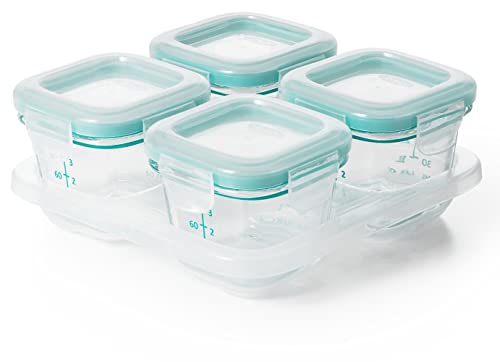
OXO Tot Glass Baby Blocks Food Storage Containers, 4 oz
Four 4-ounce glass containers with locking, leak-proof lids and a stackable tray. Glass is the sane default for anything you intend to reheat: OXO states the body goes from freezer to microwave or oven without shattering from the temperature change, and glass does not absorb colours or food odours the way plastic does. Measurement markings on the body make portioning straightforward, and every component separates for cleaning.
- Brand
- OXO Tot
- Category
- Our Pick
The stacking tray is the unglamorous feature that keeps a freezer shelf from becoming an avalanche of unlabelled tubs.

mushie Silicone Baby Food Freezer Tray with Lid, 9 Cups x 1.5 oz
Nine silicone cups of 1.5 ounces each, with ounce and millilitre markings inside every cup and a clip-on BPA-free plastic lid. This is the batch-cooking tool rather than the storage tool: you fill it, freeze it, pop the cubes out of the flexible silicone, and move them to a bag so the tray is free for the next batch. The 1.5-ounce portion is close to what a baby new to solids actually eats, which means fewer half-eaten thaws thrown away.
- Brand
- mushie
- Category
- Best Freezer Tray
Silicone is the only tray material where the cubes come out without a running-water fight. Rigid plastic trays make you choose between a cracked tray and a thawed edge.

Comotomo Glass Food Storage Container with Silicone Lid, 4 oz, 6-Pack
Six 4-ounce tempered glass jars with one-piece silicone lids and no clips or latches to break. Comotomo's claim for the design is that food touches only tempered glass and food-contact silicone, never plastic, and that the soft lid presses into place for an airtight seal. Six jars is the number that makes a Sunday batch-cook session work without rationing containers, and the two-piece design means there is very little to lose in a dishwasher.
- Brand
- Comotomo
- Category
- Best Glass Multipack
Six matching jars changes how you cook: you stop portioning around how many lids you can find.

Olababy Silicone Baby Food Storage Containers, 2 oz, 4-Pack
Four 2-ounce food-grade silicone containers with airtight lids and measurement markings. Silicone splits the difference between glass and plastic: unbreakable like plastic, but it does not stain from tomato or beetroot and does not warp in a dishwasher. The 2-ounce size is deliberately small — it suits a first-foods portion, a snack or a dipping sauce rather than a full meal. Olababy also sells the same container in 4 ounces, which is the size to buy if you want one container to hold a whole meal.
- Brand
- Olababy
- Category
- Best Silicone Containers
The clear silicone is more useful than it sounds: you can see which cube is squash and which is pear without opening anything.

mushie Silicone Baby Food Containers, 4 oz, 3-Pack
Three 4-ounce silicone jars, each a different muted colour, with a blank panel on the base to write a child's name on. Those two details are aimed squarely at daycare, where unlabelled containers go missing and colour-coding is how you remember which jar holds which meal. Each container measures about 3 by 3 by 2.1 inches with interior measurement markings, and the whole thing is top-shelf dishwasher safe.
- Brand
- mushie
- Category
- Best for Daycare and Travel
A write-on panel on the bottom sounds like a gimmick until the first week of daycare, when it is the only reason your containers come home.
- 01OXO TotOur PickOXO Tot Glass Baby Blocks Food Storage Containers, 4 oz
- 02mushieBest Freezer Traymushie Silicone Baby Food Freezer Tray with Lid, 9 Cups x 1.5 oz
- 03ComotomoBest Glass MultipackComotomo Glass Food Storage Container with Silicone Lid, 4 oz, 6-Pack
- 04OlababyBest Silicone ContainersOlababy Silicone Baby Food Storage Containers, 2 oz, 4-Pack
- 05mushieBest for Daycare and Travelmushie Silicone Baby Food Containers, 4 oz, 3-Pack
How long does homemade baby food keep in the freezer?+
Can you refreeze a thawed baby food puree?+
Is it safe to feed my baby from the same container I stored the food in?+
Sammie Seelbach
Sammie is a mom of two and the lead reviewer at Smart Baby Reviews. Since becoming a parent she has become obsessed with researching the safest, smartest baby gear on the market — testing thermometers at 2 a.m., wrangling baby gates, and sterilizing more bottles than she can count. She shares what actually works so other parents can make confident, informed decisions for their little ones.