Baby-Proofing Doors: Knob Covers, Locks, and Pinch Guards

This post may contain affiliate links. Read our policy.
The sound that got me off the sofa was not a bang. It was the small, tidy click of a door latching shut, then silence from a room I could no longer see into. My daughter had let herself into the laundry room, pulled the door closed behind her, and could not work out how to open it again.
Some of the links below are affiliate links, and we may earn a small commission — at no extra cost to you — if you buy through them. Here is what took me two kids to understand: a door is three separate problems, and most of us only ever solve one. It opens. It closes on fingers. And it locks. Each needs different hardware, and the pack of knob covers in your cart addresses exactly one.
Baby proofing door knobs is a good place to start and a bad place to stop. Here are all three in order — the door chapter of our complete baby-proofing guide.
A door is three problems, not one
Problem one: the door opens. A child gets into the garage, the basement, the medicine cabinet, the room with the pool beyond it, or out the front of the house. This is the one everybody buys for.
Problem two: the door closes. On fingers. A national study of US emergency-department data published in Clinical Pediatrics estimated that 1,392,451 US children aged 17 and under received emergency treatment for door-related injuries between 1999 and 2008 — roughly one injury every four minutes. Children aged four and under made up 41.6 percent of them, and the most common mechanism was a pinch in the door, at 54.8 percent. Among children admitted to hospital, the most frequent treatment was for amputations, at 32 percent.
Problem three: the door locks. A toddler shuts themselves into a bathroom, or the lock you fitted last month turns out to be the thing between you and them. A knob cover does nothing for fingers, and a pinch guard does nothing to keep a child out of the garage.
Which doors in your house actually need locking
Locking every door is how you end up propping them all open by week three, so be honest about the list. The doors that earn a lock are the ones where the other side cannot be fixed by tidying: the garage, the basement or attic stairs, the utility room with detergent pods at floor height, the door to a pool, deck or driveway, and any bathroom you cannot keep emptied of medicines and standing water. The Consumer Product Safety Commission puts it in one line: use door knob covers and door locks to help prevent children from entering rooms and other areas with possible dangers. Everything else is a bedroom or a living room, and those need problem two, not problem one.
Cupboards and cabinets get folded in here by mistake. A cabinet door is a different job with different hardware — magnetic locks, strap latches, U-shaped handle locks — and nothing in this guide fits one. If your list is mostly kitchen and bathroom cabinetry, start with the best cabinet and drawer locks and come back here for the room doors.
Baby proofing door knobs: what a cover really stops
A door knob cover is a two-piece plastic shell that clips around a round knob and spins freely on it. A small hand closes on it and it just rotates. An adult squeezes the halves hard enough to bite on the knob underneath and turns in the same motion.
For round knobs it works, it costs almost nothing, and it is the right first purchase. The Safety 1st Parent Grip Door Knob Covers come four to a pack for about 5.50 dollars as of August 2026, enough for most of one floor. Each cover measures 2 x 2.5 x 2.5 in, worth checking against unusually large knobs.
Now the three honest limits.
They do nothing on lever handles. There is nothing round to spin around. If your house has levers, skip the category entirely — it is the most common wasted baby-proofing purchase I see.
They can be worked off. They are held on by grip, not fasteners, and a child has all afternoon.
They expire. The CPSC is blunt in the same guide: no device is completely childproof, and determined toddlers have been known to overcome or disable them. Devices also only work if reengaged after use, which for a knob cover means it has to be back on the knob.
You may already own some, incidentally — most multi-pack kits include knob covers, so an all-in-one baby-proofing kit may cover problem one for your interior doors already.
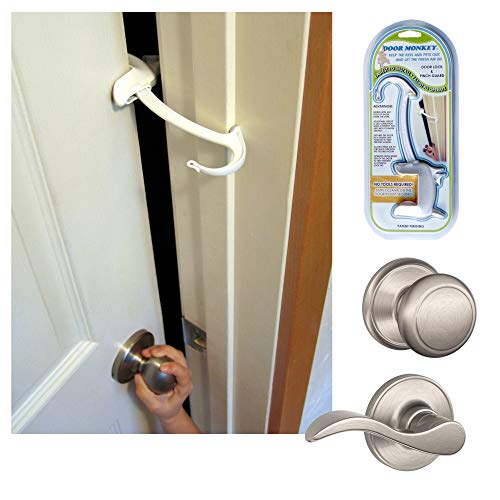
Where a cover will not work, a clamp is the better tool. The Door Monkey grips the edge of the door rather than the handle, so it does not care what the handle looks like, and it goes on in seconds with no tools or tape, at around 15 dollars as of August 2026. Measure first: it is built for standard 1-3/8 in thick interior doors with rectangular door stop moulding.
The door-top lock, for the doors where the stakes are highest
Everything at handle height is a puzzle a child works on daily. A lock on top of the door is not, which is why door-top locks are the standard answer for exterior doors.
They are also commonly recommended where a child leaves the house unsupervised, a documented risk for autistic children in particular. The National Autism Association states that nearly half of children with autism have a tendency to wander or bolt from safe settings, and that in its own study of wandering-related deaths, accidental drowning accounted for 71 percent of lethal outcomes, followed by traffic injuries at 18 percent. Its prevention checklist covers securing the home, outdoor gates and garage door, and using simple window and door alarms. If that is your family, treat the hardware as one layer of a plan built with advice specific to your child.
Homes with pools are the other clear case. The AAP's guidance on pool dangers and drowning prevention is to use multiple layers of protection, since no single step can prevent all drowning, and that house doors should be locked if a child could get to the pool through them — while being clear that locks and alarms do not substitute for a properly installed pool fence.
The GlideLok Door Top Lock is what I would fit on an exterior door. It sits on top like a saddle, out of reach, and according to the maker it cannot be pulled apart from below the way a knob cover can; it is painted metal rather than plastic, and parents work it from either side. At about 54 dollars for two as of August 2026 it costs several times what everything else here does — it is priced for doors where the other side is a driveway or a pool. It is also a drilled installation, one screw into the frame, with a strict fit list: hinged doors only, nothing that slides, and you must be able to reach the top of the door.
One more case: the basement door. For a basement, attic or garage flight, the door at the top is often a better control point than a gate on the treads, because a latched door is a full barrier rather than something you step over forty times a day. Sometimes you want both, and our guide to gating stairs and banisters sorts out which.
Problem two: fingers, and the cheapest good buy in baby-proofing
Go back to that Clinical Pediatrics estimate. One door injury every four minutes across US emergency departments, four in ten to children aged four and under, more than half of them a pinch, amputation the treatment admitted children most often received. That is not a freak-accident category. That is a Tuesday.
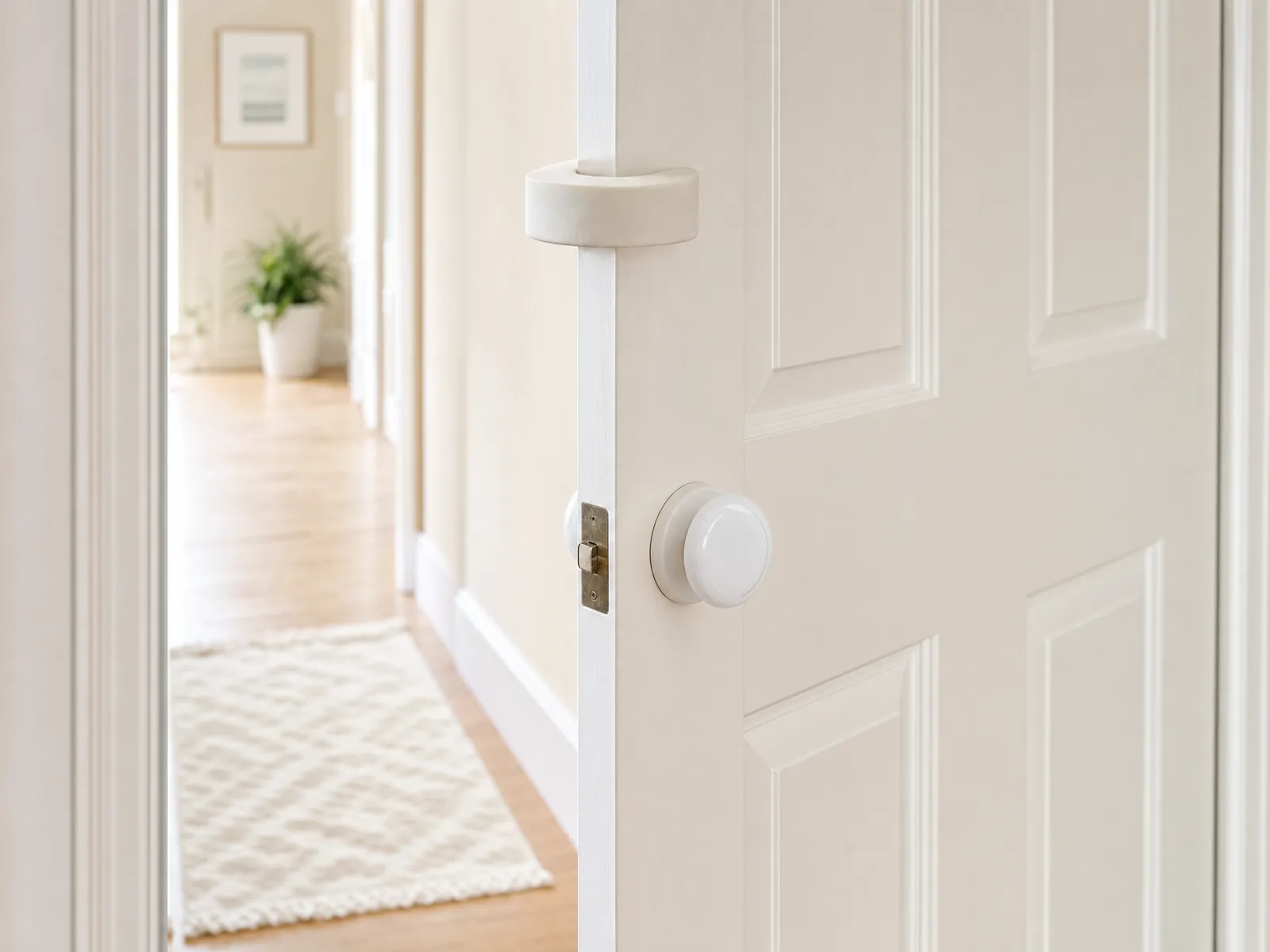
A finger pinch guard is a C-shaped piece of foam that slips over the edge of the door and stops it closing far enough to crush anything. The Jool Baby Door Pinch Guards come six to a pack for about 10 dollars as of August 2026, which does every interior door in a normal house.
Two details keep them in use. They sit at any height on the door edge, including at the top where a child cannot pull them off, and when you want a door properly shut you slide one off and hang it on the knob. The soft EVA foam will not mark doors or frames, which matters if you are renting.
The hinge side is the gap nobody guards
In a hospital study of 340 children treated for door-related finger injuries, published under the title When doors slam, fingers jam!, the finger or fingers were trapped on the hinge side in 57 percent of patients. In the same group, 94 percent of families used no safeguard device.
The hinge side is the worse edge for a mechanical reason: it sits right next to the pivot, so the gap there closes with far more force than the same push delivers at the handle edge. Small fingers there are on the wrong end of a lever.
Hinge-side guards are their own product category, usually a soft sleeve covering the gap. The partial version, if you would rather not buy another thing, is a pinch guard on the latch edge, which stops the door travelling far enough for the hinge gap to shear closed.
Problem three: the child who locks themselves in
This is the scenario I opened with.
Most interior privacy locks have an emergency release on the outside of the knob or lever: a small hole, or a straight slot. The matching key is a thin pin or a small flat blade that came with the door hardware, which means it is in a drawer somewhere or it is gone. Find yours today, test it on one door, then tape it to the top of the door frame — close enough that you are never hunting for a screwdriver while a child cries on the other side.
If your hardware has no release, the better answer is a lock that works from both sides. Both the Door Monkey and the GlideLok do, so a child cannot use them to lock you out, or lock themselves in.
Sliding doors and patio doors
Sliding doors are their own category and most child locks simply refuse them. Nothing that clamps to a swinging door edge works on a panel that runs on a track, and a door-top lock like the GlideLok explicitly excludes sliding glass, pocket and bifold doors.
The purpose-built option blocks the slide instead. The Toddleroo Sliding Door and Window Lock is the one I would fit, at about 8 dollars as of August 2026. A slide-and-release motion activates the wings to lock, so an adult can work it one-handed, and it attaches with VHB adhesive rather than screws — no drilling, no track modification, and the maker says it leaves no marks. It works on sliding glass or wood doors and on windows, useful when the patio door and the window beside it have the same problem.
If that patio door leads to a pool, remember the AAP's framing: a locked door is a layer, not a replacement for the fence.
The fire-escape trade-off nobody mentions
Every child lock you add makes a door slower for an adult to open, and some of those doors are how people get out of a burning house. The NFPA's home fire escape planning guidance is to mark two ways out of each room, including windows and doors, and, when you walk the plan, to check that the escape routes are clear and that doors and windows can be opened easily; the US Fire Administration puts it as find two ways out of every room, and make sure doors and windows are not blocked. The CPSC builds the same caution into its device advice twice: a knob cover should allow a door to be opened quickly by an adult in case of emergency, and if you fit window guards, at least one window in each room should still be easily usable for escape in a fire.
The friction is the feature by day and the cost at 3am, both at once. What most families I know settle on:
- Put the serious, out-of-reach locks on doors that lead away from the escape route — basement, garage, utility room, pool — rather than on the doors that form it.
- On doors that are part of a way out, prefer devices an adult can release in one motion, in the dark, without a key or a tool.
- Make sure every adult has physically operated each lock. Babysitters and grandparents get shown, not told.
- Walk your escape plan with the hardware installed, not before. A route you have never tested with the locks on is a route you have not tested.
That is the trade-off, honestly stated. Your house, your call.
What to do first
In this order.
- Fit pinch guards on every interior door, at the top where a child cannot reach them. Cheapest, fastest, and it addresses the injury the data says is actually happening.
- List the doors that genuinely need to stay shut. Garage, basement, utility, pool, driveway. Usually three or four, not fifteen.
- Match hardware to handle. Round knobs get covers. Levers get an edge clamp. Exterior doors and doors to water get a lock mounted on top.
- Find the privacy-lock release key and tape it above the frame.
- Do the sliders, the gap most people leave open because nothing standard fits.
- Walk your fire escape route with everything installed, then show every other adult how each one opens.
And keep the framing right. The CPSC says it best: no device is completely childproof, determined toddlers have been known to overcome or disable them, and they only work if properly installed and reengaged after use. None of this makes a house safe. At best it buys you some time between a child deciding to try a door and getting through it. Supervision is the safety measure; the lock just widens the margin.
When you are ready for the rest, our guide to baby-proofing your home room by room picks up where this leaves off. But do the pinch guards tonight. Ten dollars, four minutes, and the one thing here the data says you are most likely to need.
Door Monkey Child Proof Door Lock & Pinch Guard
A clamp that fits over the edge of the door in seconds with no tools, tape or hardware, so nothing marks the door finish, and it solves two of the three door problems at once. It works with any style of knob or lever handle, which is what makes it the answer for the handles a knob cover cannot grip, and it holds the door in a partly cracked position so it doubles as a pinch guard. It is operable from both sides, so a child cannot use it to lock you in or out of a room. Check the fit before you order: it is made for standard 1-3/8 in thick interior doors with standard rectangular door stop moulding, and the maker publishes installation requirements worth reading first.
- Brand
- Door Monkey
- Category
- Our Pick
It was the only thing that worked on our lever handles, and I like that the door still cracks open so I can hear the room.

Safety 1st Parent Grip Door Knob Covers, White, 4 Count
The classic answer to problem one, and the cheapest. The cover spins freely on the knob, which is meant to stop small hands getting the grip they need to twist it open, while an adult squeezes and turns in one motion. Safety 1st describes the polypropylene as stronger and more secure than the previous version, and the white finish is meant to disappear against ordinary trim. The fit limit is the whole story here: these are made for most standard round door knobs, each cover measuring 2 x 2.5 x 2.5 in, so they do nothing at all for lever handles. Sold as a 4-pack.
- Brand
- Safety 1st
- Category
- Best Knob Covers
Four covers did every round knob on our main floor for the price of a coffee, and the spin is genuinely hard for a toddler to beat.

Jool Baby Door Pinch Guards, 6 Pack
Six foam C-shaped guards that slip around the edge of the door and stop it slamming shut on small fingers. They can sit at any height on the door edge, including up at the top where a child cannot reach them, and when you want the door to close fully you slide one off and hang it on the knob. The soft EVA foam will not damage doors or door frames, which matters in a rental. They also stop a pet being accidentally shut in or out of a room, which is how ours end up earning their keep.
- Brand
- Jool Baby
- Category
- Best Pinch Guards
Six of these cost less than one urgent-care copay, and they went on every interior door in the house in about four minutes.

GlideLok Child Safety Door Top Lock, 2 Pack
This sits on top of the door like a saddle, out of a child's reach, so it cannot be pulled apart from below the way a knob cover can, and it is painted metal rather than plastic. Parents can lock and unlock it from both sides of the door, and you must be able to reach the top of the door to operate it at all. Two hard constraints before you buy: installation requires one included screw drilled into the door frame, which on most exterior doors lands on the outside portion of the frame, and it fits most hinged doors up to 1-3/8 in thick, or up to 1-13/16 in with the spacer bar removed. It does NOT fit any sliding door on a track — pocket, bifold or sliding glass — nor storm doors, patio screen doors, metal door frames, or double doors that swing both ways.
- Brand
- Predictable Solutions
- Category
- Best for Exterior Doors
It is the only thing on our back door I trust, mostly because there is nothing down at his height for him to work on.

Toddleroo by North States Sliding Door & Window Lock, Pack of 1, White
The one piece of hardware here for the doors that slide instead of swing, which is the category almost every other child lock refuses. It is made to stop a child sliding open a patio door, a closet door or a window, and it works on sliding glass or wood. A slide-and-release motion activates the wings to lock, so it is simple for an adult to operate one-handed. It attaches with VHB adhesive rather than screws, so there is no drilling and no track modification, and the maker says it does not leave marks. Made from non-toxic ABS plastic.
- Brand
- Toddleroo by North States
- Category
- Best for Sliding Doors
Our patio door was the one gap in the whole downstairs, and this fixed it without putting a single hole in the frame.
- 01Door MonkeyOur PickDoor Monkey Child Proof Door Lock & Pinch Guard
- 02Safety 1stBest Knob CoversSafety 1st Parent Grip Door Knob Covers, White, 4 Count
- 03Jool BabyBest Pinch GuardsJool Baby Door Pinch Guards, 6 Pack
- 04Predictable SolutionsBest for Exterior DoorsGlideLok Child Safety Door Top Lock, 2 Pack
- 05Toddleroo by North StatesBest for Sliding DoorsToddleroo by North States Sliding Door & Window Lock, Pack of 1, White
Do door knob covers work on lever handles?+
How do I get into a room my toddler has locked from the inside?+
At what age can a child defeat a door knob cover?+
Are child door locks a fire hazard?+
What stops a door slamming on my child's fingers?+
Do I need anything on the hinge side of the door?+
Sammie Seelbach
Sammie is a mom of two and the lead reviewer at Smart Baby Reviews. Since becoming a parent she has become obsessed with researching the safest, smartest baby gear on the market — testing thermometers at 2 a.m., wrangling baby gates, and sterilizing more bottles than she can count. She shares what actually works so other parents can make confident, informed decisions for their little ones.