Baby's First Foods — and the Short List of What to Avoid

This post may contain affiliate links. Read our policy.
Your baby's first foods do not need to come in a particular order. The American Academy of Pediatrics says so directly — your baby's first foods are your choice — and the CDC states that for most children, you do not need to give food in a certain order. What matters is two things: get iron and zinc in, and know the short list of foods that stay off the tray. Some of the links below are affiliate links, and we may earn a small commission, at no extra cost to you, if you buy through them.
I spent the week before we started solids reading a chart somebody's aunt had laminated: orange vegetables first, then green, then fruit last so she would not develop a sweet tooth. I followed it for eleven days. Then my daughter ate a piece of roast chicken off the table, which was not on the chart at all, and I realised I had been treating folklore as a protocol.
Here is the version I wanted instead: the one nutritional priority that is genuinely evidence-based, the foods worth starting with, the short avoid list with a source for every item, and the separate list of shapes rather than foods that cause choking. The full walk-through of starting baby on solids covers the mechanics. None of it applies until the signs your baby is ready for solids are there.
Baby First Foods Have One Real Nutritional Job: Iron and Zinc
If you remember one sentence from this page, make it this one. The AAP's guidance on starting solids asks you to be sure to include foods that provide iron and zinc, such as baby food made with meat or iron-fortified cereals. That is the only nutrient the guidance singles out by name; the rest of the page covers texture, timing and a short list of things to leave out.
The reason is arithmetic. A baby's needs climb around the half-year mark, and milk alone stops covering them. The WHO puts it plainly: around the age of 6 months, an infant's need for energy and nutrients starts to exceed what is provided by breast milk. And the jump is not small. The AAP's clinical report on iron deficiency, summarised by the American Academy of Family Physicians, states that iron intake in infants between six and 12 months of age should be 11 mg per day.
Eleven milligrams is a lot of food for someone who eats two tablespoons at a sitting, which is why fortified cereal keeps showing up in official lists: it is a concentrated delivery mechanism. The CDC's page on iron splits the sources into heme iron from red meat, seafood, poultry and eggs, and non-heme iron from iron-fortified cereals, tofu, beans, lentils and leafy greens, and adds a trick worth using: pairing non-heme iron sources with foods high in vitamin C can help your baby absorb needed iron. Lentils with a little tomato.
None of this replaces milk. The AAP notes that at first, your baby will still be getting most of their nutrition from breast milk, formula or both, and the WHO recommends continued breastfeeding up to 2 years of age or beyond alongside complementary foods. Whatever you feed from — breast, formula, or a set of glass baby bottles — that stays the main event through the first year.
The Best First Foods for Baby, Grouped by What They Solve
Rather than a sequence, think in three buckets: things that carry iron, things that are easy wins, and things that teach texture.
| Food | Why it is on the list | 6 months | 9 months |
|---|---|---|---|
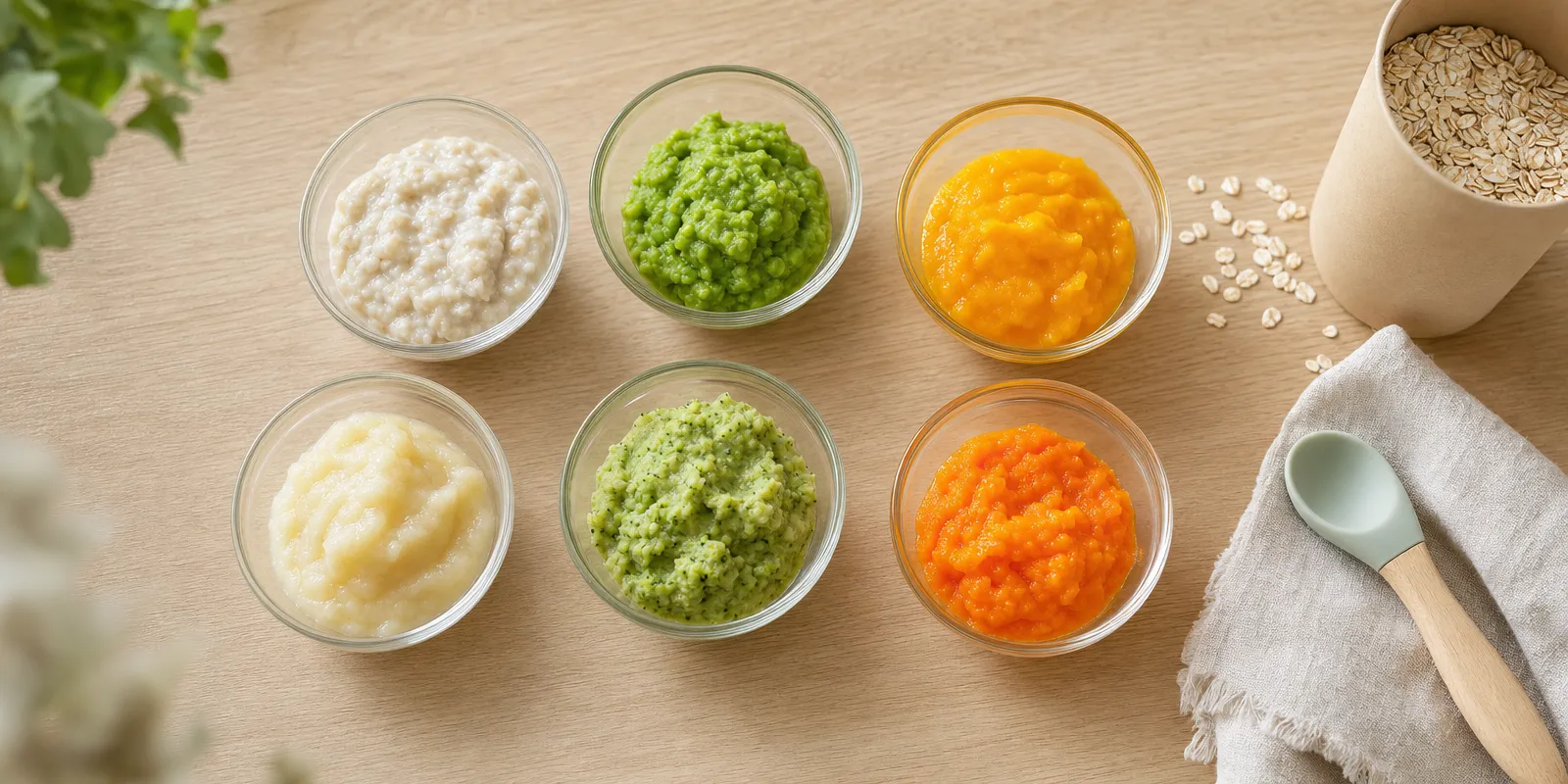
| Iron-fortified oat or barley cereal | Concentrated iron; mixes to any thickness | Thin, with breast milk or formula | Thicker, stirred into fruit or yoghurt |
| Pureed or finely shredded meat and poultry | Heme iron plus zinc, the two AAP nutrients | Smooth puree, thinned | Soft shreds the size of a grain of rice |
| Lentils, beans, tofu | Non-heme iron and zinc without meat | Mashed smooth | Soft-cooked and squashable |
| Egg, well cooked | Common allergen, easy to prepare, iron and protein | Mashed yolk and white | Strips of omelette |
| Avocado, banana | Easy acceptance; fat and calories | Mashed | Spears, soft enough to squash |
| Sweet potato, butternut, carrot | Vitamin A; naturally sweet so usually accepted | Puree | Soft-cooked finger-sized sticks |
| Broccoli, spinach, peas | Non-heme iron and folate | Puree | Soft florets with a stalk to hold |
Two notes. Dairy as an ingredient is not the same as cow's milk as a drink — plain yoghurt and cheese in food are generally fine in the first year, while milk in a cup is not. And texture, not age, is the dividing line: the AAP asks only that foods be soft or pureed to prevent choking.
Allergens belong in this list, not after it. The AAP's position is that there is no evidence that waiting to introduce baby-safe soft foods, such as eggs, dairy, soy, peanut products or fish, beyond four to six months of age prevents food allergy. We cover the how in introducing allergens to your baby, including the babies for whom the AAP recommends testing first. Peanut and egg go in alongside sweet potato, not six months later.
Why Rice Cereal Is No Longer the Default First Food
For decades, the default answer to that question was a box of rice cereal. That advice has quietly expired, and the reason is inorganic arsenic.
On 5 August 2020 the FDA issued final guidance setting an action level of 100 micrograms per kilogram, or 100 parts per billion, of inorganic arsenic in infant rice cereals. The agency said it was taking the action because exposure to inorganic arsenic is associated with neurodevelopmental effects. The FDA's consumer guidance gives the mechanism: rice tends to absorb arsenic more readily than other crops, which is why a limit exists for rice cereal and not for oat.
Read the FDA's own framing, which is more measured than the headlines were. Its advice to parents is that rice cereal fortified with iron is a good source of nutrients for your baby, but it should not be the only source and does not need to be the first source — and that other iron-fortified infant cereals include oat, barley and multigrain. The agency also reported that 76 percent of samples were at or below the 100 ppb level in 2018, up from 36 percent between 2011 and 2013.
So this is not a health scare, and a box of rice cereal in your cupboard is not a crisis. It is a reason not to make rice the one grain your baby eats every day — which is exactly what the old advice produced. A related caution from the NHS: children under 5 years old should not have rice drinks as a substitute for breast milk or infant formula, as they may contain too much arsenic. A fuller treatment of heavy metals in baby food is coming later in this series.
What replaced rice is the same product made from a different grain. An iron-fortified oat cereal such as the Earth's Best organic whole grain oatmeal does the identical job — it is there for the fortification, not the oats — and runs about 22.70 dollars for a six-pack as of September 2026. If you would rather not commit to six boxes before you know whether your baby will take a spoon, the Gerber Stage 1 organic oatmeal is the same purchase at a lower entry price, around 17.40 dollars for five boxes as of September 2026. According to Gerber, each serving carries 60 percent of the daily value of iron plus 14 vitamins and minerals including zinc and vitamin B12 — the manufacturer's own figure, but the right pair of nutrients.
One place cereal should not go is a bottle. The AAP is direct: do not put baby cereal in a bottle because your baby could choke.
One New Food Every Three to Five Days, and What That Rhythm Is For
The AAP asks you to introduce one single-ingredient new food from any food group every 3 to 5 days and look out for any reactions. The CDC gives the same interval: wait 3 to 5 days between each new food.
The purpose is diagnostic. If something goes wrong — a rash, vomiting, unusual fussing — you want a short list of suspects instead of a casserole. Mixed meals are not forbidden once a food is established: three days after pear and oats have both gone in, pear-and-oats together is not a new food.
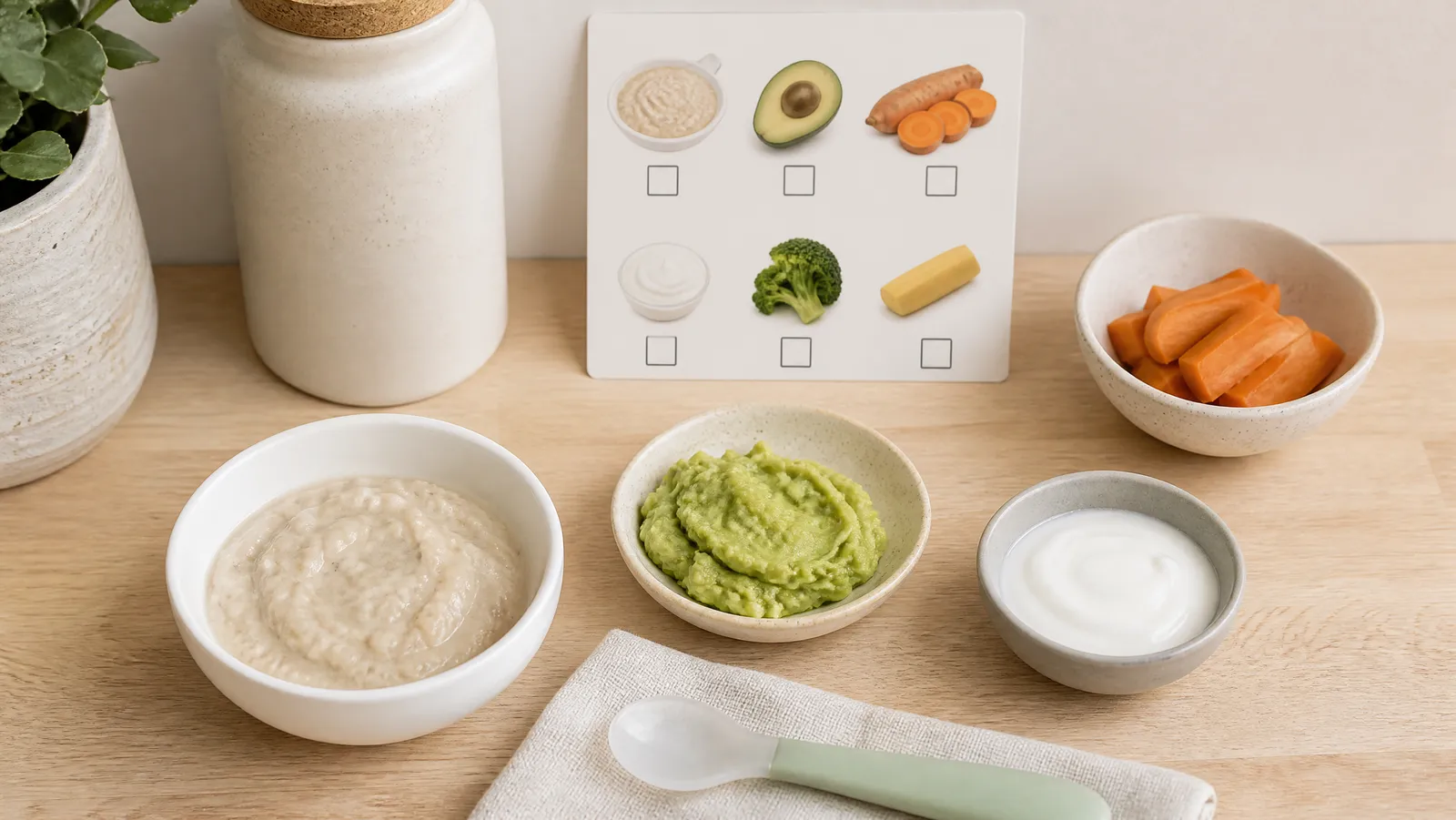
Where the rhythm gets hard is the bookkeeping. By week three nobody can remember whether the baby has had parsnip, or whether she liked it the first time or only the third. We used a fridge chart; if you want one, the BIROYAL first food tracker is a wipe-clean magnet listing 127 foods with five checkboxes each, about 9.99 dollars as of September 2026. It is a ten-dollar convenience, not a health device — a sheet of paper does the same job. The five boxes rather than one is the useful part, since acceptance usually takes several tries.
Foods to Avoid: Baby's Short List, With the Reason for Each
Here is the whole list. It is shorter than the internet suggests, and every line has a health body behind it.
| Avoid before 12 months | Why | Source |
|---|---|---|
| Honey, including honey cooked into food | May cause infant botulism, a severe food poisoning | CDC |
| Cow's milk as a drink | May put a baby at risk for intestinal bleeding; too much protein and minerals for young kidneys | CDC |
| Fruit and vegetable juice | Not needed; reduces appetite for more nutritious foods | CDC, AAP |
| Added sugars | Infants and young children should not have added sugars | CDC |
| Unpasteurised milk, cheese, yoghurt and juice | Risk of harmful bacteria that can cause severe diarrhoea | CDC |
| Caffeinated drinks (under 2 years) | No established safe limit for young children | CDC |
| Rice drinks as a milk substitute (under 5 years) | May contain too much arsenic | NHS |
Honey has the sharpest edge. The CDC states that honey given to children younger than 12 months may cause a severe food poisoning called botulism, and advises against adding honey to baby food, water, infant formula or pacifiers. Its botulism prevention guidance extends that to products made with honey. The part people miss: baking does not fix it, because the danger is bacterial spores rather than a toxin heat destroys. Honey in a muffin counts. After the first birthday it is a normal food.
Cow's milk is a drink rule, not a dairy rule. The CDC's position is that giving cow's milk before 12 months may put a baby at risk for intestinal bleeding, and that it carries more protein and minerals than young kidneys process easily. Yoghurt and cheese as ingredients are a different question, worth putting to your pediatrician.
Juice is ruled out by both. The CDC says children younger than 12 months should not drink any fruit or vegetable juice. The AAP adds the mechanism: babies do not need juice, and juice reduces the appetite for other, more nutritious foods, including breast milk and formula.
Added sugars are a flat no rather than a moderation rule. The CDC states that infants and young children should not have added sugars, naming muffins, flavoured yoghurts and cookies as the usual sources. Fruit is not the target — a jar with sugar in the ingredient list is.
The Choking-Shape List Is About Form, Not Food
The avoid list above is about what is in the food. This one is about geometry, and it is the list that prevents emergencies.
The AAP's choking prevention guidance gives one number to carry around: cut food for infants and young children into pieces no larger than one-half inch. Its high-risk list runs to hot dogs, hard or sticky candy, chewing gum, nuts and seeds, whole grapes, raw vegetables such as carrot sticks, raw fruit chunks, popcorn, thick chunks of peanut butter (spread it thinly instead), marshmallows, meat sticks and sausages, and chunks of meat or cheese. The AAP asks that these be kept from children until 4 years of age or older, depending on each child's development and maturity — with the caveat that round, firm foods such as hot dogs or grapes can be served if completely chopped into tiny pieces. The NHS adds that whole nuts should not be given to children under 5, though ground nuts and thinly spread smooth nut butter are fine from six months.
Two shapes cause most of the trouble: round things the diameter of an airway, and hard things that do not compress. Quarter the grapes lengthways. Slice the hot dog lengthways, then across. Grate the raw carrot.
And know the difference between the noise that is fine and the silence that is not — gagging and choking look alarming in the same way and mean opposite things. Gagging is loud, red-faced and protective. Choking is quiet.
When Can Baby Have Salt, and What About Sugar and Seasoning?
This is the question nobody's family agrees on, so here are the numbers.
The NHS publishes a maximum recommended salt intake by age and puts children under 1 year old at less than 1g of salt a day — rising to no more than 2g from 1 to 3 years, and no more than 6g from age 11 upwards. Less than a gram is under a quarter of a teaspoon, and nearly all of it is already covered by breast milk, formula and ordinary food. The NHS reason: babies' kidneys are not fully developed and cannot process it.
The American figure is expressed as sodium. The National Academies set an Adequate Intake for sodium of 370 mg a day for infants aged 7 to 12 months, derived from breast milk plus ordinary complementary foods — roughly 70 mg from milk and 300 mg from food. That describes a normal diet; it is not a target to hit. Either way the instruction is identical, and the NHS states it directly: do not add salt to your baby's food or cooking water, and do not use stock cubes or gravy, as they are often high in salt. Cooking one meal for the family? Season the adults' portions at the table.
Sugar is simpler. The NHS says your baby does not need sugar, and that avoiding sugary snacks and drinks helps prevent tooth decay. The CDC's line: infants and young children should not have added sugars.
Herbs and spices are the happy exception. Nothing in the NHS or CDC guidance rules out cinnamon, cumin, garlic, dill or black pepper — the restriction is on salt and sugar, not on flavour. Cook the lentils with cumin. Just leave the stock cube out.
Sweet Potato Before Broccoli: The Myth That Will Not Die
The most persistent piece of first-foods folklore is that fruit must come last or your baby will refuse vegetables forever. It is the one my laminated chart was built on. The AAP answers it in one sentence: there is no evidence that your baby will develop a dislike for vegetables if fruit is given first.
The honest picture is that the evidence on order of introduction is thin in both directions. There is some — a randomised controlled trial run through Massey University gave 117 Auckland infants either vegetables only or vegetables plus fruit for the first four weeks, and at nine months the vegetables-only group ate roughly double the broccoli and spinach of the control group. A genuine finding, and one small trial, with the children still being followed to see whether it lasts.
So: vegetables first is a sensible preference and may buy a modest early advantage. It is not a rule, and if your baby's first food was banana, nothing has been ruined.
A Concrete First Fortnight
Fourteen days, one new food every three days or so, iron in most of them. A shape, not a prescription.
- Days 1-3. Iron-fortified oat cereal, mixed much thinner than looks right, once a day after a milk feed. Expect most of it to come back out.
- Days 4-6. Avocado, mashed. Easy acceptance, useful fat, forgiving texture.
- Days 7-9. Sweet potato, steamed and pureed, or soft sticks if you are doing finger foods.
- Days 10-12. Red lentils cooked soft with a little tomato — non-heme iron plus the vitamin C that helps absorb it.
- Days 13-14. An allergen, deliberately. Smooth peanut butter thinned into the cereal, or well-cooked egg. Morning, at home, on a day you are not going anywhere.
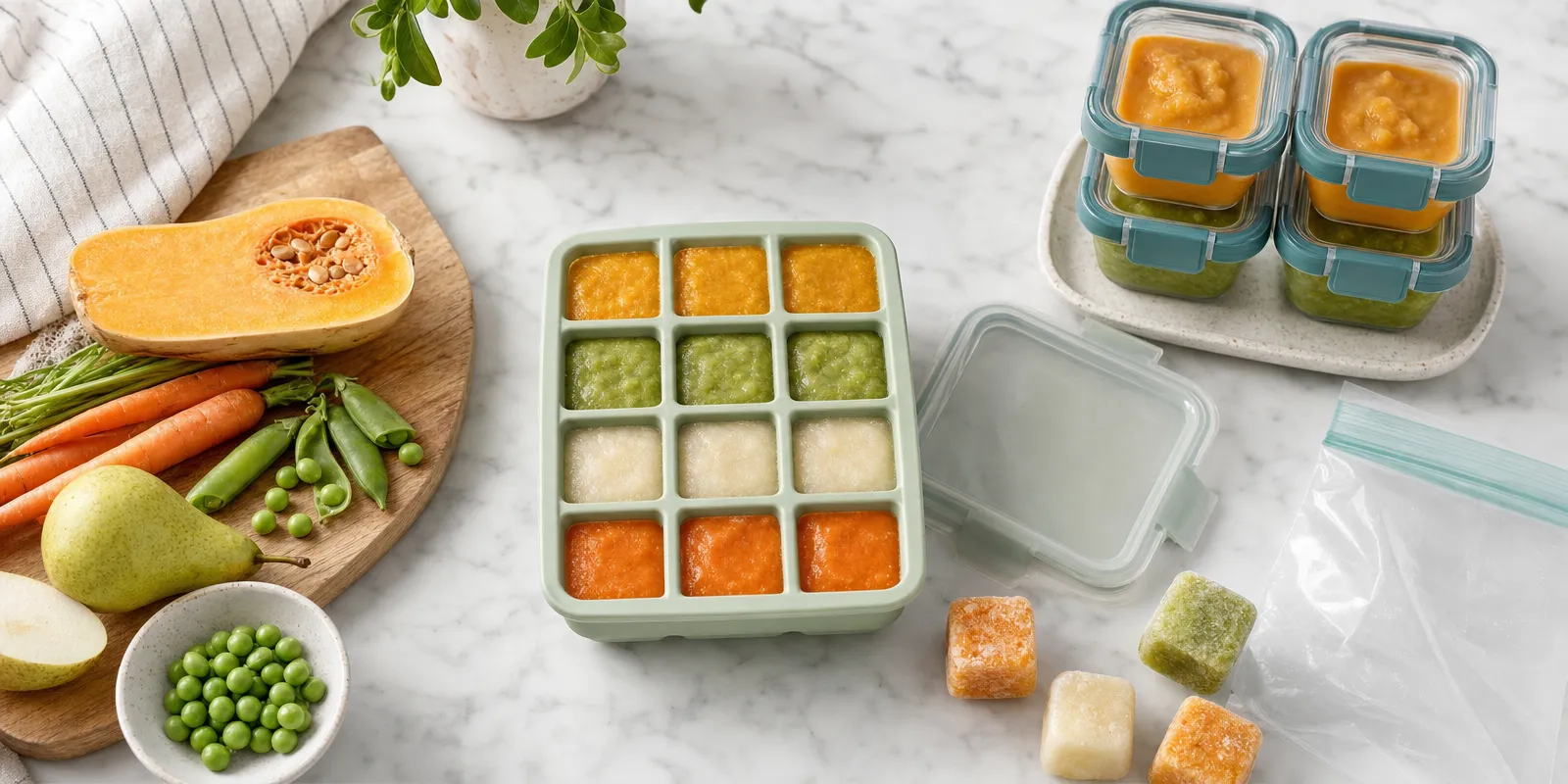
The shopping list is short: fortified oat cereal, a sweet potato, an avocado, red lentils, smooth peanut butter and eggs. Do not buy the full weaning aisle. Freezing leftovers in an ice cube tray works, and we will cover baby food storage containers and baby food pouches in later guides.
Two practical points. Eating safely means sitting upright and stable, which is a chair job — our roundup of the best high chairs for starting solids covers what matters. And since you will now be in the kitchen with a baby on the floor daily, it is a reasonable moment to baby-proof your kitchen.
Amounts in these two weeks are tiny and variable, and that is normal. A separate guide to how much solid food by age comes later in this series.
What I Would Tell a Friend
There is no magic first food. Pick something soft, get iron and zinc into most meals, hold the line on honey, cow's milk as a drink, juice and added sugars, cut everything smaller than half an inch, add no salt, and let the laminated chart go. The order will not matter in a year. The iron might.
And take the caveats seriously: babies vary, some have reflux or eczema or a family allergy history that changes the plan, and your pediatrician is the one who has weighed yours. For the full sequence from readiness through first meals, start with our complete guide to starting solids.

Earth's Best Organic Whole Grain Oatmeal Cereal, 8 oz (Pack of 6)
An iron-fortified single-grain oat cereal with a short ingredient list built around organic whole grain oat flour. Oat rather than rice is the reason it is here: it carries the same iron fortification without rice's inorganic-arsenic question. Mixes with breast milk, formula or water to whatever thickness your baby will accept, which in week one is thinner than you expect.
- Brand
- Earth's Best
- Category
- Our Pick
Buying the six-pack felt absurd until we were four weeks in and mixing it into everything to get the iron up.

Gerber Stage 1 Organic Oatmeal Cereal, 8 oz, 5-Pack
The same idea at a lower price per box. According to Gerber, each serving carries 60 percent of the daily value of iron, 14 grams of whole grains and 14 vitamins and minerals including zinc and vitamin B12 — iron and zinc being the two nutrients the AAP specifically asks you to prioritise in first foods. Blends into purees and pancakes as readily as into milk.
- Brand
- Gerber
- Category
- Best Value
It dissolves properly. Cheaper cereals go lumpy and a beginner will reject a lumpy spoon on principle.

BIROYAL Baby First Food Tracker Magnet, 127 Foods
A 12 by 8 inch wipe-clean fridge magnet listing 127 foods across fruit, veg, protein, grains and dairy, with five checkboxes each so you can mark repeat exposures rather than one-and-done. It solves a genuinely annoying problem: three weeks in, nobody remembers whether the baby has had parsnip, or how they took it the first time.
- Brand
- BIROYAL
- Category
- Most Useful Extra
Five boxes per food instead of one is the detail that matters — acceptance usually takes several tries, and the chart stops you writing a food off early.
- 01Earth's BestOur PickEarth's Best Organic Whole Grain Oatmeal Cereal, 8 oz (Pack of 6)
- 02GerberBest ValueGerber Stage 1 Organic Oatmeal Cereal, 8 oz, 5-Pack
- 03BIROYALMost Useful ExtraBIROYAL Baby First Food Tracker Magnet, 127 Foods
What should my baby's first food actually be?+
Why can babies not have honey before 12 months?+
Is rice cereal still safe for babies?+
When can a baby have salt, and how much is too much?+
Can my baby have cow's milk or juice before their first birthday?+
Should I give vegetables before fruit so my baby does not develop a sweet tooth?+
Sammie Seelbach
Sammie is a mom of two and the lead reviewer at Smart Baby Reviews. Since becoming a parent she has become obsessed with researching the safest, smartest baby gear on the market — testing thermometers at 2 a.m., wrangling baby gates, and sterilizing more bottles than she can count. She shares what actually works so other parents can make confident, informed decisions for their little ones.