Are Weighted Sleep Sacks and Swaddles Safe for Babies?
This post may contain affiliate links. Read our policy.
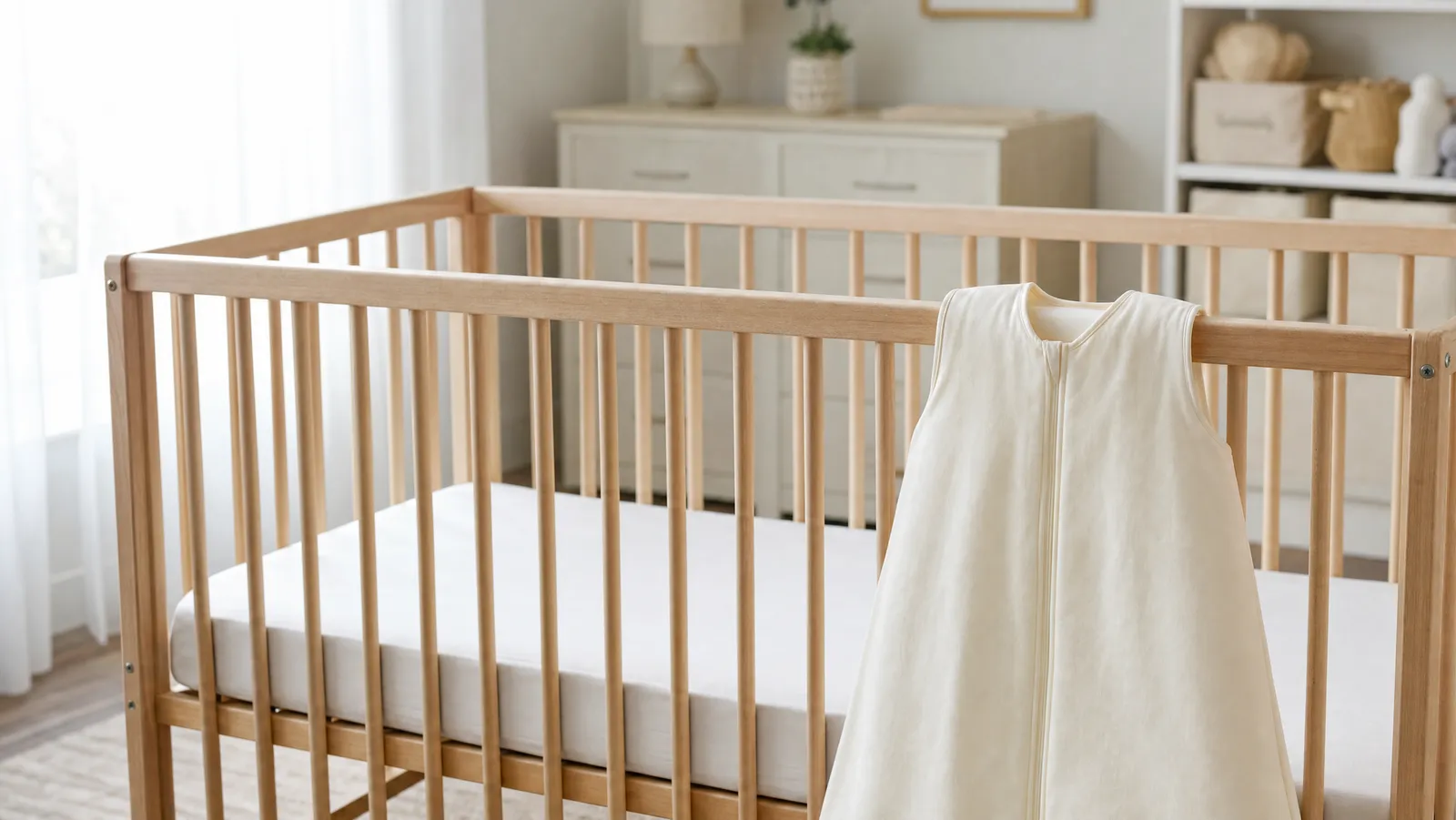
No. If you are asking whether weighted sleep sacks are safe, the honest answer is that the American Academy of Pediatrics and the Consumer Product Safety Commission both tell families not to use them, and no US safety standard has ever been written to say how much weight on a sleeping baby would be acceptable. Some of the links below are affiliate links, and we may earn a small commission, at no extra cost to you, if you buy through them.
I know why you are here at eleven at night. An ad follows you around for a week, the reviews are ecstatic, and the promise is the one thing you would trade almost anything for. A friend swears by hers. It looks like a normal sleep sack with a slightly padded chest. Nothing about it looks like a hazard, which is exactly what makes this hard.
So here is the long version: are weighted sleep sacks safe, according to whom, on what evidence, and what to do if one is already folded in your nursery drawer. I am going to be straight about the thin parts too, because the evidence base here is thinner than either side of the argument tends to admit. Everything below assumes the basic safe sleep rules are already in place: on the back, firm flat surface, nothing loose in the crib.
What a Weighted Sleep Sack or Swaddle Actually Is
A weighted sleep sack looks like an ordinary wearable blanket with beads or pellets sewn in — concentrated in a panel across the chest in some designs and spread throughout the garment in others, according to UVA Health. A weighted swaddle does the same thing with the arms wrapped. The added weight is the product. It is marketed as a gentle hug, a proxy for the pressure of a hand on the chest.
How much weight? According to UVA Health, which published Dr. Rachel Moon on this in August 2024, these products have carried between half a pound and nearly two pounds — potentially more than 10% of a newborn's body weight. That range exists because nobody has ever set a limit.
Keep two categories separate. A weighted sleep sack or swaddle is worn, with the weight resting on the torso. A weighted blanket is loose bedding, and it fails safe-sleep guidance on its own separate grounds before you even get to the weight, in the same way a quilt or a comforter does. When Congress took a run at the issue, the Safeguarding Infants from Dangerous Sleep Act, introduced in August 2024, defined the wearable category as a wearable blanket, sleep sack, swaddle or similar product for a child up to one year old containing materials that add weight for a purpose other than insulation or decoration.
One more thing worth naming: the moment these products get bought. It is very often the rolling milestone, when the swaddle has to go and the nights fall apart — which is really a question about when to stop swaddling and what replaces it, not a question about weight.
Are Weighted Sleep Sacks Safe According to the AAP?
The American Academy of Pediatrics has been consistent since its 2022 safe sleep policy statement, and the sentence people quote from it is: weighted swaddle clothing or weighted objects within swaddles are not safe and therefore not recommended. That wording is reproduced in a December 2023 letter Senator Richard Blumenthal sent to two makers of these products, Dreamland Baby and Nested Bean.
The parent-facing version on HealthyChildren, the AAP's site for families, is blunter. Its guide to safe sleep says: do not use weighted blankets, sleepers, swaddles or other weighted objects on or near your baby, and do not use weighted swaddle blankets or weighted objects like rice bags inside the swaddle.
The AAP's swaddling page adds the stated reason in one line: do not use weighted swaddles or weighted blankets, which can place too much pressure on a baby's chest and lungs.
Note what that guidance is not. It is not a claim that a particular brand has killed a particular baby, and it is not a recall. It is a recommendation against a category, and the AAP applies it to every weighted product regardless of who makes it or how the weight is distributed.
What the CPSC Has Said, and What It Has Not Done
The regulator's position is where most of the confusion lives, because the guidance and the rulebook do not match.
The guidance says no. CPSC advises parents against using weighted blankets and swaddles for sleep, and told CBS News it encourages parents to consult their pediatrician before buying any product claiming to improve baby health or help with sleep. The agency also said it was investigating multiple fatalities associated with weighted infant products. A CPSC commissioner wrote directly to retailers, and the shelves emptied fast: Target, Walmart, Nordstrom, Babylist and Amazon all removed weighted infant sleepwear, according to the Consumer Federation of America.
The rulebook says nothing. As Blumenthal's letter put it in plain terms, CPSC does not have an existing standard for the use of weighted sleep products on infants. In November 2023 the commission rejected a proposal to pursue a mandatory standard by a 3-1 vote, with then-Chairman Alexander Hoehn-Saric saying the agency had not conducted enough research to pursue rulemaking on the issue yet — a detail reported in the litigation coverage that followed.
That gap is now in court. Dreamland Baby sued the agency over the warning, announced in May 2024, arguing the commission disparaged its product without following formal procedures; CPSC has enacted no ban and issued no recall. In February 2026 the company's lawyers asked the US District Court for the District of Columbia for summary judgment ordering CPSC to retract the statement. I found no ruling as of this writing, and it is worth being clear about what the case is and is not: it is a fight about administrative process, not a scientific finding that the products are safe.
Does the New Wearable-Sleep Standard Cover Weight?
Short answer: not as far as the published scope goes.
ASTM F3735, the first US voluntary safety specification written specifically for wearable sleep products, was approved on February 1, 2026. It covers infant garments and garments with a swaddling feature for children up to 2 years, and it excludes loose blankets, step-in coverings and outdoor sleep products. The hazards it addresses are suffocation, strangulation and choking, handled through design, sizing, labeling and testing requirements.
Weight is not in that list. The scope summaries make no mention of weighted fill or weight limits, just as they set no thermal ratings — a point we made in our guide to TOG ratings and nursery temperature as well. So a claim that a sack meets F3735 is a claim about its neckline, its construction and its labeling. It is not an answer to the weight question.
Why the Weight Itself Is the Concern
The reasoning the pediatric bodies give is mechanical, and it is short enough to hold in your head.
An infant rib cage is not rigid. Dr. Rachel Moon of UVA Health, who helped write the AAP's 2022 safe-sleep recommendations, explains it this way: babies under one year have cartilage rather than bone in their ribs, so if you put a weight on the chest, it is going to deform and press down on the lungs and on the heart.
Movement matters. The same piece notes that added weight can stop a baby moving as they need to, and may make it harder to reposition if they roll onto their belly. A product bought to solve the rolling transition can complicate the thing that makes rolling safe, which is a baby who can freely move.
Oxygen is the measurable version of the worry. UVA describes research in which babies' oxygen levels went down and heart rates went up under weighted sacks — never to a dangerous level, and the observation was stopped at two minutes, which is exactly why nobody can tell you what a whole night looks like.
Notice how much of what makes a sleep space safe sits under the baby rather than on top of them. Getting crib mattress firmness and fit right is a bigger lever than anything you can add to the equation.
The Evidence Is Thin, and Pretending Otherwise Helps No One
This is the part most articles skip, in both directions.
There is no peer-reviewed literature establishing that these products are safe for healthy infants. Blumenthal's December 2023 letter states there has been no evidence in peer-reviewed scientific literature evaluating the safety of weighted sleep products on infants. The 2020 study manufacturers have pointed to involved 16 infants under a weighted blanket for 30-minute sessions under constant supervision in a hospital setting — not a baby alone in a crib for eleven hours.
The trial that was supposed to fill the gap did not. A study titled Assessment of the Safety and Efficacy of Weighted Wearable Blankets in Healthy Infants During Sleep was registered with Indiana University as lead sponsor and Dreamland Baby Co. as a collaborator. Its registry record shows it began on April 1, 2024, enrolled 6 participants, and was terminated because of the safety concerns raised by CPSC and the AAP. Four nap polysomnograms were completed; two participants withdrew before the overnight studies. A single-arm study with four usable naps cannot settle anything, in either direction.
Manufacturer claims are manufacturer claims. Blumenthal's letter quotes Dreamland Baby saying its products exceed all CPSC standards, and Nested Bean saying its items have undergone extensive tests to meet mandatory and voluntary safety standards. His response is the one to keep: there is no CPSC standard for weight on a sleeping infant to exceed. Both companies have defended their products publicly — the Nested Bean CEO told CBS News the products have always been safe as designed, and the Dreamland Baby CEO said no study was performed before the products launched in 2018 — and both reported sales falling by more than half after retailers pulled them.
So the truthful summary is uncomfortable and short. The bodies that publish safe-sleep guidance say do not use these. The published evidence is not strong enough to prove harm in a specific product, and it is nowhere near strong enough to establish safety. When the downside case is an infant death and the upside case is a better night, that asymmetry is the whole argument.
If You Already Bought One
Nothing here is a judgment on you. These were sold in mainstream stores, gifted at showers, and recommended by people who love your baby.
The practical steps are small. Stop using it for sleep and put an unweighted sack in the drawer instead. There is nothing to return under a recall, because there is no recall. If your baby wore one and something about their breathing or colour concerned you, or you are simply worried, describe it to your pediatrician — that is the right place for a specific question about your specific baby, and it is a completely ordinary thing to ask.
Then leave it there. Worry is not a safety measure, and the nights already behind you are not something you can revise.
What to Use Instead
The honest replacement for a weighted sack is a plain one, plus attention to the two variables that actually change how a baby sleeps: temperature and fit.
A conventional unweighted sleep sack. This is the product safe-sleep guidance points to, because it gets the loose blanket out of the crib without adding anything to the baby. The Yoofoss 3-pack is the plainest version of the idea: 0.5 TOG, GOTS-certified organic cotton, a two-way zipper with an interior guard and a top cover, roomy in the legs and close-fitting at the arms and neck, three to a box for about $27.99 as of August 2026. Three is the right number, because one is always in the wash.
More TOG, not more weight. If the appeal of the weighted sack was a baby who seemed cold or unsettled in a cool room, the fix is insulation. The PurComfy Supersoft at 1.0 TOG, around $35.99 as of August 2026, is the mid-weight version: bamboo viscose over a polyester wadding certified to Oeko-Tex Standard 100 Class 1, with a J-shaped zipper that opens like a book. Our guide to TOG ratings and nursery temperature walks through matching the weight to your actual room, and our roundup of the best baby sleep sacks goes size by size.
Then check the free things. The room temperature, the layer underneath, the firmness of the surface, and what does not belong in the crib — none of which costs anything, and all of which matter more than any feature you can buy. If the product hunt started because your baby began rolling, the answer is safe sleep after your baby rolls over rather than a heavier sack.
The Bottom Line
- The major US bodies say no. The AAP says weighted swaddles, sleepers, blankets and objects do not belong on or near a sleeping baby; CPSC advises against weighted blankets and swaddles.
- The rulebook is empty, which cuts both ways. No mandatory standard, no ban, no recall — and no approved amount of weight either.
- The new ASTM F3735 standard does not answer this. It addresses suffocation, strangulation and choking, not weight.
- The evidence is thin. No peer-reviewed safety literature for healthy infants, and the trial that might have helped was terminated after four naps.
- If you own one, stop using it and move on. Speak to your pediatrician if anything worried you.
- Buy the boring version. An unweighted sack in the right TOG solves the problem the weighted one advertised.
I would rather hand you a genuinely uncertain answer than a confident one I cannot support. The uncertainty here is about how much risk these products carry, not about what the guidance says — the guidance is not ambiguous at all. And when the guidance is clear and the evidence is thin, the cheap move is to follow the guidance, because the plain sack costs less anyway.
If the rest of the sleep space is still a work in progress, our full safe-sleep walkthrough covers the surface, the room and the setup around it.
Tonight, do the simplest version: an ordinary sack, a cool room, a bare crib. You've got this.

Yoofoss Baby Sleep Sack 3-Pack (0.5 TOG, GOTS Organic Cotton, 0-6 Months)
A conventional, unweighted wearable blanket — the thing safe-sleep guidance actually points to. 100% organic cotton certified to the Global Organic Textile Standard, 0.5 TOG, with a 2-way zipper, an interior zipper guard and a top zipper cover. Arm and neck openings are sized to fit closely while the leg room stays generous. Three to a pack; sizes S 0-6 months through XL 18-24 months.
- Brand
- Yoofoss
- Category
- Unweighted Alternative
Nothing clever, nothing weighted, three in a box — which is exactly the point when the question you are asking is whether the clever version is safe.
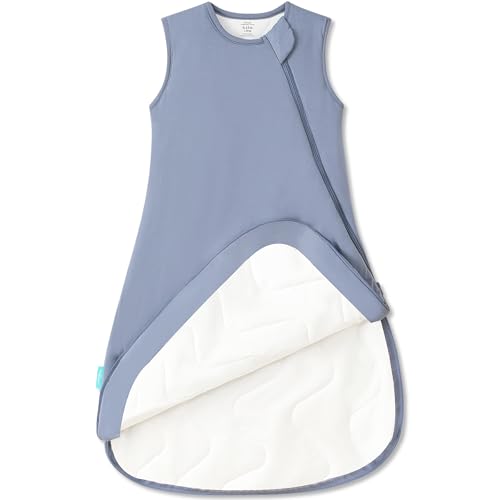
PurComfy Supersoft Sleep Sack (1.0 TOG, Bamboo Viscose, 6-15 Months)
A mid-weight unweighted bag for a cooler room, in 96% viscose and 4% spandex with 100% polyester wadding certified to Oeko-Tex Standard 100 Class 1. PurComfy is unusually plain about the construction difference: the 1.0 and 2.5 TOG versions carry wadding and the 0.5 does not. A two-way J-shaped zipper opens like a book for changes. Sized 6-15 months.
- Brand
- PurComfy
- Category
- Warmer Unweighted Option
If the appeal of a weighted sack was that your baby seemed cold or unsettled, this is the honest fix — more TOG, no added weight on the chest.
- 01YoofossUnweighted AlternativeYoofoss Baby Sleep Sack 3-Pack (0.5 TOG, GOTS Organic Cotton, 0-6 Months)
- 02PurComfyWarmer Unweighted OptionPurComfy Supersoft Sleep Sack (1.0 TOG, Bamboo Viscose, 6-15 Months)
Is the Dreamland Baby weighted sack safe?+
What about weighted blankets for toddlers?+
I already used a weighted sleep sack. What now?+
Are weighted sleep sacks banned or recalled in the US?+
Does the new ASTM sleep-sack standard cover weighted products?+
My baby only settles with pressure on their chest. What do I do?+
Sammie Seelbach
Sammie is a mom of two and the lead reviewer at Smart Baby Reviews. Since becoming a parent she has become obsessed with researching the safest, smartest baby gear on the market — testing thermometers at 2 a.m., wrangling baby gates, and sterilizing more bottles than she can count. She shares what actually works so other parents can make confident, informed decisions for their little ones.