The Best All-in-One Baby-Proofing Kits

This post may contain affiliate links. Read our policy.
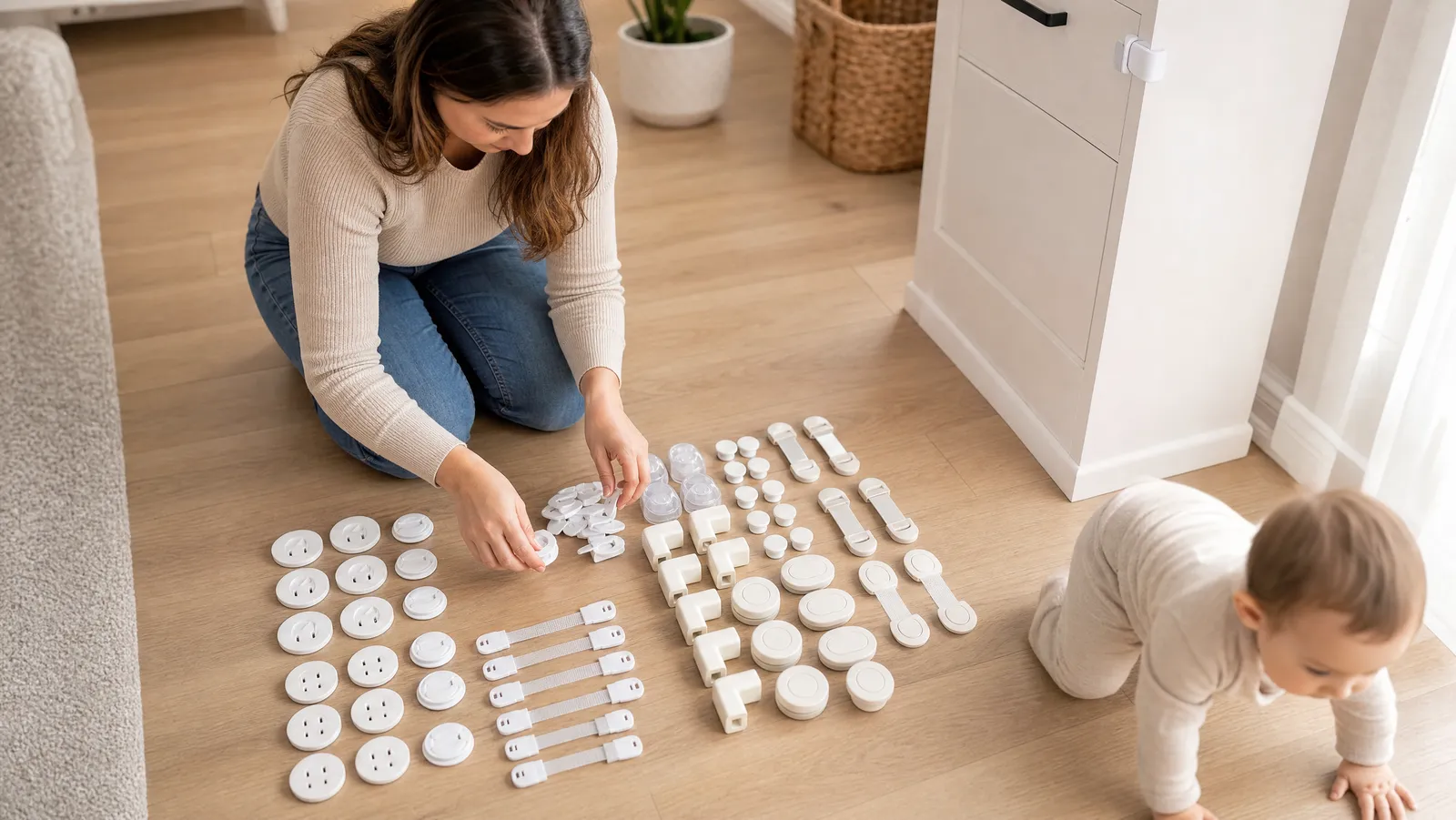
My son learned to crawl on a Thursday. By Saturday he had found the outlet behind the couch, the sharp corner of the coffee table, and the drawer where we keep the knives. Buying a lock for every door and a cap for every outlet, one product at a time, was going to take a week of shopping. So I bought a kit instead.
Some of the links below are affiliate links, and we may earn a small commission — at no extra cost to you — if you buy through them. The best baby proofing kit is the one whose contents match the hazards in your house, not the one with the biggest number on the box. A 60-piece kit that is half outlet caps covers less ground than a 42-piece kit with a real spread of latches, corner guards and door locks.
A kit is the fastest, cheapest way to baby-proof your home on the first pass: one order, one afternoon, most of a house handled. What a kit will not do is finish the job. The stairs, the TV, the one cabinet in every kitchen that refuses a generic latch — those get bought separately. Below is how to read a piece count, the five kits I would actually buy, and the gaps you will still be left with.
What a baby-proofing kit is actually good for
A kit buys breadth, cheaply. For the price of two or three standalone products you get twenty to eighty small devices covering four or five hazard categories in a single box, which is enough to take a house from no coverage to most of the way there in an afternoon. That is the whole pitch, and it is a good one.
It helps to see where that lands against the full job. The Consumer Product Safety Commission's childproofing guide lists 12 safety devices for a home with young children, including safety latches and locks for cabinets and drawers, safety gates, door locks, anti-scald devices for faucets and shower heads, corner and edge bumpers, receptacle or outlet covers and plates, window guards, and smoke and carbon monoxide detectors.
Hold a kit's contents up against that list and the shape of the thing becomes obvious. A typical all-in-one kit covers four of the twelve — latches, corner guards, outlet covers, door devices — and sometimes furniture straps as a fifth. It never includes gates, anti-scald valves, window guards, or detectors.
That is not a criticism. It is the job description. A kit handles the high-volume, low-cost hazards that are annoying to shop for individually, and leaves you a short, specific list of things to buy on purpose. Every kit in this guide costs between roughly 18 and 43 dollars as of July 2026 — roughly what you would pay for a single hardware-mounted stair gate.
How to read a piece count (the only math that matters)
Ignore the headline number and count the categories. A piece count tells you how many objects are in the box, not how many hazards they address, and the two are easy to pull apart once you look at a contents list.
Take the Dreambaby 46-piece kit. Thirty of those 46 pieces are outlet plugs, which leaves 16 pieces of actual cabinet and door coverage. Now take the BooBoo Baby 42-piece kit: 10 lock straps, 10 corner guards, 20 outlet protectors, 2 door lever locks. The smaller number is the more even spread. Meanwhile the Safety 1st 80-piece set earns its count honestly with 30 latches, but includes zero corner guards and zero anchors.
Outlet caps are what pads almost every headline number, and they are the weakest device in the category. The CPSC's guidance is careful here: it advises making sure outlet protectors cannot be easily removed by children and are large enough that children cannot choke on them. The Electrical Safety Foundation International cites Temple University research in which 47 percent of the four-year-olds studied could remove one brand of cap, and 100 percent of the two- and four-year-olds could remove a second brand, in many cases within ten seconds. If outlets are a live worry in your house, read up on outlet covers and choose the type deliberately. A stack of 30 plug caps in a kit is a bonus, not a selling point.
So before you order anything, walk the house with a notepad and count:
- Doors and drawers a crawler can actually reach, room by room
- Sharp corners at head height for someone learning to stand
- Accessible outlets that are not behind furniture
- Doors you want closed to a toddler, and whether they have knobs or levers
- Tall or top-heavy furniture and every television in the house
That tally is your shopping list. Match it against a kit's contents breakdown, and the right kit usually picks itself.
The best baby proofing kits, compared
Safety 1st 80-Piece Childproofing Set: the most latches for the money
If your house is mostly a cabinet problem, the Safety 1st Home Safeguarding and Childproofing Set is the efficient answer. Thirty cabinet and drawer latches, 4 slide locks for double-door cabinets, and 6 Grip 'n Twist knob covers means you can lock down a kitchen, a bathroom vanity, a laundry cabinet and two adults-only rooms out of one box, at around 20 dollars as of July 2026.
Its blind spot is right there in the contents list: no corner guards and no furniture anchors. If your living room is all sharp coffee-table edges, this is not your kit on its own. But for pure door-and-drawer coverage per dollar, nothing else here comes close, which is why it is my overall pick.
Inaya 50-Piece Deluxe Kit: the only one with real furniture anchors
The Inaya Complete 50pc Deluxe Baby Proofing Kit is the most complete box here, and the reason is the 12 anti-tip furniture straps. Every other kit in this roundup treats furniture anchoring as an afterthought or skips it; Inaya ships enough straps to do the dressers, the bookcase and the TV stand, rated by the brand to support up to 85 lbs each with single and dual mounting options.
The rest is well balanced too: 10 adjustable multi-use latches, 12 flexible hidden locks, and 16 foam corner protectors in grey and brown. At about 43 dollars as of July 2026 it is the priciest kit here, but it is also the only one that meaningfully touches furniture tip-overs — the hazard the CPSC runs a standing public-awareness campaign about, at anchorit.gov.
BooBoo Baby 42-Piece Kit: the most balanced starter
Forty-two pieces, and not one category carrying the count. The BooBoo Baby 42 Pack Premium Child Safety Kit splits into 10 lock straps, 10 corner guards, 20 outlet protectors and 2 door lever locks — a genuinely even spread for around 18 dollars as of July 2026, the cheapest kit in this guide.
Installation is the other selling point. The straps press onto the surface and click into place, with no tools and no drilling, and they work on cupboards, refrigerators, wardrobes, trash cans, microwaves, dishwashers and toilet seats. BooBoo Baby states the straps and corner guards remove without residue or damage, which matters if you rent. This is the kit I would hand a first-time parent who wants to stop researching and start installing.
Dreambaby 46-Piece Home Safety Kit: best known brand
The Dreambaby 46 Piece Home Safety Kit is the cautionary tale I keep using, and I still recommend it with eyes open. Thirty of the 46 pieces are outlet plugs. The real coverage is 10 safety catches, 2 multi-purpose latches, 2 door knob covers and 2 sliding locks — 16 pieces doing the structural work, at about 23 dollars as of July 2026.
What you are buying alongside those 16 pieces is a long-established child-safety brand, and there is real value in that when you are ordering plastic parts online with no way to inspect them first. Just do the subtraction before you decide it covers your house.
Baitiny 60-Piece Kit: outlets plus a pair of anchors
The Baitiny Baby Proofing Kit covers the widest set of categories at around 27 dollars as of July 2026: 12 invisible cabinet locks, 14 corner protectors, 14 three-prong plug covers with a removal key, 6 door lock straps, and 2 metal furniture anchors. The corner protectors are clear TPU rather than foam, which suits families who would rather not have visible bumpers on every table.
Since this whole guide is about counting what is actually in the box, I have to apply the rule here too: that itemized list is Baitiny's own, and it adds up to 48 pieces plus the removal key, not 60. I cannot tell you where the other dozen live. It does not change my read of the kit, because the categories it covers are what makes it useful and those are all itemized, but it is a good illustration of why the headline number on any of these boxes is the last thing you should shop on.
One claim here deserves unpacking. Baitiny states its zinc-alloy anchors secure dressers and TVs up to 400 lbs and meet ASTM F3096, the standard performance specification for tipover restraints used with clothing storage units. It is worth knowing exactly what that standard is: according to ASTM, F3096 defines the test method and requirements for tipover restraints as required in Specification F2057, and it assesses the strength of the restraint only — it does not address how the restraint performs once installed in your particular wall. We dug into tip-over standards in more depth in our furniture-anchor guide. The other performance percentages on this listing are seller marketing claims that we could not verify, so buy it for the contents list, not the copy.
What a kit will not cover
Here is the part most roundups skip. Plan for these before you convince yourself the box did everything.
Stairs and doorways. No kit includes a safety gate, and gates sit right near the top of the CPSC's device list. Budget separately for the top of the stairs, the bottom of the stairs, and the kitchen doorway.
The one cabinet that defeats generic latches. Every kitchen has it: the frameless door, the thick drawer front, the curved corner cabinet, the fridge. Kit straps are built to fit everything, which means they fit some things poorly. When a kit latch pops loose under a firm tug, swap that single door out for one of the dedicated cabinet and drawer locks — a magnetic lock or a purpose-built appliance latch — rather than writing off the whole kit.
Furniture and televisions. This is the biggest gap, and the highest stakes. According to a Consumer Product Safety Commission report released in February 2024, an estimated 17,800 people a year are injured in furniture, TV and appliance tip-overs, children under 18 account for 44 percent of those injuries — roughly one child treated in an emergency department every 53 minutes — and children make up 71 percent of the fatalities. New furniture is getting safer: after the STURDY Act was signed into law in December 2022, the CPSC adopted ASTM F2057-23 as a mandatory stability standard for clothing storage units, effective September 1, 2023. That does nothing for the dresser already in your bedroom. Two anchors in a kit will not do a whole house.
Water temperature, windows, blind cords, and detectors. Anti-scald devices, window guards, cordless window coverings, and working smoke and carbon monoxide alarms are all on the CPSC's list and none of them come in a box of latches.
Storage habits. No device replaces putting dangerous things out of reach. The American Academy of Pediatrics advises keeping harmful items out of reach and out of sight, ideally in a cabinet with a lock or safety latch. Safe Kids Worldwide's March 2013 research report put the scale of the problem at roughly 67,000 young children a year in an emergency room for medicine poisoning — about one every eight minutes. The trend since has been in the right direction: Safe Kids now describes a child under six going to the emergency room for medicine poisoning about every nine minutes, with ER visits down from their 2010 peak. It is still a lot of children. Latch the under-sink cabinet, yes, and also move the medicine up high.
No kit makes a house childproof
I want to be plain about this, because kit listings are not. The CPSC says directly that no device is completely childproof, and that determined youngsters have been known to overcome or disable them. The agency also stresses that to be effective these devices must be properly installed with the instructions followed carefully, and that older children in the house need reminding to re-secure a device after they disable it — which, with adhesive kit hardware, means wiping the surface clean, pressing firmly, and giving the adhesive its full cure time before you trust it.
The framing the CPSC uses is the one worth keeping: child safety devices are an important aid to parental supervision, not a substitute for it. They may buy you seconds — the moment you turn to the stove or answer the door — and that is genuinely worth having. But they are a layer, not a lid, and the households I have seen do this best treat a kit as the floor of their plan rather than the ceiling.
How to install a kit in one afternoon
Work in order of danger, not in order of room. Start with the cabinet holding cleaners and dish pods, then any cabinet or drawer with medicine in it, then the laundry detergent, then the trash cabinet and the fridge. That sequence covers the hazards that send families to the ER before you spend an hour on the tupperware drawer.
Wipe every mounting surface with rubbing alcohol first and let it dry. Kitchen cabinets carry an invisible film of cooking grease that quietly ruins adhesive, and a latch that pops off in week two is worse than no latch, because you stopped worrying about that door. Press each piece firmly, hold for a slow count of thirty, then leave everything alone before you test it. Follow the cure time in your kit's own instructions and do not shorten it — Safety 1st, for one, tells you to wait a full 24 hours after installing an adhesive cabinet latch before you use it.
Do outlets and corners last. They are the fastest to install and the least likely to be the thing that hurts someone this week. And whatever you have left in the bag when you are done, keep it — you will find a drawer you missed.
The bottom line
Buy for your contents list, not for the number on the box. If your house is mostly cabinets, the Safety 1st 80-piece set is the best value here and my overall pick. If you have not anchored your furniture yet, the Inaya 50-piece kit with its 12 straps is worth the extra money. If you want the most even coverage for the least cash, the BooBoo Baby 42-piece kit is the easy call, and the Baitiny 60-piece kit is the one to reach for if you want clear corner guards and a pair of anchors in the same order.
Then finish the last 20 percent on purpose: a gate for the stairs, a proper lock for the cabinet that beat the kit, real anchors for every tall piece of furniture, and medicine stored up high where a failed latch does not matter. Work through how to baby-proof your home room by room and you will know exactly which gaps are left. One box gets you most of the way in an afternoon. The rest is a short, specific list — and that is a much better problem than the one you started with.

Safety 1st Home Safeguarding and Childproofing Set (80 Pcs), White
Eighty pieces, and here is the breakdown that matters: 30 cabinet and drawer latches, 4 cabinet slide locks for double-door cabinets, and 6 Grip 'n Twist door knob covers for the rooms you want to keep adults-only. That makes it the most latch-and-knob heavy kit in this roundup, which is exactly right if your problem is a kitchen and a bathroom full of doors and drawers. What it does not include is corner guards or furniture anchors, so plan on buying those separately.
- Brand
- Safety 1st
- Category
- Our Pick
One order got our whole first floor sorted in an afternoon — latches, knob covers and all — and I still had spare latches left in the bag.

Inaya Complete 50pc Deluxe Baby Proofing Kit
Fifty pieces spread across four real jobs: 10 adjustable multi-use latches, 12 flexible hidden locks, 16 foam corner protectors, and 12 anti-tip furniture straps. Those straps are the reason this one stands out — it is the only kit here that ships a serious number of furniture anchors, and Inaya rates each strap to support up to 85 lbs, with single and dual mounting options. The corner protectors come 8 grey and 8 brown with pre-applied adhesive, and Inaya states the cabinet locks are intended to secure drawers and cabinets against children up to about five years old. It also includes a 1-year warranty and video instructions.
- Brand
- Inaya
- Category
- Best Coverage (Anchors Included)
The twelve furniture straps are what sold me — I anchored both dressers, the bookcase and the TV stand out of one box.

BooBoo Baby 42 Pack Premium Child Safety Baby Proofing Kit
Forty-two pieces: 10 safety lock straps, 10 corner guards, 20 outlet socket protectors, and 2 door lever locks. It is the most evenly spread mix in this roundup, with locks, corners, outlets and doors all genuinely represented rather than one category padding the count. Installation is press-and-click with no tools and no drilling, and it works on cupboards, cabinets, refrigerators, wardrobes, drawers, trash cans, microwaves, washing machines, dishwashers and toilet seats. BooBoo Baby states the straps and corner guards remove without residue or damage.
- Brand
- BooBoo Baby
- Category
- Best Balanced Starter Kit
This was the box I handed my husband when he asked where to start — nothing to learn, just peel and click.

Dreambaby 46 Piece Home Safety Kit
Forty-six pieces, but 30 of them are outlet plugs — so the real cabinet-and-door coverage here is the other 16: 10 safety catches, 2 multi-purpose latches, 2 door knob covers, and 2 sliding locks. That makes this the clearest example in the roundup of a headline piece count running ahead of what is actually in the box. It still covers cabinets, drawers and doors alongside the outlets, and Dreambaby is a long-established child-safety brand, which counts for something when you are buying sight-unseen.
- Brand
- Dreambaby
- Category
- Best Known Brand
I bought it for the brand name and I would buy it again — just know going in that most of the count is outlet plugs.

Baitiny Baby Proofing Kit, 60 Packs
Sold as 60 pieces, though Baitiny's own itemized list adds up to 48 plus a removal key: 12 invisible cabinet locks, 14 corner protectors, 14 three-prong plug covers, 6 door lock straps, and 2 metal furniture anchors. The plug covers ship with a removal key for adults, and the corner protectors are clear TPU rather than foam, which suits families who would rather not have visible bumpers on every table. Baitiny states its two zinc-alloy anchors secure dressers and TVs up to 400 lbs and meet the ASTM F3096 tip-over standard. The rest of the listing's performance percentages are seller marketing claims we could not verify, so judge this kit on its contents.
- Brand
- Baitiny
- Category
- Best for Outlets Plus Anchors
The clear corner guards were the compromise that got our living room baby-proofed without my husband grumbling about foam bumpers.
- 01Safety 1stOur PickSafety 1st Home Safeguarding and Childproofing Set (80 Pcs), White
- 02InayaBest Coverage (Anchors Included)Inaya Complete 50pc Deluxe Baby Proofing Kit
- 03BooBoo BabyBest Balanced Starter KitBooBoo Baby 42 Pack Premium Child Safety Baby Proofing Kit
- 04DreambabyBest Known BrandDreambaby 46 Piece Home Safety Kit
- 05BaitinyBest for Outlets Plus AnchorsBaitiny Baby Proofing Kit, 60 Packs
Are baby-proofing kits actually worth it, or should I buy everything separately?+
How many pieces do I actually need?+
Do the locks in a kit hold as well as standalone ones?+
What does an all-in-one kit almost never include?+
When should I buy one?+
Will kit latches and corner guards damage my cabinets and furniture?+
Sammie Seelbach
Sammie is a mom of two and the lead reviewer at Smart Baby Reviews. Since becoming a parent she has become obsessed with researching the safest, smartest baby gear on the market — testing thermometers at 2 a.m., wrangling baby gates, and sterilizing more bottles than she can count. She shares what actually works so other parents can make confident, informed decisions for their little ones.