How to Start Your Baby on Solids

This post may contain affiliate links. Read our policy.
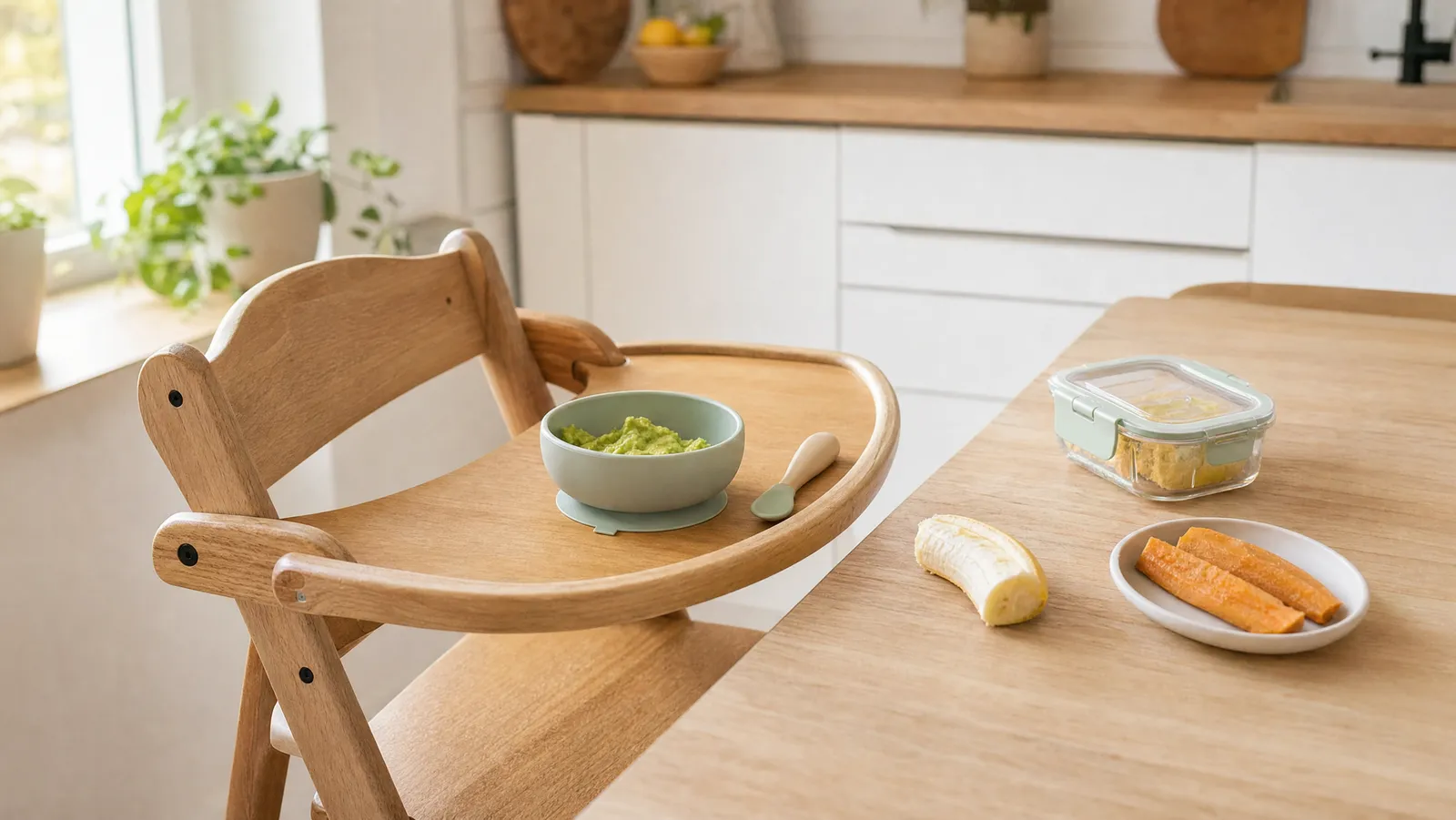
Starting solids means offering food other than breast milk or formula at about 6 months, once your baby can sit up with support, hold their head steady, and open their mouth when the spoon arrives. Milk stays the main meal for the rest of the first year. Everything on the tray is practice. Some of the links below are affiliate links, and we may earn a small commission, at no extra cost to you, if you buy through them.
The first time I put oatmeal in front of my daughter she looked at the spoon the way you would look at a wasp in the car. Half a teaspoon went in. Most of it came back out, which I now know is a tongue that has not finished learning its job rather than a verdict on the oatmeal. Then she leaned forward for more, and by the third day she was hitting the bowl with her palm because I was too slow. That whole arc took ninety seconds a day for a week, and I had prepared for it with a blender, a steamer, four silicone bowls and a book.
Here is the thing nobody says plainly. Starting baby on solids is two separate questions that get run together, and only one of them has anything to do with shopping. The first is when and how — readiness, first foods, allergens, choking, how much — and it is answered by pediatric guidance that has changed meaningfully in the last decade. The second is what you actually need on the table, which is a shorter list than any registry will tell you: something for your baby to sit in, something to put food on, something to get it into their mouth, and a way to store the rest.
So this page leads with the first question and keeps the gear section deliberately small.
When to Start: Age, and the Signs That Actually Matter
About 6 months, and not before 4. According to the CDC, the Dietary Guidelines for Americans and the American Academy of Pediatrics recommend introducing children to foods other than breast milk or infant formula at about 6 months, and the same guidance says introducing foods before 4 months is not recommended. The AAP's own starting solid foods guide frames it from the other side: the AAP recommends providing your baby only breast milk for approximately 6 months after birth.
That is the calendar. The calendar gives you permission; your baby decides the day. The AAP's readiness checks are the ones to run, and they are all things you can watch for over a weekend:
- Can they hold their head up? The AAP's phrasing is that your baby should be able to sit in a high chair with good head control.
- Do they open their mouth when food comes their way? Leaning in, opening up and tracking the spoon is an intention, not a reflex.
- Can they move food from a spoon into their throat? Early on, the tongue pushes food straight back out. That fades.
- Size. The AAP notes that babies who have doubled their birth weight and weigh about 13 pounds or more may be ready.
The CDC's list adds the physical ones: sitting alone or with support, controlling head and neck, swallowing food rather than pushing it out, bringing objects to the mouth and grasping small objects. Taken together they describe a baby who can hold themselves up, want the food, and get it down — which is the entire test.
Two things about the gap between 4 and 6 months, because that is where the pressure lands. Doubling birth weight often happens near 4 months, and it is one signal among several rather than a start date. And a baby born early is working from a different clock, which is a question for your own pediatrician rather than a chart. For the signs in detail, including the ones that mislead parents most often, see signs your baby is ready for solids.
Baby-Led Weaning or Purees?
Both work. This is a question about texture and who holds the spoon, not a nutritional fork in the road, and most families I know end up doing some of each by accident.
Baby-led weaning means skipping purees and handing your baby soft finger foods they feed themselves. The AAP's own review of the approach is measured rather than enthusiastic: some studies suggest baby-led weaning does not pose higher choking risks than traditional feeding, but the AAP flags that self-fed diets can be low in iron, vitamins, minerals and other essentials, because a baby who loves fruit may turn away from the meats and cheeses that carry the food energy. The same page is explicit that purees are not a lesser option — pureed foods can be nutritious, too.
If you go the finger-food route, the AAP describes the shape: foods cut into finger-shaped pieces, soft enough to mash with the gums or chew with just a few teeth. If you go the spoon route, the AAP's feeding guide sketches the same progression from the other direction: strained or pureed foods first, then between 8 and 12 months mashed table foods that can contain small chunks, with finger foods arriving once your baby develops a pincer grip.
The two paths converge by about 9 months either way, which is the argument for not being precious about it. We ran purees at dinner because it was fast and I wanted the meal over, and strips of roasted sweet potato at weekend lunches when there was time to clean up. Our comparison of baby-led weaning and purees goes through the iron question and how to combine both.
Gagging Is Not Choking
Learn the difference before the first meal, because you will see one of them in the first week and almost certainly not the other.
Gagging is loud. Coughing, spluttering, watering eyes, a dramatic face, and then the food comes forward and your baby carries on. The AAP's feeding guide describes the reflex doing exactly what it is supposed to do: it keeps food from getting into the airway, and it also prevents choking. The AAP's instruction is not to panic but to adjust — gagging means you need to slow down, and to give smoother foods or smaller amounts.
Choking is quiet. The airway is blocked, so there is no cough and no sound, and that silence is the signal. This is why every source treats supervision as the actual safety device. The CDC says to watch your child at all times while they are eating and to have them sit up while eating, with no lying down, crawling or walking, and to cook and prepare food to the right shape, size and texture for your child's development. The AAP's choking prevention guidance adds the number to cut to: pieces no larger than one-half inch for infants and young children.
The scale is why this section exists at all. According to the AAP, choking is a leading cause of death for infants and children, most children who die from choking are under age 5, and two-thirds of them are babies under a year old. The AAP's baby-led weaning guidance is correspondingly strict about the mechanics: keep the baby upright and sitting while eating, supervise every meal, and let nobody else put food into the baby's mouth — only the baby does that.
Three habits carry most of the risk reduction: your baby is upright, you are sitting with them rather than in the next room, and the food is the right texture for the mouth eating it. Our guide to gagging and choking covers the difference in signs and what an infant first-aid class teaches you to do.
First Foods, and the Short List of What to Avoid
The best first food is whichever one you will actually make. The AAP is unusually relaxed here — your baby's first foods are your choice — with one nutritional priority attached: include foods that provide iron and zinc, such as baby food made with meat or iron-fortified cereals. The AAP also suggests introducing one single-ingredient new food from any food group every three to five days, which gives you a clean read on reactions.
About rice cereal. The old default has quietly expired, and it is worth knowing why. The FDA has noted that relative to body weight, rice intake for infants, primarily through infant rice cereal, is about three times greater than for adults, and its advice is direct: iron-fortified rice cereal is a good source of nutrients for your baby, but it should not be the only source, and does not need to be the first source. Other fortified infant cereals include oat, barley and multigrain. In final guidance issued August 5, 2020, the FDA set an action level of 100 parts per billion for inorganic arsenic in infant rice cereals, citing the association between inorganic arsenic exposure and neurodevelopmental effects. The CDC puts the practical version in one line: offer a variety of fortified infant cereals such as oat, barley and multigrain instead of only rice cereal.
The avoid list is short and firm. According to the CDC:
- Honey, before 12 months. It may cause a severe food poisoning called botulism, and that includes honey added to food, water, infant formula or a pacifier.
- Cow's milk as a drink, before 12 months. The CDC's stated concern is a risk of intestinal bleeding. Yogurt and cheese are a different matter and can come earlier.
- Juice, before 12 months. The CDC says children younger than 12 months should not drink any fruit or vegetable juice, and the AAP says the same.
- Added sugars. The CDC's line is that infants and young children should not have added sugars at all.
- Unpasteurized drinks and foods, which the CDC ties to harmful bacteria that can cause severe diarrhea.
Then the choking shapes, which are about form rather than food: the AAP names hot dogs, nuts and seeds, whole grapes, raw vegetables such as carrot sticks, popcorn, chunks of peanut butter and hard, gooey or sticky candy among the foods to avoid or modify for young children, and advises keeping the riskiest ones from children until age 4 or older depending on the child. Grapes get quartered, nut butter gets spread thin, carrots get cooked soft.
One more thing changes in the same week, and it is not on the tray: the floor. A baby who eats is a baby who drops, and the dog, the low cupboard and the trash can all become part of mealtime. This is the moment for baby-proofing your kitchen. Our page on first foods to offer goes further into building a week of variety without cooking twice.
Introducing the Common Allergens Early
This is the piece of advice that reversed inside one generation, so if you were told to wait, you were told correctly at the time and it is no longer the guidance.
The AAP's current position is stated as a negative, which is how you can tell it is answering an old rule: there is no evidence that waiting to introduce baby-safe soft foods, such as eggs, dairy, soy, peanut products or fish, beyond 4 to 6 months of age prevents food allergy. The CDC's instruction is the positive version — introduce potentially allergenic foods when you introduce other foods.
The evidence behind the change is specific. According to NIAID, the Learning Early About Peanut trial reported in 2015 that regular peanut consumption begun in infancy and continued to age 5 produced an 81 percent relative reduction in the development of peanut allergy among infants at high risk because they already had severe eczema, egg allergy or both. That result produced the Addendum Guidelines for the Prevention of Peanut Allergy in the United States, published in January 2017, which recommend that the highest-risk infants — severe eczema and/or egg allergy — have age-appropriate peanut-containing food introduced as early as 4 to 6 months of age, following evaluation. The guidelines also describe an ongoing amount rather than a single taste: roughly 6 to 7 grams of peanut protein per week, divided across three or more feedings.
For a baby with no eczema and no known allergy, that looks like ordinary meals. Smooth peanut butter thinned with warm water, breast milk or puree to the texture of a thin sauce. A spoonful of whole-milk yogurt. Scrambled egg mashed fine. Baked white fish flaked into sweet potato. Offer one new allergen at a time, earlier in the day rather than at bedtime, and once a food is in, keep it in — regular exposure is the part the trial actually tested.
Two safety notes. Whole nuts and thick gobs of nut butter are choking hazards and never belong in an infant's mouth, so texture matters as much as timing. And if your baby has severe eczema, a known egg allergy, or a sibling with a serious food allergy, that is the one conversation to have with your pediatrician before you start, because the guidelines call for evaluation first. Our page on introducing allergens to your baby has the week-by-week version.
Heavy Metals in Baby Food: What Changed in 2026
This is the subject where the last two years have moved fastest, and where a guide written in 2023 is now out of date.
The federal piece. On January 6, 2025 the FDA issued final guidance setting action levels for lead in processed food intended for babies and young children under two: 10 parts per billion for fruits, vegetables other than single-ingredient root vegetables, mixtures including grain- and meat-based ones, yogurts, custards and puddings, and single-ingredient meats; and 20 parts per billion for single-ingredient root vegetables and for dry infant cereals. Read the scope carefully, because it is narrower than the headlines suggested. The guidance covers packaged processed foods in jars, pouches, tubs and boxes, and it does not cover infant formula, beverages, or snack foods such as puffs and teething biscuits. It is also guidance to industry rather than a legal limit, issued under the FDA's Closer to Zero program, whose stated aim is to reduce dietary exposure to contaminants in foods eaten by babies and young children to as low as possible over time.
The state piece is what makes this a 2026 story. California's AB 899 required baby food manufacturers to test a representative sample of each production aggregate at least monthly for four toxic elements — arsenic, cadmium, lead and mercury — beginning January 1, 2024, and from January 1, 2025 to publish those results on the manufacturer's website and to carry a QR code or other machine-readable code on the label linking to them. Maryland's House Bill 97, known as Rudy's Law, was signed on May 16, 2024 and required testing from January 1, 2025, with the website and labeling disclosure requirement taking effect January 1, 2026.
The practical upshot for a parent standing in an aisle: some baby food labels now carry a QR code that resolves to batch test results. Compliance is uneven, though — on March 6, 2026 the California Attorney General warned manufacturers that some sites only return results if you enter a code found on the package. Where it does work, it gives you no pass-fail answer, but it turns a vague worry into a number you can look at.
The free move is still the best one. Vary the grains, vary the vegetables, and do not let any single food carry a whole week. Our page on heavy metals in baby food goes through what the numbers mean and which categories the rules do not touch.
The High Chair
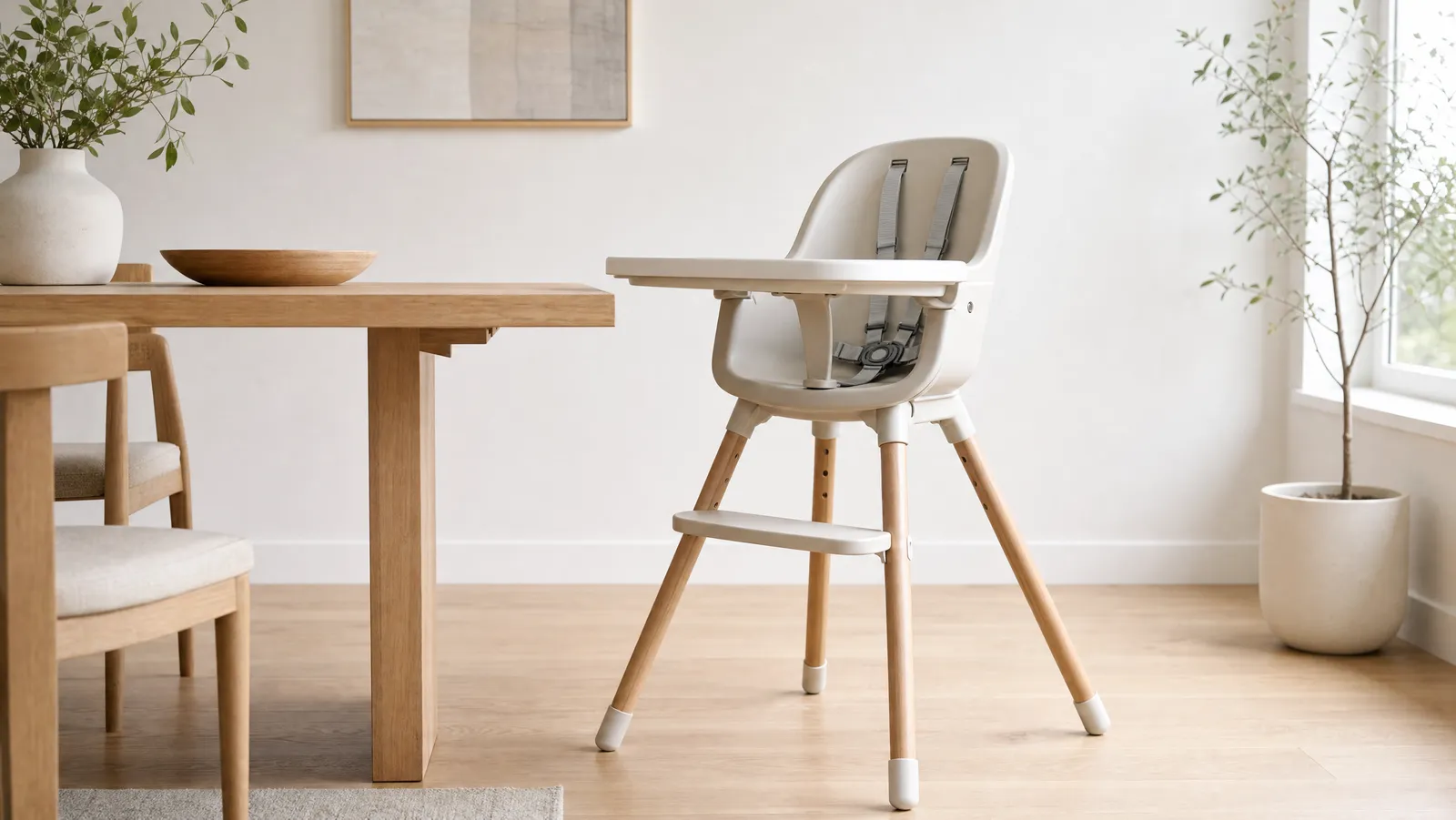
The high chair is the one purchase in this guide I would not improvise, because posture is a safety feature. You want your baby upright rather than reclined, supported at the hips and back, with feet resting on something solid rather than dangling, and a surface you can wipe in one pass.
High chairs are covered by a mandatory federal standard. CPSC's business guidance states that high chairs must comply with ASTM F404-21, the standard consumer safety specification for high chairs, which became mandatory by operation of law on July 23, 2022, and the rule is codified at 16 CFR part 1231. The standard covers restraint systems, openings, structural integrity, tray latch release and side containment. That matters most for anything secondhand: a chair from 2015 was built to an older version of the same standard, and a chair with a missing harness is not a chair.
Then use the restraint, every time, including the crotch strap. A tray is not a restraint — it is a table, and a baby who pushes off it can slide down or tip the chair. The CDC's rule that children sit up while eating is easiest to follow when the seat does the work.
The chair also decides whether meals happen at the table with you, which is the setting every choking-prevention guideline assumes. We compared models on harness design, footrest adjustability, cleaning and how they fit a real kitchen in our guide to the best high chairs for starting solids.
Plates, Bowls, and Spoons
You need a bowl and a soft-tipped spoon. Everything past that is convenience — real convenience, but not safety.
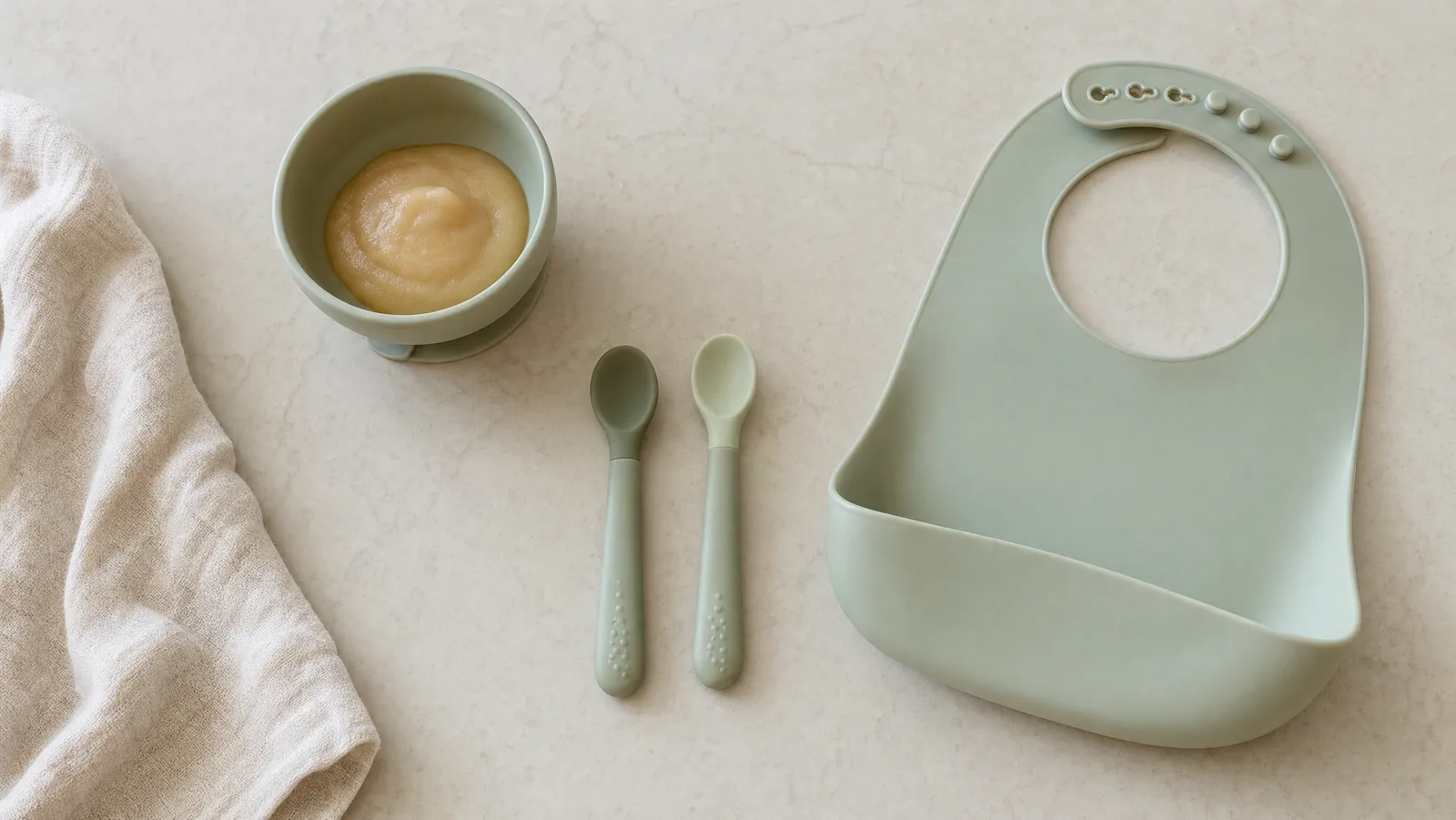
What actually helps, in order. A suction base, because the physics of a six-month-old is that anything not attached to the table ends up on the floor within four minutes. A shallow bowl or divided plate, so food can be scooped rather than chased. Two spoons — one for you, one for the baby to wave around and eventually aim — with soft silicone tips rather than hard plastic, since babies bite the spoon. And a bib with sleeves once self-feeding starts, because a catch-pocket bib solves the chest and does nothing for the forearms.
If you would rather buy the table setting in one go, the o'doe 17-piece feeding set covers it at 31.99 dollars as of September 2026: a suction plate with lid, a suction bowl, wooden and silicone spoons and forks, a sippy cup with straw and lid, a bib with catcher, a fruit feeder and a finger toothbrush. It is food-grade silicone throughout, dishwasher safe and microwave and fridge safe, and the maker says the large suction base is tested to hold until the meal is over. The small cutlery has sensory bumps on the handles.
For the sleeves problem, the Tiny Twinkle mess proof bib is a full-coverage apron rather than a bib, at 11.95 dollars as of September 2026: waterproof, fast-drying fabric that wipes down or goes in the machine, OEKO-TEX Standard 100 certified, free of PFAS, BPA and phthalates, sized 6 to 24 months. Ours lives on the back of the high chair rather than in a drawer, which is the only storage system that survives a real week. Our roundup of baby plates, bowls and spoons compares suction strength and shapes.
Making Ahead and Storing It
Batch cooking is the habit that makes solids sustainable, and the reason is arithmetic: a baby eats a tablespoon or two, and nobody wants to steam a carrot for a tablespoon.
The food safety rules are short and worth following exactly. According to the FDA, you should not feed a baby from a jar of baby food and then put the jar back in the refrigerator, because saliva on the spoon may contaminate the remaining food. Put a serving size on a dish, refrigerate what is left in the jar, and throw away whatever is not eaten from the serving dish. The FDA's storage window for home-prepared baby food is 1 to 2 days in the refrigerator and 3 to 4 months in the freezer.
So the workflow is: cook once, portion immediately, label with the date, serve out of a separate dish. Freeze in units you will actually thaw, because a large frozen block gets reheated twice and the second reheat is the one that goes in the bin.
Four ounces turns out to be the right unit, which is why the OXO Tot Glass Baby Blocks work so well at 25.99 dollars as of September 2026: four 4-ounce glass containers with locking, leak-proof lids and a stackable tray. Glass is the sane choice for anything you will reheat, since it goes from freezer to microwave or oven without a thermal shock problem, and it does not absorb colours or odours the way plastic does. The measurement markings make portioning quick. Our comparison of baby food storage containers covers ice-cube-tray systems and pouch refills too.
Do You Need a Baby Food Maker?
Almost certainly not, and I say that as someone who bought one.
A baby food maker steams and then blends, in one jug, with one button. Both jobs are already done by a saucepan with a steamer basket and either a stick blender, a countertop blender or a fork. Steam until soft, blend with a splash of the cooking water: that is the entire technique, and the fork version is adequate for banana, avocado, sweet potato and anything else that gives up under pressure.
Where these machines earn their counter space is narrow but real. Very small batches are exactly the size baby portions come in, and steaming and blending in the same vessel means one thing to wash instead of three at the end of a day when you are already behind. If your blender lives at the back of a high cupboard, a machine that sits out may be the difference between making food and buying it.
What they do not do is anything nutritional. There is no processing advantage over a pot. If you are choosing between a baby food maker and a better high chair, buy the chair. Our review of a baby food maker looks at which functions are worth paying for.
How Much to Offer, and How Milk Fits Around It
Start smaller than the jar suggests, and let milk keep doing the heavy lifting.
According to the CDC, the starting amount is 1 or 2 tablespoons of food, and the rhythm is something to eat or drink every 2 to 3 hours, about 5 or 6 times a day, which works out to roughly three meals and two to three snacks as your baby grows into it. Watch for signs that they are still hungry or full and follow those rather than the spoon count. The same guidance is clear that breast milk or infant formula remains the main source of nutrition from 6 to 12 months, and that as your baby gradually eats more solid foods, they will gradually need less formula.
That last point lowers the temperature in a lot of kitchens. Through the second half of the first year, a refused dinner is a skipped rehearsal, not a missed meal.
Water can join the table at the same time as food. The CDC puts a 6 to 12 month old at 4 to 8 ounces of water a day, and the AAP says it is fine to offer a little water once solids start but to limit it to no more than 1 cup, 8 ounces, each day — enough to practise with an open cup, not enough to displace milk. Juice stays out entirely until 12 months.
Since milk is still the main event, the bottle matters more than the plate. If you are replacing scratched bottles around this stage, our comparison of glass baby bottles is a good place to start. Our breakdown of how much solid food by age carries this forward month by month, through the 9-month jump in texture and the 12-month handover to table food.
Pouches: Convenient, and Easy to Overuse
Pouches are not the enemy. They have one failure mode: they are so easy that they replace the meal instead of filling a gap in it.
Two things to know. First, sugar. A 2019 analysis in Nutrients of pureed, ready-to-serve infant and toddler foods sold in the United States looked at 703 products, of which 397 were squeeze pouches, and found that pouches in the fruit-based category were more likely to contain added sugars than the same foods in other packaging — 47.9 percent of fruit-based pouches versus 15.0 percent of fruit-based products in other packages. Set that against the CDC's position that infants and young children should not have added sugars at all, and reading the ingredient list becomes a thirty-second habit rather than a fussy one.
Second, the skill. Sucking a puree through a spout is a different motor task from moving food around a mouth and chewing it, and the same study's authors flagged that the effect of pouches on early eating behaviours deserves more research. That is a call for caution rather than a finding, so treat it as one.
The compromise that works: squeeze the pouch onto a spoon or into a bowl at the table, and save the spout for the car, the stroller and the airport. Our guide to baby food pouches covers label-reading and which categories most often carry added fruit juice.
The First Two Weeks, Concretely
Nothing here is a schedule to hit. It is the shape most first fortnights take.
| Days | What to offer | What you are watching for |
|---|---|---|
| 1 to 3 | One food, once a day, a teaspoon or two, after a milk feed when your baby is calm rather than starving | Whether food goes in and stays in. Tongue-thrust and mess are normal |
| 4 to 7 | Same food or a second single-ingredient food, still once a day, working up toward 1 to 2 tablespoons | Interest, leaning in, opening the mouth. Any reaction to a new food |
| 8 to 10 | Add an iron-rich food — iron-fortified oat cereal or pureed meat — and introduce a new single-ingredient food every 3 to 5 days | That iron and zinc are getting in, per AAP guidance |
| 11 to 14 | Move to twice a day if your baby is enthusiastic, and introduce the first allergen in a smooth, thinned form earlier in the day | Tolerance, and whether you can keep it in the diet regularly afterwards |
Two weeks in, you are not aiming for volume. You are aiming for a baby who sits in a chair, opens their mouth and treats the tray as normal. Volume follows on its own, usually around 8 or 9 months, and usually on a day you had not planned anything.
The rest is smaller than it looks from here. A seat, a bowl, a spoon, a bib, something to freeze the leftovers in, and a rotation of foods wide enough that no single ingredient has to be perfect. Then start on a Saturday morning when nobody is in a hurry.
Explore the full series
- When to Start Solids: Age, Readiness Signs, and Why Not Sooner — The readiness signs that matter more than a birthday — and the real reason four months is a floor, not a target.
- The Best High Chairs for Starting Solids — Six high chairs compared on the things that decide it: harness, footrest, seat height and how bad the cleanup is.
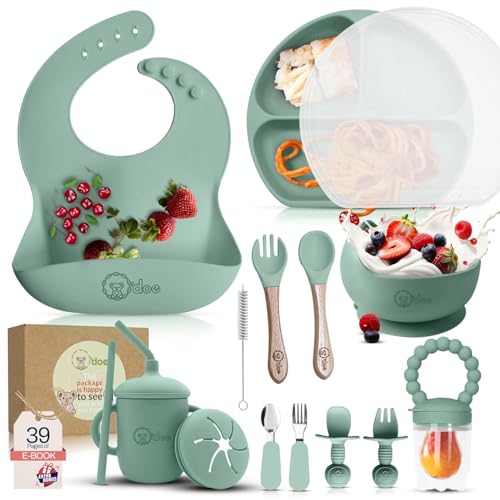
o'doe 17-Piece Silicone Baby Feeding and Weaning Set
If you would rather buy the whole table setting once, this is it: a suction plate with lid, a suction bowl, wooden and silicone spoons and forks, a sippy cup with straw and lid, a bib with catcher, a fruit feeder and a finger toothbrush. The suction plate and bowl use a large base the maker says is tested to hold until the meal is over. Everything is food-grade silicone, dishwasher safe, and microwave and fridge safe.
- Brand
- o'doe
- Category
- Our Pick
Buying one box beat assembling a feeding kit out of six separate orders, and we still use the suction plate daily a year on.
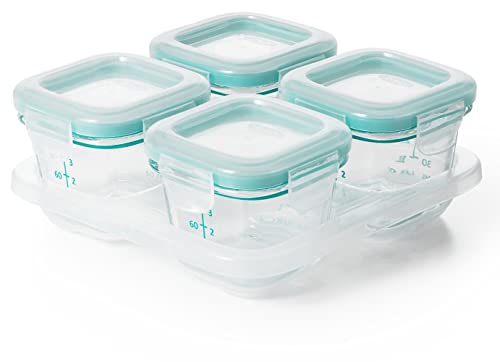
OXO Tot Glass Baby Blocks Food Storage Containers, 4 oz
Four 4-ounce glass containers with locking, leak-proof lids and a stackable tray. Glass is the sane choice for anything you will reheat: it goes from freezer to microwave or oven without shattering from the temperature change, and it does not absorb colours or food odours the way plastic does. Measurement markings on the body make portioning straightforward, and every component separates for cleaning.
- Brand
- OXO Tot
- Category
- Best for Batch-Cooking
Four ounces turns out to be exactly the unit of baby food. We batch on Sunday and the week feeds itself.
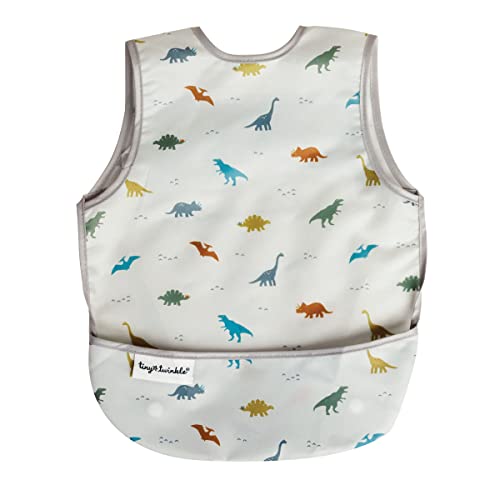
Tiny Twinkle Mess Proof Baby Bib and Feeding Apron
A lightweight fabric apron rather than a catch-pocket bib, for the stage where food ends up on sleeves and shoulders as much as on the tray. The fabric is waterproof and fast-drying, wipes down or goes in the washing machine, and is OEKO-TEX Standard 100 certified and free of PFAS, BPA and phthalates. Sized 6-24 months.
- Brand
- Tiny Twinkle
- Category
- Best Full-Coverage Bib
Once she started feeding herself, a neck bib stopped being enough. Sleeves were the problem, and this solved the sleeves.
- 01o'doeOur Picko'doe 17-Piece Silicone Baby Feeding and Weaning Set
- 02OXO TotBest for Batch-CookingOXO Tot Glass Baby Blocks Food Storage Containers, 4 oz
- 03Tiny TwinkleBest Full-Coverage BibTiny Twinkle Mess Proof Baby Bib and Feeding Apron
What is the best first food for a baby?+
Can I start solids at 4 months?+
When can my baby have peanut butter?+
How much solid food should a 6-month-old eat?+
Is rice cereal still a safe first food?+
Sammie Seelbach
Sammie is a mom of two and the lead reviewer at Smart Baby Reviews. Since becoming a parent she has become obsessed with researching the safest, smartest baby gear on the market — testing thermometers at 2 a.m., wrangling baby gates, and sterilizing more bottles than she can count. She shares what actually works so other parents can make confident, informed decisions for their little ones.