When to Stop Swaddling (and How to Transition Out)

This post may contain affiliate links. Read our policy.
When to stop swaddling is not a date on the calendar. The American Academy of Pediatrics says to stop as soon as your baby shows any sign of trying to roll over — usually around 3 to 4 months, but sometimes as early as 2. The behaviour is the deadline. The age is only the average, and almost every parent hears the age instead. Some of the links below are affiliate links, and we may earn a small commission, at no extra cost to you, if you buy through them.
Here is how that landed in our house. At eleven weeks my daughter started doing a thing at 3 a.m. that I filed under wriggling — hips twisting, one shoulder lifting off the mattress, the whole burrito rocking and settling back. She was not yet three months and I had three to four months in my head, so I kept swaddling. She was not wriggling. She was practising.
That gap between the age you were told and the behaviour in front of you is where this topic goes wrong. So: what the stop signal actually looks like, why the arms are the part that matters, and a staged plan for the baby who will not sleep without the swaddle. It assumes the basics of a safe sleep space are handled — on the back, firm flat surface, nothing loose in the crib.
When to Stop Swaddling: Rolling, Not a Birthday
The AAP's swaddling guidance for parents sets the stop signal in a single sentence that contains no age: "Stop swaddling as soon as your baby shows any signs of trying to roll over." The only age it gives is the early edge — some babies start working on rolling as early as 2 months, "but every baby is different."
The AAP's 2022 safe sleep policy statement says the same thing with the average attached: "When an infant exhibits signs of attempting to roll (which usually occurs at age 3 to 4 months but may occur earlier), swaddling is no longer appropriate because it could increase the risk of suffocation if the swaddled infant rolls to the prone position."
Read those together. The trigger is a behaviour. The three-to-four-month figure describes when that behaviour usually shows up; it is not a permission slip that expires on a date. Consumer Reports frames the practical window the same way, putting first signs of rolling typically between 8 and 12 weeks and calling that the ideal time to start the transition.
So the useful question is not how old your baby is. It is what she did last night.
What Signs of Trying to Roll Actually Look Like
Nobody hands you a checklist, and the successful roll is the least useful signal, because by then you are late.
You are watching for effort, not achievement: twisting the hips to one side, throwing the legs across the body, arching the back, rocking side to side on the spine, getting up onto one shoulder, or breaking an arm out of a swaddle that held fine last week. Any of it, once, counts.
Two things make this harder than it sounds. Most of it happens in the dark while you are half asleep, which is a good argument for treating an escaped arm as evidence rather than laundry. And awake behaviour counts — a baby working on rolling during floor time can do it at 2 a.m.
The CDC lists rolling from tummy to back among the things most children can do by six months — far later than the swaddle deadline, because it marks when most babies finish learning, not when yours starts trying.
Why Rolling Is the Line: The Arms Are the Safety Feature
Here is the mechanism that convinced me.
The AAP's policy statement is blunt about the stakes: "There is a high risk for death if a swaddled infant is placed in or rolls to the prone position." Its parent page adds that some studies have shown an increased risk of SIDS and unintentional suffocation when babies are swaddled if they are placed on their stomach to sleep, or if they roll onto their stomach. Safe to Sleep, the NICHD campaign, describes the same failure: a swaddled baby may have trouble moving out of the stomach or side position, which carries greater risk than the back position.
The Lullaby Trust puts it plainest: once a baby shows signs of rolling, stop swaddling them with their arms wrapped inside the material, because they could roll onto their tummy and not be able to roll back again, as they cannot use their arms.
So the swaddle is not dangerous because of the fabric or the fit. It is dangerous at exactly one moment, because it has removed the limbs your baby needs then.
And before you feel bad about anything already done: the AAP says there is no evidence to recommend swaddling as a strategy to reduce the risk of SIDS in the first place. It is a settling technique, not a safety intervention.
The Uncomfortable Truth About the One-Arm-Out Method
Search how to stop swaddling and you will find a dozen night-by-night schedules. Three nights with the left arm out, three with the right, then both. Or five and five.
I went looking for the source of those schedules and could not find one. The AAP, the NICHD's Safe to Sleep campaign, the CPSC and the Lullaby Trust all address when swaddling must end; none publishes a transition timetable. The closest thing to guidance on arms is the AAP's line that "there is no evidence with regard to risk of SIDS related to the arms being swaddled in or out," and that parents "can decide on an individual basis whether to swaddle and whether the arms are swaddled in or out, depending on the behavioral and developmental needs of the infant."
So, honestly: one arm at a time is a convention, not a protocol. It is a reasonable way to make a change gradual, and the AAP explicitly leaves the arms-in-or-out decision to you. It has not been tested, and nobody should present it as though it has.
Here is the part the schedules quietly get wrong, which matters more than the schedule itself. A gradual transition is something you do before signs of rolling appear, not a way to extend past them. Once your baby is attempting to roll, one arm still pinned is still swaddling, and the policy language carves out no exception for half. If rolling has started, both arms come out tonight.
A Transition Plan, Staged by What You Are Solving For
If you have runway before the deadline, use it. Here are the stages, with the caveat above attached to each.
| Stage | What it does | When it fits |
|---|---|---|
| Full swaddle, arms in | Suppresses the startle reflex most fully | Newborn weeks, no signs of rolling |
| Arms up, hands free | Keeps the torso snug, frees the arms | Any time you want to soften the change |
| One arm out | Half the containment, half the freedom | Before signs of rolling, as a stepping stone |
| Both arms out, sack only | Nothing restricts the arms | From the first sign of rolling onward |
Stage one is a dimmer switch rather than an off switch. The SwaddleDesigns Transitional Swaddle Sack is the clearest version of the idea: arms-up half-length sleeves with foldover mitten cuffs you can wear open or closed. SwaddleDesigns states the design is meant for babies starting to roll, babies who sleep arms-up and suck on their hands, and babies who escape a classic swaddle: with the mitts closed it partially suppresses the Moro reflex, and if the baby rolls, the arms are free to reposition. 100% cotton, 0.5 TOG, sized by weight from 6-14 lbs to 21-24 lbs, and recognized by the International Hip Dysplasia Institute as hip-healthy. About $19.99 as of August 2026, and you can open one mitt at a time.
Stage two prints the stages on the label. The Roksuma Transition Swaddle two-pack names three: arms-in to reduce the startle reflex, one-arm-out for self-soothing, then two-arms-out as a plain sleep sack. 100% cotton at 0.8 TOG, interior zipper guard, roomy leg space, sized medium for 14-20 lbs and roughly 3-6 months. Around $31.99 as of August 2026 for two, the right quantity for the stretch where one is always in the wash.
If your baby is already attempting to roll, skip to the last row of that table. That is not a failure of the plan. That is the plan.
Where the Transition Ends: A Plain Sleep Sack
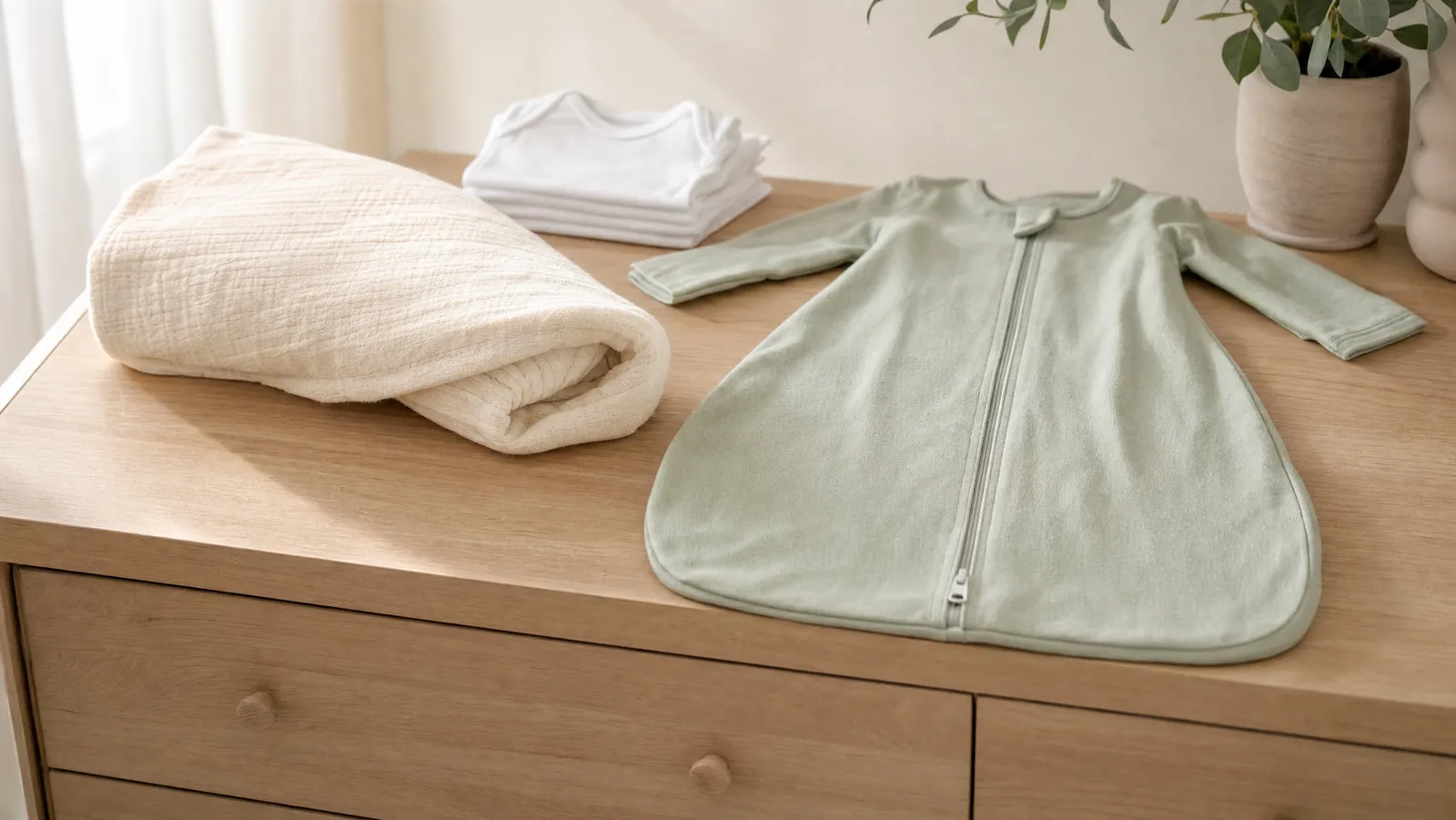
Everything above is scaffolding. The destination is a sleeveless wearable blanket with the arms fully free, and the AAP is relaxed about how long you stay: "Sleep sacks that do not swaddle and allow the baby to move freely can be used as long as you want."
The 2022 policy explains what the sack is for. Dressing an infant in layers of clothing "is preferable to blankets and other coverings to keep the infant warm while reducing the chance of head covering or entrapment," and wearable blankets "can also be used." The sack earns its place by getting the loose blanket out of the crib, not by being cozy.
The Burt s Bees Baby Beekeeper is the plainest example: 100% organic cotton at 0.5 TOG, an interior zipper guard and pull cover, and a zipper that opens from the bottom for night changes, sized 0-6 months from 10 lbs up to 18-24 months at 36 lbs. About $22.95 as of August 2026.
Check two things on whatever you buy. Fit at the neck and armholes, so your baby cannot wriggle down. And warmth against your actual room, since sleep sack TOG ratings only mean something paired with a thermometer. For a shortlist, the best baby sleep sacks works through the weights and sizes. One more filter: ASTM F3735, a new voluntary safety standard covering swaddle products and other wearable sleep products for infants and toddlers, was approved in February 2026.
The Thing Not to Reach For on the Way Out
When the nights get hard, the internet will offer you a weighted swaddle or a weighted sack as the replacement for the pressure your baby is missing. Do not take it.
The AAP's 2022 policy is unambiguous: "weighted swaddle clothing or weighted objects within swaddles are not safe and therefore not recommended." The CPSC's safe sleep guidance tells families not to use weighted blankets or weighted swaddles. We work through the evidence in a separate piece on whether are weighted sleep sacks safe. If your baby genuinely only settles with pressure, that is a conversation with your pediatrician, not a purchase.
What Else Changes the Week Your Baby Starts Rolling
Losing the swaddle is rarely the only thing that shifts. Better to see the list at once than discover it at 4 a.m.
- The crib gets emptier, permanently. That includes the swaddle blanket itself, because a swaddle that has come undone is a loose blanket. We have a separate walk-through of what does not belong in the crib.
- The sleep surface may need to change. A baby learning to roll is often close to outgrowing the bassinet, so the two decisions arrive together — our comparison of bassinet vs crib covers the limits manufacturers set.
- The mattress goes down. The AAP advises lowering it periodically as your child grows taller.
- Back to sleep does not change. You still place your baby on their back every time. Once they roll both ways comfortably on their own, the AAP does not ask you to keep turning them back, provided the crib is bare. More on that in our piece on safe sleep after your baby rolls over.
While You Are Still Swaddling: Hips and Heat
If you have weeks left before the deadline, two details are worth getting right, because both are easy to get wrong in the direction of tighter.
Hips. The AAP's policy says swaddling "should be snug around the chest but allow for ample room at the hips and knees to avoid exacerbation of hip dysplasia," and its parent page warns that tightly wrapping a baby's legs straight can lead to hip dislocation or hip dysplasia. The International Hip Dysplasia Institute gives the technical version — hips in slight flexion and abduction, knees also in slight flexion — and says swaddling with hips and knees extended raises the risk of dysplasia and dislocation. In plain terms, the legs need room to bend up and out. Snug at the chest, loose at the legs, with two or three fingers of room at the chest.
Heat. A swaddle is a layer and it is easy to forget to count it. The AAP's ceiling is no more than one layer more than an adult would wear to be comfortable in the same room, and its signs of overheating are specific: sweating, flushed skin, or the chest feeling hot to the touch. The Lullaby Trust adds the rule that catches people out — never place extra bedding over a swaddled baby, and check the chest or the back of the neck rather than the hands and feet.
Expect a Few Rough Nights, and Plan for Them
Here is what the product pages leave out. For a baby who loves the swaddle, this transition usually costs you sleep, and no schedule or sack reliably prevents that.
In our house it was roughly three bad nights, two mediocre ones, then normal. Plenty of babies barely notice; plenty take longer. What helped was timing rather than technique: we started on a Friday, not in the week of a growth spurt or a trip.
The deadline is not negotiable, but the pace before it is yours. If sleep is still falling apart weeks later, talk to your pediatrician rather than buy something.
The Bottom Line
- Watch the behaviour, not the calendar. Stop at the first sign of trying to roll — twisting, arching, getting up on a shoulder, breaking an arm free.
- The arms are the safety feature. A swaddled baby who reaches their stomach cannot use their arms to get back.
- One arm at a time is convention, not guidance. Use it before the deadline, and know nobody has tested it.
- Once rolling starts, both arms come out. Half a swaddle is still a swaddle.
- The destination is a plain, arms-free sleep sack — fitted at the neck, matched to your room, never weighted.
- Budget for a few hard nights and start on a weekend.
If you are staring down the first sign of rolling tonight, do the simple version: arms-free sack, baby on her back, bare crib. That is the whole safety requirement. When the rest of the room needs attention, the rest of the safe sleep setup covers everything the sack sits inside.
A few loud nights, and then it is behind you. You've got this.

SwaddleDesigns Transitional Swaddle Sack (0.5 TOG, 100% Cotton, Arms-Up Half-Length Sleeves)
A transitional sack with arms-up half-length sleeves and foldover mitten cuffs that can be worn open or closed. SwaddleDesigns states the design is meant for babies starting to roll, babies who sleep arms-up and suck on hands to self-soothe, and babies who escape a classic swaddle: with the mitts closed it partially suppresses the Moro reflex, and if the baby rolls, the arms are free to reposition. 100% cotton, 0.5 TOG, 2-way double-pull zipper. Sizes by weight: S 6-14 lbs (0-3 mo), M 14-21 lbs (3-6 mo), L 21-24 lbs (6-9 mo). Recognized by the International Hip Dysplasia Institute as hip-healthy.
- Brand
- SwaddleDesigns
- Category
- Arms-Up Transition
The half-sleeve-with-mittens idea is the thing I wish someone had shown me sooner — it is a dimmer switch rather than an on/off switch, and you can open one mitt at a time instead of going cold turkey.

Roksuma Transition Swaddle 2-Pack (0.8 TOG, 100% Cotton, Arms In/Out, 3-6 Months, 14-20 lbs)
A two-pack built around three explicit stages the maker names on the label: arms-in to reduce the startle reflex, one-arm-out for self-soothing, then two-arms-out as a plain sleep sack. 100% cotton at 0.8 TOG with a smooth 2-way zipper, an interior zipper guard and a top zipper flap, and roomy leg space. Sized medium for 14-20 lbs, roughly 3-6 months.
- Brand
- Roksuma
- Category
- Staged Transition
Two in a pack is the right number, because the transition is the exact stretch of life where one of them is always in the wash.

Burt s Bees Baby Beekeeper Wearable Blanket (0.5 TOG, Organic Cotton)
Where the transition ends: a plain sleeveless wearable blanket in 100% organic cotton at 0.5 TOG, with an interior zipper guard and a zipper pull cover. The zipper opens from the bottom for late-night changes. Burt s Bees describes sleep bags as designed to replace the loose blankets the American Academy of Pediatrics says do not belong in a crib. Sizes run 0-6 months (from 10 lbs) up to 18-24 months (to 36 lbs).
- Brand
- Burt s Bees Baby
- Category
- The Destination
This is the endpoint of the whole exercise — arms out, nothing loose in the crib, and a sack cheap enough to own three of.
- 01SwaddleDesignsArms-Up TransitionSwaddleDesigns Transitional Swaddle Sack (0.5 TOG, 100% Cotton, Arms-Up Half-Length Sleeves)
- 02RoksumaStaged TransitionRoksuma Transition Swaddle 2-Pack (0.8 TOG, 100% Cotton, Arms In/Out, 3-6 Months, 14-20 lbs)
- 03Burt s Bees BabyThe DestinationBurt s Bees Baby Beekeeper Wearable Blanket (0.5 TOG, Organic Cotton)
When exactly should I stop swaddling my baby?+
My baby will not sleep without the swaddle. What do I do?+
Can I keep swaddling with one arm out after my baby starts rolling?+
Is it safe to swaddle a 5-month-old who is not rolling yet?+
What do I use instead of a swaddle?+
How long does the swaddle transition usually take?+
Sammie Seelbach
Sammie is a mom of two and the lead reviewer at Smart Baby Reviews. Since becoming a parent she has become obsessed with researching the safest, smartest baby gear on the market — testing thermometers at 2 a.m., wrangling baby gates, and sterilizing more bottles than she can count. She shares what actually works so other parents can make confident, informed decisions for their little ones.