Safe Sleep Once Your Baby Starts Rolling Over

This post may contain affiliate links. Read our policy.
If you are standing over the crib at 1am having just found your baby face-down, here is the answer. A baby who can roll from back to stomach and from stomach to back on their own can be left in the position they chose. You do not have to turn them over. That reassurance comes with two conditions attached, and the conditions are the article. Some of the links below are affiliate links, and we may earn a small commission, at no extra cost to you, if you buy through them.
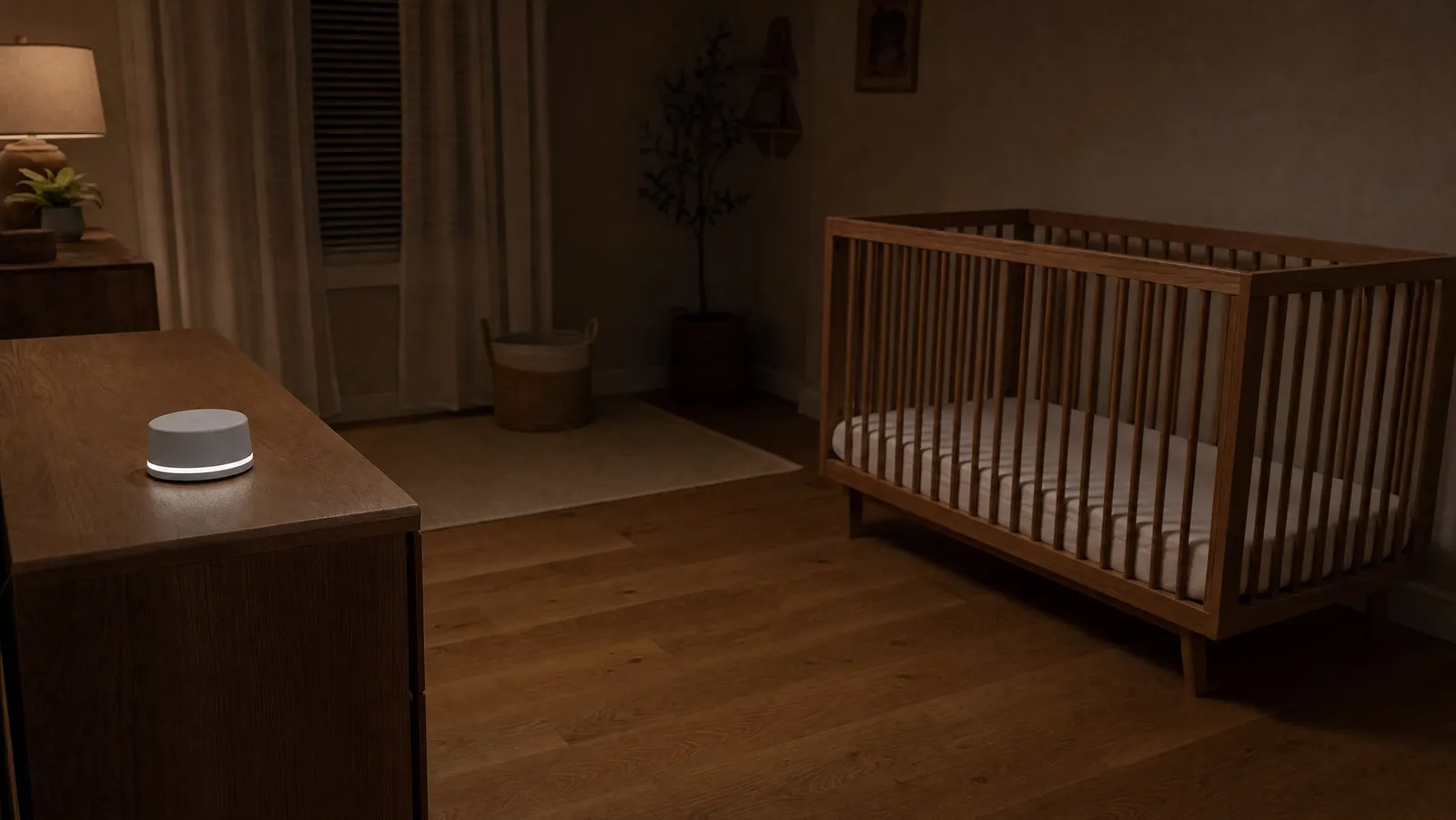
Ours happened at nineteen weeks. I got up for a noise that turned out to be nothing, looked in, and found her face-down, one cheek flat on the sheet, both arms tucked underneath her. I rolled her back. She rolled over again before I reached the door. Then I stood in the dark for forty minutes watching a baby breathe and trying to remember what the guidance actually said.
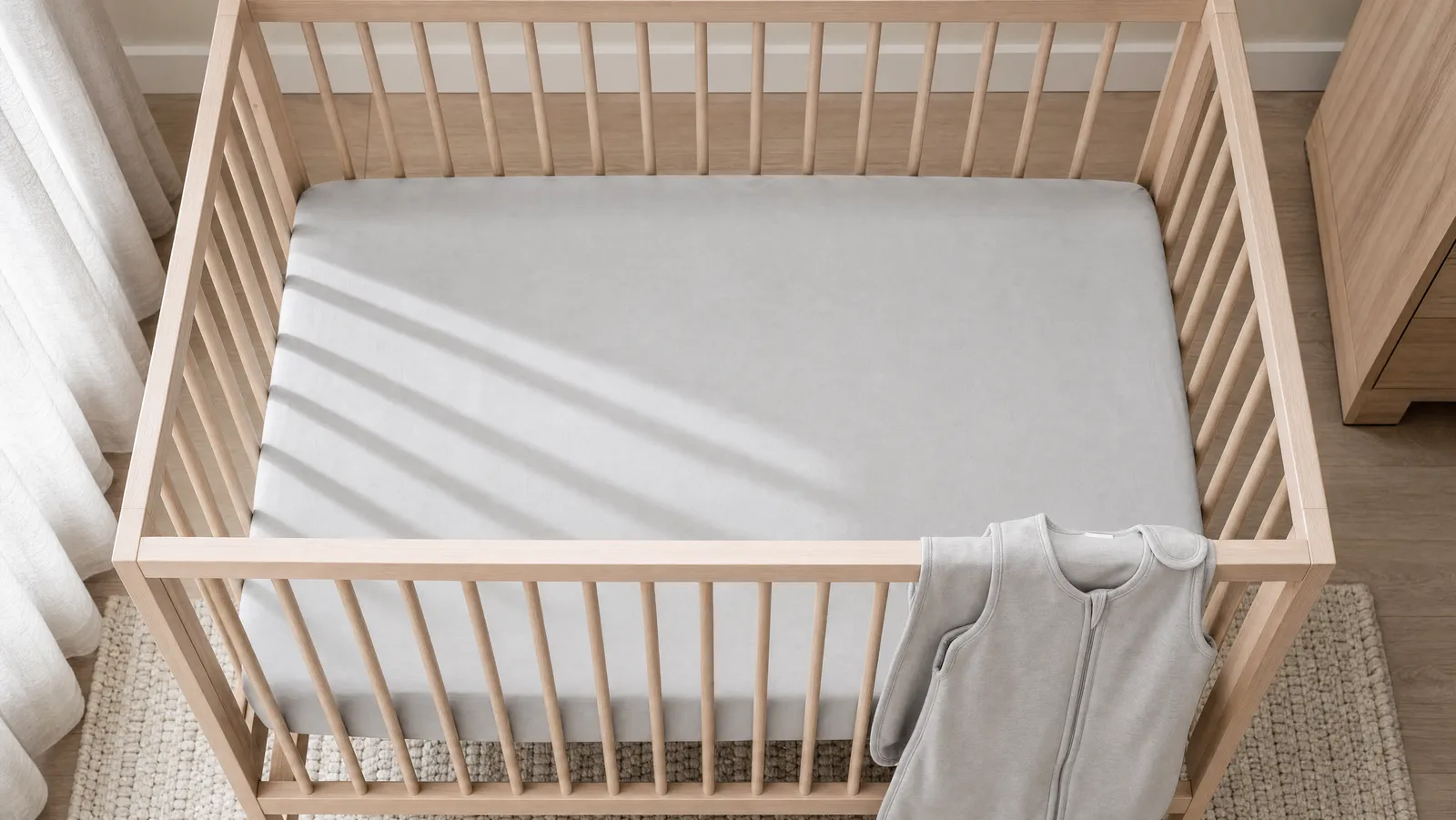
The two conditions are these. Your baby rolls both ways independently — back to stomach and stomach to back — and the crib holds a firm flat mattress, a fitted sheet and nothing else. If you already have the safe sleep basics in place, the second condition is done and you are only judging the first.
Baby Rolling Over in Sleep: What the Guidance Actually Says
Three bodies say the same thing in three registers, and the phrasing is careful in ways summaries flatten.
The AAP's 2022 policy statement is the formal version: "Infants who can roll from supine to prone and from prone to supine can be allowed to remain in the sleep position that they assume."
NICHD's Safe to Sleep answers it as the question parents actually type: "Once babies can roll from back to stomach and from stomach to back on their own, you can leave them in the position they choose after starting sleep on their back."
The AAP's parent guide to safe sleep is the kitchen-table version: "You should always place your baby to sleep on their back. But if they're comfortable rolling both ways (back to tummy, tummy to back), then you don't need to keep turning your baby to their back again."
Notice what none of them drop. The permission is about repositioning, not about placement — you still put your baby down on their back to start every sleep. And the AAP's policy attaches a condition a few lines later in the same recommendation: "Because rolling into soft bedding is an important risk factor for sleep-related death, an infant's sleep environment should be clear of everything but a fitted sheet."
So the answer is not "rolling is fine." It is "you do not have to fix the position, provided there is nothing in there to roll into."
Do I Have to Flip My Baby Back Over? The In-Between Window
Here is the part most articles blur, and the part you are probably living in. Babies rarely acquire both directions on the same night, so there is a stretch — days for some, weeks for others — where your baby can get onto their stomach and cannot reliably get off it. Guidance in that window is genuinely less crisp, and the honest thing is to show you the difference rather than split it.
- NICHD's Safe to Sleep is permissive. "If they can roll only one way on their own, you can reposition them to their back if they roll onto their stomach during sleep." That is a can, not a must.
- The NHS is directive. Its SIDS advice lists, under things to do, "move your baby onto their back if they roll (until they can roll onto their front and back again by themselves)."
- The Lullaby Trust marks the same finish line. Its safer sleep guide for parents says: "Once they start to roll from back to front and front to back by themselves, you can leave them to find their own sleep position."
The conservative choice is the NHS one: while your baby can only roll one way, turn them back when you find them face-down. I will not dress that up as protocol — I could not find a trial showing that repositioning a one-way roller changes outcomes. The argument is mechanical rather than statistical: a baby who cannot make the return trip cannot solve a problem they end up in, which is the same logic that ends swaddling.
Both ways means both ways, observed. Not "she managed it once on the playmat." Watch for it in daylight, in both directions, unprompted, on more than one day. That is the whole test, and there is no certificate.
The useful thing to do in the meantime is tummy time. The AAP's 2022 policy recommends supervised, awake tummy time for short periods beginning soon after hospital discharge, "increasing incrementally to at least 15–30 min total daily by age 7 wk." The Lullaby Trust makes the connection explicit: "Tummy time whilst awake can help strengthen their muscles for rolling." No product closes this window faster. Floor time can help.
Why You Still Place Them on Their Back for the Full First Year
Back sleeping does not expire when rolling starts, because nobody knows when it should.
The AAP's 2022 technical report states it as a gap in the evidence: "Because data to make specific recommendations as to when it is safe for infants to sleep in the prone position are lacking, the AAP recommends that all infants continue to be placed supine until 1 year of age." Safe to Sleep gives the same boundary — back sleeping is safest for all babies "until they are 1 year old."
The numbers behind that are about placement, and that distinction matters more here than anywhere else on this page.
| What the evidence measured | Reported risk |
|---|---|
| Prone (stomach) sleep position generally | Odds ratio 2.3 to 13.1 |
| Placed on the side, found on the stomach | Odds ratio 8.7 |
| Unaccustomed to prone, then placed prone (compared with infants usually placed prone) | Adjusted odds ratio 8.7 to 45.4 |
Those figures are all quoted from the AAP's 2022 technical report, and every one of them describes a baby who was put somewhere. The last row is the one worth sitting with: an infant who normally sleeps on their back, placed prone for a single sleep, carries the largest reported risk increase here — a figure the AAP measures against infants who usually sleep prone, so it is not read off the same baseline as the first row. That is the sentence for a well-meaning grandparent or a new daycare, not for a parent whose baby travelled there under their own power.
What the literature does not give you is an equivalent figure for a baby who rolls. The AAP reports none, and says why in that language about lacking data. Placing a baby prone is a measured, large risk; a baby who rolls both ways under their own power is in a situation the evidence has not quantified — which is why the instruction targets what you do, not where they end up.
One more line from the same report is worth keeping for the 3am readings: "Parents may be reassured in being advised that the incidence of SIDS begins to decline after 4 months of age."
When Do Babies Roll Over? A Range, Not a Birthday
If you want to know whether your baby is early or late, the range is wide enough to make the question nearly meaningless.
- As early as 2 months. Safe to Sleep: "Babies may start rolling over on their own as early as 2 months of age."
- Attempts usually at 3 to 4 months, the AAP's figure for signs of attempting to roll, "but may occur earlier."
- Rolling over generally at 4 to 6 months, where the AAP's technical report puts the milestone.
- Tummy to back by 6 months on the CDC's list. The CDC's 6-month checklist includes "Rolls from tummy to back." Its 4-month checklist does not list rolling at all — the physical milestone there is pushing up onto elbows or forearms during tummy time.
That last gap trips people up. The CDC's checklists were revised in 2022, and the working group that rewrote them set each milestone at the age by which most children — 75 percent or more — would be expected to demonstrate it, rather than at an average age. The CDC states the standard on the checklist: developmental milestones are "things most children (75% or more) can do by a certain age."
So a 6-month CDC entry is not a deadline; it is the age by which three quarters of babies are already done. Rolling at 15 weeks is not precocious, and rolling at 25 weeks is not necessarily behind. If you are worried, ask a pediatrician — not a checklist read at 2am.
The Swaddle Comes Off at the First Attempt, Not the First Success
If your baby is rolling and still being swaddled, this is the one thing on the page that changes tonight.
The AAP's 2022 policy: "When an infant exhibits signs of attempting to roll (which usually occurs at age 3 to 4 months but may occur earlier), swaddling is no longer appropriate because it could increase the risk of suffocation if the swaddled infant rolls to the prone position." The same statement adds: "There is a high risk for death if a swaddled infant is placed in or rolls to the prone position." Safe to Sleep gives the parent-facing version — stop swaddling once your baby starts rolling over on their own, to reduce the risk of suffocation, entrapment and strangulation.
The mechanism is why the two topics belong together: a swaddled baby who ends up face-down cannot use their arms to push clear, which is the suffocation risk the AAP names. We go through the signals and the timeline in our guide to when to stop swaddling. The short version is that the trigger is a behaviour, not a birthday, and one arm still wrapped is still a swaddle.
If you have runway before the first attempt, a two-step product makes the change gradual. The Love to Dream Swaddle Up 2-in-1 Transition Bag has zip-off wings: free one arm, then the other a few nights later. 1.0 TOG, sized 13-19 lbs, about $42.95 as of September 2026.
If you want a finer dial, mitten cuffs give you one. The SwaddleDesigns Transitional Swaddle Sack is 0.5 TOG cotton with half-length arms-up sleeves and fold-over mitts you can wear open or closed, a two-way zipper, and recognition from the International Hip Dysplasia Institute as hip-healthy. Sizes by weight: S 6-14 lbs, M 14-21 lbs, L 21-24 lbs, around $19.99 as of September 2026. SwaddleDesigns markets it specifically for babies starting to roll, on the grounds that the sleeves leave the arms free to reposition — the manufacturer's rationale rather than a finding from the safety literature, but it describes the right idea plainly.
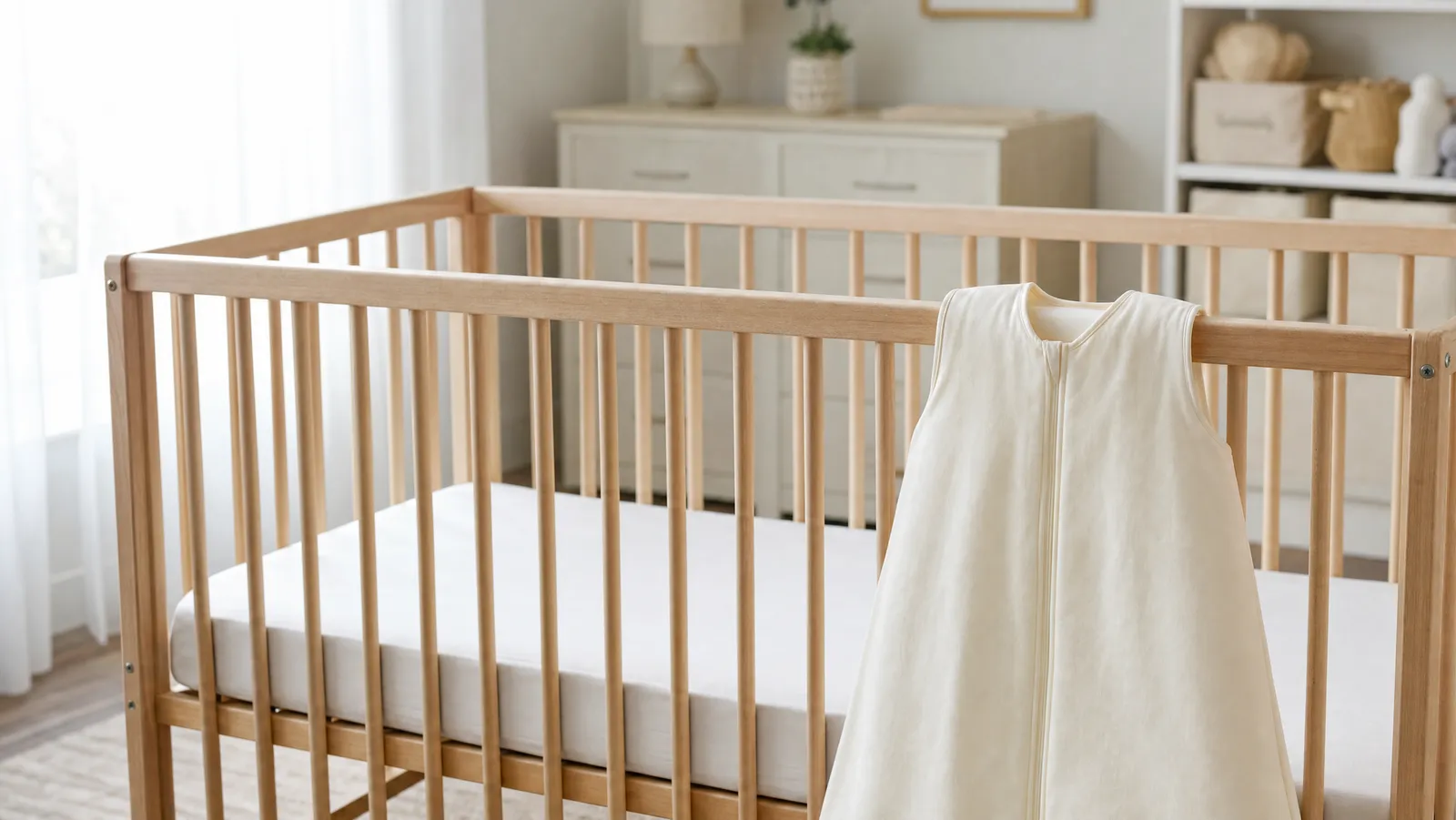
And the destination is boring on purpose. Once rolling has started, what you want is a sleeveless sleep sack — nothing over the arms, nothing loose in the crib. The AAP's position is that dressing an infant in layers of clothing is preferable to blankets and other coverings, and that wearable blankets can be used. The Yoofoss sleep sack three-pack is a plain example: GOTS-certified organic cotton at 0.5 TOG, a two-way zipper for night changes, sizes S at 0-6 months through XL at 18-24 months, about $27.99 for three as of September 2026.
A Rolling Baby Makes the Bare Crib Non-Negotiable
This is the finding that changed how I thought about the whole stage, and it is one sentence in the AAP's technical report: one study of sleep-related deaths reported to state child death review teams found that the predominant risk factor for sleep-related deaths in infants 4 to 12 months of age was rolling into objects in the sleep area. The report's conclusion follows directly — parents and caregivers should keep the sleep environment "clear of everything but a fitted sheet."
Read the ages on that. Four to twelve months is the rolling year, and the hazard shifts as your baby gains mobility: a newborn cannot travel to the thing at the end of the crib, and a five-month-old can.
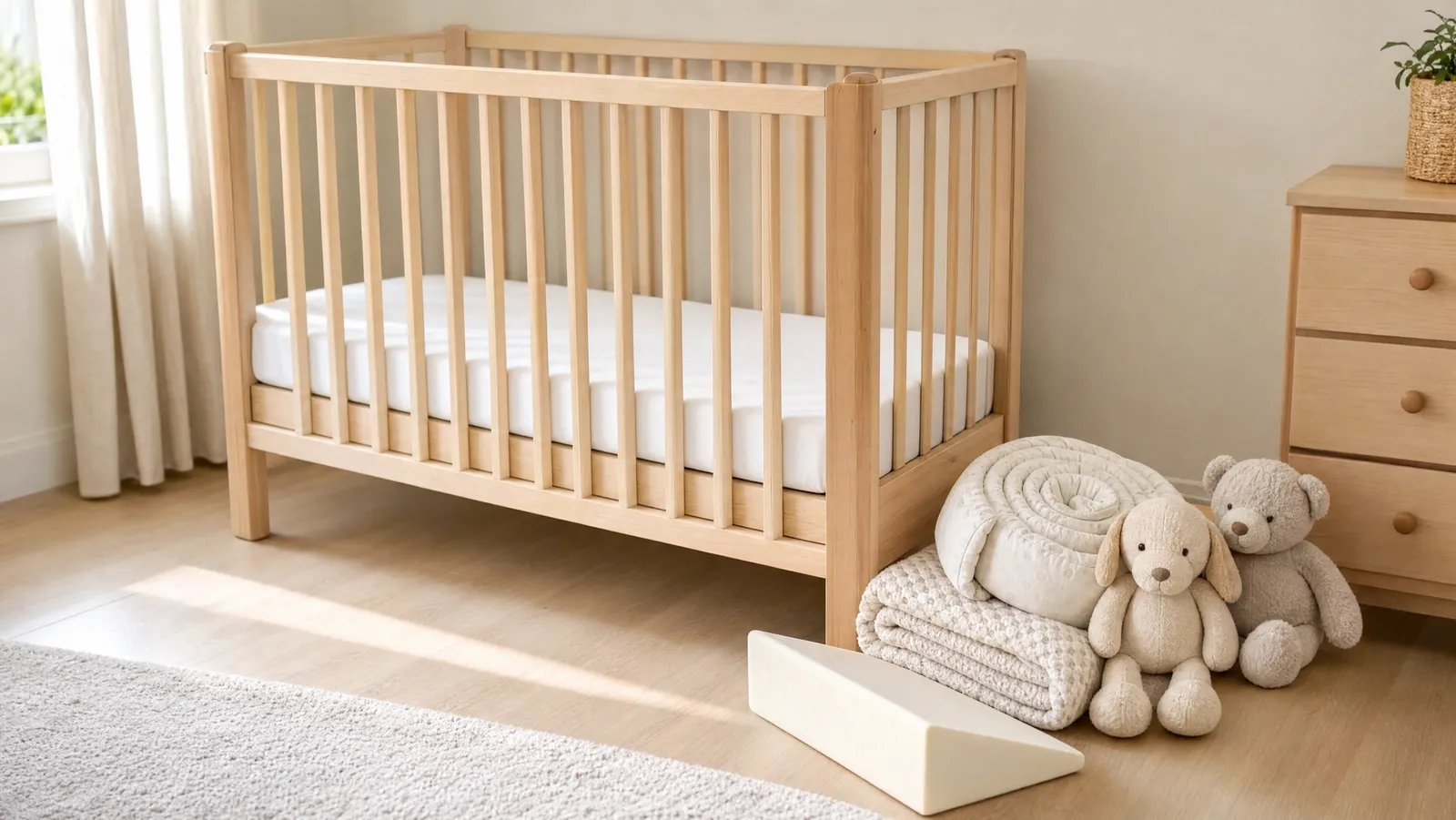
So the crib rule does not relax when rolling starts. It tightens, because a baby who can roll can press their face into whatever they reach. No bumpers, no pillows, no loose blankets, no positioners, no soft toys — our full list of what does not belong in the crib covers the items people forget, including the swaddle blanket you just retired, which is now simply a loose blanket. The NHS puts it in one line: keep the cot clear of anything that could cover the face and head.
Nothing You Can Buy Stops a Baby Rolling Safely
The moment rolling starts, the ads find you: wedges, bolsters, nests, pods, anti-roll mats, weighted sacks, all marketed at exactly this fear. Every safety body that has looked at them says the same thing.
Positioners and wedges. The FDA's guidance to parents is blunt: do not use infant positioners, because they "could harm your baby." It names the exact failure mode this article is about: "Infants may suffocate after rolling from a side to stomach position or after being placed on their sides in the positioning product." A joint CPSC and FDA warning in 2010 reported 12 infant deaths associated with sleep positioners, in babies between 1 and 4 months, and told parents to stop using them. The AAP's technical report adds that the CPSC has received reports of deaths from suffocation and entrapment associated with wedges and positioning devices, including incidents in which infants slipped out of the restraints or rolled into a prone position while using the device.
Anything sold as SIDS prevention. The FDA states it is not aware of any clinical or scientific evidence that currently available baby products prevent or reduce the chance of SIDS. The AAP's 2022 policy says to be particularly wary of such devices and warns that they may provide a false sense of security.
Weighted products, the category aimed hardest at this exact stage. The AAP's 2022 policy recommends that weighted blankets, weighted sleepers, weighted swaddles or other weighted objects not be placed on or near a sleeping infant. We work through the marketing and the evidence in our piece on whether weighted sleep sacks are safe. A baby who needs to be able to move is the last baby you want to weigh down.
What Actually Changes Tonight
- Place your baby on their back, every sleep, until their first birthday. Rolling changes nothing about placement.
- If they roll both ways on their own, leave them — conditional on the rest of this list.
- If they only roll one way, roll them back. The NHS says do it; Safe to Sleep says you may. Conservative is fine here.
- The swaddle is finished — both arms, from the first attempt at rolling, not the first success.
- The crib goes to a fitted sheet and nothing else, because rolling into objects is the predominant risk factor for sleep-related death from 4 to 12 months.
- Buy nothing that promises to hold a baby in place.
- Keep checking on them. Not repositioning is not the same as not paying attention.
The night it first happens is frightening, and knowing that the correct response is mostly to do nothing does not help much at 1:40am. What helped me was realising the work had already been done in daylight: firm mattress, bare crib, no swaddle. Nothing left to fix, which is why there was nothing left to do.
If part of that setup is still on your list, our full guide to safe sleep covers the room your rolling baby is now moving around in. Get that right, and there is far less left to do when the rolling starts.

Love to Dream Swaddle Up 2-in-1 Transition Bag, 1.0 TOG, 13-19 lbs
A 1.0 TOG transition bag with zip-off wings, sized for babies 13-19 lbs. The design lets you free one arm while the other stays swaddled, then remove the second wing a few nights later, so the change happens in two steps instead of one. Love to Dream describes the stretchy fabric as fitting snugly enough to stay on through the night without blankets or loose layers, and sells the range in different weights to reduce overheating risk.
- Brand
- Love to Dream
- Category
- Wing-Down Transition
The two-step wing removal exists because going from fully swaddled to fully free overnight is how you lose a week of sleep.

SwaddleDesigns Transitional Swaddle Sack, 100% Cotton, 0.5 TOG, 3-6 Months
A 0.5 TOG cotton sack with half-length arms-up sleeves and fold-over mitten cuffs that can be worn open or closed. SwaddleDesigns markets it specifically for babies starting to roll: the sleeves allow arm mobility so a baby who rolls can use their arms to reposition, while closed mitts still partly damp the startle reflex. It is recognized by the International Hip Dysplasia Institute as hip-healthy, and has a two-way double-pull zipper. Sizes by weight: S 6-14 lbs, M 14-21 lbs, L 21-24 lbs.
- Brand
- SwaddleDesigns
- Category
- Arms-Up Option
Mitten cuffs you can open one at a time turn a hard cutoff into a dial, which is the whole point of a transition product.

Yoofoss Baby Sleep Sack 3-Pack, 0.5 TOG, GOTS-Certified Organic Cotton, 2-Way Zipper
A three-pack of sleeveless wearable blankets in GOTS-certified organic cotton at 0.5 TOG, with a two-way zipper for night changes. This is where the transition ends up: no wings, no sleeves, nothing restricting the arms, and no loose blanket in the crib. Arm and neck openings are cut so the sack cannot be kicked off or pulled over the face, and the legs stay roomy for hip movement. Sizes S (0-6 months) through XL (18-24 months).
- Brand
- Yoofoss
- Category
- Arms-Free Destination
Once a baby is rolling, a plain sleeveless sack is the boring correct answer, and boring is what you want at 2am.
- 01Love to DreamWing-Down TransitionLove to Dream Swaddle Up 2-in-1 Transition Bag, 1.0 TOG, 13-19 lbs
- 02SwaddleDesignsArms-Up OptionSwaddleDesigns Transitional Swaddle Sack, 100% Cotton, 0.5 TOG, 3-6 Months
- 03YoofossArms-Free DestinationYoofoss Baby Sleep Sack 3-Pack, 0.5 TOG, GOTS-Certified Organic Cotton, 2-Way Zipper
Do I have to flip my baby back over if they roll onto their stomach at night?+
When is it safe for a baby to sleep on their stomach?+
My baby rolls onto their side and stops there. Is side sleeping safe?+
Should I stop swaddling if my baby is rolling?+
Is there anything I can buy to stop my baby rolling over in the crib?+
Can I stop checking on my baby once they can roll both ways?+
Sammie Seelbach
Sammie is a mom of two and the lead reviewer at Smart Baby Reviews. Since becoming a parent she has become obsessed with researching the safest, smartest baby gear on the market — testing thermometers at 2 a.m., wrangling baby gates, and sterilizing more bottles than she can count. She shares what actually works so other parents can make confident, informed decisions for their little ones.