Gagging vs Choking: How to Tell the Difference at the Table

This post may contain affiliate links. Read our policy.
Here is the whole distinction in one sentence: gagging is loud, and choking is usually quiet. A gagging baby coughs, gurgles, sputters, goes red in the face and pushes food forward with their tongue. A choking baby often makes no sound at all, because no air is moving past the blockage. If you remember one thing about gagging vs choking in a baby, make it that the noise is the reassuring part. Some of the links below are affiliate links, and we may earn a small commission, at no extra cost to you, if you buy through them.
The first time my daughter gagged on a strip of steamed sweet potato I stood up fast enough to knock my chair over. She went scarlet, made a noise like a small drain, pushed the piece back out onto her chin, then looked at me with mild irritation. I had watched a reflex do its job.
Most of us file those two events under one heading, and the confusion is expensive: families retreat to thin purees for months, or put off starting your baby on solids well past readiness, because one loud lunch frightened everybody. So here is what each looks like, which foods cause real harm, and the habits that lower risk — none of which is a product.
What Gagging Looks and Sounds Like in a Baby
Gagging is the body's own choking prevention. When something travels too far back too fast, the throat contracts and the tongue thrusts forward, moving food toward the front of the mouth instead of down toward the airway. It is built to fire early, and in a beginner it fires often, because of where the trigger sits. Children's Wisconsin quotes pediatrician Patrick Lehman, MD: "When you start feeding solids around 6 months, your child's gag reflex is farther forward in the mouth — it'll move back in the throat as they age."
What it looks like at your table:
- It is loud. Children's Wisconsin describes gagging as involving "a lot of coughing and gurgling."
- The colour usually goes red, not blue or grey, and the eyes stay open and often water.
- The food comes forward, onto the tongue or tray, and it ends by itself, usually within seconds.
It also gets less dramatic with practice. In the BLISS randomized trial published in Pediatrics, infants in the baby-led group gagged more frequently at 6 months but less frequently at 8 months than the control group. So the job during a gag is unglamorous: stay close, stay quiet, let it finish.
What Choking Looks Like, and Why It Is Usually Silent
Choking is the absence of all of that. Children's Wisconsin puts it plainly: "Choking occurs when a piece of food has wholly or partially blocked the windpipe, obstructing breathing. This can cause high-pitched sounds while breathing or may even be silent."
The American Red Cross describes the severe version the same way — a baby whose airway is completely blocked cannot cry, cough or make any noise. A cough needs moving air. If nothing is moving, nothing sounds.
Which makes the most useful sentence here the unintuitive one: the quiet baby is the emergency. Watch for silence, a weak or absent cough, wide panicked eyes, colour going dusky around the lips, and a chest that pulls in with no sound coming out.
HealthyChildren.org, the American Academy of Pediatrics' parent site, states that "choking is a leading cause of death for infants and children," and that "most children who die from choking are under age 5 — and two-thirds are babies under a year old." The same page notes that "being without oxygen for more than 4 minutes can cause brain damage or even death."
Non-fatal events are far more common. A study by Nationwide Children's Hospital and the CDC, published in Pediatrics, found that from 2001 through 2009 more than 12,000 children a year — about 34 a day — were treated in US emergency departments for choking on food, more than 60 percent of them aged 4 and younger.
Gagging vs Choking: The Side-by-Side
| Gagging | Choking | |
|---|---|---|
| Sound | Loud — coughing, gurgling, retching | Often none, or a weak cough |
| Breathing | Continues, noisily | Obstructed or stopped |
| Colour | Red in the face | Pale, dusky, or blue around the lips |
| Eyes | Open, watering, often annoyed | Wide, panicked |
| The food | Moves forward, onto tongue or tray | Stays where it is |
| How long | Seconds; it resolves itself | Does not resolve without help |
| What it is | A protective reflex working | A blocked airway |
| What you do | Stay close, let it finish | Act immediately; have someone call 911 |
Partial obstruction is the awkward middle: the Red Cross distinguishes a baby with a weak cough or none, who cannot clear the blockage alone, from one still coughing forcefully. Silence in a baby who was eating ten seconds ago is never something to wait out.
Baby Choking Hazards: The Foods and Shapes That Cause Real Trouble
Shape does more damage than hardness. The foods on every hazard list are roughly the diameter of a small airway and smooth enough to seal it. HealthyChildren.org advises keeping high-risk foods "from children until 4 years of age or older, depending on each child's development and maturity level," and names hot dogs, hard or sticky candy, nuts and seeds, whole grapes, raw vegetables, chunks of raw fruit, popcorn, thick peanut butter, marshmallows, and chunks of meat or cheese. The CDC's choking hazards list overlaps almost exactly, adding uncut cherry tomatoes, whole corn kernels, raisins, chips and pretzels.
Some are shape problems you can solve; some are not solvable before the molars arrive.
| High-risk food | Why it is risky | What to do instead |
|---|---|---|
| Whole grapes, cherry tomatoes, large berries | Round, smooth, airway-sized | Quarter lengthwise, so no round face is left |
| Hot dogs, sausages, meat sticks, string cheese | Cylindrical and compressible — a near-perfect plug | The AAP says round, firm foods "can be served if completely chopped into tiny pieces" |
| Thick chunks of nut or seed butter | Sticky; coats rather than clears | The AAP's instruction is to "spread thinly instead," or thin it with water or yoghurt |
| Raw hard vegetables and fruit — carrot, apple | Too hard for gums | Cook until it squashes between thumb and forefinger, or grate it raw |
| Whole or chopped nuts and seeds | Hard and unchewable without molars | Ground fine, or thinly spread as a butter |
| Popcorn, chips, hard and gummy candy, marshmallows | Unchewable at any size | Skip until at least 4 |
The four-year line tracks development, not a birthday: the AAP's policy statement on prevention of choking among children puts young children's risk down to the developmental vulnerabilities of a small airway and an underdeveloped ability to chew and swallow, which is why HealthyChildren ties the cutoff to "each child's development and maturity level" rather than to the date alone. Which foods are worth introducing early and which are worth skipping is the subject of our guide to baby's first foods.
The Half-Inch Rule, and the Shapes That Beat It
HealthyChildren.org gives the number: "cut food for infants and young children into pieces no larger than one-half inch, and teach them to chew their food well." It is a ceiling in any direction, not a target, and the scope is infants and young children — it does not expire on the first birthday.
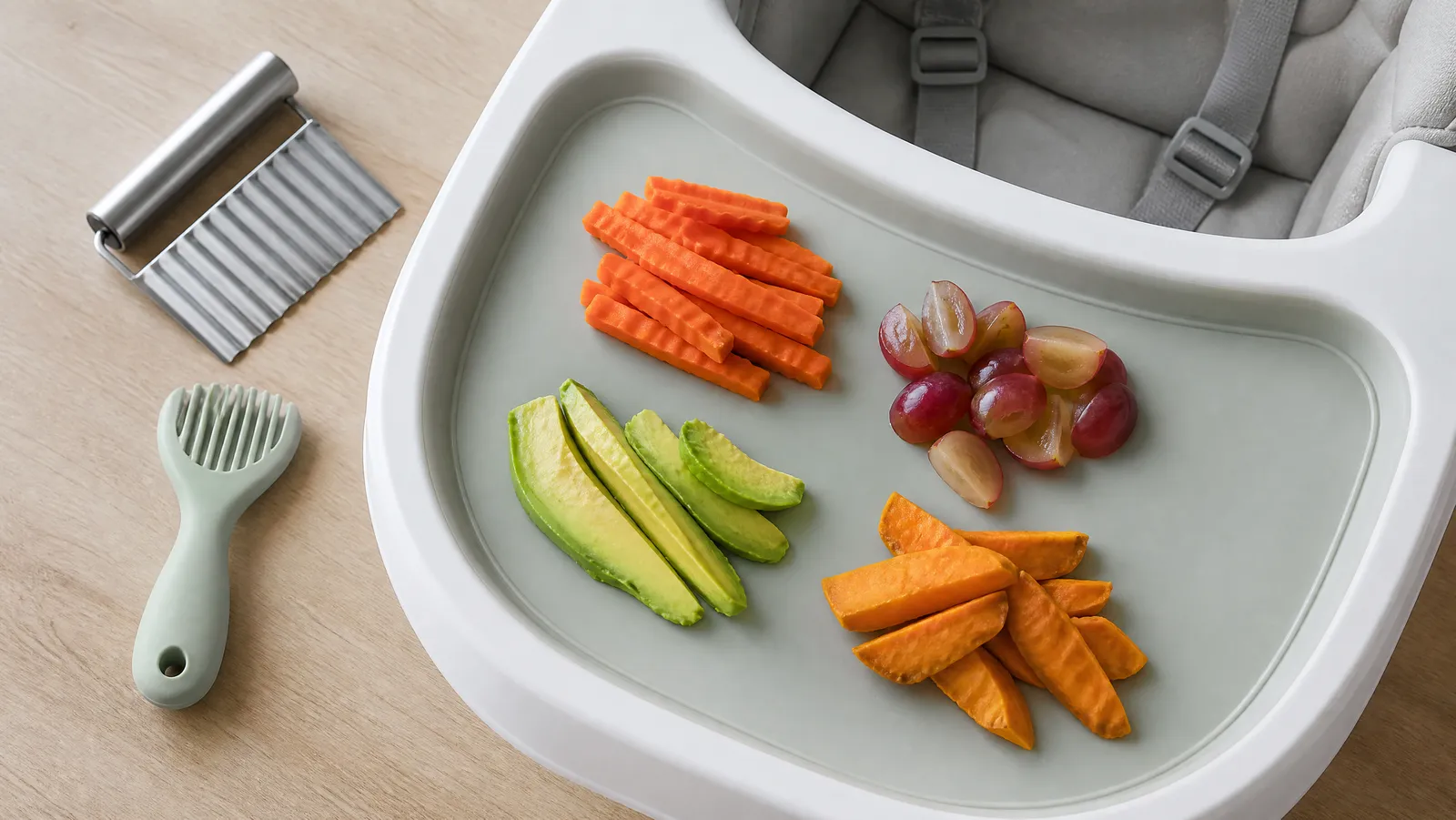
Half an inch is also awkward for a six-month-old, who grips with a whole fist. The AAP's baby-led weaning guidance fills the gap: "cut foods into finger-shaped pieces (similar to a small baby carrot)," and "don't offer round, coin-shaped slices of veggies, fruits or meat, since those can increase choking risks." So: finger-length strips at around six months, then pieces no bigger than half an inch once the pincer grasp arrives, nearer nine months.
Texture is the easiest thing to test: the AAP's standard is food "your baby can mash with their gums or chew with just a few teeth." If it will not squash between your thumb and finger, it is not ready for a baby without molars.
Does Baby-Led Weaning Raise Choking Risk?
The strongest evidence is the BLISS randomized controlled trial of 206 infants, published in Pediatrics in 2016. It found that 35% of infants choked at least once between 6 and 8 months of age, "and there were no significant group differences in the number of choking events at any time." The authors concluded that "infants following a baby-led approach to feeding that includes advice on minimizing choking risk do not appear more likely to choke than infants following more traditional feeding practices."
Three things that finding does not say. It does not say choking is rare — 35% is a third of the cohort, across both arms, so spoon-fed babies choked too. It does not exonerate baby-led weaning in general: what was tested was the method bundled with explicit coaching on choking risk, not handing a baby a breadstick and hoping. And the authors flagged that "the large number of children in both groups offered foods that pose a choking risk is concerning."
The AAP is correspondingly measured. Its baby-led weaning page says "some studies suggest baby-led weaning does not pose higher choking risks than traditional feeding" — suggest, not show — then spends most of its length on food shapes, seating and harnesses. The method is probably not the risk factor; the preparation is. We compare the two in baby-led weaning and purees.
What Actually Reduces Risk at Your Table
Four habits, none of which costs anything.
Upright and supported. The CDC says to "have your child sit up while eating (no lying down, crawling, or walking)" and to "avoid letting your child eat in the car or stroller." The AAP says to "sit your child in a highchair for stability and comfort" and "buckle the harness while they're eating." A reclined seat puts gravity on the wrong side, and a slumping baby spends their effort staying vertical instead of managing food. If the seat makes your baby slump, that is a chair problem — our roundup of the best high chairs for starting solids covers what to look for, and the readiness signs are worth checking first.
Eyes on, the whole meal. The CDC says to "watch your child at all times while they are eating," and HealthyChildren says to "supervise mealtimes for infants and young children." The emergency signal is an absence of noise, and you cannot hear silence from the next room.
One eater at a time, at the table. HealthyChildren is direct: "insist that children eat at the table or sit down when they eat. Never let them run, walk, play or lie down with food in their mouths." In a house with more than one child, the usual delivery route for a hazard food is an older sibling being generous.
Shape and texture, every time. The CDC's short version: "avoid small, sticky, or hard foods that are difficult to chew and swallow," and "cutting food into smaller pieces and mashing foods can help prevent choking." This is the habit that has to survive a bad day.
One more nobody warns you about: a baby who eats is a baby who drops, so the floor becomes part of mealtime about three days in. That puts baby-proofing your kitchen on the same week's list as the high chair.
The Gear That Helps With Shape, and the Gear That Cannot
No product prevents choking. There is no cutter, bowl, bib or gadget that widens an airway or teaches a baby to chew, and I want to be blunt about that before recommending anything, because the gear aisle is happy to imply otherwise. What gear does is make the right shape easy to produce at 5pm on a Tuesday.
The Mogi Baby BLW cutting guide kit is a flexible board printed with visual food-cut guides, plus two fridge magnets and a reference brochure, about $24.99 as of September 2026. The magnets earn its place: the board lives in a drawer, the magnets on the fridge where the decision gets made.
The ezpz baby-led weaning food cutters are two nylon cutters producing exactly the two shapes above — finger-length strips for the palmar grasp, small cubes for the pincer grasp. According to ezpz, they were designed and tested by a pediatric feeding specialist; they are dishwasher safe, about $11.99 as of September 2026.
The DF DUALFERV crinkle cutters are the ten-dollar answer: two 430-stainless wavy cutters, blade about 2.9 inches wide, around $9.99 as of September 2026. The ridged cut leaves a grippier surface on slippery foods — cooked carrot, sweet potato, banana — which helps a baby whose hands do not close reliably. All three are about shape. None is a safety device.
Infant Choking First Aid: Learn It Before You Need It
I am not going to write out back blows here, and you should be wary of any blog that does. You cannot learn to support an infant's head along your forearm from a numbered list read in a panic. HealthyChildren's advice on this is one line long: "take a certified CPR and first aid course."
What a class gives you that an article cannot: the infant sequence, which is not the adult one — babies get chest thrusts, not abdominal thrusts; how to hold a head with no neck strength; and when the sequence becomes CPR. All of it on a doll, with an instructor correcting your hands.
The American Red Cross runs first aid and CPR training for parents covering adults, children and babies, in person and online. Children's Wisconsin encourages caregivers to take CPR and first aid classes regardless of their child's age, and to refresh every few years. Book it for the month before you start solids, and bring everyone who feeds the baby.
Anti-Choking Devices: Where the Evidence Actually Sits
These get marketed hard to new parents, so here is the precise state of play. In March 2026 the FDA granted LifeVac a De Novo classification as a Class II device, creating the new category of "suction anti-choking device as a second-line treatment" under 21 CFR 874.5400. Two details matter. Second-line means the authorised use is after a basic life support choking protocol has failed, not instead of one. And the authorised population is choking victims aged one year and above, so a six-month-old starting solids falls outside its authorised use entirely.
Reporting on that authorisation by Medical Daily notes that the 2025 American Heart Association guidance for a choking infant is five back blows alternating with five chest thrusts, with no device in the sequence, and that the FDA has cautioned that reaching for a device first can delay those steps, partly because "taking a device out of its packaging and assembling it takes time." The same reporting notes that the supporting evidence is largely laboratory testing, cadaver studies and reported rescues, with no randomized human trial settling whether the devices improve survival.
Notice what is absent, too: neither the AAP's choking-prevention page nor the CDC's choking hazards page mentions these devices at all. Both point to prepared food, supervision and a certified first aid course. As of September 2026, no major pediatric body has endorsed them as a substitute for trained first aid, and between a device and a class, the class is not a close call.
What to Take to the Table Tonight
Noise is reassurance. Silence is an emergency. That single reversal is what most of us get backwards on day one, and getting it right is what lets you sit through a loud, red-faced, entirely normal gag without hauling your baby out of the chair.
The rest is a short list. Half an inch is the ceiling, in any direction. Finger-length strips first, smaller pieces once the pincer grasp shows up. Quarter the round things lengthwise, spread the sticky things thin, cook the hard things soft, and let the AAP's four-year list wait. Upright, harnessed, supervised, one eater at a time. And take anything specific to your own baby — reflux, low tone, a feeding difficulty — to your pediatrician rather than to a blog.
None of that requires you to be calm. I was not, for about two months. I was just informed enough to keep sitting down, which is all the job asks. For the rest — first foods, portions, the first few weeks — the full starting-solids guide picks up where this stops.
Your baby is going to gag. Loudly, memorably, and probably in front of someone with opinions. That is the system working. You've got this.

Mogi Baby BLW Cutting Guide Kit for Babies & Toddlers
A flexible cutting board printed with visual food-cut guides, plus two fridge magnets and a printed reference brochure. The point is not the board — it is having the shapes at eye level while you are prepping, so you are not deciding how to cut a grape from memory at 5pm. Rounded edges, food-safe materials, and light enough to use as a transfer paddle from board to tray.
- Brand
- Mogi Baby
- Category
- Our Pick
The magnets are the part that earns its place. The board lives in a drawer; the magnets are on the fridge where the decision actually gets made.

ezpz Baby-Led Weaning Food Cutters, 2-Pack (Sage)
Two nylon cutters that produce the two shapes a beginner actually needs: finger-length strips for the 6-month palmar grasp, and small cubes for the 9-month pincer grasp. Designed and tested by a pediatric feeding specialist, and dishwasher safe. They do one narrow job, which is why they work — the cut is consistent even when you are rushing.
- Brand
- ezpz
- Category
- Best for Shapes
Consistency is the whole value. Eyeballing strips means some come out chunky, and chunky is the one you notice later.

DF DUALFERV Stainless Steel Crinkle Cutter, 2-Pack
Two 430-stainless wavy cutters with ABS handles, blade about 2.9 inches wide. The ridged cut leaves a grippier surface on slippery foods — cooked carrot, sweet potato, cucumber, banana — which is a real help for a baby whose hands do not close reliably yet. Ten dollars for a pair, and they wash and hang like any other kitchen tool.
- Brand
- DF DUALFERV
- Category
- Budget Pick
Ridges on a slice of steamed carrot are the difference between a baby holding it and a baby watching it shoot across the tray.
- 01Mogi BabyOur PickMogi Baby BLW Cutting Guide Kit for Babies & Toddlers
- 02ezpzBest for Shapesezpz Baby-Led Weaning Food Cutters, 2-Pack (Sage)
- 03DF DUALFERVBudget PickDF DUALFERV Stainless Steel Crinkle Cutter, 2-Pack
Is it normal for my baby to gag on food?+
How do I know if my baby is choking and not just gagging?+
How small should I cut my baby's food?+
Which foods are the biggest choking hazards for babies?+
Does baby-led weaning make choking more likely?+
Should I buy an anti-choking device for my baby?+
Sammie Seelbach
Sammie is a mom of two and the lead reviewer at Smart Baby Reviews. Since becoming a parent she has become obsessed with researching the safest, smartest baby gear on the market — testing thermometers at 2 a.m., wrangling baby gates, and sterilizing more bottles than she can count. She shares what actually works so other parents can make confident, informed decisions for their little ones.