Crib Mattress Firmness and Fit: What Actually Matters
This post may contain affiliate links. Read our policy.
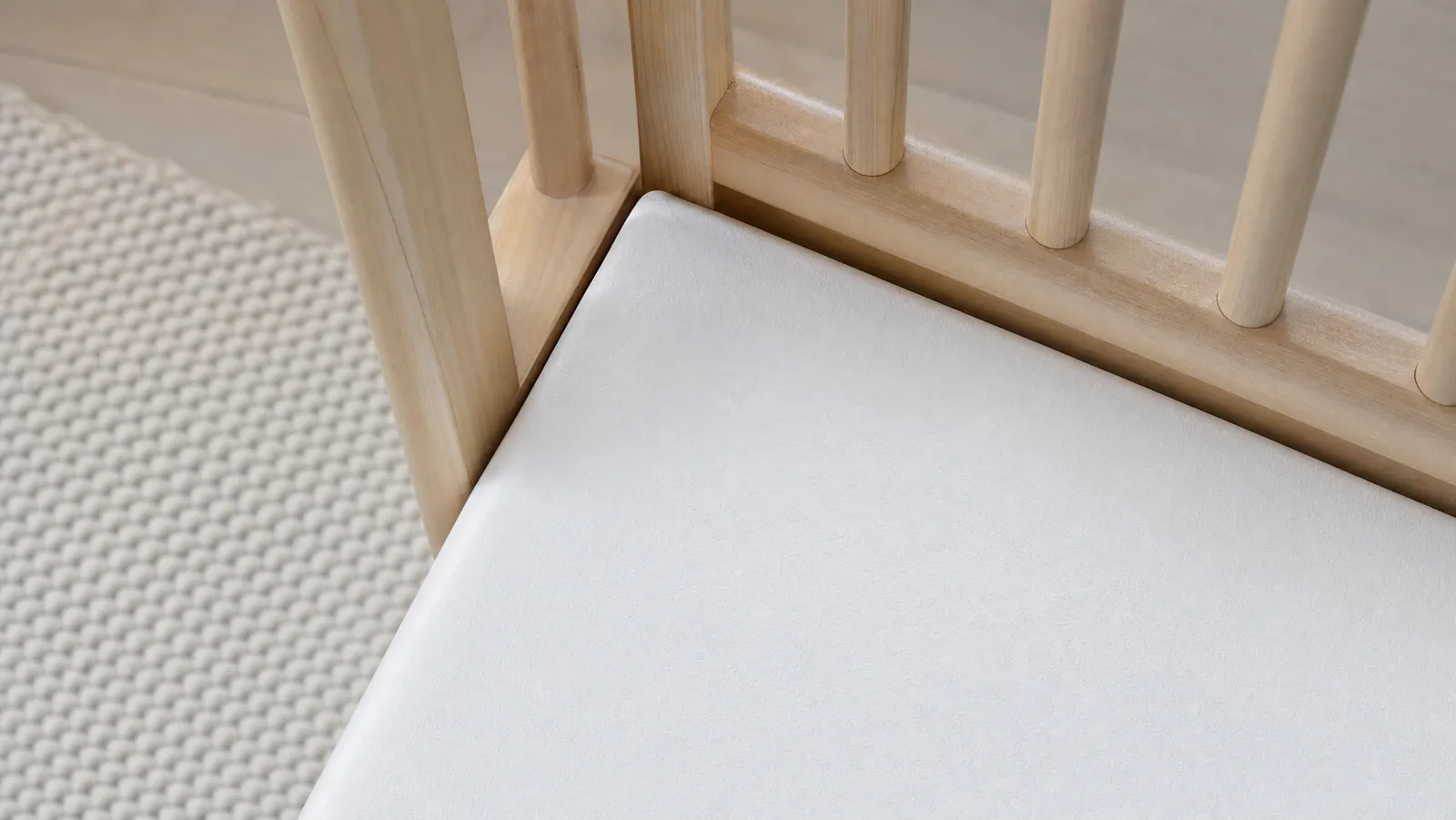
A crib mattress is firm enough when it does not indent under your baby, and it fits when you cannot slide more than a couple of fingers into the gap at the side. Those two properties are the core of the safety specification. Everything else printed on the box — coil counts, organic covers, dual zones — is comfort or chemistry. Some of the links below are affiliate links, and we may earn a small commission, at no extra cost to you, if you buy through them.
I bought our first crib mattress in a shop, and the only test I ran was to press my palm into the display model and think, yes, that is firm. It was. It also had rounded corners, which at home left a wedge of a gap at each corner of the crib. Firmness passed. Fit failed.
That is the problem in one sentence: firm is a word the mattress industry is allowed to use loosely, so the two things that actually protect a baby are physical tests you run yourself — the press test and the gap test. This page is the long version of the mattress paragraph in our guide to a safe sleep space, and it is about full-size cribs. If you are still weighing bassinet vs crib, bassinets and play yards ship with their own mattress sized to that product.
What Crib Mattress Firmness Actually Means
Crib mattress firmness is not a comfort preference but a suffocation control, and every definition the safety bodies use is mechanical rather than descriptive. The AAP's parent guide to safe sleep heads its section "Use a firm, flat sleep surface for sleep" and defines the term in one line: "A firm surface means that it shouldn't indent when your baby is lying on it." It adds that "any surface that inclines more than 10 degrees isn't safe for your baby to sleep on." NICHD's Safe to Sleep gives the version you can test by hand: firm means "returns to its original shape quickly if pressed on," flat means "like a table, not a hammock," level means "not at an angle or incline."
Why this became a federal test is worth stating once. Approving the mandatory crib mattress standard in 2022, CPSC said it was aware of at least 494 incidents, including 139 fatalities, related to crib mattresses between January 2010 and April 2021. The hazard patterns it named were design-related issues and compression of the mattress, causing asphyxiation or suffocation.
So there is a floor now, and it is recent: Consumer Reports suggests checking your mattress was made and sold in the US after August 15, 2022, when the standard took effect. What the floor does not give you is a scale. "Extra firm" is marketing, not a graded rating, which is why you still run the test.
The Press Test: How Firm Should a Crib Mattress Be?
Press the heel of your hand hard into the middle of the mattress, then lift it off and watch. A safe surface resists while you press and comes straight back to level. If you can still see the shape of your hand for even a beat, or if the surface cradles your palm, it is too soft.
Now do the edge and a corner, because that is where mattresses cheat, and the perimeter is where a baby who has rolled ends up.
Then do it again with the fitted sheet on. Everyone skips this, and it is in the federal standard for a reason: the crib mattress rule runs its dimensional test with a 100% cotton fitted sheet washed twice in hot water, because a tight sheet compresses a mattress and changes how it sits.
The clearest numeric threshold comes from the UK. The Lullaby Trust's mattress guidance says a baby's head "should sink no more than a few millimetres into a mattress," with no raised or cushioned edges and no sagging. The AAP's crib guidance says it without the number: "The mattress should be very firm and should not sag under your baby's weight." One material fails by design: memory foam, as Consumer Reports notes, is engineered to slowly conform to whatever is placed on it.
The Gap Test and the Crib Mattress Two-Finger Rule
How to run it. Push the mattress hard into one corner of the empty crib so the slack collects on the opposite side, then try to get your fingers into the gap along the far side and far end. Repeat toward the other corner, sheet on.
The two-finger rule is consumer guidance, not a laboratory test method. CPSC does publish it: its crib safety tips say never to allow a gap larger than two fingers at any point between the sides of the crib and the mattress, and to check again every time you change the sheets. What it approximates is a dimensional requirement, and that requirement is the tighter number: Consumer Reports summarises the CPSC guidance as no more than a 1/2-inch gap between mattress and crib perimeter. Two adult fingers side by side are more like an inch to an inch and a half, so the rule is generous — it catches a badly wrong mattress and happily passes a marginal one. If two fingers slide in, stop there. If not, you have ruled out the gross failure, not confirmed a good fit.
Corners deserve their own look. The federal crib mattress standard at 16 CFR 1241 sets a separate corner gap limit, measured with that washed cotton sheet installed and the mattress pushed to the crib perimeter, and it is far larger than the side gap: the corner gap "shall not exceed 3.15 in." Corners are where rounded mattress edges meet square crib frames, and they were my first mattress's failure — which is why a spec sheet like the DaVinci Deluxe Coil, 52 by 27.75 by 5 inches with square corners at about $149 as of August 2026, repays reading rather than skimming.
Crib Mattress Fit: The Numbers That Settle It
The AAP's requirement is a sentence: "The mattress should fit snugly, with no space between the mattress and the crib walls," and "Make sure your crib mattress is designed for your specific crib and that it fits tightly." The numbers behind it sit in two federal standards, which is why they are rarely quoted correctly.
| What it governs | The requirement | Source |
|---|---|---|
| Crib interior | 28 in. plus or minus 5/8 in. wide by 52 3/8 in. plus or minus 5/8 in. long | 16 CFR 1219.1 |
| Mattress used in a full-size crib | At least 27 1/4 in. by 51 1/4 in.; thickness not exceeding 6 in. | CPSC crib guidance |
| Full-size crib mattress, as sold | At least 27 1/4 in. wide by 51 5/8 in. long | 16 CFR 1241.2 |
| Corner gap, sheet on, mattress pushed to perimeter | Not more than 3.15 in. | 16 CFR 1241.2 |
The window is narrow: a nominal 28-inch interior minus a 27 1/4-inch minimum mattress leaves three quarters of an inch of slack across the whole width, roughly 3/8 inch per side if centred. That is the real target, and far tighter than two fingers. CPSC considers those numbers important enough that a warning naming them has to appear on the crib itself — go and read yours.
So "fits most cribs" is not a specification. Measure your crib's interior, then buy a mattress whose published dimensions land inside that window — the ASANEST dual-sided foam mattress at 52 by 28 by 5 inches, about $69.99 as of August 2026, gives numbers rather than a compatibility claim.
Nothing Goes On Top: Toppers, Pads and Padding
The AAP's prohibited list names toppers explicitly. Soft objects and loose bedding increase the risk of entrapment, suffocation or strangulation, and the list runs: "pillows and pillow-like toys, quilts, comforters, mattress toppers, non-fitted sheets, blankets, toys, bumper pads or related products that attach to crib slats or sides." The Lullaby Trust adds sheepskins, pods and nests, because soft material around a baby's head can cover the mouth and nose.
A waterproof cover is not a topper, and the difference is loft. The Lullaby Trust recommends a waterproof mattress protector so you can wipe it clean and dry, and Consumer Reports reports the AAP's preference for a flannel-backed waterproof cover that fits perfectly over a mattress that stays firm. A thin fitted layer under the sheet is fine; a quilted pad that adds cushioning is a topper wearing a different label. If it changes the press test, take it off. Most mattresses solve this in the cover itself — waterproof and tear-resistant like the DaVinci's, or removable and washable like the ASANEST's zippered knit.
Added weight is the same category of mistake as added padding. The Lullaby Trust lists weighted swaddles, blankets and sleeping bags among the bedding to avoid under 12 months, which is the short answer to are weighted sleep sacks safe: nothing that presses down on a sleeping baby, nothing that props one up.
If the worry is that a firm mattress feels cold, the fix goes on the baby, not the mattress. That is what a sleep bag is for, and choosing the weight is covered in our guide to TOG ratings and nursery temperature and our roundup of the best baby sleep sacks. Warmth is a clothing decision; the surface stays bare. The same instinct covers what does not belong in the crib, including hardware nobody thinks of as bedding, like white noise machines clipped to a rail.
Foam vs Innerspring: Neither One Is Safer
This is the comparison every buying guide leads with, and the least important decision on the page. Consumer Reports quotes infant and toddler sleep expert Carolynne Harvey directly: "Whether one is better than the other is really based on parent priorities. You can find good options in each category." That matches the standards, which set firmness and dimensional requirements without caring what is inside.
- Foam is usually high-density polyurethane, weighs roughly 8 to 13 pounds according to Consumer Reports, and costs less — but it can soften and compress over time, which eventually becomes a firmness problem.
- Innerspring uses steel coils, typically 80 to more than 200 per mattress, weighs roughly 10 to 20 pounds, and lasts longer. Coil count and steel gauge are its firmness levers.
Weight is the spec nobody mentions and everybody feels, because you will lift this mattress one-handed more often than you expect. The Lullaby Earth, about $159.20 as of August 2026, is built around it: a wave support core, a plant-based waterproof coating instead of vinyl, light enough that changing a sheet is a one-person job. Consumer Reports' chief scientific officer also suggests covers labelled vinyl-free or phthalate-free, because vinyl is likely to carry remnant phthalates. And the DaVinci coil mattress weighs about 8 pounds, putting a dual-sided innerspring at the light end of the foam range. Category is not destiny. Read the number.
Certifications Decoded, and What None of Them Measure
Four labels dominate crib mattress packaging, and three are about chemistry rather than suffocation.
- GREENGUARD Gold is a chemical emissions certification from UL Solutions. UL describes the Gold tier as setting lower VOC limits for sensitive groups, covering more than 360 VOCs plus total chemical emissions, and requiring compliance with California Section 01350.
- CertiPUR-US applies to flexible polyurethane foam. The programme certifies foams made without ozone depleters, PBDEs and Tris flame retardants, heavy metals, formaldehyde or CPSC-regulated phthalates, with low VOC emissions of less than 0.5 parts per million.
- Oeko-Tex Standard 100 is a textile certification. Oeko-Tex tests every thread, button and accessory against over 1,000 harmful substances; Product Class 1 covers babies up to 3 years and carries the strictest limits.
- JPMA certification is the odd one out, and it has been renamed Baby Safety Alliance Verification: a voluntary programme based on ASTM standards, US federal and state laws and Canadian regulations, with each product sample-tested at an independent lab. This is the physical-performance one, and the AAP's crib guidance still points parents to the JPMA seal on new furniture.
None of these is a firmness rating, and none is a fit rating. A GREENGUARD Gold mattress can be too soft. An Oeko-Tex cover tells you about the fabric, not what is under it. Emissions certifications answer a real question about chemical exposure — just not this one. The ASANEST stacks four at once, including a Baby Safety Alliance Verified listing, and you would still run the press test.
When to Replace a Crib Mattress, and the Secondhand Question
Mattresses fail slowly, and the failure mode is the property you bought them for. Consumer Reports gives the test for reuse between siblings: check it is still firm enough not to indent beneath your baby's head, and does not change shape under a fitted sheet. If it does either, buy a new one.
Secondhand from outside the family is where the evidence gets interesting, and it deserves reporting accurately. A case-control study in Scotland covering 131 SIDS cases and 278 matched controls found routine use of an infant mattress previously used by another child was significantly associated with increased SIDS risk, at a multivariate odds ratio of 3.07 — stronger for a mattress from another home (4.78) than from the same home (1.64), and strongest when the used mattress was the surface for the last sleep (6.10). The authors concluded that a valid statistical association exists but that "there remains insufficient evidence to establish a cause and effect relation."
The Lullaby Trust follows that without overstating it: buy new for each baby where you can, and if you cannot, work a checklist — a well-fitting waterproof cover, no rips, tears or water damage, no sagging, and a fit with no gaps.
One caveat applies to any hand-me-down. A safety standard binds newly manufactured or imported products and does nothing for the mattress already in the spare room — the same point we made about the STURDY Act in our piece on when to start baby-proofing. A mattress made before August 15, 2022 was never required to pass a firmness test at all.
The Bottom Line
- Press it. Heel of the hand, middle, edge and corner, sheet on. It should come straight back to level, and a baby's head should sink no more than a few millimetres.
- Push it into a corner and check the far side. Two fingers means no. Fewer than two means measure.
- Measure the crib interior first. A full-size crib is 28 by 52 3/8 inches inside, give or take 5/8 inch. "Fits most cribs" is not a number.
- Nothing on top but one fitted sheet. A thin fitted waterproof layer is fine; padding, quilting or weight is not.
- Ignore foam versus innerspring as a safety question, and read certifications for what they are: GREENGUARD Gold, CertiPUR-US and Oeko-Tex measure emissions, not firmness.
These two tests cost nothing and outrank every claim on the packaging. A mattress that passes both, and that meets the federal standard in force since August 2022, is doing what a safe sleep surface has to do, whether it cost $70 or $160. One that fails either is not, whatever is printed on the box.
If the rest of the room is still a work in progress, our complete safe sleep guide covers the crib, the placement and the standards behind it.
Tonight, do the free part: push the mattress into one corner and see what the other side gives you. You've got this.

DaVinci Deluxe Coil Crib Mattress (Dual-Sided, Extra-Firm Infant Side, GREENGUARD Gold)
A dual-sided mattress with an extra-firm infant side and a softer toddler side, measuring 52 x 27.75 x 5 inches with square corners for a snug fit against standard crib rails. GREENGUARD Gold certified and tested for over 10,000 chemical emissions and VOCs, made in the USA. The waterproof cover is non-crinkly and tear-resistant with side air vents. DaVinci states it is made without polyurethane foam, vinyl or added flame retardants, and it weighs about 8 lbs.
- Brand
- DaVinci
- Category
- Innerspring Example
Square corners sound like a trivial spec until you fit a mattress with rounded ones and find a gap at each end of the crib.

ASANEST Dual-Sided Foam Crib Mattress (52 x 28 x 5 in, Machine-Washable Oeko-Tex Cover)
A foam alternative at the standard 52 x 28 x 5 inches, with a firm infant side and a softer toddler side you reach by flipping it. High-density foam core, zippered knitted cover that removes and machine washes. The maker lists a stack of certifications: Oeko-Tex Standard 100 certified cover, GREENGUARD Gold certified mattress, CertiPUR-US certified foam, UL Validated Formaldehyde Free, Baby Safety Alliance Verified, and free of fiberglass and chemical flame retardants.
- Brand
- ASANEST
- Category
- Foam Example
The removable, washable cover is the feature you will actually use — repeatedly, usually at an unreasonable hour.

Lullaby Earth Non-Toxic Waterproof Crib Mattress (GREENGUARD Gold Certified)
A full-size crib mattress built around a wave support core, with a plant-based waterproof coating instead of vinyl and no added flame retardant chemicals. GREENGUARD Gold certified and tested for low chemical emissions. Lullaby Earth describes the flat surface and firm support as following CPSC and pediatrician recommendations, and the design is light enough that changing a sheet is a one-person job.
- Brand
- Lullaby Earth
- Category
- Lightweight Example
Weight is an underrated spec. You will lift this mattress more times than you expect, always while holding a fitted sheet in your teeth.
- 01DaVinciInnerspring ExampleDaVinci Deluxe Coil Crib Mattress (Dual-Sided, Extra-Firm Infant Side, GREENGUARD Gold)
- 02
- 03Lullaby EarthLightweight ExampleLullaby Earth Non-Toxic Waterproof Crib Mattress (GREENGUARD Gold Certified)
How firm is too soft for a crib mattress?+
Can I use a mattress topper in a crib?+
Is a secondhand crib mattress safe?+
What size is a standard crib mattress?+
Do I need a waterproof mattress pad, or is the fitted sheet enough?+
Are dual-sided crib mattresses safe on the infant side, and when do I flip it?+
Sammie Seelbach
Sammie is a mom of two and the lead reviewer at Smart Baby Reviews. Since becoming a parent she has become obsessed with researching the safest, smartest baby gear on the market — testing thermometers at 2 a.m., wrangling baby gates, and sterilizing more bottles than she can count. She shares what actually works so other parents can make confident, informed decisions for their little ones.