How to Baby-Proof Your Kitchen

This post may contain affiliate links. Read our policy.
I spent most of my daughter's first year in the kitchen with her on my hip. It is where breakfast happens, where the bottles get washed, where I answer emails standing up. It is also the most hazardous room she has access to: a heat source, a chemical cupboard, a bin of half-eaten food and a drawer of knives, all in the one room neither of us can avoid.
Some of the links below are affiliate links, and we may earn a small commission — at no extra cost to you — if you buy through them. Here is the short version: the kitchen gets handled in danger order, not in cabinet order. Burns first, poisons second, appliances third, floor-level clutter last.
Most baby proofing kitchen advice online is a shopping list. This is an order of operations. The kitchen is the highest-yield room in baby-proofing your home, and the one people over-shop for. You do not need forty latches — you need about six decisions, made in the right sequence.
Do this first: the burn and poison hazards
If you do only two things today, do these. Move every cleaner, dishwasher pod, vitamin bottle and medicine out of the under-sink cabinet onto a high, locked shelf. Then make a rule that hot drinks never travel while someone is holding the baby. Burns and poisonings are among the kitchen injuries that can escalate fastest, and both are addressed with habits before hardware.
On the poison side, the American Academy of Pediatrics recommends storing medicine, cleaning and laundry products including detergent packets, paints and pesticides in their original packaging, in locked cabinets or containers, out of sight and reach of children. The AAP makes one point I think about constantly: most childhood poisonings happen at home, often while a parent or caregiver is nearby but distracted. Not absent. Distracted.
Put the Poison Help line — 1-800-222-1222 — in your phone and on the fridge. The AAP's Bright Futures parent guidance is to put the Poison Help number into all phones, including cell phones, and the Consumer Product Safety Commission lists the same hotline in its childproofing guide.
On the burn side, the AAP advises adjusting your water heater so the hottest temperature at the faucet is no more than 120 degrees Fahrenheit (48.9 degrees Celsius); the CPSC lands on the same number from the other end, saying the water heater itself can be set to 120 degrees Fahrenheit or lower. That number is about timing: the burn prevention program at the Children's Hospital of Philadelphia, citing Safe Kids Worldwide, notes it takes three seconds of exposure to hot tap water at 140 degrees Fahrenheit for a young child to sustain a third-degree burn.
The AAP also advises against carrying your baby and hot liquids like coffee, tea or soup at the same time, and against holding a baby near hot liquids on the stove or tabletops. I broke that one for months. Now the coffee stays on the counter and I go to it.
Baby proofing stove knobs: the cheapest fix in the room
On most ranges the control knobs live on the front panel, which puts them at roughly the eye level of a child who has just learned to pull up. A burner can be lit in one second by a hand that has no idea what it did.
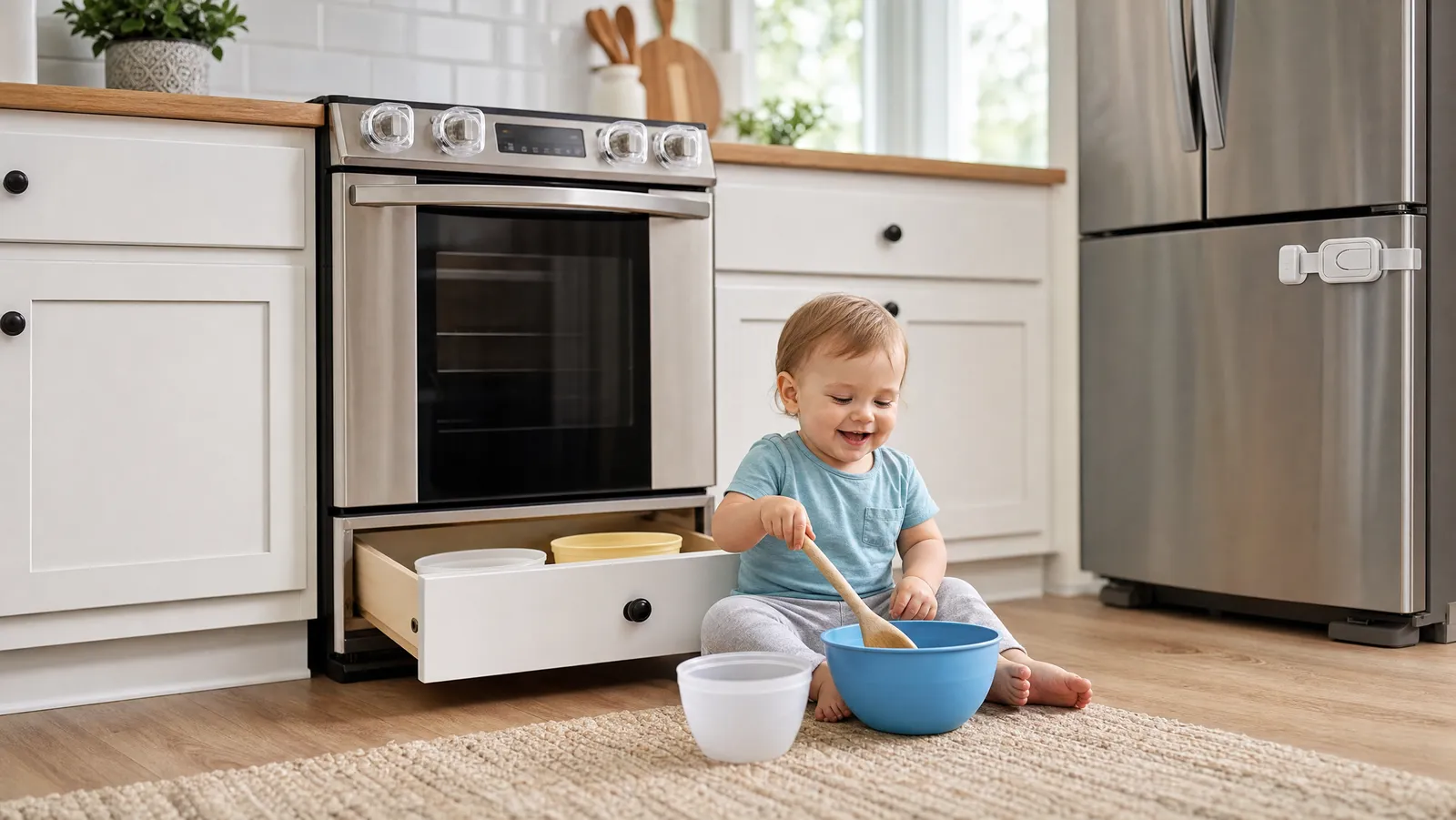
Knob covers are the answer, and they cost less than a takeaway lunch. The Safety 1st Clear View Stove Knob Covers are the set I would fit first: five covers with a hinged lid so you can still cook without wrestling anything, and transparent bodies so you can see at a glance whether a burner is on. They run about 11 dollars as of July 2026. That see-through detail sounds like marketing until you can check every knob from the doorway at 10pm.
For a gas range with slim knobs a bulky cover will not swallow, the Lwuzkdo Gas Stove Knob Locks take a different approach: a clip that seats into the gap around the knob rather than capping it, with no adhesive and no tools. Two caveats, both from the maker. The gap under your knob has to measure 0.28 to 0.43 in, so get a ruler out first. And Lwuzkdo states plainly that these suit pets and very young toddlers but may not stop agile, clever children aged two and up.
Hardware is only half of it. The CPSC's range safety advice is to turn pot handles inward when cooking and not to leave children unsupervised in the kitchen, and CHOP adds the companion habit: use the back burners, away from the reach of children. Costs nothing, removes the grab-and-pull entirely.
The oven door is also a step stool
This is the kitchen hazard almost nobody warns new parents about: a free-standing range can tip forward when a child stands or pulls on an open oven door.
In its Range Tipover Safety Alert, the CPSC states that a range anti-tip bracket can save you or your child from serious injury or death. The agency reported an estimated yearly average of 1,700 appliance-related instability and tipover injuries treated in hospital emergency departments for 2006 through 2008, and for 2000 through 2008 it received reports of 13 fatalities associated with instability and tipover of stoves, ovens and ranges, many involving children younger than 10.
You may already own the fix. The CPSC notes that voluntary safety standards for gas and electric ranges require manufacturers to supply anti-tip brackets with new ranges, so yours may be sitting in a drawer, or installed but not actually engaged. Its advice: check that the bracket is attached securely to the wall or floor with the range held in it, install one if your range has none, and keep tempting items like cookie jars away from the range so a child does not use an open oven door as a step.
It is the same logic as anchoring the dressers and bookcases in the rest of your house — the CPSC's childproofing guide groups them together, noting that free standing ranges and stoves should be installed with anti-tip brackets to prevent scalding and crushing injuries.
Once the range is anchored, an oven door lock closes the loop. The EUDEMON Childproof Oven Door Lock mounts with heat-resistant adhesive, releases with a two-button press an adult can do one-handed, and costs about 10 dollars as of July 2026. Measure before you order. EUDEMON specifies flat oven fronts only, a door-to-oven gap under 0.78 in, and knobs more than 4.4 in apart, and it acknowledges that on some ovens the door can still open one to two centimetres while locked. That is a few seconds of resistance, not a sealed door — and the maker says so itself.
The fridge, the dishwasher and the trash can
These three are the appliances a cruiser conquers first, and each hides a different problem. The dishwasher is the sharpest: knives pointing up, glass, and a detergent cup a toddler can reach without stretching the moment the door drops open. Poison Control notes that automatic dishwashing detergents are alkaline, with a pH of at least 10, which is what makes them capable of causing tissue injury and burns, and that liquid versions tend to cause more injury than powders and tablets because their pH runs higher — sometimes as high as 13. Swallowing enough can cause severe burns and swelling of the throat, esophagus and stomach. Poison Control advises keeping these products away from food, out of reach and sight of children, preferably in cabinets with child-resistant closures, and in their original containers.
So the pods live high, never under the sink and never decanted into a jar that looks like candy.
The fridge is less dangerous and more relentless, and the trash can is where the choking hazards actually are — chicken bones, bottle caps, produce stickers, plastic wrap. All three take the same fix: an adhesive strap latch rated for appliances. The Vmaisi Multi-Use Strap Locks come twelve to a pack for about 13 dollars as of July 2026, enough to do the fridge, dishwasher, trash, oven and a few cupboards in one order. If you would rather the hardware disappear into a stainless kitchen, the grey KIZZHISI set does the same job in a finish that reads as hardware, not baby gear.
One note decides whether any of it holds: KIZZHISI says its 3M VHB bond reaches full strength after 24 hours. Wipe the surface with rubbing alcohol first — kitchen fronts carry a film of grease that quietly kills adhesive — then press, and wait a day before testing.
Baby proofing kitchen cabinets: decide what goes up before you buy a single latch
Here is the mistake I made: I bought latches first and thought about storage second. A latch is only a delay, so height does most of the work — the AAP asks for both, in locked cabinets and out of sight and reach. Work the room in two passes. First, relocate. Cleaners, pods, medicines, vitamins, alcohol, plastic bags, matches and lighters all move to a high cabinet. Then latch. Lock the under-sink door, the knife drawer, the low pantry and the glassware cupboard, in that order.
The CPSC recommends safety latches and locks on cabinets and drawers in kitchens and bathrooms because they help prevent children getting to medicines, laundry detergent, household cleaners, matches, cigarette lighters, knives and other sharp objects. It adds what may be the most underrated sentence in home safety: even products with child-resistant packaging should be locked away and kept out of reach, because that packaging is often not childproof.
I am not re-reviewing latches here — the hardware deserves its own comparison. When you get to baby proofing kitchen drawers and doors and have to choose between magnetic, adhesive and U-shaped styles, work through our guide to the best cabinet and drawer locks and buy for the doors you actually have.
Leave one exception on purpose: a safe drawer of plastic containers, wooden spoons and dish towels, nothing small enough to choke on. It takes a startling amount of pressure off the doors you did lock.
Counters, corners and the cords you stopped noticing
Crouch to about two feet and look again — the kitchen changes completely. At standing-toddler height you will find counter corners, a kitchen island end, and — the one that gets people — a bar-height table edge sitting at roughly head level for a child still learning to walk into things. The CPSC recommends corner and edge bumpers to help prevent injuries from falls against sharp edges of furniture, which is exactly the case a kitchen island makes. Fitting corner guards on the island and the table takes ten minutes.
Then deal with the cords. The kettle, the slow cooker and the air fryer all trail a cord that becomes a handle the moment it hangs past the counter edge, and everything on the other end is hot. Push the appliances back and coil the slack.
And skip the linens. CHOP advises against using tablecloths or placemats around young children, because they can pull on them and bring hot food or drinks down. A bare table looks worse and behaves better.
Floor level: what a crawler actually sees
The last pass is the boring one, and it catches what a checklist written by someone without kids misses.
- The pet bowls. Water gets tipped and drunk from, and kibble is a choking hazard. Feed the dog behind a gate, or while the baby naps.
- The recycling. Cans with cut edges, glass and bottle caps sit at exactly crawler height. Latch it or move it into a cupboard.
- The bottom drawers. Foil boxes have serrated metal edges and heavy pans slam. Latch the sharp ones, leave the pot lids as a free toy.
- The high chair. Keep it clear of the counter, the stove and any cord — a child in one reaches a surprising distance.
- Floor cleaning. A bucket of cleaning water is a drowning and a poisoning hazard in one. Never leave it down while you answer the door.
Should you gate the kitchen off entirely?
Sometimes the room is the problem, and the answer is a door rather than fifteen latches. The CPSC lists safety gates as a way to help prevent falls and to keep children out of rooms and other areas with possible dangers, and a kitchen with one doorway is the ideal candidate. Open-plan is harder, and you may be better served by putting the child somewhere safe inside the room. CHOP's advice is to put your toddler in a safe area such as a high chair or play pen while you cook, and never to leave a child alone in a kitchen.
My take after two kids: gate the kitchen if you can span it in one go, and use the gate during the twenty minutes the stove is actually on. A gate you climb over forty times a day gets propped open by week two, and a propped gate protects nobody.
The bottom line: your kitchen in one afternoon
Run it in this order and you cover the real risks before dinner.
- Relocate the poisons. Cleaners, pods, medicines and vitamins go high and locked. Poison Help, 1-800-222-1222, goes in your phone.
- Check the water heater. The AAP puts the ceiling at 120 degrees Fahrenheit at the faucet, and the CPSC says the heater can be set to 120 degrees or lower.
- Cover the stove knobs and start cooking on the back burners with the handles turned in.
- Check the range's anti-tip bracket and add an oven lock if your oven front will take one.
- Latch the fridge, dishwasher and trash, then the under-sink door and the knife drawer.
- Guard the island corner, tame the cords, give the baby one safe drawer.
Keep one thing in mind as you install all of it. The CPSC is blunt that no device is completely childproof, that determined toddlers have been known to overcome or disable them, and that these devices must be properly installed and reengaged after use to work at all. Every latch here is a few seconds of delay, not a guarantee. The delay is the point — it covers the ten seconds you turn to drain the pasta.
For the rest of the house, work through our complete baby-proofing guide one room at a time. But start here. The kitchen is where you both are all day, and it is where one afternoon of work buys back the most peace of mind.

Safety 1st Child Proof Stove Knob Covers, Clear View (Set of 5)
Five covers that fit over your stove knobs to stop a child accidentally turning on a gas or electric burner. The hinged lid flips up to give an adult quick access when it is time to cook, and the covers are transparent, so you can still see at a glance whether a burner is on or off. They are made of heat-resistant plastic built for repeated daily use, and the oversized universal design is meant to fit most modern ranges.
- Brand
- Safety 1st
- Category
- Our Pick
The clear window is the part I did not expect to care about, and now I check it every night before bed.

EUDEMON Childproof Oven Door Lock, Black (1 Pack)
A heat-resistant PC lock that mounts with adhesive tape, so there is no drilling and no tools; EUDEMON says the adhesive holds at least 35 lbs and removes without residue. The double-button release is designed so an adult can work it one-handed while a baby cannot, and the lock rotates 180 degrees between locked and unlocked. Measure before you buy, because the maker states real fit limits: flat oven fronts only, a door-to-oven gap under 0.78 in (20 mm), and the two knobs more than 4.4 in (11 cm) apart. EUDEMON is also upfront that on some oven designs the door can still open 1-2 cm while locked, and that the lock is not a substitute for adult supervision.
- Brand
- EUDEMON
- Category
- Best Oven Door Lock
It took me two minutes to fit and it ended the game where my son hung off the oven handle every time I cooked.

KIZZHISI Child Proof Refrigerator Lock (5 Pack, Grey)
Five adhesive strap locks the maker rates for refrigerators, dishwashers, ovens, cupboards, closets, drawers and trash cans, which covers most of the doors a kitchen actually has. They mount with 3M VHB adhesive and KIZZHISI says the bond reaches full strength after 24 hours, so fit them the day before you need them to hold. No tools, no drilling, and no damage to the appliance surface. The grey finish reads as hardware rather than as baby gear, which matters when five of them are living on your kitchen fronts.
- Brand
- KIZZHISI
- Category
- Best for the Fridge
I put one on the fridge and one on the dishwasher, waited a day before testing them, and neither has budged since.
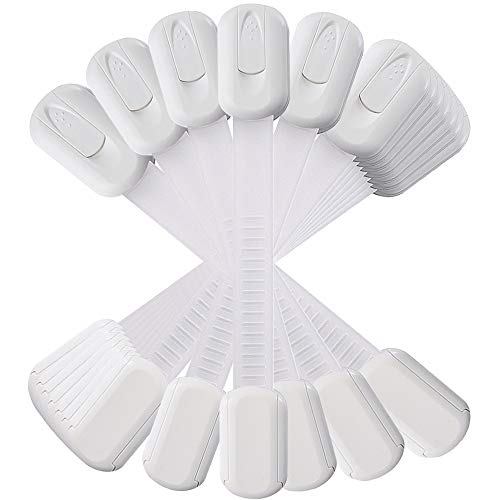
Vmaisi Multi-Use Adhesive Strap Locks (12 Pack, White)
Twelve adjustable strap latches, which is enough to do the fridge, the dishwasher, the trash can, the oven and a few stray cupboards in one order. They are listed as compatible with cupboards, drawers, toilets and fridge-freezers, so the leftovers get used up in the bathroom and laundry room instead of sitting in a drawer. They mount with adhesive, so there are no screws and no holes in the cabinetry. The job they are built for is stopping a child opening a fridge, dishwasher or drawer and reaching what is inside, or pinching fingers in the door.
- Brand
- vmaisi
- Category
- Best Multi-Use Value Pack
Twelve was the right number. I did the whole kitchen in one afternoon and still had four left for the bathroom.

Lwuzkdo Gas Stove Knob Locks (5-Pack, Black)
Five clips shaped to seat into the gap around a gas-range knob rather than cap the whole knob, so your controls stay close to stock and stay easy for an adult to use. There is no adhesive and no tools; they press on in one step. The maker describes the high-temperature-resistant PTC composite as resisting both heat and cleaning chemicals. Two limits worth knowing before you order: the gap under the knob has to measure 0.28-0.43 in for the clip to seat, and Lwuzkdo says plainly that these suit pets and very young toddlers but may not stop agile, clever children aged two and up.
- Brand
- Lwuzkdo
- Category
- Best for Gas Ranges
I measured the gap under our knobs first, which I would recommend, and they clipped straight on with nothing sticky left behind.
- 01Safety 1stOur PickSafety 1st Child Proof Stove Knob Covers, Clear View (Set of 5)
- 02EUDEMONBest Oven Door LockEUDEMON Childproof Oven Door Lock, Black (1 Pack)
- 03KIZZHISIBest for the FridgeKIZZHISI Child Proof Refrigerator Lock (5 Pack, Grey)
- 04vmaisiBest Multi-Use Value PackVmaisi Multi-Use Adhesive Strap Locks (12 Pack, White)
- 05LwuzkdoBest for Gas RangesLwuzkdo Gas Stove Knob Locks (5-Pack, Black)
At what age do I need to baby-proof the kitchen?+
Should I just gate the kitchen off entirely?+
Do I need an oven lock if I already have stove knob covers?+
Where should household cleaners and medicines go in a kitchen?+
What about dishwasher detergent pods?+
Is a safe drawer for the baby a good idea?+
Sammie Seelbach
Sammie is a mom of two and the lead reviewer at Smart Baby Reviews. Since becoming a parent she has become obsessed with researching the safest, smartest baby gear on the market — testing thermometers at 2 a.m., wrangling baby gates, and sterilizing more bottles than she can count. She shares what actually works so other parents can make confident, informed decisions for their little ones.