The Best White Noise Machines for Babies (and Safe Volume Limits)
This post may contain affiliate links. Read our policy.
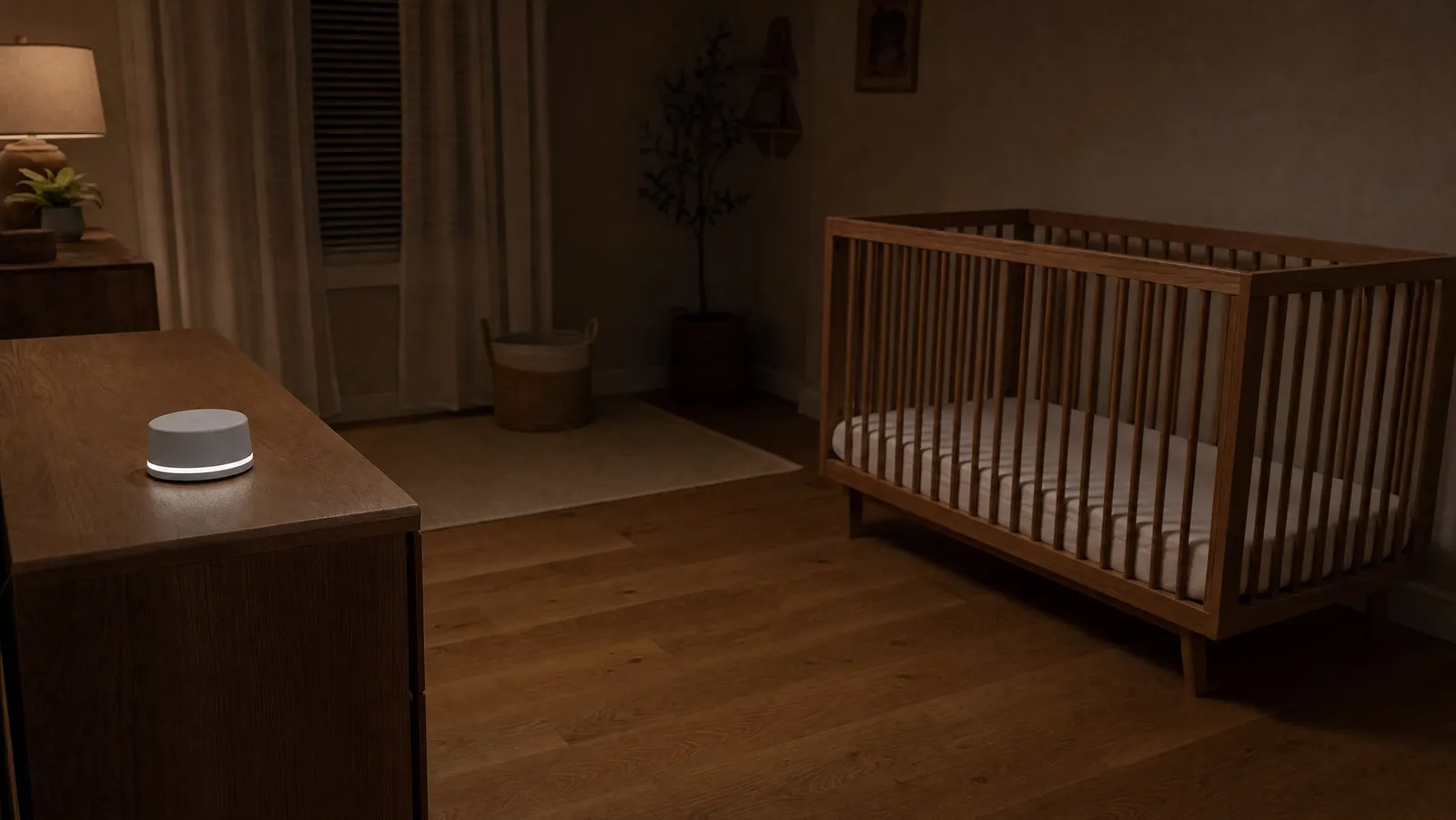
The best white noise machine for a baby is not the one with the most sounds. It is the one you can turn down far enough and put far enough away. Our pick is the Magicteam Sound Machine, because 32 discrete volume steps let you sit just under a safe level instead of choosing between too quiet and too loud. Some of the links below are affiliate links, and we may earn a small commission, at no extra cost to you, if you buy through them.
I bought our first sound machine and did the obvious thing with it. I clipped it to the crib rail, six inches from my daughter's head, because that is where the clip fits. It stayed there about five weeks.
That is the mistake this article exists to prevent, which is why the safety section comes first. White noise is not inherently a hazard; it is a useful tool that becomes one when it is used carelessly, and the careless part is almost always distance. So: the volume and placement research, which doubles as the buying criteria, then six machines worth putting in a safe sleep space.
How Loud Is Too Loud for a Baby Sound Machine?
Aim for roughly 50 decibels at your baby's head, about the level of a quiet conversation, and get there by moving the machine rather than nudging the dial. That 50 dBA figure is the noise limit recommended for infants in hospital nurseries, and it is the benchmark the central study on these devices measured against.
That study is Infant Sleep Machines and Hazardous Sound Pressure Levels, by Sarah Hugh and colleagues, published in Pediatrics in April 2014. They played 14 commercially available infant sleep machines at maximum volume and measured output at 30, 100 and 200 centimetres — about 1 foot, 3.3 feet and 6.6 feet — applying correction factors for the ear canal of a six-month-old. Two findings do the work:
- All 14 exceeded 50 dBA at 30 cm — roughly the distance from a baby's head to the crib rail. Not some of them. All of them.
- Three produced output above 85 dBA. At those levels for more than eight hours, the authors noted, this exceeds current occupational limits for accumulated noise exposure in adults and risks noise-induced hearing loss.
Their recommendation is the part to memorise: place the machine as far away as possible from the infant, never in the crib or on a rail, at low volume, for a limited time.
The Numbers Everyone Borrows, and Why
No regulator sets a sound limit for a machine in a nursery. ABC News reported in June 2024 that these devices are not federally regulated and are often not clearly labelled for noise. Every number here is borrowed from somewhere else.
The 85 dBA figure comes from work: NIOSH's recommended exposure limit is 85 A-weighted decibels averaged over an eight-hour shift, and OSHA's permissible exposure limit is 90 dBA over an eight-hour day. Both are occupational standards for adults, not paediatric ones. The 50 dBA figure comes from hospitals — it is the limit currently recommended for infants in hospital nurseries, and it is what the 2014 study measured against. The AAP has addressed newborn noise since its 1997 committee statement, Noise: A Hazard for the Fetus and Newborn, which set the bar lower still: drawing on EPA figures, it recommended average sound levels in a newborn intensive care unit stay below 45 dBA.
The follow-up literature is more reassuring. A 2021 study in the International Journal of Pediatric Otorhinolaryngology, Hazardous sound outputs of white noise devices intended for infants, tested eight machines and six iPhone apps at their lowest and highest volume settings, at 10 cm (inside a crib), 30 cm (just outside the rail) and 100 cm (across the room). At minimum volume, no device exceeded 85 dBA at any distance. At maximum volume, 9 of the 14 — 64.3 percent — exceeded 85 dBA at 10 cm, but none did at 30 cm or 100 cm.
So the risk has a shape: not "sound machines are dangerous," but "maximum volume, inches from a head, for hours" — three decisions, each free to reverse. The AAP's 2023 noise policy statement is balanced on it — pediatricians can counsel parents who use infant sleep machines about safe use, and while some studies show potential benefits, one study raised potential concern about sound levels. It also supplies the best rule of thumb here: if an environment sounds too loud for an adult, it probably is too loud for a child. And it stresses that the dose of noise means duration, not just volume.
Where to Put a Baby Sound Machine
Across the room, on a solid surface, never in the crib and never clipped to the rail. Distance is the highest-leverage decision here, and it is free. The specific numbers the sources give do not agree:
- The 2014 Pediatrics authors said as far away as possible, never in the crib or on a rail.
- Children's Hospital of Philadelphia puts a number on it: more than 200 centimetres, about 6.6 feet.
- Children's National sets a much lower floor — at least two feet from the crib — with the volume below 50 decibels.
The "at least seven feet" rule you see everywhere appears to be a rounding of the 200 cm the 2014 study used as its furthest measurement distance — a reasonable rule of thumb rather than a published standard. Treat two feet as the floor and across the room as the target.
Where "across the room" is depends on your sleep surface, so the bassinet, crib, or play yard decision comes first: a bassinet beside your bed may not have six feet in any direction, while a nursery crib usually does. If the geometry will not give you distance, buy the finest volume control you can and turn it down further.
Two rules that are not negotiable:
Nothing on or in the crib. A sound machine belongs on the list of things that go near a crib and never inside one, alongside everything else in what does not belong in the crib — and that includes clip-on models, whatever the packaging suggests. A clip that fits a rail puts a speaker inches from an ear.
Mind the cord. A plug-in machine near a crib means a power cord near a crib: a specific hazard, not a general caution. Run it behind furniture, keep every inch beyond the reach of a standing baby, and read cord safety around the crib before you pick the outlet. It is the one place a battery machine has a real safety argument over a plug-in.
How to Set the Volume, and How to Measure It
Set it standing where your baby's head goes. Turn it up until it just masks the hallway, then take it down one step. If you would raise your voice to talk over it at the crib, it is too loud.
Your phone gives you an approximate number, approximate being the operative word. Of 130 iOS apps and 62 Android apps NIOSH examined, only three came within ±2 dBA of a reference sound level meter. NIOSH built its own iOS Sound Level Meter app, which met that ±2 dB criterion and came within ±1 dB with an external calibrated mic — over a 65 to 95 dB SPL range that starts above what you are aiming at in a nursery. Treat a reading of "50" as a sanity check, not a measurement.
What I Looked For
Four criteria, straight out of the research and none of them on the box:
- Volume granularity. Four steps may leave no setting between too quiet to mask anything and louder than you want.
- Timer behaviour. Can it run all night if you want, and stop if you do not?
- Whether it can sit far away — and whether it glows once it gets there.
- Cord or battery. Battery means no cord near the crib, and travel. Plug-in means never changing a AA at 2am.
Sound count did not make the list. Twenty-five sounds is twenty-four you will never use.
The Best White Noise Machines for Babies
Our pick: Magicteam Sound Machine
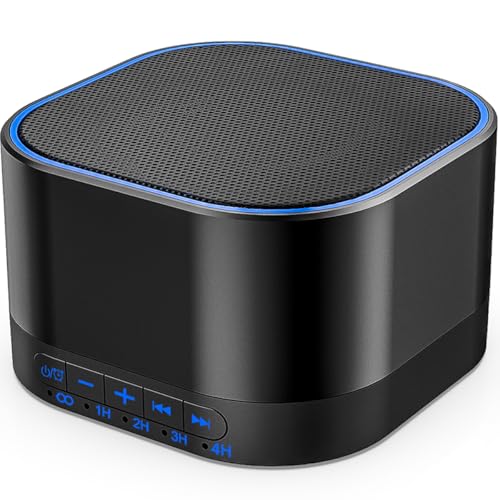
The Magicteam wins on the one spec that maps to the research: 32 discrete volume levels. Most machines give four or five steps, which is the difference between sitting just under a safe limit and choosing between too quiet and too loud. Boring, and the whole reason it is the top pick.
The rest holds up: 20 non-looping sounds including white, brown and pink noise; timers at 1, 2, 3 and 4 hours or continuous play; a memory function that restores your last settings; and a 3 x 3 x 1.8-inch body that disappears on a far dresser. The limitation is that it is AC or USB powered with no battery, so plan the outlet. About $19.54 as of September 2026.
Best for travel: MyBaby SoundSpa On-the-Go
Cordless is the entire argument. The MyBaby SoundSpa from Homedics runs on 3 AAA batteries (not included), fits a diaper bag, and offers four sounds: heartbeat, white noise, ocean and lullaby. Auto shut-off at 15, 30, 45 or 60 minutes, BPA-free plastic, no cord. About $14.99 as of September 2026.
The caveat is real. It has an integrated clip, and Homedics lists cribs among the things it attaches to. Do not. A machine clipped to a rail sits inches from an ear — exactly the arrangement all 14 machines in the 2014 study failed at 30 cm. Use a stroller, a bag or a car seat handle.
Simplest plug-in: Homedics SoundSleep
The Homedics SoundSleep is the anti-feature pick, and that is praise. Six digitally recorded sounds — white noise, thunder, ocean, rain, summer night and brook — button volume control, and continuous play or auto-off at 15, 30 or 60 minutes. Ships with a wall adapter, about $23.99 as of September 2026.
No app, no night light, no screen glow, nothing to get wrong at 3am. For a machine whose job is to sit across the room and make one noise, that is the right feature set. The trade-off is granularity: buttons are not 32 steps.
Best with night light: Dreamegg D1 Nova
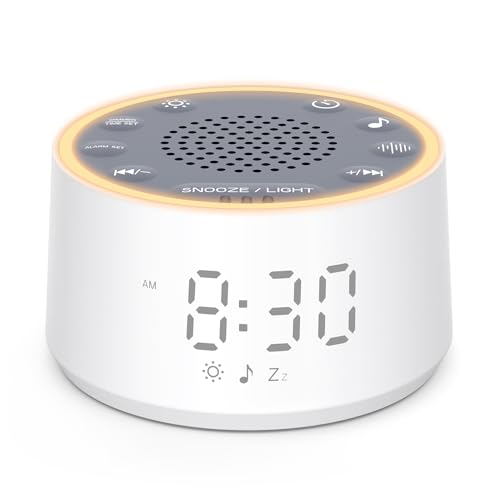
If you want the machine to double as the nursery lamp, the Dreamegg D1 Nova is the one. Twenty-five sounds — 6 white noise tracks, 2 fan, 8 lullabies, 9 nature — a 10-colour night light and an adjustable-brightness clock display. The timer is the widest here at 10 to 480 minutes. Around $29.48 as of September 2026.
The dimmer on the clock display is the feature worth paying for, because a machine that lights a room at 2am has solved one problem by creating another. But name the tension: a night light is something you want near you and a sound machine is something you want far away. On a nightstand, the volume dial does the work.
Best smart machine: Hatch Baby Sound Machine
The Hatch Baby Sound Machine is the app-controlled option: light and sound presets you can schedule and adjust remotely from your phone, a physical Big Button on top to start a favourite or stop it without unlocking anything, and a twist collar for volume. Sounds include pink noise and heartbeat alongside stories and songs.
Fixing the volume from another room without opening the nursery door is worth something for safety, not just convenience: it removes the reason people creep in and nudge a dial up.
Two honest trade-offs. It is by far the most expensive machine here at about $79.99 as of September 2026 — roughly three times the next-priciest pick and four times the budget ones. And part of what you are buying is software — it ships with three months of Hatch+, the subscription carrying the sleep-consultant chat and guides. Hatch states that is optional afterwards and does not auto-renew, better than the category norm, but you are buying into an app.
Best clip-on: Munchkin Shhh Soother
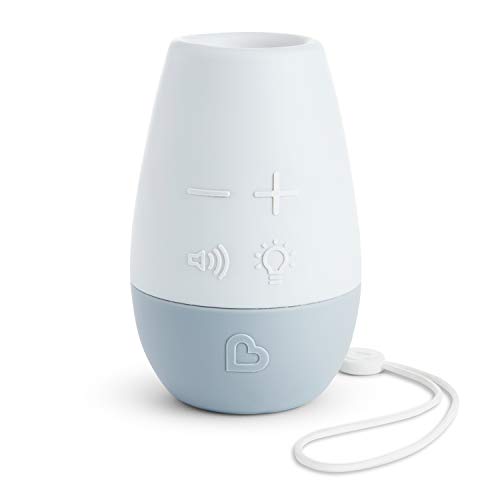
The Munchkin Shhh is a battery-powered puck with three sounds — shushing, heartbeat and white noise — raised 3-D icons you can identify by touch in the dark, and a night light that glows steadily or pulses with the sound. Two AA batteries, not included, about $18.48 as of September 2026.
The raised icons give it away as designed by somebody who had stood in a dark nursery. But the auto shut-off maxes out at 30 minutes — 10, 20 or 30 — to conserve the batteries, and Munchkin's own framing is naptime on the go. That is the honest limitation: a nap-and-stroller machine, not an all-night one, and the stroller is where the clip goes.
How the Six Compare
| Machine | Price band | Power | Timer | Night light | Volume control |
|---|---|---|---|---|---|
| Magicteam Sound Machine | Under $20 | AC or USB only | 1/2/3/4 hr or continuous | No | 32 discrete levels |
| MyBaby SoundSpa On-the-Go | Under $20 | 3 AAA batteries | 15/30/45/60 min | No | Not specified |
| Homedics SoundSleep | $20-$30 | Plug-in (wall adapter) | 15/30/60 min or continuous | No | Button control |
| Dreamegg D1 Nova | $20-$30 | Not specified | 10 to 480 min | 10-colour, plus dimmable clock | Not specified |
| Hatch Baby Sound Machine | $75-$85 | Not specified | App-scheduled presets | Yes, app-controlled | Twist collar, plus app |
| Munchkin Shhh Soother | Under $20 | 2 AA batteries | 10/20/30 min (30 max) | Steady or pulsing | Not specified |
Price bands reflect listings as of September 2026 and move constantly.
Should White Noise Play All Night?
The sources genuinely disagree, and pretending otherwise would be dishonest.
The cautious side is well represented. The 2014 Pediatrics authors recommended limiting duration, CHOP advises against nightly continual use, and Children's National says there is no need for constant white noise and to turn the machine off once your baby falls asleep. The reasoning is cumulative dose — the frame the AAP's 2023 policy uses in stressing that duration matters, not only volume.
The other side is why people run it all night: masking only works while it plays. Switch it off at 10pm and the door slam at 11 arrives unmuffled.
A 2024 scoping review in Sleep Medicine, Continuous white noise exposure during sleep and childhood development, is more careful than the retellings: evidence suggests deleterious effects of continuous moderate-intensity white noise on early development in animal models, and the review states that human subject data generally corroborate those models — while also suggesting that low-intensity noise exposure may be beneficial during sleep. Its authors concluded that the data support limiting maximal sound intensity and duration on commercially available devices, and reported that white noise machines can exceed 91 dB at maximum volume — above NIOSH's guideline for even a two-hour adult shift.
Note the phrase doing the work: low-intensity. If you run it all night, the low volume and the distance are what make that reasonable, and a timer is a fair hedge if your baby only needs help falling asleep. The Magicteam and the Homedics SoundSleep offer both, so you can decide later.
Does White Noise Cause Speech Delay?
This claim circulates with far more confidence than its evidence supports.
In April 2003, Chang and Merzenich published Environmental noise retards auditory cortical development in Science. They reared rat pups in continuous, moderate background noise — not injurious to their peripheral hearing, but loud enough to mask normal environmental sounds — and those animals did not reach basic benchmarks of auditory development until they were three or four times older than normal rats.
Two details get dropped every time this is retold. First, the delay reversed: auditory development matured to normal adult levels once the animals left the noise. Second, Chang said plainly that the rat is not a perfect model of human auditory development.
That is an animal study about masking, not a human study about sound machines, and the 2024 scoping review did not find one either — what it found was animal evidence of harm that human data broadly echoes, alongside a signal that low-intensity noise during sleep may help. Hospitals take the cautious line — CHOP states that nightly exposure to these machines could affect hearing, speech and language development — but that is a precaution built largely on animal work and on studies of chronic noise exposure in general, not on a trial of sound machines in infants.
So: indirect evidence rather than a demonstrated sound-machine harm, and worth acting on anyway, because acting on it is free. Keep the volume low, and use the machine for sleep rather than all-day background — babies acquire language while awake, which needs a room quiet enough to hear speech in. Worries about your own child's hearing or speech milestones belong with your pediatrician, not a buying guide.
White Noise, Pink Noise, or Brown Noise?
Mostly preference, and I would not pay extra for a colour.
Nationwide Children's Hospital laid the three out in July 2025: white noise is a steady shhh with all frequencies at equal intensity, brown noise is deeper and more rumbling like a waterfall, and pink noise sits between them, softer, like rainfall. It notes that some research suggests pink noise may promote more stable, deeper sleep — but stops short of declaring a winner. Its actual advice: every child is different, some prefer the brighter sound of white noise while others respond better to deeper tones, and keep the volume low with the machine away from the crib.
Most of the infant-specific research is on white noise, largely in newborn and NICU settings. To try all three without buying three machines, the Magicteam carries all three. Change the sound before you change the volume.
The Bottom Line
Buy one, set it low, put it across the room. That is the article.
- Distance first. Across the room is the target, two feet is the floor, in or on the crib is never. Moving the machine is free and does more than any other adjustment.
- Volume second. Around 50 dBA at your baby's head — quiet-conversation level. Never the maximum setting.
- Duration third. Low and far makes all-night play reasonable, a timer is a fair hedge, and experts genuinely disagree.
- Buy for the volume dial and the timer, not the sound count — and route the cord.
For most families that is the Magicteam on a dresser across the room, plus the MyBaby SoundSpa in the diaper bag for travel.
While you are outfitting the room, the best baby sleep sacks covers the other piece of nursery kit that gets bought the same week, and the rest of your baby's sleep space walks through the crib, the mattress and the room in order.
Tonight, do the free part. Stand where your baby's head goes, listen, and move the machine another three feet away. You've got this.
Magicteam Sound Machine, 20 Non-Looping Sounds, 32 Volume Levels, AC or USB Powered
A 3 x 3 x 1.8-inch box with 20 non-looping sounds, including white, brown and pink noise, fan, rain, ocean and brook. The specification that matters for a nursery is the volume control: 32 discrete levels rather than the four or five steps most machines give you, which is the difference between being able to sit just under a safe limit and having to choose between too quiet and too loud. Timer options run 1, 2, 3 and 4 hours or continuous play, and a memory function restores your last sound, volume and timer. Powered by AC or USB only, with no battery.
- Brand
- Magicteam
- Category
- Our Pick
Thirty-two volume steps sound like spec-sheet padding until you are trying to set a machine just below 50 decibels at seven feet and your other option is a knob with four positions.

MyBaby SoundSpa On-the-Go Portable Sound Machine (Homedics)
A cord-free, battery-powered soother with four sounds: heartbeat, white noise, ocean and lullaby. It runs on 3 AAA batteries (not included) and has an integrated clip, plus auto shut-off at 15, 30, 45 or 60 minutes. Homedics builds it from BPA-free plastic and sizes it for a diaper bag. The clip is the thing to be careful with: it is designed to attach to strollers, bags and car seats, and Homedics also lists cribs, but a sound machine clipped to a crib rail is inches from a baby's ear and does not belong there.
- Brand
- Homedics
- Category
- Best for Travel
Cordless is the entire argument for this one. It goes in the diaper bag, and it means a hotel nap sounds like home.

Homedics SoundSleep White Noise Sound Machine, 6 Sounds, Auto-Off Timer
Six digitally recorded sounds, white noise, thunder, ocean, rain, summer night and brook, in a compact plug-in unit with button volume control. It will play continuously or shut off at 15, 30 or 60 minutes. There is no app, no night light and nothing to configure, which for a nursery is a feature rather than a compromise: no screen glow, no phone, and no settings to get wrong at 3am. Ships with a wall adapter.
- Brand
- Homedics
- Category
- Simplest Plug-In
No app, no lights, no pairing. You press a button and it makes noise, which is the entire job.
Dreamegg D1 Nova Sound Machine with Nursery Lamp, 25 Sounds, 10-Colour Night Light
An updated version of Dreamegg's D1, with 25 sounds broken down as 6 white noise tracks, 2 fan sounds, 8 lullabies and 9 nature sounds, plus a 10-colour night light, an adjustable-brightness clock display and a built-in alarm with seven nature wake sounds. The timer runs from 10 to 480 minutes, and it weighs about half a pound. The dimmable display is the part worth paying for if the machine lives on a nightstand rather than across the room.
- Brand
- Dreamegg
- Category
- Best with Night Light
The dimmer on the clock display is the underrated feature. A sound machine that lights up the room at 2am has solved one problem by creating another.

Hatch Baby Sound Machine and Night Light Routine Builder (Putty)
The app-controlled option: light and sound presets you can schedule and adjust remotely from your phone, a physical Big Button on top to start a favourite or stop it without unlocking anything, and a twist collar for volume. Sounds include pink noise and heartbeat alongside stories and songs. It comes in five colours made with recycled materials and ships with three months of Hatch+, the subscription that carries the sleep-consultant chat and guides; Hatch states the subscription is optional afterwards and does not auto-renew. Worth naming the trade-off: this is by far the most expensive machine here, roughly three times the price of the next-priciest pick, and part of what you are buying is software.
- Brand
- Hatch Baby
- Category
- Best Smart Machine
Being able to fix the volume from your phone, from another room, without opening the nursery door, is genuinely worth something at 4am.
Munchkin Shhh Portable White Noise Sound Machine and Baby Soother
Three sounds, shushing, heartbeat and white noise, in a battery-powered puck with raised 3-D icons you can find in the dark and a soft night light that either glows steadily or pulses with the sound. The auto shut-off runs 10, 20 or 30 minutes, with 30 as the maximum to conserve the two AA batteries (not included). The short maximum timer is the honest limitation: this is a nap-and-stroller machine, not an all-night one, and Munchkin's own framing is naptime on the go.
- Brand
- Munchkin
- Category
- Best Clip-On
Raised icons you can identify by touch, in the dark, without turning anything on. Somebody who had actually been in a dark nursery designed this.
- 01
- 02HomedicsBest for TravelMyBaby SoundSpa On-the-Go Portable Sound Machine (Homedics)
- 03HomedicsSimplest Plug-InHomedics SoundSleep White Noise Sound Machine, 6 Sounds, Auto-Off Timer
- 04DreameggBest with Night LightDreamegg D1 Nova Sound Machine with Nursery Lamp, 25 Sounds, 10-Colour Night Light
- 05Hatch BabyBest Smart MachineHatch Baby Sound Machine and Night Light Routine Builder (Putty)
- 06MunchkinBest Clip-OnMunchkin Shhh Portable White Noise Sound Machine and Baby Soother
How loud is too loud for a baby sound machine?+
Should white noise play all night, or only until my baby falls asleep?+
Does white noise cause speech delay in babies?+
Where should I put a baby sound machine?+
Is white noise, pink noise, or brown noise better for babies?+
Do I need a sound machine at all?+
Sammie Seelbach
Sammie is a mom of two and the lead reviewer at Smart Baby Reviews. Since becoming a parent she has become obsessed with researching the safest, smartest baby gear on the market — testing thermometers at 2 a.m., wrangling baby gates, and sterilizing more bottles than she can count. She shares what actually works so other parents can make confident, informed decisions for their little ones.