What Does Not Belong in the Crib: Bumpers, Loungers, and Positioners
This post may contain affiliate links. Read our policy.
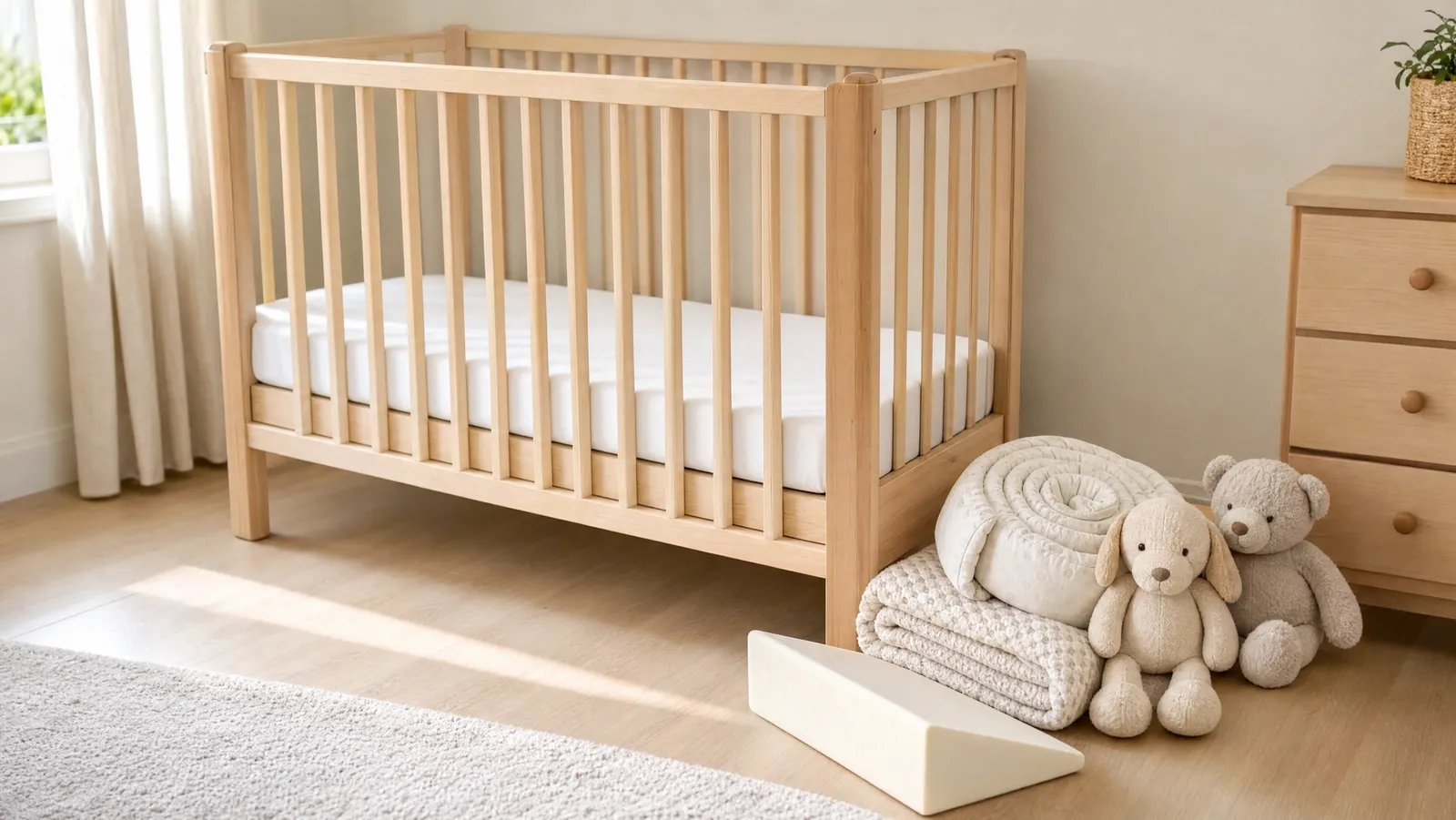
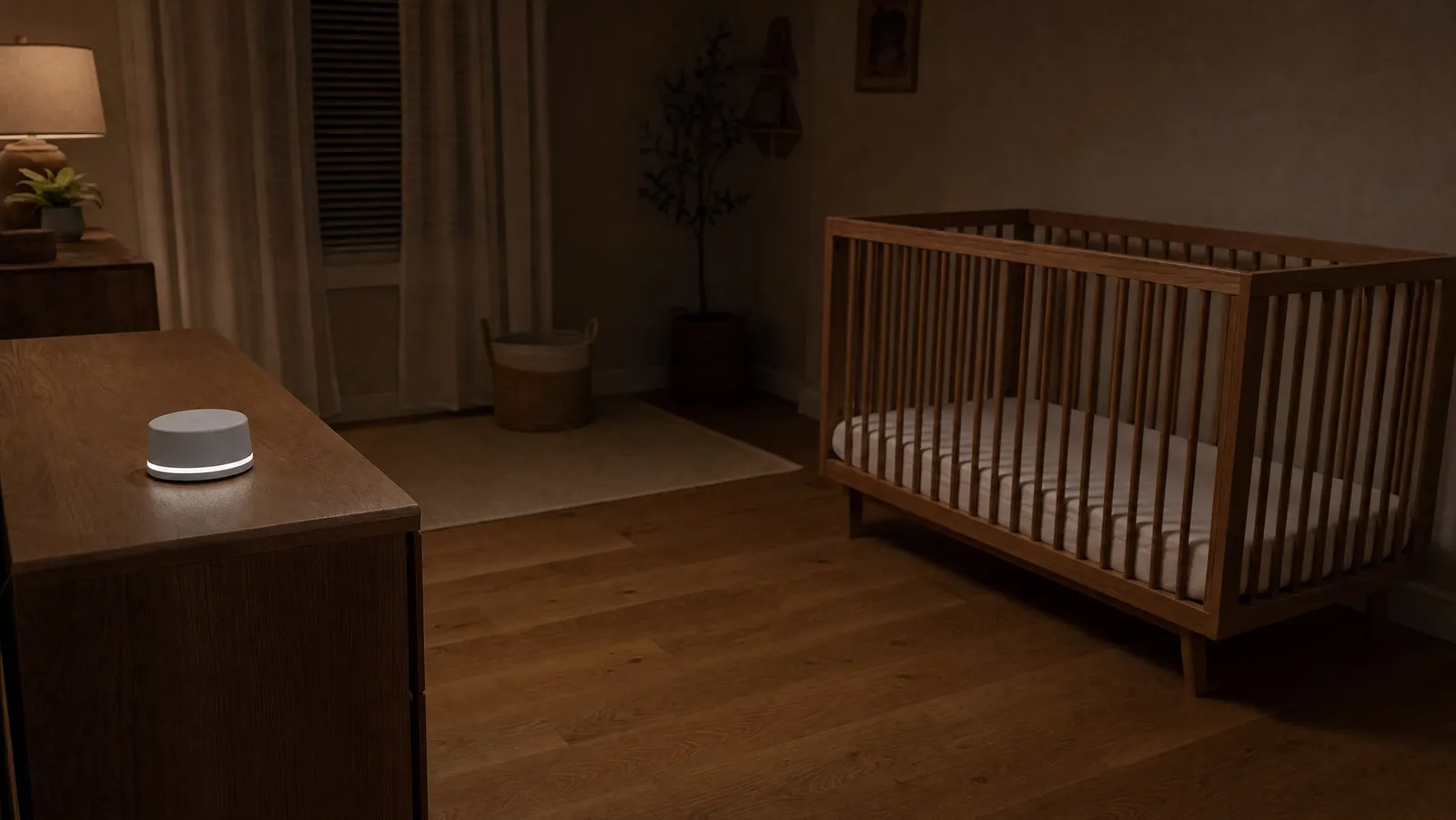
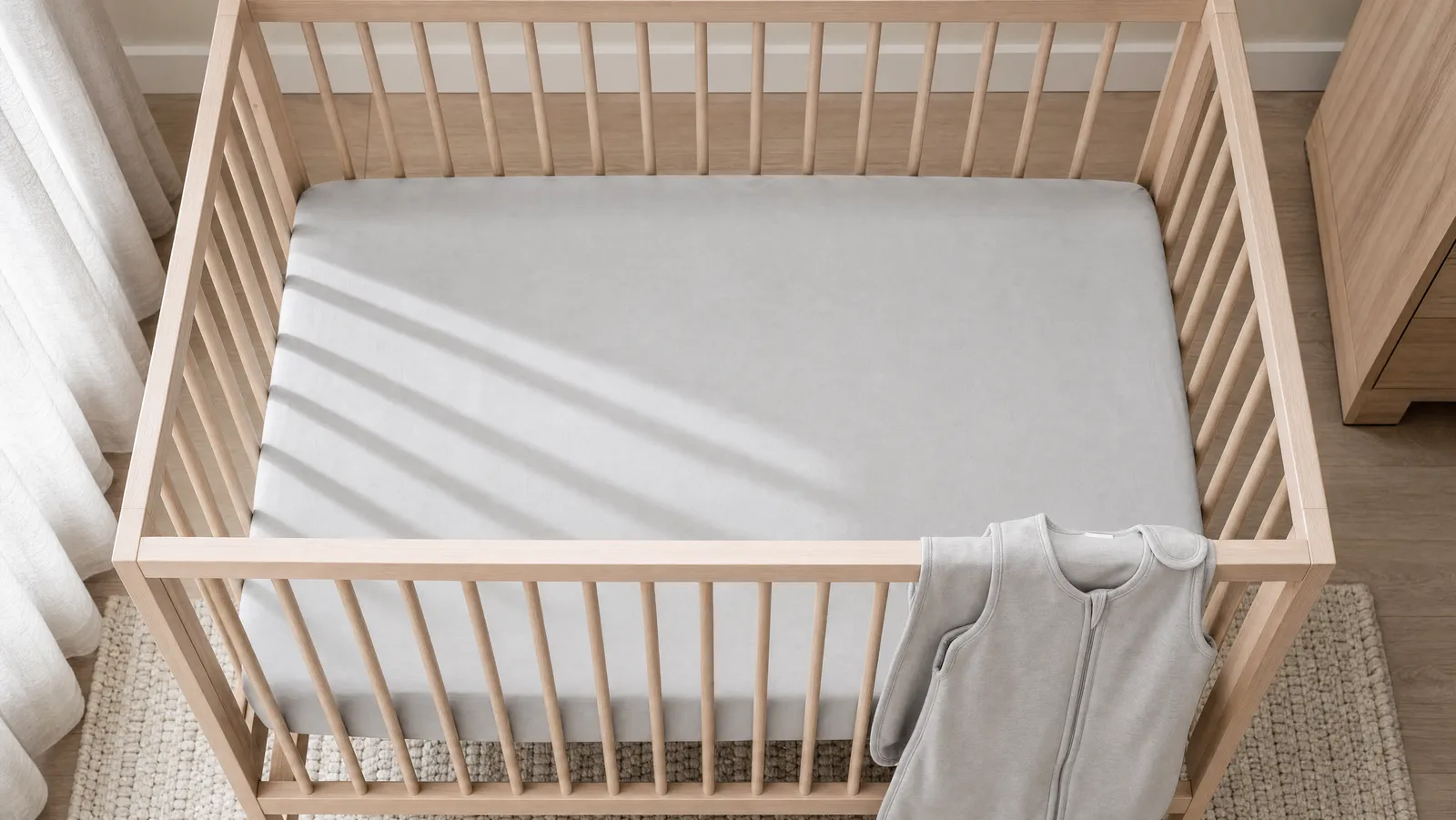
What not to put in a crib is a long list with a very short opposite: a firm mattress, a tight fitted sheet, and a baby on their back. That is the entire permitted inventory. Bumpers, loungers, positioners, wedges, pillows, quilts, mattress toppers and stuffed animals all come out. Some of the links below are affiliate links, and we may earn a small commission, at no extra cost to you, if you buy through them.
We were given a bedding set at a shower — quilt, skirt, sheet and a padded bumper, all in the same fabric, tied together with a ribbon. It did not occur to me that three of those four items were things I would take straight back out of the crib. Nobody buys a bumper to be reckless. It comes in the set.
So here is the mental model worth keeping: a safe crib is defined by subtraction. You do not build it up, you strip it down. And the striking part, once you go category by category, is how much of what is sold to fill a crib is either federally banned, actively recalled, or explicitly contradicted by the American Academy of Pediatrics. Everything below assumes the basics of a safe sleep space are already in place: on the back, own surface, flat and firm.
What Does Belong in the Crib
Three things. Shorter than the list that follows, which is the point.
A firm, flat mattress that fits. The AAP's parent guide to safe sleep defines firm as a surface that should not indent when your baby is lying on it, and says any surface inclining more than 10 degrees is not safe for sleep. The DaVinci Deluxe Coil, around $149 as of September 2026, is one version of the spec: 52 by 27.75 by 5 inches with square corners, extra-firm on the infant side. Our guide to crib mattress firmness and fit runs the two tests that actually decide it.
One fitted sheet made for that mattress. Not a flat sheet, not a quilted pad, not a topper. The American Baby Company two-pack, about $12.59 as of September 2026, is the boring correct thing: cotton jersey, 28 by 52 inches, elastic all the way around rather than at the corners only.
Your baby, on their back. That is the list.
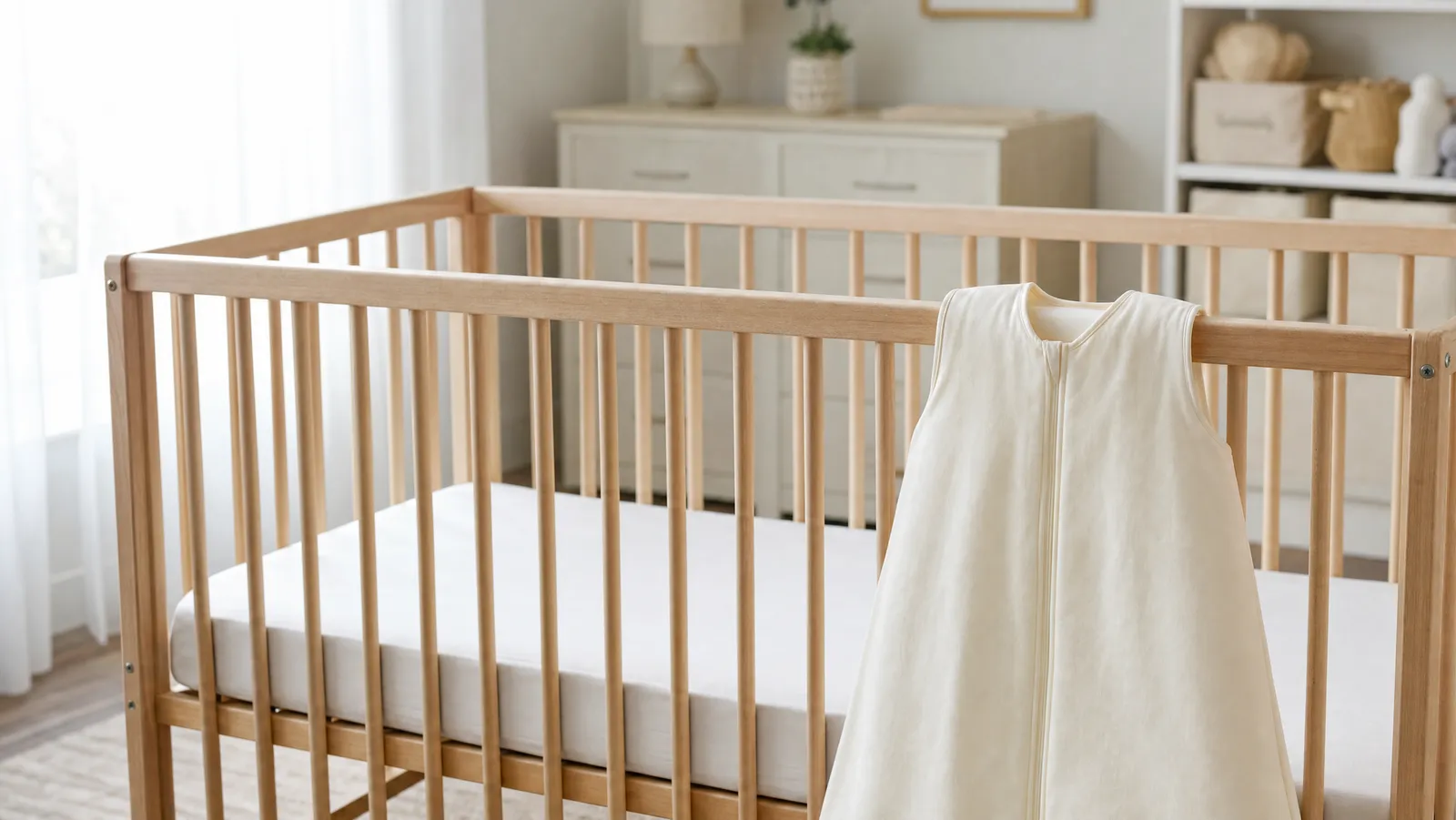
If your worry is that a bare crib is a cold crib, the fix goes on the baby rather than into the crib. The AAP says so in one line: if you are worried about your baby getting cold, dress them in layers of clothing or use a wearable blanket. That means a wearable blanket — something like the Yoofoss three-pack, roughly $27.99 as of September 2026 — doing the job a blanket was bought to do without putting anything loose in the crib.
What Not to Put in a Crib, and What Each Status Actually Means
Before the list, a distinction that gets flattened constantly and is genuinely useful when you are standing over a bin bag deciding what to throw away.
- Banned for sale. Unlawful to sell, manufacture, distribute or import in the US, regardless of when it was made. This is the strongest status and it applies to very few products.
- Recalled. A specific product, from a specific maker, pulled from the market. The wider category may still be perfectly legal.
- Advised against. No law at all — a recommendation from the AAP, CPSC or FDA. This covers most of the crib.
| What it is | Status as of September 2026 | What that means for you |
|---|---|---|
| Padded bumpers, vinyl bumper guards, vertical slat covers | Banned for sale since November 12, 2022 | Take it out, and do not pass it on |
| Inclined sleepers over 10 degrees | Banned for sale since November 12, 2022 | Not a sleep surface at any age under 1 |
| Infant loungers and nests | Legal, regulated since May 2025, never for sleep | Supervised awake use only |
| Sleep positioners and anti-roll wedges | Warned against by FDA and CPSC since 2010 | Take it out |
| Non-padded mesh crib liners | Explicitly excluded from the ban; not recommended by the AAP | Legal is not the same as endorsed |
| Pillows, quilts, comforters, mattress toppers, loose blankets | Advised against by the AAP | Take it out |
| Stuffed animals and pillow-like toys | Advised against by the AAP for the first year | Take it out |
| Crib mobiles and hanging toys | Fine early, hazardous later | Remove by hands and knees or 5 months |
Crib Bumpers: Banned, and Still Turning Up
President Biden signed the Safe Sleep for Babies Act on May 16, 2022. CPSC's business guidance states the consequence in one sentence: effective November 12, 2022, regardless of the date of manufacture, all inclined sleepers for infants and crib bumpers as defined in the Act are considered banned hazardous products. Both bans landed on the same day, 180 days after the law was signed, and the bumper ban is now codified at 16 CFR part 1309.
The statutory definition is broader than most people assume. A crib bumper means any material intended to cover the sides of a crib to prevent injury from impacts against the side of a crib, or to prevent partial or complete access to any openings in the sides of a crib. CPSC spells out that this includes a padded crib bumper, a supported and unsupported vinyl bumper guard, and vertical crib slat covers. So the ban is not only about the quilted pad in the bedding set — it also catches the vinyl guards and the individual slat sleeves.
Why Congress went this far. In his statement on the Act's enactment, then-CPSC Commissioner Richard Trumka said the law bans crib bumpers, responsible for at least 107 infant deaths between 1990 and 2016.
And the ban has not emptied the market. In September 2025, CPSC announced a recall of about 360 LXDHSTRA baby loungers sold on Amazon between May and August 2025, which shipped with padded crib bumpers in violation of the Act. Nearly three years after the ban, a marketplace listing is still not proof of legality.
Mesh Crib Liners: A Real Grey Area
This is the one place where the honest answer has two halves that point different directions.
Legally, they are exempt. The statutory definition of a crib bumper says outright that it does not include a non-padded mesh crib liner, and CPSC's crib bumper FAQ confirms that non-padded mesh crib liners are not subject to the ban — though they still have to meet other CPSC requirements, including lead content, phthalate limits and small parts rules.
Medically, nothing changed. The AAP's list of what to keep out of the sleep area names bumper pads or related products that attach to crib slats or sides, and a mesh liner is by construction a product that attaches to crib slats or sides. Writing for parents in June 2022, Premier Health states the pediatric position without hedging: the AAP advises that crib bumpers should never be used for infants' cribs, not any kind, not at any time.
That gap between the statute and the guidance is not a loophole anyone should feel clever about. Congress carved out mesh because it is not padded, not because a pediatric body signed off on it.
Inclined Sleepers and the Rock 'n Play
An inclined sleeper for infants is defined by CPSC as a product with an inclined sleep surface greater than 10 degrees that is intended, marketed or designed to provide sleeping accommodations for an infant up to 1 year old. Banned for sale since November 12, 2022, codified at 16 CFR part 1310.
There is a second rule doing related work. CPSC's Infant Sleep Products standard, 16 CFR 1236, took effect on June 23, 2022 and requires that any product marketed or intended for infant sleep meet an existing federal standard for cribs, bassinets and cradles, play yards or bedside sleepers — with a sleep surface angle of 10 degrees or lower. Between the two, the inclined sleeper category is closed.
The history behind the number. Fisher-Price recalled 4.7 million Rock 'n Play Sleepers on April 12, 2019, after more than 30 infant fatalities. It re-announced that recall on January 9, 2023, by which point approximately 70 additional fatalities had been reported, including at least eight that occurred after the initial recall. The hazard, in CPSC's words, is that infants died after rolling from their back to their stomach or side while unrestrained.
That last clause is worth carrying into the next milestone: read our guide to safe sleep once your baby starts rolling before the rolling starts, not after. And the subtraction rule does not change with the furniture — whether you are using a bassinet, crib, or play yard, the permitted contents are identical.
Loungers and Nests: Legal, Regulated, Still Not for Sleep
This is the category that changed most recently, so it is the one worth knowing about in 2026.
There is now a federal standard. CPSC approved a safety standard for infant support cushions on October 16, 2024, citing 79 infant deaths and 124 injuries between 2010 and 2022 associated with these products, most in infants younger than three months. The rule requires firmness testing across every surface an infant can contact, sidewalls that form an angle greater than 90 degrees with the occupant surface so they slope away from the baby, a maximum incline of 10 degrees, and conspicuous permanent warning labels. The requirements of the standard, 16 CFR 1243, apply to products manufactured after May 5, 2025.
A compliant lounger is still not a sleep product. Lisa Trofe of the Baby Safety Alliance told Consumer Reports that loungers meeting current safety standards are safe when used as intended on a low, flat surface while a baby is awake and under direct supervision, and that they are not intended to be used for sleep. Consumer Reports, writing in June 2026 — more than a year after the rule went into effect — also reported one infant death in a lounger in February 2026, and three lounger-related infant deaths reported to CPSC during 2025.
The recall that defined the category. Boppy recalled about 3.3 million Newborn Loungers on September 23, 2021, after eight infant deaths between December 2015 and June 2020. CPSC's stated hazard: infants can suffocate if they roll, move, or are placed on the lounger in a position that obstructs breathing, or roll off onto an external surface such as an adult pillow. In 2023 CPSC and Boppy issued a fresh warning after two additional infant deaths were reported shortly after the recall.
The practical rule is unglamorous and easy: a lounger is a supervised, awake, floor-level object. If your baby falls asleep in it, move them.
Sleep Positioners and Anti-Roll Wedges
These are marketed as safety devices, which makes them the hardest category to argue with. The regulators have been unusually direct.
CPSC and FDA issued a joint warning on September 29, 2010 after 12 infant deaths over 13 years, in babies aged one to four months, who suffocated in sleep positioners or became trapped between the device and the side of a crib or bassinet. The advice given then is still the advice now: stop using sleep positioners, and never put pillows, infant sleep positioners, comforters or quilts under a baby or in a crib.
FDA's current guidance for parents says it in five words — do not use infant positioners — and adds that infants may suffocate after rolling from a side to a stomach position, or may become entrapped in the product or between the positioning device and the crib. FDA also notes that any product claiming to prevent or reduce the chance of SIDS has never been cleared or approved for that use.
Positioners are now inside the scope of that infant support cushion rule — CPSC names infant positioners, products intended to keep an infant in a particular position while supine or prone, among those covered. They have gone from having no mandatory CPSC standard to being covered by one. Covered is not the same as recommended.
Bedding, Toys and Everything Else in the Set
The AAP's 2022 policy statement is the source everything else quotes. Keep soft objects — pillows, pillow-like toys, quilts, comforters, mattress toppers, fur-like materials — and loose bedding such as blankets and non-fitted sheets away from the infant's sleep area, because airway obstruction from soft objects or loose bedding is the most common mechanism for accidental infant suffocation. Bumper pads and similar products that attach to crib slats or sides are not recommended.
CPSC's crib safety tips give the same list in plainer words for infants under 12 months: do not put pillows, quilts, comforters, sheepskins, pillow-like bumper pads or pillow-like stuffed toys in the crib, and consider using a sleeper instead of a blanket.
Near the Crib, Not In It
These are the things that are fine in the room and wrong on the rail.
Mobiles and hanging toys. Nemours KidsHealth, following CPSC guidance, says to remove any mobiles when your baby starts pushing up on hands and knees, or by age five months, whichever comes first, and to keep toys with strings or ribbons out of reach. A mobile is a strangulation hazard the moment a baby can reach it.
Sound machines. Fine in the room, wrong clipped to a crib rail — both because it is one more object within reach and because distance is how you control volume. Our roundup of white noise machines covers placement and levels.
Monitor cords. CPSC has documented seven strangulation deaths and three near-strangulations involving baby monitor cords since 2002, and the guidance is a measurement: keep all cords at least three feet from any side of the crib, top, bottom and all four sides.
Window blind cords. CPSC recommends not placing cribs, beds and play yards near window blind cords at all, and going cordless where you can.
The Bottom Line
- A crib holds a firm mattress, a fitted sheet and a baby. Everything else is subtraction.
- Bumpers are banned for sale, not just discouraged — padded bumpers, vinyl guards and vertical slat covers, since November 12, 2022.
- Mesh liners are legally exempt and still not recommended. Two different questions, two different answers.
- Inclined sleepers are banned; loungers are legal but never for sleep. A compliant lounger is a supervised, awake, floor-level product.
- Positioners have carried an FDA and CPSC warning since 2010. No positioner has ever been cleared to prevent SIDS.
- Warmth goes on the baby, not in the crib. A wearable blanket replaces the blanket.
- Clear the airspace around the crib too. Mobiles gone by five months, cords three feet away.
Almost nothing in this article is a judgment on a purchase. Bumpers came in bedding sets, loungers were sold in every baby store in the country, and positioners were marketed as the responsible choice. The reason to know which is which is not guilt — it is that when you know a product is banned rather than merely frowned upon, the decision about the bin bag makes itself.
If you are working through the whole nursery rather than just the crib, our room-by-room safe sleep guide covers the surface, the room and the setup around it.
Tonight, take everything out. It should look too empty. That is what right looks like.

American Baby Company 2-Pack Fitted Crib Sheets, 100% Cotton Jersey, 28 x 52 in
A two-pack of 100% cotton jersey fitted sheets measuring 28 x 52 inches with a 9-inch pocket depth, sized for a standard crib mattress. A full elastic band runs the whole way around rather than just at the corners, which is what keeps a sheet from popping off a corner in the night. Machine washable, and the reason to buy two is that you will be changing one at an unreasonable hour.
- Brand
- American Baby Company
- Category
- The Only Bedding
A tight fitted sheet is the entire list of bedding a crib is allowed. Everything else in this article is a thing you take out.

Yoofoss Baby Sleep Sack 3-Pack, 0.5 TOG, GOTS-Certified Organic Cotton, 2-Way Zipper
A three-pack of sleeveless wearable blankets in GOTS-certified organic cotton at 0.5 TOG, with a two-way zipper so a diaper change does not mean undressing the whole baby. Yoofoss sizes the arm and neck openings so the sack cannot be kicked off or worked over the face, and leaves the leg room wide for hip movement. Sizes run S (0-6 months) through XL (18-24 months).
- Brand
- Yoofoss
- Category
- Instead of a Blanket
The three-pack matters more than it sounds. A sleep sack is laundry, and a baby with only one is a baby who eventually goes to bed without it.

DaVinci Deluxe Coil Crib Mattress (Dual-Sided, Extra-Firm Infant Side, GREENGUARD Gold)
A dual-sided coil mattress measuring 52 x 27.75 x 5 inches with square corners for a snug fit against standard crib rails, extra-firm on the infant side and softer on the toddler side. GREENGUARD Gold certified and tested for over 10,000 chemical emissions and VOCs, made in the USA without polyurethane foam, vinyl or added flame retardants, and it meets CA 1633 flammability standards. The waterproof cover is non-crinkly with side air vents, and the whole thing weighs about 8 lbs.
- Brand
- DaVinci
- Category
- The Foundation
A firm mattress and a tight sheet are the whole sleep surface. Once those two are right, the job is subtraction.
- 01American Baby CompanyThe Only BeddingAmerican Baby Company 2-Pack Fitted Crib Sheets, 100% Cotton Jersey, 28 x 52 in
- 02YoofossInstead of a BlanketYoofoss Baby Sleep Sack 3-Pack, 0.5 TOG, GOTS-Certified Organic Cotton, 2-Way Zipper
- 03
Are crib bumpers illegal in the US?+
Can my baby sleep in an infant lounger?+
When can my baby have a blanket or a stuffed animal in the crib?+
Are mesh crib liners safe?+
My baby keeps getting an arm or a leg stuck through the crib slats. What do I use instead of a bumper?+
I was given a full crib bedding set. What do I actually keep?+
Sammie Seelbach
Sammie is a mom of two and the lead reviewer at Smart Baby Reviews. Since becoming a parent she has become obsessed with researching the safest, smartest baby gear on the market — testing thermometers at 2 a.m., wrangling baby gates, and sterilizing more bottles than she can count. She shares what actually works so other parents can make confident, informed decisions for their little ones.