The Best Baby Plates, Bowls, and First Spoons

This post may contain affiliate links. Read our policy.
The best baby plates and bowls are the ones that stay put on the surface you actually own, in one piece you can clean in about ten seconds. Our pick is the Bumkins Silicone Grip Dish at about $14.39 as of October 2026, because the plate and its suction base are moulded as one piece. Some of the links below are affiliate links, and we may earn a small commission, at no extra cost to you, if you buy through them.
I decided our first suction plate was faulty inside a week. It skidded across the table, took lunch with it, and the ring I had pressed down so carefully came off in my hand. The plate was fine. The table was the problem: solid oak, open grain, a seam down the middle.
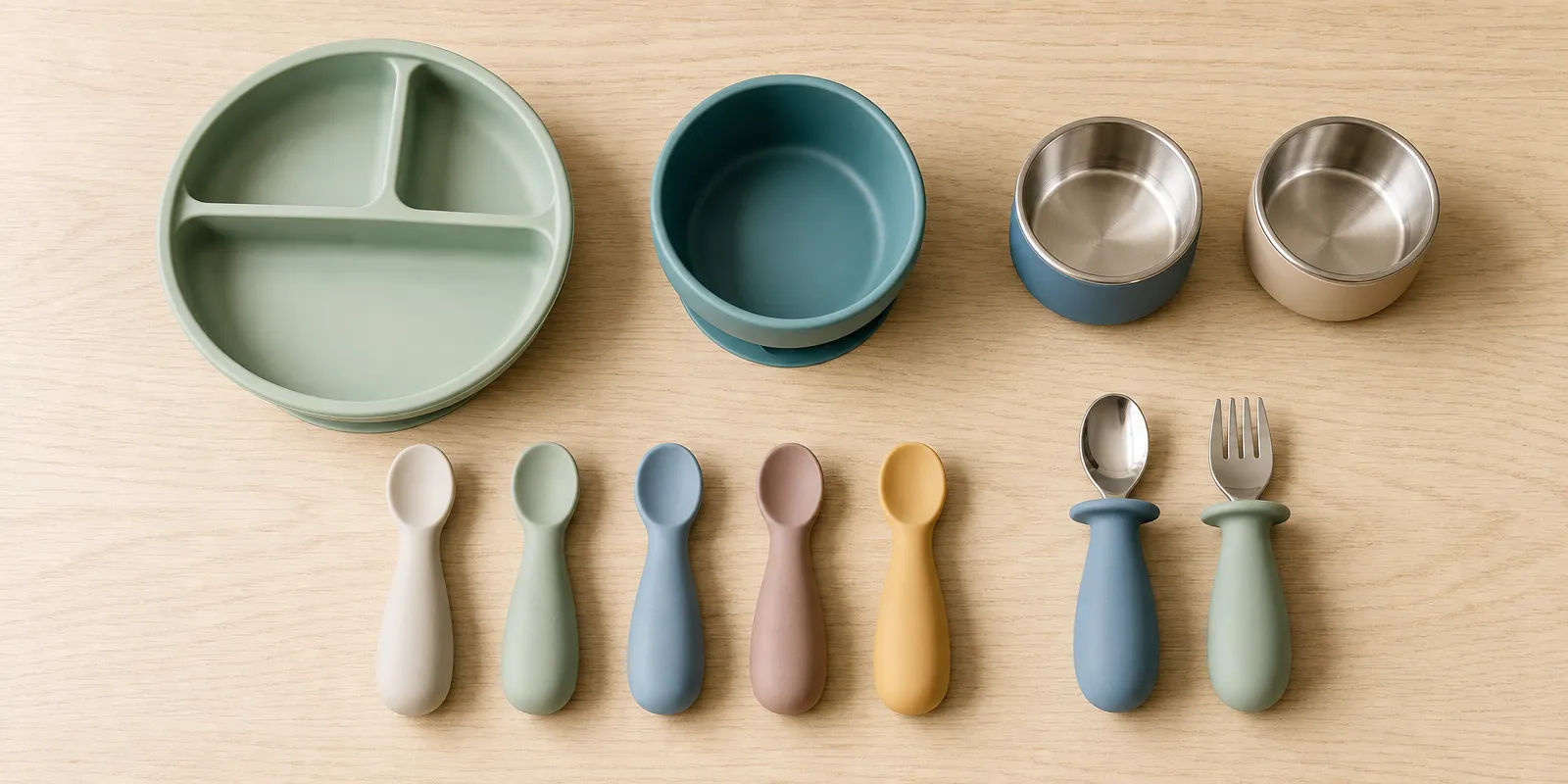
That is most of what this guide is for. Nearly everything in this aisle works, the marketing is close to content-free — BPA free, food grade, 100% silicone — and the properties that decide whether you still use a dish in six months are not on the box. At the start of starting solids you need about three items, not twelve.
What Actually Differs: Five Properties, Not Fifty Features
- Base type: suction or weighted. Suction is strong on glass, sealed laminate and smooth plastic, and useless on raw wood, textured trays and anything with a seam. A weighted base does not care about the surface.
- One piece or two. A separate suction ring means a gap that collects food, plus a part that gets lost.
- Spoon bowl depth. A shallow bowl is what a beginner can actually get food off.
- Handle length, and whose hand it is for. Long handle, adult feeding a baby; short fat handle, baby feeding themselves. Two tools, and you want both.
- Material. Silicone, stainless or plastic, each good at something and bad at something else.
A sixth property is not a feature: everything here is going over the edge of the tray. That is the operating condition, not a flaw to design around — and it is why no glass bowl made this list.
Suction Plates for Babies: Where They Work and Where They Fail
A suction cup holds because you squeeze the air out and nothing gets back in. Anything that lets air creep under the rim breaks the seal: the pores in unsealed wood, ridges moulded into a tray, a non-slip texture, a crumb, a join line. If you can see grain, texture, a ridge pattern or a seam, suction will not hold there.
That makes this a real dependency between two purchases. Among the seats in our guide to the best high chairs for starting solids, the ones with a smooth one-piece plastic tray give you the ideal surface; others have a moulded tray with raised edges or an insert with a lip, and that is where a parent decides a perfectly good plate is defective. Your tray decides whether suction is an option at all.
Suction buys time, not permanence: a determined ten-month-old learns the lift-from-one-edge trick. The base that works everywhere is a weighted one, which is why one pick below has no suction cup.
Silicone, Stainless, or Plastic: The Honest Version
Silicone is unbreakable, quiet when dropped, usually microwaveable and soft on gums. It can also absorb odours — Bumkins says so itself and recommends an unscented detergent — and silicone in a drawer attracts lint like nothing else.
Stainless steel fixes what eventually makes you replace silicone and plastic: it does not stain from tomato or beetroot and it does not hold smells. You cannot microwave it, so a steel bowl serves and reheating happens elsewhere.
Plastic is consumable: it stains, scratches and warps, and under a dollar a spoon that is a fair trade. Glass is absent for the reason above — these dishes get thrown on a hard floor.
What "food grade" actually means
"Food grade" and "FDA approved" are not the same thing, and neither is a certificate a plate earns. What exists is a regulation. FDA's rule on rubber articles intended for repeated use, 21 CFR 177.2600, is the food-contact specification silicone kitchenware is generally made to comply with: it lists the permitted polymers and adjuvants and caps what can be pulled out of the finished surface. For aqueous foods, refluxing distilled water must yield "total extractives not to exceed 20 milligrams per square inch during the first 7 hours," with a parallel n-hexane limit for fatty foods. A migration specification, not a seal of approval.
Bumkins states its silicone is platinum-cured and 100% food-safe: the maker describing its own curing chemistry, untested by us. Bumkins also dismisses the silicone "pinch test" as unscientific — the maker's own position on a claim some competitors make. File both under marketing.
Why every label mentions BPA and phthalates
The concern is documented: NIEHS describes bisphenol A as a chemical "often called an endocrine disruptor because of its ability to alter hormone activity", and notes that most people are exposed through diet because BPA is used widely in food packaging. What sits under the label is a process, not a badge: CPSC requires importers and manufacturers of children's products to issue a written Children's Product Certificate based on testing by a CPSC-accepted third-party laboratory, which is why you will not read "CPSC certified" below. Bumkins states its own products are third-party lab tested to CPSC and CPSIA standards for BPA, lead and phthalates.
The One Safety Note Here, Kept Proportionate
This is cutlery, not a car seat. The honest version is three points.
Seated and supervised. The American Academy of Pediatrics' choking prevention guidance says to "supervise mealtimes for infants and young children," to "insist that children eat at the table or sit down when they eat," and to "never let them run, walk, play or lie down with food in their mouths." That last rule covers the hardware too: no wandering with a spoon in the mouth.
Upright, with head control. The AAP's guidance on starting solid foods puts it in one sentence: "Your baby should be able to sit in a high chair, a feeding seat or an infant seat with good head control."
Small hard parts are what to look for. CPSC treats as a small part "any object that fits completely into the small parts cylinder... which approximates the size of the fully expanded throat of a child under three years old," and the ban exists to prevent "deaths and injuries to children under three from choking on, inhaling, or swallowing small objects" — including pieces that break off in use-and-abuse testing. In a kitchen that is one habit: look at the thing before you hand it over. A chewed-through spoon tip or a nibbled suction ring goes in the bin.
Gagging and choking are different events, and the food side has its own piece: gagging versus choking. Babies reach self-feeding on their own timetable, so talk to your pediatrician about your baby's readiness rather than a date on a box.
Purees or Self-Feeding Changes What You Buy
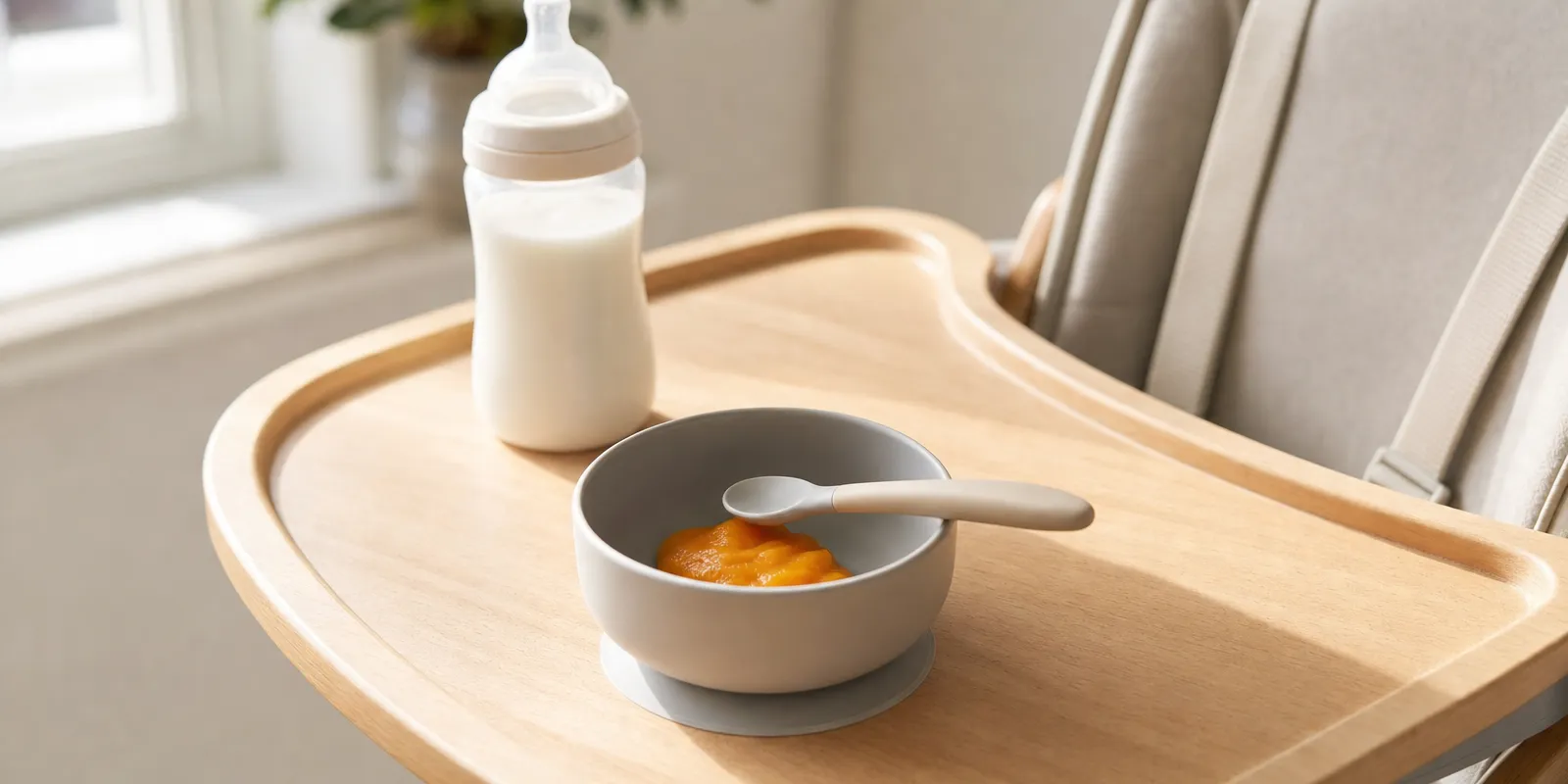
Purees need a bowl with high walls and a shallow spoon in an adult hand. Self-feeding needs the opposite: a flat surface the baby can see food on and food a hand can pick up. Most families do some of each, which is why the kit below is one plate and one bowl. Our comparison of baby-led weaning and purees settles that question; the readiness signs come first, and what goes in the dish is in our guides to first foods and introducing allergens.
The Best Baby Plates and Bowls
Prices are as of October 2026 and move constantly.
Our pick: Bumkins Silicone Grip Dish
The Bumkins Silicone Grip Dish wins on construction, not cleverness: plate and suction base are one moulded piece of silicone. No separate ring means no seam for food to work into and no gasket to peel off and scrub — the chore that sends a nicer plate to the back of the cupboard. The well is divided.
Bumkins lists it as microwave and freezer safe, oven safe to 400F, top-rack dishwasher safe and boilable, so a portion goes fridge to microwave to table in one dish. It is labelled for ages 6 months and up.
Two caveats. The ASIN we sourced is the Disney Toy Story Alien print — Bumkins sells the same dish in plain colours, so buy that version if you want a plain plate. And it is a suction plate, so re-read the surface rule. About $14.39, down from a $19.95 list price.
Best bowl for learning to scoop: OXO Tot Silicone Bowl
The OXO Tot Silicone Bowl is $29.99 — more than twice the Bumkins plate, and nearly twice what three steel bowls cost below. A lot for one bowl, so it has to earn it on two things.
The first is the weighted base: no suction cup, so no surface requirement. It works on oak, on a textured tray, on a table with a seam. Had my oak table met this bowl first, I would never have had that argument.
The second is wall geometry. The walls are soft, high and contoured to push food back toward the middle rather than over the rim. Scooping is the hard part of early self-feeding, and a shallow, straight-sided bowl makes it harder. OXO sized it narrow enough for small hands to carry, and rates it dishwasher and microwave safe. Worth it if your table will not take suction and your baby is learning to load a spoon; otherwise buy the Bumkins plate and keep the fifteen dollars.
Best unbreakable set: PandaEar Stainless Steel Suction Bowls
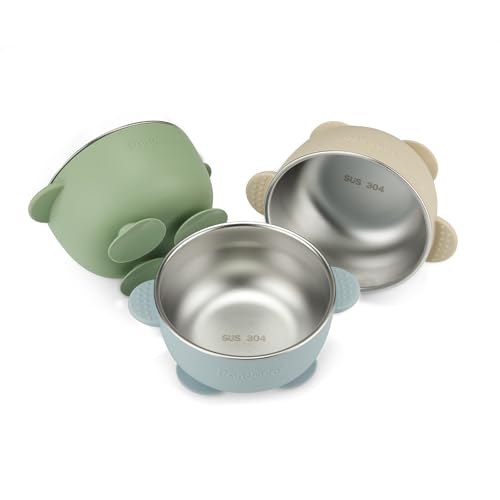
Three bowls for $16.48 — about $5.49 each — is the best value here. The PandaEar bowls are stainless steel inside a removable silicone sleeve with a suction base, and PandaEar states the steel is 304 food grade and resists stains, odours and corrosion. The sleeve damps the clatter when a bowl goes over the edge, and three of anything is the right number.
Now the cost, plainly: these cannot go in the microwave. They are steel, so reheating happens elsewhere and the bowl only serves. If you batch-cook, pair these with baby food storage containers you can reheat in, and serve from the prepped portion. They use suction, so the surface rule applies here too.
The Best Baby Spoons and First Cutlery
Here is what people get wrong, and it costs them a second purchase: a feeding spoon and a self-feeding spoon are two different tools. The spoon you use at six months has a long handle, because you are reaching into a jar or across a tray, and a shallow bowl, because a beginner cannot clear a deep one. The spoon your baby uses has a short, fat handle for a palm grip — how a baby holds anything long before a pencil grip appears.
The timeline is why you need both. HealthyChildren.org from the AAP says to let your baby try feeding herself "as soon as she's ready — usually around 8 or 9 months old," while its self-feeding timeline puts "able to fill his spoon and get it to his mouth consistently" at around 15 months. So there is a long stretch where your baby holds a spoon and you load it.
Best first spoons: Elk and Friends Silicone Spoons
Six soft silicone spoons for $12.99, about $2.17 each. The Elk and Friends set is dual-ended: one end for dipping into a puree, the other a shallow, narrow scoop sized for a small mouth. That shallow bowl is why this is our first-spoon pick — a deep spoon delivers more than a beginner can handle.
The handle is textured and doubles as a teether, useful in the long phase when your baby holds a spoon with no intention of eating from it, and the travel case keeps a clean spoon in the bag. Elk and Friends describes the silicone as food grade and BPA free, dishwasher safe and boilable, and states that the spoons get independent third-party safety testing.
Best budget spoons: Munchkin Soft Tip Infant Spoons
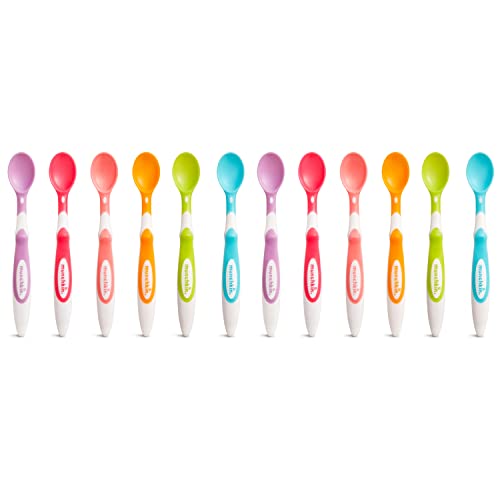
Twelve spoons for $6.92, down from $8.99 list — about 58 cents each, roughly a quarter of the per-spoon price of the Elk and Friends set. The Munchkin Soft Tip spoons are plain plastic with rounded soft tips and a shallow bowl. Nothing clever.
Be clear on what they are, because the price makes them sound like the best spoon here and they are not the best spoon for every job. The handle is long and shaped for an adult grip — Munchkin says it reaches the bottom of a baby food jar. These are spoons you feed with, not spoons a baby learns to load. They answer a different question: where do I keep a spoon? These live in the glovebox, the changing bag and a grandparent's drawer, and losing one costs about sixty cents.
Best for moving to real cutlery: Ali+Oli Spoon & Fork Set
The Ali+Oli learning set is a stainless spoon and fork on chunky food-grade silicone handles, $14.99. The handles are fat enough for a palm grip, which is why this works where a slim metal toddler spoon does not. The fork has rounded teeth that spear a soft cube of sweet potato without being sharp, the handles are BPA, PVC and phthalate free, and Ali+Oli describes a moulded collar behind each utensil head as a shield that deters it from going too deep into the mouth.
It is labelled 6 months and up, but set expectations by the milestone, not the label. This is a transition-to-cutlery product that earns its place from around 9 to 12 months onward; a six-month-old will wave it and drop it, which is fine but is not cutlery use. Buy it second, not first.
One spec to report rather than referee: Ali+Oli says its utensils are 316 stainless, where the PandaEar bowls are 304. Grade 316 contains 2 to 3 percent molybdenum, which 304 does not, and that molybdenum "gives 316 better overall corrosion resistant properties than Grade 304, particularly higher resistance to pitting and crevice corrosion in chloride environments." Both are standard food-contact steels, so treat it as a mild bonus.
How the Six Compare
| Item | Type | Material | Base | Microwave | Dishwasher |
|---|---|---|---|---|---|
| Bumkins Grip Dish | Divided plate | Silicone; maker states platinum-cured | Suction, one moulded piece | Yes; oven to 400F | Top rack; boilable |
| OXO Tot Silicone Bowl | Bowl, high walls | BPA-free silicone | Weighted, no suction | Yes | Yes |
| PandaEar Bowls (3) | Bowls, 3-pack | 304 stainless per maker, silicone sleeve | Suction, removable sleeve | No — steel | Yes |
| Elk and Friends Spoons (6) | Dual-ended spoons | Food-grade silicone | n/a | Not stated | Yes; boilable |
| Munchkin Soft Tip Spoons (12) | Spoons, adult handle | BPA-free plastic | n/a | Not stated | Not stated |
| Ali+Oli Spoon & Fork | Spoon and fork | 316 stainless per maker, silicone handles | n/a | Not stated | Yes |
A "not stated" cell means our source data is silent, not that the product fails.
What You Actually Need to Buy
Three items. Not twelve, and not a fourteen-piece boxed set with a cup and a snack pot you will never use.
- One plate or bowl that stays put on your surface. Smooth tray or sealed table: the Bumkins Silicone Grip Dish at about $14.39. Wood, texture or a seam: a weighted bowl instead.
- A multipack of shallow feeding spoons. The Elk and Friends six-pack at about $12.99, or the Munchkin twelve-pack at about $6.92 if you would rather scatter cheap spoons about.
- A bib and something on the floor. Not in this guide, and more use to you than a third dish.
That is about $27.38 as of October 2026 for the plate and the good spoons together, and it is enough to start. Buy later, once your baby shows you the gap: a second bowl, because one is always in the dishwasher, and a toddler fork and spoon at around 9 to 12 months. Skip the five-compartment tray — portion theatre for a baby eating a tablespoon or two.
All of this ends up in a low cupboard, where a toddler can reach their own bowl and a crawler finds everything else. If you have not done that pass, baby-proofing your kitchen covers the latches, the cords and the appliance zone in order. Soft unbreakable things in the reachable drawer; sharp and heavy things higher up.
The Bottom Line
Buy for the base, the number of pieces and the handle length, and ignore the rest of the listing.
For most families that is the Bumkins Silicone Grip Dish at about $14.39 as of October 2026 — provided you have a smooth tray or sealed table for it to grip, and remembering that our link is the Toy Story Alien print. If your table is wood, textured or seamed, skip suction and spend $29.99 on the OXO Tot Silicone Bowl. If stains and smells are what will eventually make you bin a dish, the PandaEar steel bowls at $16.48 for three are the cheapest fix — as long as reheating can happen somewhere else.
Then do the free part at every meal: sit your baby down, stay in the room, and look at the spoon before you hand it over.
When the kit is sorted, our complete starting-solids guide walks through the first month in order — what to offer, how much, and what the mess should look like. The dishes are the easy part. You've got this.

Bumkins Disney Silicone Grip Dish Suction Plate (Toy Story Alien)
A one-piece silicone plate with a divided well and a suction base that grips a high chair tray or a smooth table. Because plate and base are a single moulded piece, there is no seam to trap food and no separate suction ring to lose. Bumkins says the silicone is platinum-cured, oven-safe to 400F, and top-rack dishwasher safe, so it moves from fridge to microwave without a second container.
- Brand
- Bumkins
- Category
- Our Pick
The one-piece build is the part that matters six months in: there is no gasket to peel off and scrub, which is the exact chore that makes a nicer plate end up at the back of the cupboard.

OXO Tot Silicone Bowl
This one solves a different problem from a suction plate: instead of sticking down, it uses a weighted base to stay put, and its soft high walls are contoured to push food back onto the spoon rather than over the rim. That wall shape is the whole point — scooping is the hard part of early self-feeding, and a shallow bowl makes it harder. OXO designed it narrow enough for a baby to carry, and it is dishwasher and microwave safe.
- Brand
- OXO
- Category
- Best Bowl for Learning to Scoop
A weighted base is quietly better than suction on a textured or wooden table, where suction simply does not take and you end up holding the bowl yourself.
PandaEar Stainless Steel Baby Suction Bowls, 3-Pack
Three bowls built from 304 food-grade stainless steel inside a removable silicone sleeve with a suction base. Steel is the answer to the two long-run complaints about silicone and plastic: it does not stain from tomato or beetroot and it does not hold onto odours. The trade-off is that you cannot microwave them, so reheating happens elsewhere and the bowl is only for serving. The sleeve also damps the clatter when a bowl goes over the edge.
- Brand
- PandaEar
- Category
- Best Unbreakable Set
Three bowls at this price means one is always clean, which in practice matters more than any single feature on the box.

Elk and Friends Baby Silicone Spoons, 6-Pack with Travel Case
Six soft silicone spoons with a dual-ended design: one end shaped for dipping into a puree, the other a shallow, narrow scoop sized for a small mouth. The shallow bowl is the feature that matters at the start, because a deep spoon delivers more than a beginner can manage. The textured handle doubles as a teether, and a travel case keeps a clean spoon in the bag rather than loose at the bottom of it.
- Brand
- Elk and Friends
- Category
- Best First Spoons
Six spoons is the right number. One spoon means washing up mid-meal; six means a week of lunches before the dishwasher has to run.
Munchkin Soft Tip Infant Spoons, 12-Pack
Twelve rounded, soft-tipped plastic spoons with a shallow bowl and a handle long enough to reach the bottom of a jar. There is nothing clever here, and that is the appeal: at this price you can keep a fistful in the nappy bag, the car and the kitchen drawer and not care when one disappears. The handle is sized for an adult hand, so these are spoons you feed with rather than spoons a baby learns to load.
- Brand
- Munchkin
- Category
- Best Budget Spoons
These are the spoons that live in the glovebox and the changing bag. Losing one costs about sixty cents, which is the correct emotional response to losing a spoon.

Ali+Oli Spoon & Fork Learning Set for Toddlers
A stainless steel spoon and fork on chunky food-grade silicone handles, labelled from six months. The fork has rounded teeth that will pick up a soft cube without being sharp, and the handles are fat enough for a palm grip, which is how a baby holds a utensil long before a pencil grip appears. Ali+Oli describes the moulded collar behind the bowl of each utensil as a shield that stops it going too far into the mouth.
- Brand
- Ali+Oli
- Category
- Best for Moving to Real Cutlery
The fat silicone handle is the difference between a utensil a baby waves and a utensil a baby actually gets to their mouth.
- 01
- 02OXOBest Bowl for Learning to ScoopOXO Tot Silicone Bowl
- 03PandaEarBest Unbreakable SetPandaEar Stainless Steel Baby Suction Bowls, 3-Pack
- 04Elk and FriendsBest First SpoonsElk and Friends Baby Silicone Spoons, 6-Pack with Travel Case
- 05MunchkinBest Budget SpoonsMunchkin Soft Tip Infant Spoons, 12-Pack
- 06Ali+OliBest for Moving to Real CutleryAli+Oli Spoon & Fork Learning Set for Toddlers
Do suction plates work on a wooden table?+
When can a baby use a spoon by themselves?+
Is silicone safe in the microwave?+
Sammie Seelbach
Sammie is a mom of two and the lead reviewer at Smart Baby Reviews. Since becoming a parent she has become obsessed with researching the safest, smartest baby gear on the market — testing thermometers at 2 a.m., wrangling baby gates, and sterilizing more bottles than she can count. She shares what actually works so other parents can make confident, informed decisions for their little ones.