How to Set Up a Safe Sleep Space for Your Baby
This post may contain affiliate links. Read our policy.
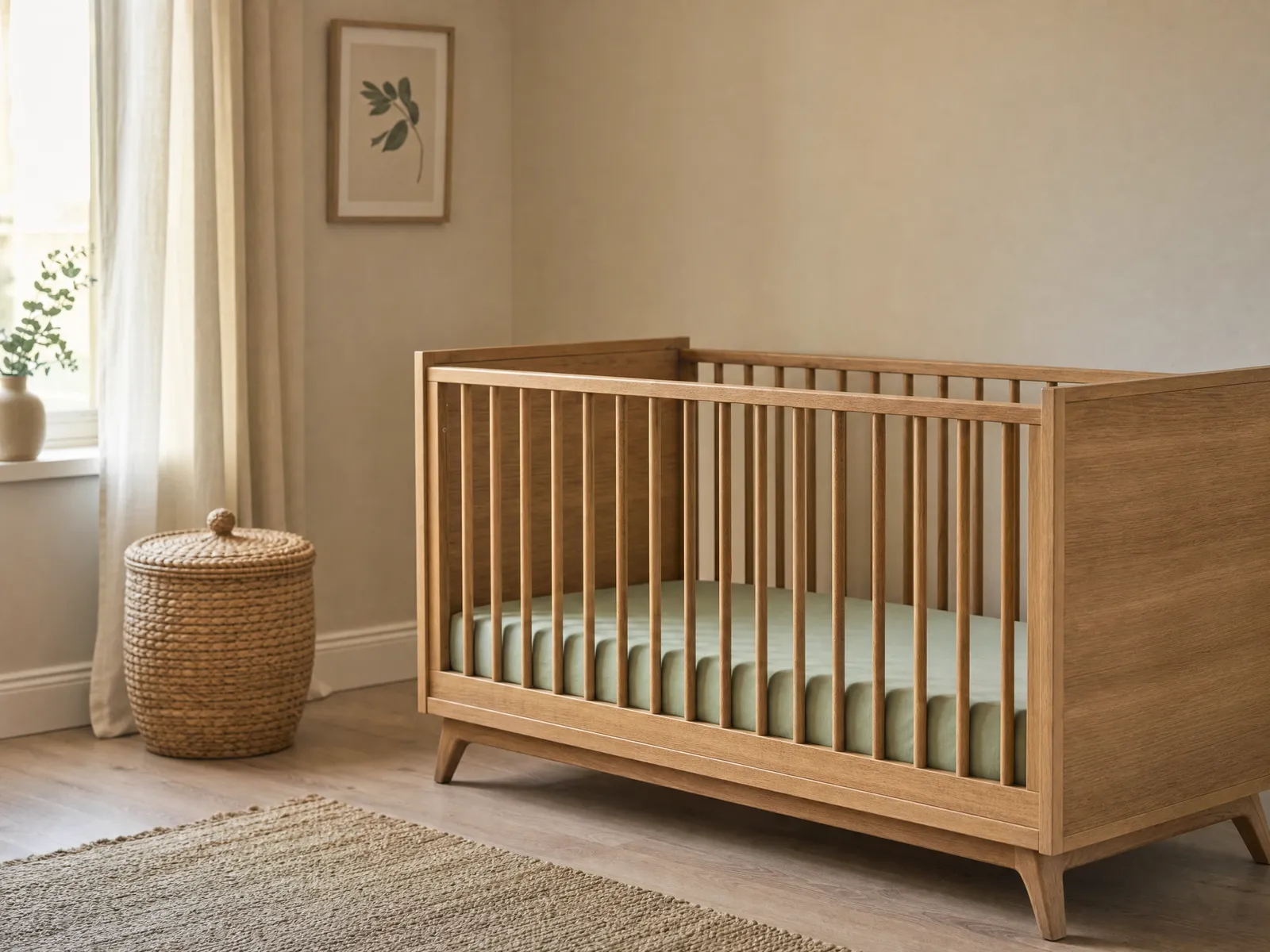
A safe sleep space is a firm, flat, level surface with a fitted sheet on it and nothing else, placed in the room where you sleep, with your baby put down on their back. That is the entire specification. Some of the links below are affiliate links, and we may earn a small commission, at no extra cost to you, if you buy through them.
The night before we brought our daughter home, I stood in her room at about eleven o'clock taking things back out of the crib. A quilt my aunt had made. Two stuffed rabbits. A rolled cotton blanket I had tucked into the corner because that is how the crib looked in the photograph on the box. All of it went into a basket on the dresser, and what was left looked bare and faintly sad, which it turns out is exactly right.
That is the hard part of safe sleep, and it is not the rule. The rule is short enough to fit on a fridge magnet. The hard part is that nearly every nursery photograph you have ever seen breaks it, and so does half of what gets marketed to you at 2am. So here is the room-level version: what to put your baby on, what to keep out, what the three federal standards rewritten in 2026 actually changed, and the handful of free decisions that matter more than anything you can buy. The rest of the house is covered in our guide to baby-proofing your home. This page is the crib and the four walls around it.
Choose the Sleep Surface: Bassinet, Crib, or Play Yard
For the first months most families use a bassinet or a crib, and the honest answer is that either is fine. What matters is not which category you pick but that the product is built and sold as a place for an infant to sleep, because those categories each have a mandatory federal standard behind them: full-size cribs, non-full-size cribs, bassinets and cradles, play yards, and bedside sleepers.
The American Academy of Pediatrics' parent guide to safe sleep sets the physical requirement: a firm, flat sleep surface, where firm means "it shouldn't indent when your baby is lying on it," and where "any surface that inclines more than 10 degrees isn't safe for your baby to sleep on."
That single sentence disqualifies a lot of things people sleep babies in. Car seats, swings, bouncers, loungers and nursing pillows are not sleep surfaces, and the fix when a baby falls asleep in one is to move them to a flat surface as soon as you reasonably can.
The regulation that closed the loophole is worth knowing by name. In 2021 CPSC issued the Safety Standard for Infant Sleep Products, 16 CFR 1236, which took effect on June 23, 2022. It says that any product marketed or intended to provide a sleeping accommodation for an infant up to five months old, and that is not already covered by the crib, bassinet, play yard or bedside sleeper standards, must meet the bassinet standard anyway. CPSC's guidance names the products it had in mind: in-bed sleepers, baby boxes, compact and travel bassinets, baby nests, and infant travel tents. Before that rule, a "nest" or a "pod" could be sold for infant sleep against no standard at all.
One free decision beats every purchase in this section: where the thing goes. The AAP's crib guidance says to place the crib away from windows and to make sure there are no strings from blinds or curtains close by that could wrap around your baby's neck. CPSC reports that on average about nine children under five years of age die each year from strangulation involving window covering cords, which is why cords and blind cords belong on the pre-birth list rather than the crawling-stage list. Move the crib to an inside wall. It costs nothing and takes a minute.
Room Sharing: Where the Sleep Space Goes
The highest-value safe sleep decision most parents make is not a product. It is which room the crib or bassinet stands in.
The AAP recommends keeping your baby's sleep area "in the same room (but not in the same bed) where you sleep for at least the first 6 months," and states that room sharing "can decrease the risk of SIDS by as much as 50%." The same guidance is blunt about the other half: "the AAP doesn't recommend bed sharing with your baby under any circumstances."
The scale is worth stating plainly, once, because it is why the rest of this page is written the way it is. According to CDC data, there were about 3,400 sudden unexpected infant deaths in the United States in 2024, the most recent year CDC reports: 1,351 from SIDS, 1,099 from unknown causes, and 947 from accidental suffocation and strangulation in bed. That last category — more than a quarter of the total — is the one a sleep space is set up to prevent.
In practice, room sharing means measuring your own bedroom before the baby comes. A bassinet needs less floor than people expect and a full-size crib needs more, and the two questions that decide it are whether you can walk around the bed at night without barking a shin, and whether the sleep surface can sit away from the window, the radiator, the blind cords and the nightstand. If a full-size crib genuinely does not fit, that is one of the few real arguments for starting with a bassinet.
The other thing room sharing changes is your own bed. Blankets, pillows and a mattress meant for adults are not a safe sleep surface, so the aim is that the baby's surface is close enough to reach without lifting them into yours.
What Changed in 2026, and What It Does Not Do for the Crib You Already Own
Three of the federal standards behind these products were updated inside twelve months, which is unusual, and it makes most guides written before this year quietly out of date.
- Bassinets and cradles. CPSC published a direct final rule on December 12, 2025 updating 16 CFR 1218 to incorporate ASTM F2194-25, effective February 21, 2026. The updated standard expands scope to cover aftermarket mattresses and revises requirements around height, stability, rigidity and battery- or mains-powered products.
- Crib mattresses. A direct final rule published February 12, 2026 updated 16 CFR 1241 to ASTM F2933-25, effective May 3, 2026. Among the additions to the ASTM standard are firmness requirements and coil spring laceration prevention requirements — both of which ASTM adopted from modifications CPSC had already imposed in 2022, and which CPSC has now dropped from its own text as redundant. CPSC kept four of its existing modifications, including a mattress compression test that addresses hazardous corner gaps, on the grounds that dropping them would reduce safety.
- Full-size cribs. A direct final rule published May 4, 2026 updated 16 CFR 1219 to ASTM F1169-25, with an effective date of August 1, 2026. The new version adds requirements for mesh- and fabric-sided products, adds requirements for protective components and bassinet or cradle accessories, and adds new warnings.
Direct final rules like these take effect automatically on the stated date unless CPSC receives a significant adverse comment during the comment window, which is why the dates are worth checking against the docket rather than taking from any blog, this one included.
Now the part that matters more than any of it. A standard applies to products newly manufactured or newly imported. It does nothing at all for the crib already standing in your spare room. We made the same point about the STURDY Act in our piece on when to start baby-proofing, and it holds here: the rule protects the next buyer, not the current owner.
So for a hand-me-down, the questions are historical. CPSC's mandatory crib standards took effect on June 28, 2011, banning traditional drop-side cribs, strengthening slats and mattress supports, improving hardware quality and requiring more rigorous testing — the agency linked detaching drop-side rails to at least 32 infant suffocation and strangulation deaths since 2000. CPSC's resale guidance is that a full-size crib made before that date should not be resold without written proof it meets the applicable requirements.
Five minutes with a flashlight settles it: find the manufacture date on the label, check the model number against the recall listings at SaferProducts.gov, confirm the slats are no more than 2 3/8 inches apart as the AAP describes, make sure every piece of original hardware is present and tight, and put anything with a drop side beyond use rather than passing it on. The AAP is equally direct about the pretty option: antique cribs rarely conform to current slat spacing, and their finish may include old layers of lead-based paint.
The Mattress: Firm, Flat, and a Snug Fit
Two properties do all the work here, and they are crib mattress firmness and fit. Everything else — organic covers, coil counts, dual zones — is comfort or chemistry, not safe sleep.
Firmness. The AAP's test is one you can run with your hand: a firm surface "shouldn't indent when your baby is lying on it." An adult mattress feels supportive and is not firm by this definition. Neither is memory foam, a mattress topper, a folded quilt or a sheepskin. Firmness has been part of the mandatory federal standard since CPSC's 2022 crib mattress rule, which bolted a firmness test onto ASTM F2933-21 as its own modification. What the 2026 update changed is where that test lives: ASTM F2933-25 now carries a firmness requirement and test method of its own, so CPSC has removed its separate modification and let the ASTM version govern.
Fit. The AAP asks that the mattress be designed for your specific crib and that "it should fit snugly, with no space between the mattress and the crib walls." The familiar shorthand is that you should not be able to fit more than two fingers between the mattress and the crib frame, and CPSC's retained compression test exists precisely because corner gaps are the failure mode that shorthand is trying to catch. A gap is an entrapment hazard, and it is the one defect a tired parent will not notice at 3am.
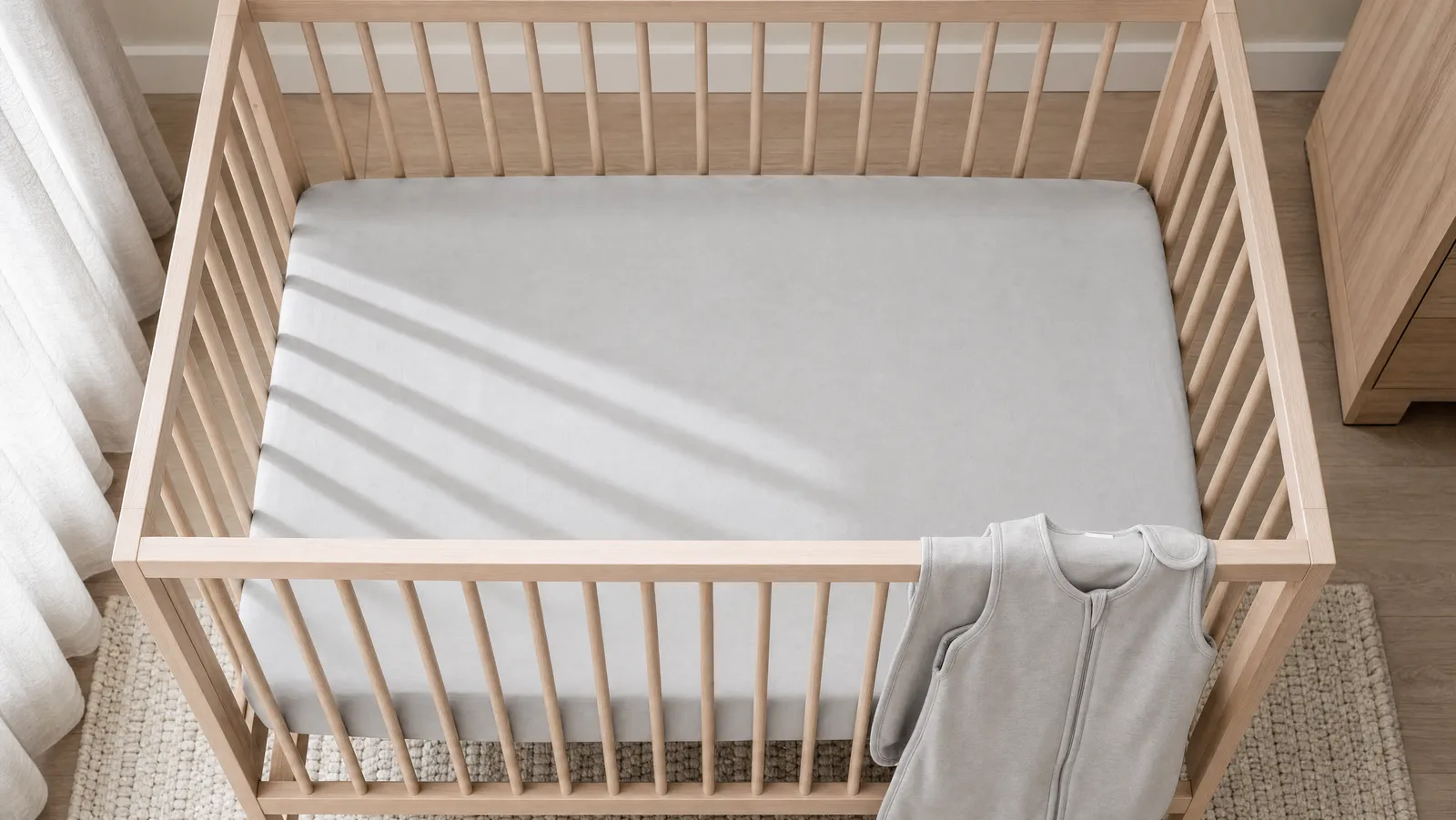
Then the sheet, and only the sheet. A fitted sheet made for that mattress, pulled tight, with nothing under it and nothing over it.
If you are buying new, the Delta Children Sweet Beginnings dual-sided mattress is the shape of thing to look for, at 79.99 dollars as of August 2026: a firm infant side you use for the whole first stage and a toddler side you flip to later, so you buy one mattress instead of two. It measures 52 by 27.5 by 5 inches for a standard full-size crib, the cover is waterproof-backed, and it is GREENGUARD Gold certified with CertiPUR-US approved foams. One practical note from the spec sheet: it ships compressed and can take up to 48 hours to fully expand, so unbox it two days before you need it, not the night before.
Whatever you buy, measure your crib first and buy the mattress for that crib. A mattress that fits "most" cribs is not a specification.
What Does Not Belong in the Crib
The list of what is banned from the crib is short, and part of it is federal law rather than advice.
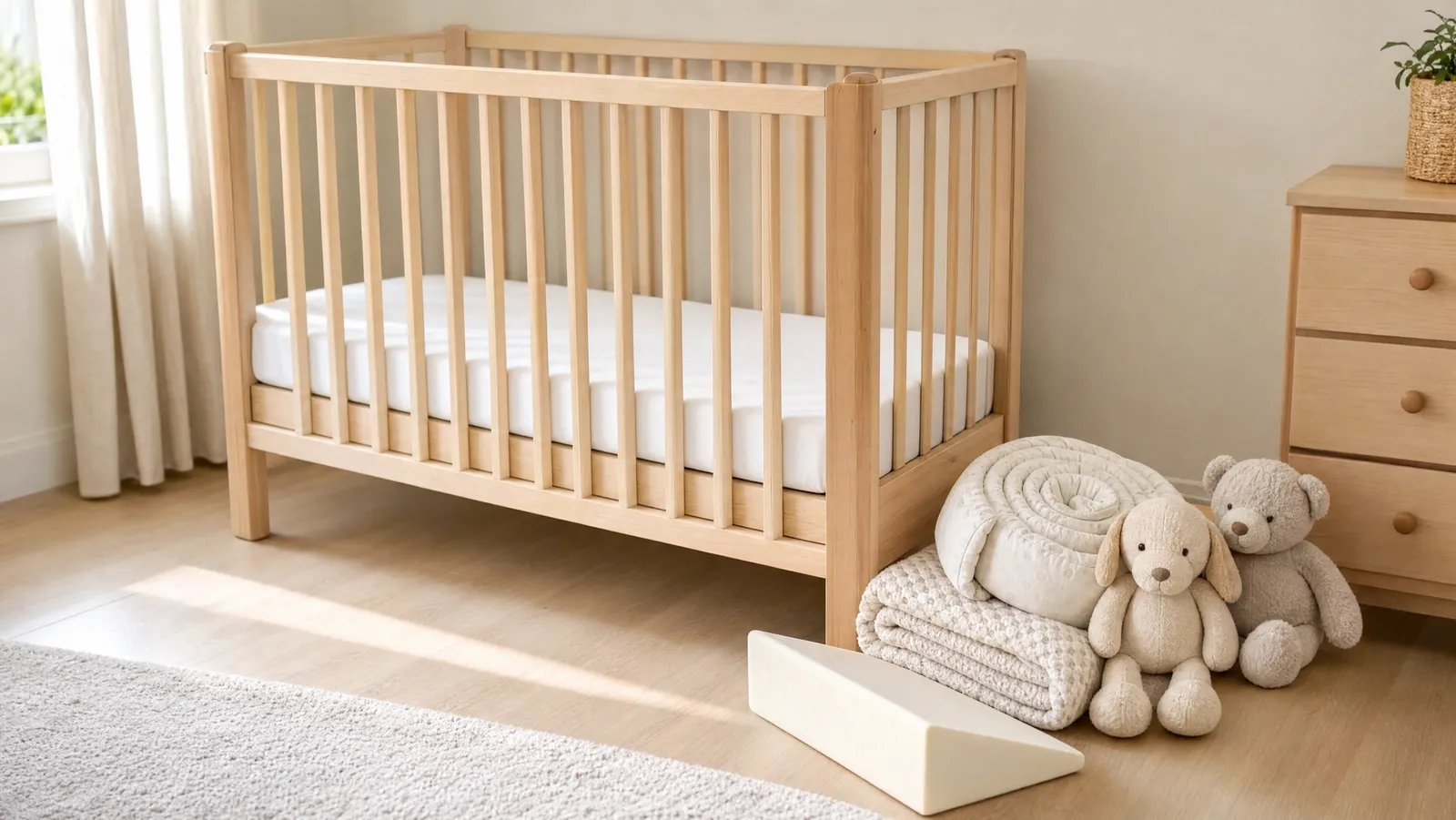
The AAP's version covers the soft objects and loose bedding that increase the risk of entrapment, suffocation or strangulation, and it names them: "pillows and pillow-like toys, quilts, comforters, mattress toppers, non-fitted sheets, blankets, toys, bumper pads or related products that attach to crib slats or sides."
Two of those are now illegal to sell. The Safe Sleep for Babies Act, signed in May 2022, made inclined sleepers for infants and crib bumpers banned hazardous products under section 8 of the Consumer Product Safety Act, effective November 12, 2022, regardless of the date of manufacture. An inclined sleeper is defined as a product with a sleep surface inclined more than 10 degrees intended, marketed or designed for infants up to one year old — the category the Fisher-Price Rock 'n Play belonged to, along with the inclined "napper" accessories sold with some play yards, which Consumer Reports has tied to infant deaths. A crib bumper is defined by what it does rather than what it is made of: any material intended to cover the sides of a crib to prevent injury from impacts against the side, or to block access to openings in the sides. Padded bumpers, vinyl bumper guards and vertical crib slat covers are all named.
The practical upshot is the one people miss. "Regardless of the date of manufacture" means the bumper set your cousin is offering you, and the inclined sleeper in the corner of the consignment store, are both covered. They are not legal to resell, and they should not go back into service. The reason to throw them away rather than pass them on is the whole point of the law.
A shorter way to hold all of this: if it is not the mattress, the fitted sheet, or the baby, it does not go in. No positioners. No wedges. No breathable mesh liners tied to the slats. No monitor clipped to the rail. Not the swaddle blanket after your baby outgrows it, and not the toy that is only there for the photo.
Dress the Baby, Not the Crib: Sleep Sacks
Once blankets are out, warmth has to go on the baby instead of over them. This is what baby sleep sacks are for, and it is the single substitution that makes a bare crib feel manageable at 4am in February.
A wearable blanket is a sleeved or sleeveless bag the baby wears over their pajamas. It cannot ride up over the face, it cannot be kicked into a corner and bunched, and it comes with a useful side effect: once your toddler is tall enough to think about climbing, a sleep sack makes getting a leg over the rail harder.
Three things to check, in order:
- The neck opening should be smaller than your baby's head. This is the fit that keeps the sack from riding up. Manufacturers size by weight and length rather than age alone, so use the chart, not the birthday.
- Arms stay out. A sleep sack is not a swaddle, and it is what most families move to when swaddling ends.
- Room for the hips and legs. A roomy leg area lets the hips sit in a frog-legged position, which is what hip-healthy design means in practice.
The Yoofoss three-pack is a reasonable default at 25.19 dollars as of August 2026: GOTS-certified organic cotton, rated 0.5 TOG for warmer rooms, with a two-way zipper that opens from the bottom so you can change a diaper without undressing the whole baby, plus an interior zipper guard and a top zipper cover between the hardware and your baby's skin. Sizes run from small at 0-6 months up to extra large at 18-24 months. The reason to buy three rather than one is laundry, not variety.
You do not have to buy any of these. A footed sleeper in a room that is warm enough does the same job for whatever you already spent on pajamas. The sleep sack is a convenience and a hedge against the blanket habit, not a safety device in its own right.
Getting the Temperature Right
Overheating is a documented risk factor, and it is easy to get wrong in both directions on the same night.
The AAP's instruction is refreshingly unfussy: "Don't let your baby get overheated. Overheating can increase the risk of SIDS," and "you should dress your baby in only one layer more than you're wearing." It adds a rule most people have never heard: do not put a hat on your baby indoors once you are home from the hospital. The NICHD's Safe to Sleep program frames the room the same way — keep it at a temperature that is comfortable for you, dress your baby in a wearable blanket rather than adding a loose blanket to the sleep area, and treat sweating, flushed or hot skin, or a chest that feels hot to the touch as a sign your baby may be too warm.
Notice that neither source gives you a number in Fahrenheit, and neither one mentions TOG ratings, which is worth saying out loud on a page full of product links. TOG is a textile measure of thermal resistance used by manufacturers to grade how insulating a garment is, on a scale that generally runs from about 0.5 for the lightest summer sacks up to 3.5 for the heaviest. It is genuinely useful for comparing two sacks from the same brand. It is not a safety certification, no US regulator sets it, and the temperature ranges printed on the packaging are the manufacturer's own. Two 1.0 sacks from two brands are not guaranteed to feel the same.
So use the number as a rough shopping guide and the AAP's layering rule as the actual check. In practice that means: an inexpensive thermometer in the room so you are not guessing, one layer more than you are comfortable in, and a hand on the back of your baby's neck or chest rather than their hands and feet, which run cool on everybody.
Then adjust for the season rather than the calendar. A 0.5 TOG sack and a short-sleeved bodysuit is a summer setup; the same sack in a cold January bedroom is not, and the answer is a heavier sack or warmer pajamas, never a blanket added on top.
Swaddling, and When to Stop
Swaddling is one of the few genuinely old-fashioned baby tricks that still works, and it has one hard stop.
The AAP's answer to when to stop swaddling is not an age. From its swaddling guidance and its parent safe sleep guide: "When your baby looks like they're trying to roll over, you should stop swaddling them. The risk of suffocation is higher if your baby rolls to their stomach while they're swaddled." Rolling usually shows up around three to four months, "but it can happen earlier." Some babies start working on it at two.
The mechanism is the part that convinced me. A swaddled baby who reaches their stomach cannot use their arms to push up or turn their head. Every other sleep skill they have is unavailable at exactly the moment they need it. That is why the trigger is the attempt, not the achievement — you stop when you see them trying, because the first successful roll will happen while you are asleep.
While you are still swaddling:
- Baby stays on their back, every time, swaddled or not.
- Snug across the arms and chest, loose at the hips. The blanket should let the legs bend up and out at the hips rather than holding them straight.
- Nothing over the face, and nothing else loose in the crib. A swaddle that has come undone is a loose blanket, which is the argument for a zip or velcro design over a hand-wrapped one.
- A swaddled baby is easy to overdress. The swaddle counts as a layer.
And if swaddling never works for your baby, plenty of them do fine without it. Skipping straight to a sleep sack with the arms out is a normal outcome, not a failure.
Weighted Sleep Sacks and Weighted Swaddles
That leaves weighted sleep sacks and weighted swaddles, the one product category on this page I would tell you to skip outright.
The AAP's 2022 policy statement is explicit that weighted swaddle clothing, or weighted objects within swaddles, are not safe and are therefore not recommended. CPSC's own safe sleep guidance is just as short: do not use weighted blankets or weighted swaddles. According to the AAP, these products are associated with concerning reductions in oxygen saturation in infants, which if sustained may be harmful to the developing brain.
The market has moved with the guidance rather than against it. In April 2024, Amazon, Target, Babylist and other retailers said they would stop selling weighted infant sleep products, a decision AAP leaders called a "strong first step". You will still find these products secondhand and from direct sellers, often marketed with the exact language an exhausted parent is searching for at midnight.
I want to be careful here, because the appeal is real and it is not silly. Weighted products are sold on the promise of longer stretches, and if you are five weeks in on ninety-minute sleep cycles, that promise lands. But the entire safety case rests on nothing restricting an infant's chest movement or their ability to shift position, and weight is the one variable that works directly against both. If your baby only settles under pressure, that is a conversation with your pediatrician rather than a purchase.
The same reasoning applies to anything else that adds mass or restraint to the sleep space: weighted blankets, weighted toys, positioners and wedges. None of them belong in a crib.
When Your Baby Starts Rolling
The rules change once your baby can roll over, though less than parents fear.
The AAP's position is that you always place your baby on their back to start sleep. "But if they're comfortable rolling both ways (back to tummy, tummy to back), then you don't need to keep turning your baby to their back again. Just be sure that there are no blankets, pillows, stuffed toys or bumper pads in your baby's bed." If your baby can only roll one way so far, you can turn them back over when they end up on their stomach.
That last clause is the reason a bare crib matters more at this stage than it did in week one. A newborn who cannot move is not going to find the muslin in the corner. A five-month-old who rolls, scoots and reaches absolutely will.
Three jobs land at the same time:
- Stop swaddling, at the first sign of trying to roll, per the section above.
- Lower the mattress. The AAP advises lowering it periodically as your child gets taller, and the trigger most families use is the day their baby can push up on their hands. Do it a stage early rather than a stage late.
- Clear the reachable radius. Anything a standing baby can grab through or over the rail is now part of the sleep space: a mobile hanging low, a wall shelf, the corner of a blanket draped over the rail, a cord.
This is also the point where the nursery stops being a room your baby is carried into and starts being a room they operate in. Our stage-by-stage guide to when to start baby-proofing covers the sequence for the rest of the house, and the timing rule is the same one that governs a crib: work one milestone ahead of the baby in front of you.
Sound, Light, and the Rest of the Room
The last set of decisions are about the room rather than the crib, and one of them has a number attached that most parents have never seen.
That is the case for white noise machines, and specifically the case against putting one on the crib rail. A 2014 study in Pediatrics measured 14 infant sleep machines at maximum volume and found that all of them exceeded 50 A-weighted decibels at 30 cm, which is the recommended noise limit for infants in hospital nurseries, and that three exceeded 85 dBA — a level that, sustained over eight hours, exceeds occupational noise limits for adults. The authors' recommendations were practical: place these machines as far from the infant as possible, never on the crib rail or in the crib, play them at low volume, and run them for a short duration rather than all night.
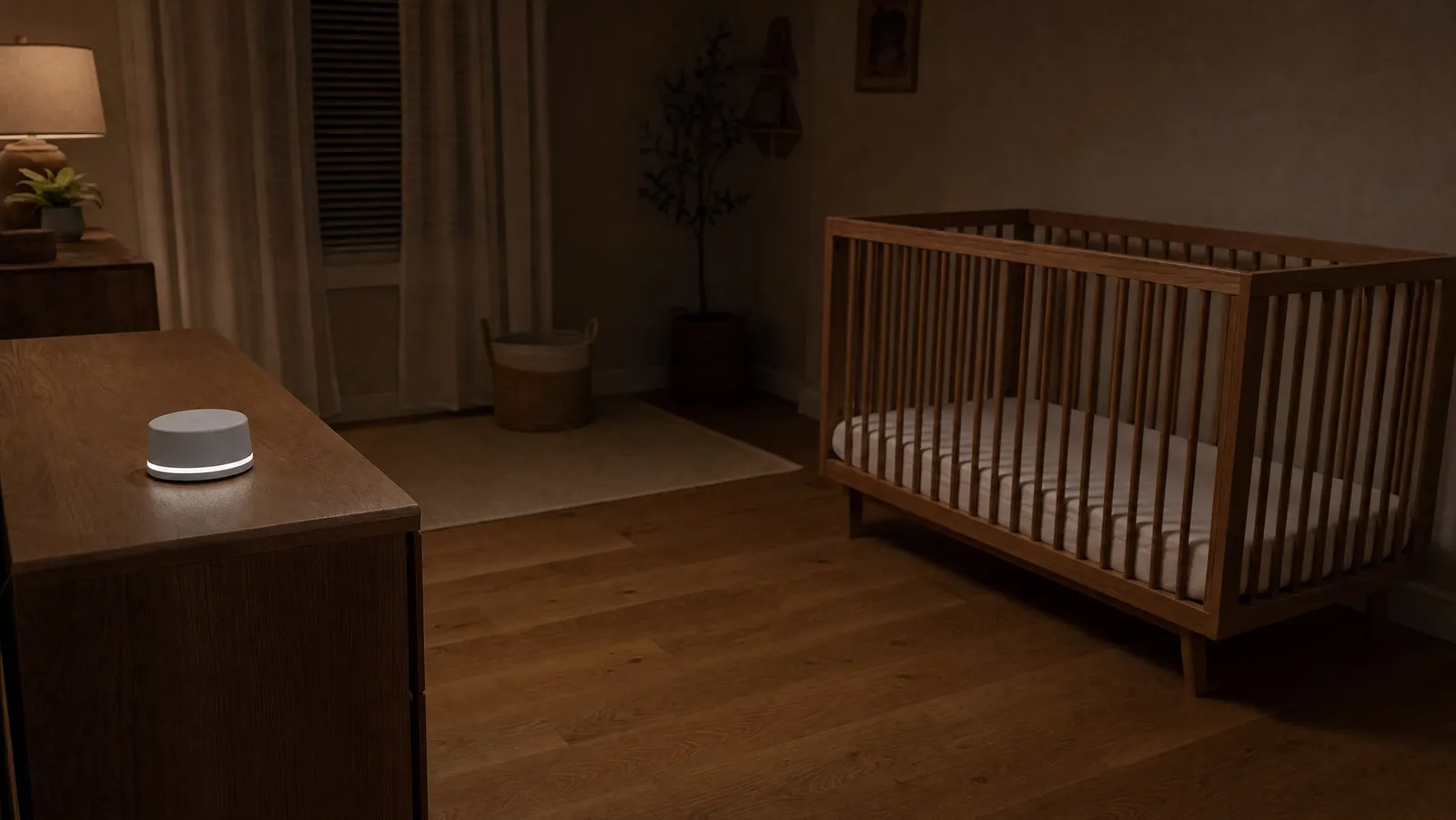
That last one is what makes a timer a buying criterion rather than a nice-to-have. The Momcozy sound machine, 24.99 dollars as of August 2026, runs 1, 3 or 6 hour timers and remembers your last sound and volume, and its top surface is a touch-dimmable lamp, which turns out to be the part you use most during night feeds. Across the room, on a dresser, lowest volume that works, on the shortest timer that works.
Light is comfort, not safety. Blackout curtains help some babies and do nothing for others, and neither outcome is a safety question — with one exception: curtains and blinds bring cords, and cords near a sleep space are the hazard covered in our guide to cords and blind cords. Corded blinds in a nursery are the one thing in this room I would replace rather than manage.
Then everything with a plug. CPSC recommends placing cords at least three feet away from any part of the crib, bassinet, play yard or other safe sleep environment, and never positioning a monitor inside or on the edge of a crib; since 2002 the agency has reported seven infants and toddlers strangled in baby monitor cords and three near-strangulations. Measure it rather than eyeballing it. The same three feet applies to the humidifier, the lamp and the sound machine.
And the furniture. The dresser that doubles as a changing table is the heaviest thing in the room and the one a toddler will eventually climb, so anchor the furniture to the wall while the room is still empty and the job takes ten minutes. If you are doing that, you may as well work through the rest of the house in the same pass — our room-by-room walkthrough of how to baby-proof your home puts the nursery in context with everywhere else your baby will end up.
The room you are aiming for is duller than the ones in catalogues. A bare crib against an inside wall, a monitor across the room, nothing hanging over the rail, a sound machine on a timer, a dresser bolted to a stud. It photographs badly and it works, and after the first few weeks you stop noticing that it looks empty at all.
Explore the full series
- Bassinet vs Crib vs Play Yard: Where Should a Newborn Sleep? — All three are safe surfaces, so the real question is fit, footprint and how long you will use it.
- Crib Mattress Firmness and Fit: What Actually Matters — The press test and the gap test — two things you can check yourself in under five minutes.
- What Does Not Belong in the Crib: Bumpers, Loungers, and Positioners — Bumpers, loungers and positioners — which are federally banned, which were recalled, and which are merely a bad idea.
- The Best Baby Sleep Sacks and Wearable Blankets — Six wearable blankets compared by TOG, fit and fabric — the safe replacement for loose crib blankets.
- Sleep Sack TOG Ratings and How to Dress a Baby for Sleep — What TOG actually measures, and how to match it to your nursery temperature and what the baby wears underneath.
- When to Stop Swaddling (and How to Transition Out) — The stop signal is rolling, not a birthday — plus a realistic plan for getting the arms out.
- Are Weighted Sleep Sacks and Swaddles Safe for Babies? — What the AAP and CPSC actually say about weighted sacks and swaddles, and what to use instead.
- Safe Sleep Once Your Baby Starts Rolling Over — The night they first roll face-down, and the two conditions that make doing nothing the right answer.
- The Best White Noise Machines for Babies (and Safe Volume Limits) — Six machines compared on the specs that matter — how quiet you can set them and how far away they can sit.

Delta Children Sweet Beginnings Dual-Sided Crib Mattress
A dual-sided foam crib mattress: use the firm infant side for the whole first stage and flip to the toddler side later. The core is plant-based soy foam, the knit cover is waterproof-backed, and it measures 52 in. by 27.5 in. by 5 in. to fit a standard full-size crib. It is GREENGUARD Gold certified for low chemical emissions, uses CertiPUR-US approved foams without PBDE flame retardants, mercury or lead, and Delta states it is free of added toxic fire retardants and phthalates. It ships compressed and can take up to 48 hours to fully expand.
- Brand
- Delta Children
- Category
- The Sleep Surface
Flip-when-they-are-ready is the right design — you buy one mattress instead of two, and the infant side is genuinely firm rather than firm-ish.

Yoofoss Baby Sleep Sack 3-Pack (0.5 TOG, Organic Cotton)
A three-pack of GOTS-certified 100% organic cotton wearable blankets rated 0.5 TOG, which is the lightweight end of the scale and suited to warmer rooms. A two-way zipper opens from the bottom for night diaper changes, and both an interior zipper guard and a top zipper cover sit between the hardware and your baby s skin. The roomy leg area lets the hips sit in a frog-legged position, which is what hip-healthy design means in practice. Sizes run S (0-6 months) through XL (18-24 months); the three-pack means one is always clean.
- Brand
- Yoofoss
- Category
- Instead of Blankets
Three in rotation is the number that actually works — one on the baby, one in the wash, one in the drawer — and at 0.5 TOG they never left our summer nursery feeling stuffy.

Momcozy Sound Machine with Touch Night Light
A rechargeable sound machine with 20 sounds, covering white, pink, brown and green noise plus fan and nature tracks. Timers run 1, 3 or 6 hours and a memory function holds your last sound and volume. The top surface is a touch-dimmable lamp, which is the part you end up using most during night feeds. It charges in about 2.5 hours and is small enough to travel, which matters more than it sounds when you are trying to keep a sleep routine intact at a grandparent s house.
- Brand
- Momcozy
- Category
- Nursery Sound
The timer is the feature to look for — we run it for the first hour of the night and it shuts itself off, which keeps the volume question from being an all-night one.
- 01Delta ChildrenThe Sleep SurfaceDelta Children Sweet Beginnings Dual-Sided Crib Mattress
- 02YoofossInstead of BlanketsYoofoss Baby Sleep Sack 3-Pack (0.5 TOG, Organic Cotton)
- 03MomcozyNursery SoundMomcozy Sound Machine with Touch Night Light
What does a safe sleep space actually need to have in it?+
Can I use a hand-me-down crib or bassinet?+
Do I need to buy a sleep sack, or is a blanket ever okay?+
Are weighted sleep sacks or weighted swaddles safe?+
What do I do when my baby starts rolling over in the crib?+
Where should the sound machine and the baby monitor go?+
Sammie Seelbach
Sammie is a mom of two and the lead reviewer at Smart Baby Reviews. Since becoming a parent she has become obsessed with researching the safest, smartest baby gear on the market — testing thermometers at 2 a.m., wrangling baby gates, and sterilizing more bottles than she can count. She shares what actually works so other parents can make confident, informed decisions for their little ones.