How Much Solid Food by Age (and How Milk Fits Around It)

This post may contain affiliate links. Read our policy.
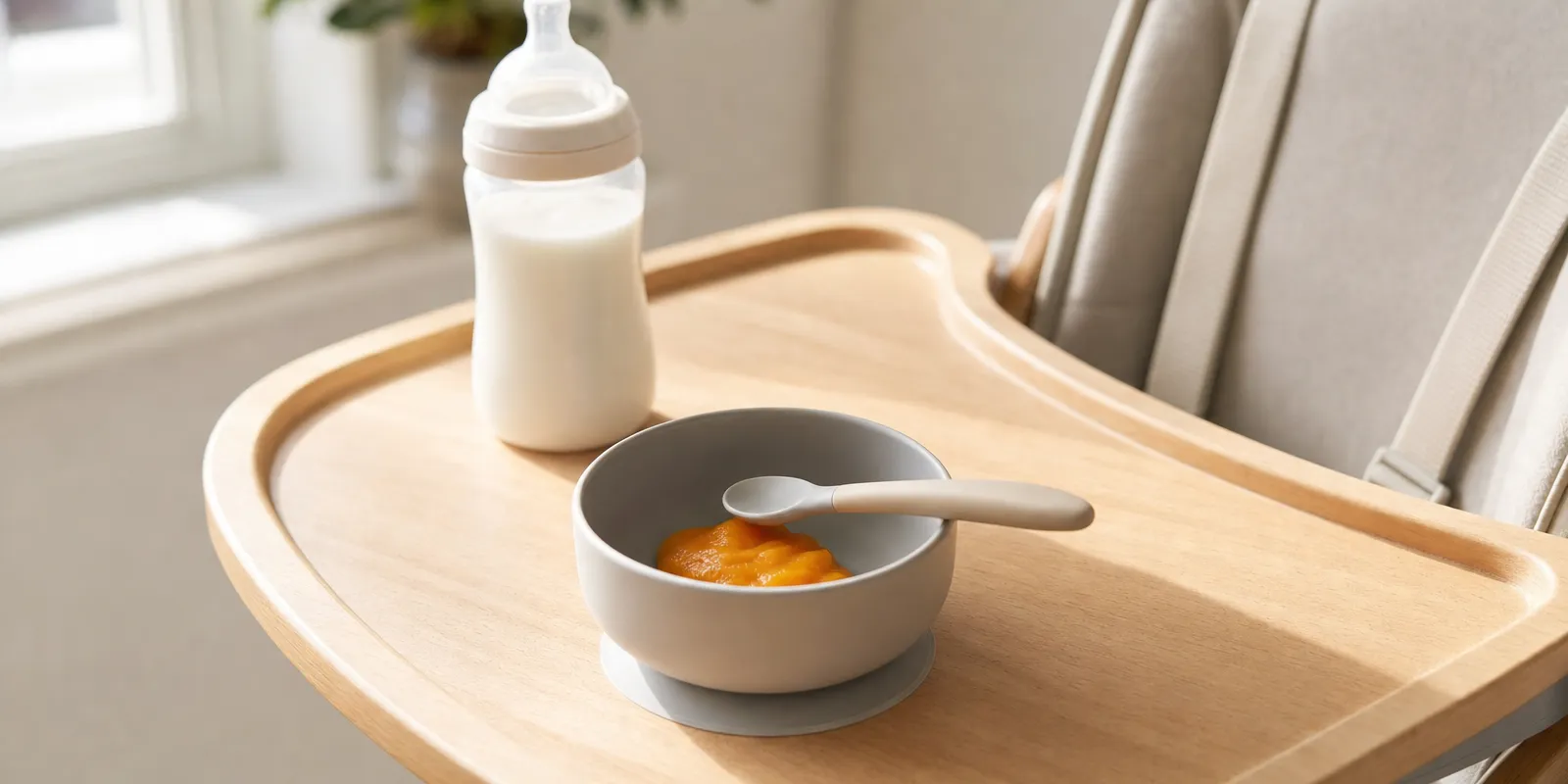
How much solid food by age, in one line: around six months you offer 1 or 2 tablespoons once or twice a day, by eight months most babies are on two or three small meals, and by a year it is three meals plus two or three snacks — while breast milk or formula stays the main source of nutrition the entire time. Some of the links below are affiliate links, and we may earn a small commission, at no extra cost to you, if you buy through them.
I measured my daughter's first dinner into a ramekin like it was a chemistry set. Two level tablespoons of pear. She ate what I would generously call a quarter of it, blew a raspberry, and I spent that evening working out whether a quarter of two tablespoons was a problem.
It was not. But nobody had told me the thing that would have saved me the evening: at six months, food is a rehearsal and milk is still the meal. So here are both halves of the answer — the reassurance, and the numbers that earn it. Readiness is its own checklist, because the signs your baby is ready for solids are physical rather than calendar entries, and the full walk-through of starting baby on solids covers first foods, allergens and the first fortnight. This one is the amounts.
Milk Is Still the Main Event — Even at Eleven Months
The most useful sentence in US infant feeding guidance is the CDC's: "Breast milk and/or infant formula continues to be the main source of nutrition for your child from 6 to 12 months. However, solid foods will gradually begin to make up a bigger part of their diet."
Put a number on it. The AAP's sample one-day menu for an 8 to 12 month old says a baby that age "needs between 750 and 900 calories each day, of which about 400 to 500 should come from breast milk or formula," or "roughly 24 ounces (720 mL) a day." Read that at the ten-month mark, with a baby who sits in a chair and gums toast: more than half the day's energy is still milk.
So why bother with solids at all? Mostly iron. The WHO says "around the age of 6 months, an infant's need for energy and nutrients starts to exceed what is provided by breast milk," and the CDC's iron guidance is specific: "once your child starts to eat foods around 6 months, it is important to give foods with enough iron to meet nutritional needs." A 2021 review in Nutrients explains why — exclusive breastfeeding covers iron needs to about six months, but "iron stores become gradually depleted at about this time, and breast milk alone can no longer meet the infant's iron requirements." It cites the National Academies' dietary reference intakes for iron — a recommended daily allowance of 11 mg a day, which the National Academies set for infants 7 to 12 months. You do not reach 11 mg with pear.
Milk for calories, solids for the nutrients milk is running short on, plus the motor skills that never appear on a chart.
How Much Solid Food by Age: The Table
Here is the whole thing on one screen. Each row is a published range, and the attribution matters as much as the number.
| Age | Solid meals a day | Typical amount offered | Breast milk or formula | Source |
|---|---|---|---|---|
| Around 6 months, first weeks | 1 to 2 | Half a spoonful to 1 or 2 tablespoons | 6 to 8 oz at each of 4 or 5 feedings | CDC, AAP, Nationwide Children's |
| 6 to 8 months | 2 to 3 | 2 to 3 tbsp per food twice a day; 3 to 5 tbsp cereal | About 30 to 32 oz a day, 4 to 5 feedings | WHO, Nationwide Children's |
| 8 to 10 months | 2 to 3, plus a snack | 2 to 3 tbsp per food twice a day; 5 to 8 tbsp cereal | About 30 to 32 oz a day, 3 to 5 feedings | Nationwide Children's |
| 10 to 12 months | 3 meals plus 2 to 3 snacks | 2 to 4 tbsp per food twice a day | About 24 to 30 oz a day, 3 to 4 feedings | CDC, AAP, Nationwide Children's |
| 12 months and up | 3 meals plus 2 to 3 snacks | Table food, same portions, more variety | About 16 oz whole cow's milk a day, or continued breastfeeding | AAP, CDC, WHO |
Two caveats. The tablespoon figures come from a hospital chart — Nationwide Children's feeding guide for the first year — which opens with a 4-to-6-month band, while the CDC says a child "can begin eating solid foods at about 6 months" and that "introducing foods before 4 months is not recommended." Follow the CDC: the bands above start at six. And every figure is an offer, not a quota.
Around Six Months: One or Two Tablespoons, Once or Twice a Day
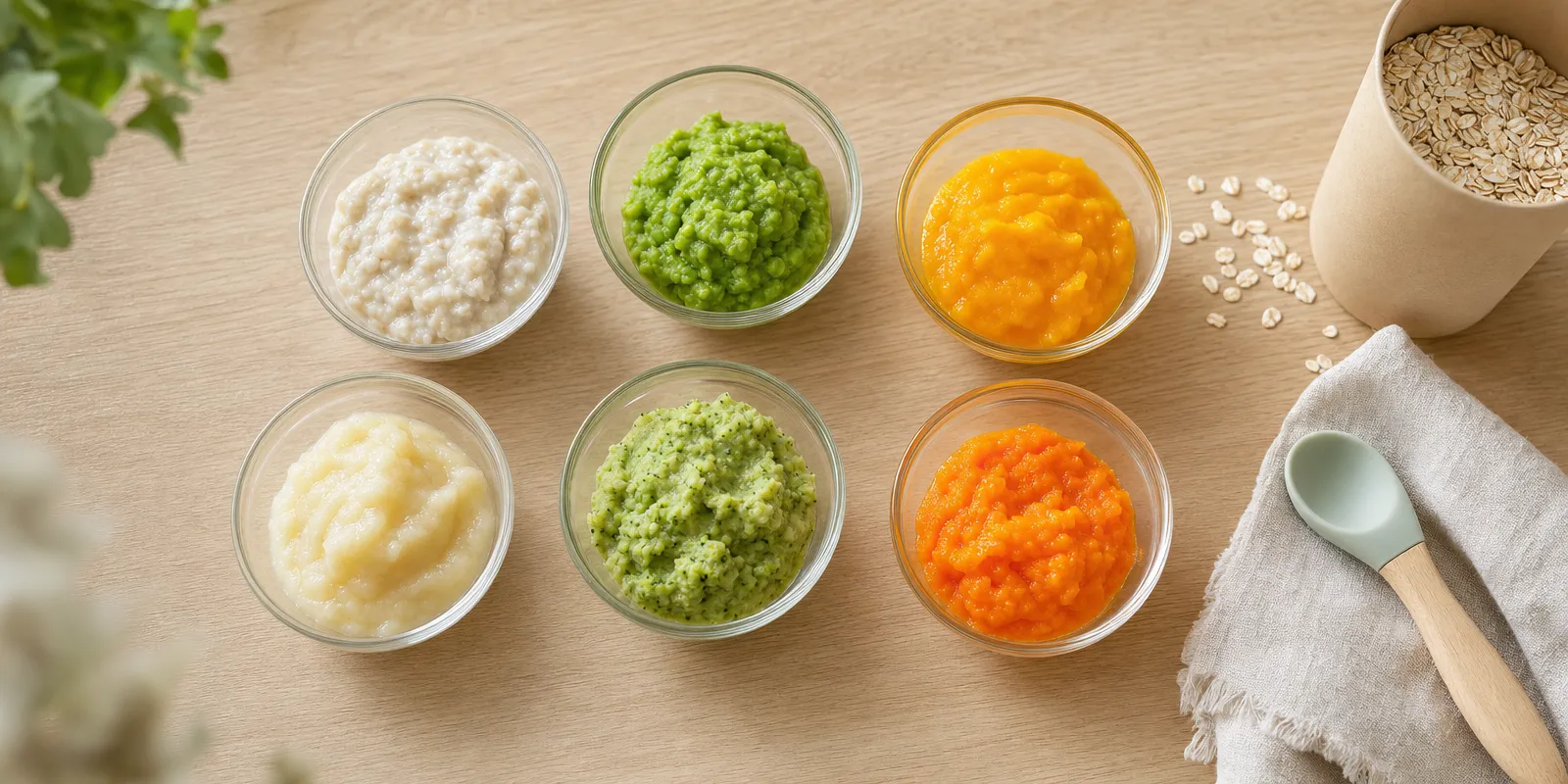
The CDC's starting instruction is short: "Give 1 or 2 tablespoons of food. Watch for signs that they are still hungry or full." The AAP goes smaller still. HealthyChildren.org says to "start with half a spoonful or less" and to "increase the amount of food gradually, with just a teaspoonful or two to start."
That spread — half a teaspoon to two tablespoons — is the answer rather than sloppiness, and most babies spend the first fortnight near the bottom of it. Neither agency puts a number on how often to offer it in those first weeks; the once-or-twice-a-day frequency comes from Nationwide Children's chart, which starts fruit and vegetables at "1 to 2 times per day."
A portion here is one single-ingredient food, thin, ideally carrying some iron; our guide to first foods to offer covers which ones and in what order. Milk barely moves: the AAP's formula feeding schedule has a six-month-old taking "6 to 8 ounces (180-240 mL) at each of 4 or 5 feedings in 24 hours," and no more than an average of "about 32 ounces (960 mL)" a day.
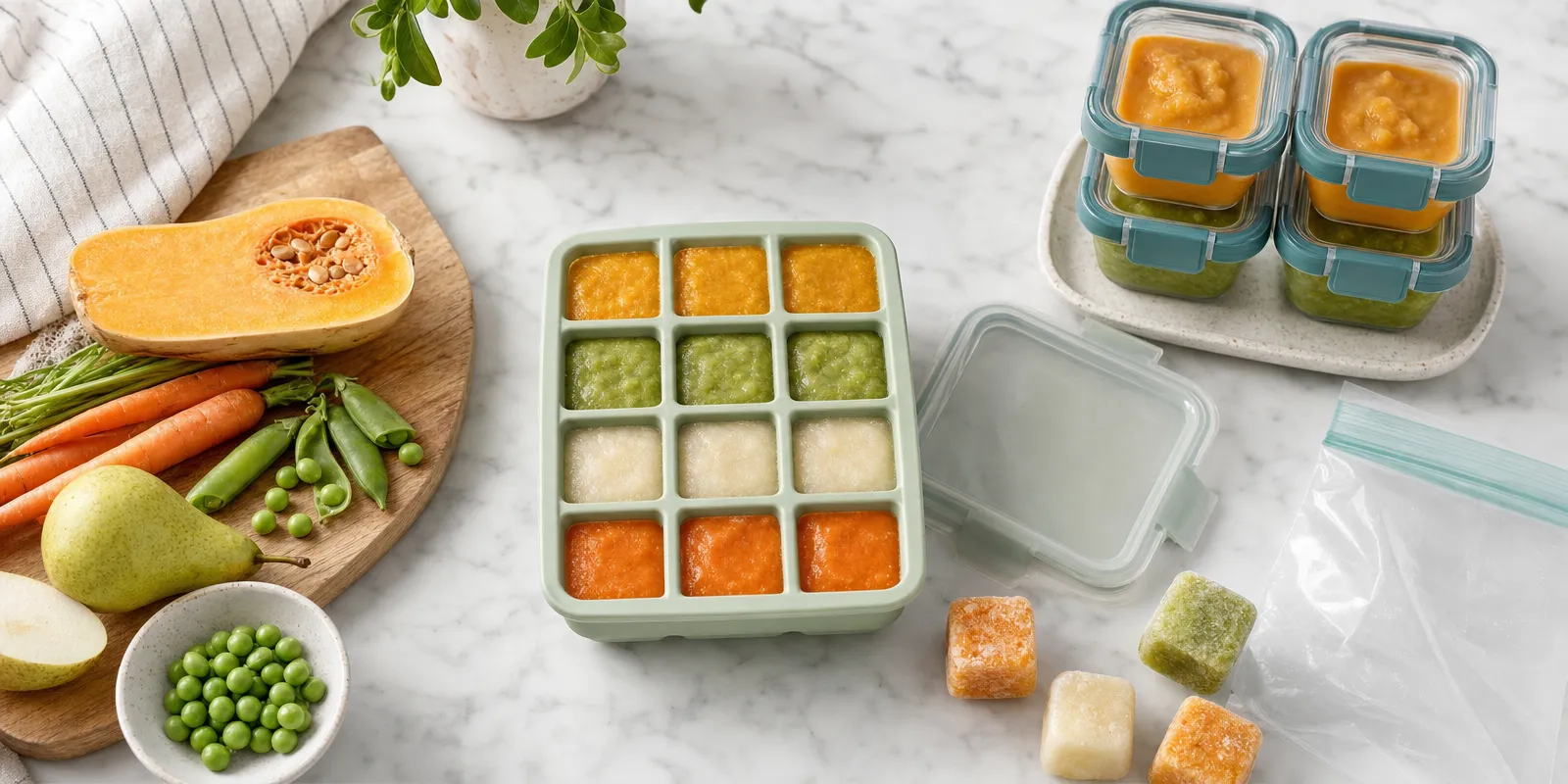
The problem at six months is not quantity, it is waste. One cube from the mushie silicone freezer tray is 1.5 ounces — three tablespoons — more than a beginner will finish and exactly the right thing to defrost. Nine cups, ounce and millilitre markings inside each one, flexible base so frozen portions pop out, about $19.99 as of October 2026.
Six to Eight Months: Two Meals, and the First Real Volume
The WHO sets the meal count: "2–3 meals per day for infants 6–8 months of age," with "1–2 additional snacks as required." Nationwide Children's seven-month row fills in the amounts — 3 to 5 tablespoons of iron-fortified single-grain cereal, 2 to 3 tablespoons of strained fruit twice a day, 2 to 3 tablespoons of vegetables twice a day, and 1 to 2 tablespoons of strained meat twice a day — against "4 to 5 feedings per day or 30 to 32 ounces per day" of breast milk or formula.
Notice that milk has not dropped at all: solids roughly double while milk holds station, which is why this half of the year feels like it should be a handover and is not.
The CDC's rhythm for the whole 6-to-12-month stretch is "something to eat or drink every 2 to 3 hours, or 5 or 6 times a day," which it describes as "about 3 meals and 2 to 3 snacks every day." That is the destination, not the seven-month target.
This is where knowing what an ounce looks like pays off. The OXO Tot Glass Baby Blocks are four 4-ounce glass containers with measurement markings on the body, airtight locking lids and a stacking tray, about $25.99 as of October 2026. Four ounces is eight tablespoons, so a full container holds more than the seven-month amounts above. Filling to the two-ounce line is closer to the mark.
Eight to Ten Months: Chunkier Food, Not Much More of It
Cereal is where the jump shows up. Nationwide Children's eight-month row moves to "5 to 8 tbsp. single-grain cereal," holds fruit and vegetables at 2 to 3 tablespoons twice a day, and switches protein to "1 to 2 tbsp., lumpy, 2 times per day" — the word "lumpy" doing a lot of work. Milk stays at "3 to 5 feedings per day or 30 to 32 ounces per day."
So the change between seven and nine months is texture, not volume, and a baby who has only had purees may well gag on the first bite of something with structure. Gagging is common at this stage and is not the same thing as choking — but the two can look alike, so our breakdown of gagging versus choking is worth reading before you change textures rather than after.
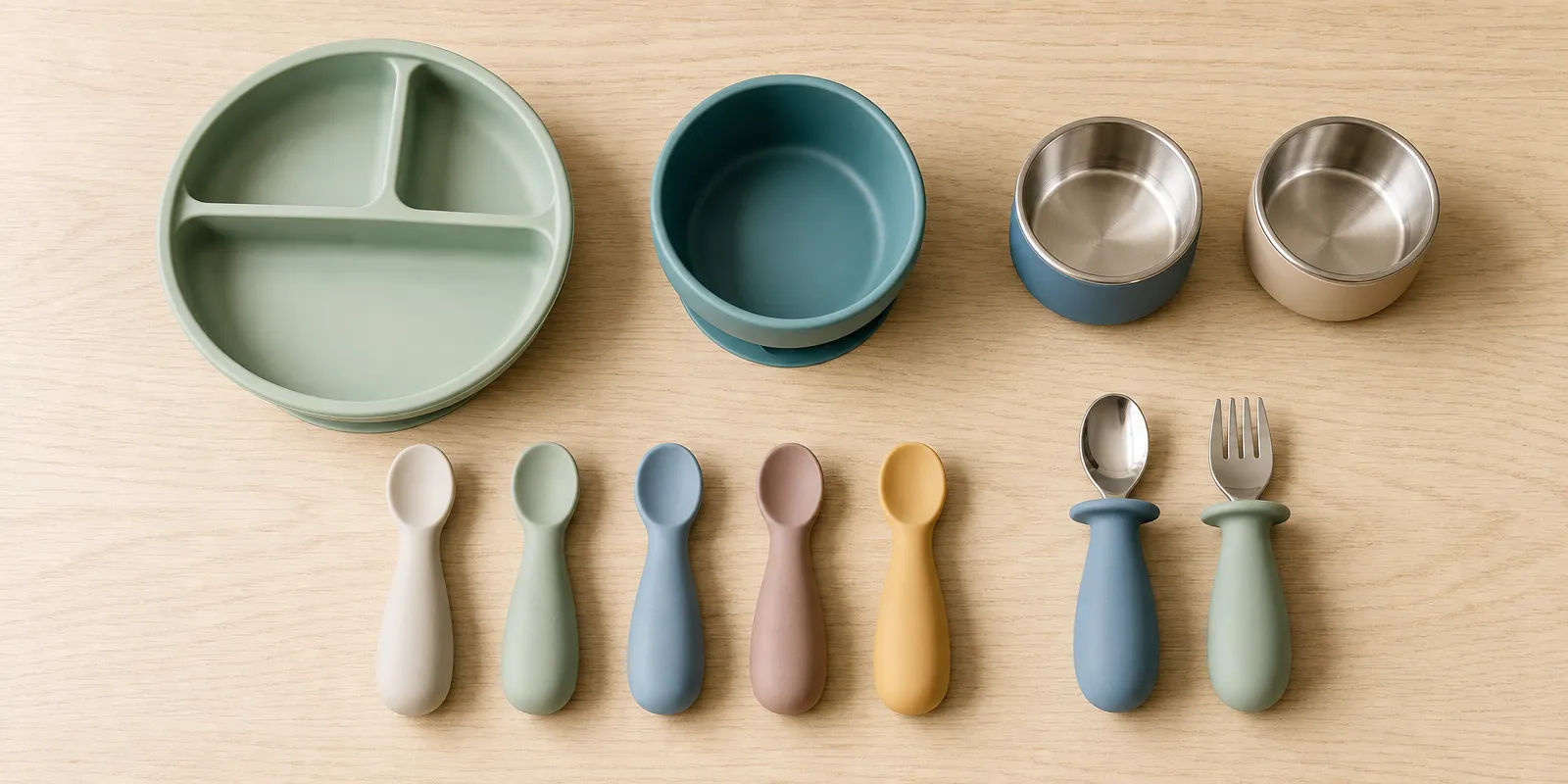
Judging a portion gets harder once food looks like food. The OXO Tot Silicone Bowl is weighted rather than suctioned, with soft high contoured walls that push food back onto the spoon, dishwasher and microwave safe, about $29.99 as of October 2026. Its value is optical: two tablespoons in a baby bowl looks like a meal, and on a dinner plate looks like a mistake you should fix by adding more.
Ten to Twelve Months: Three Meals, Two Snacks, Less Milk
This is the first band where milk genuinely falls. Nationwide Children's 10-to-12-month row gives "3 to 4 feedings per day or 24 to 30 ounces per day," down from 30 to 32, and the AAP's roughly 24 ounces lands in the same place.
Solids take up the slack: fruit and vegetables at 2 to 4 tablespoons twice a day, protein at 2 to 3 tablespoons of finely chopped table meat, fish without bones or mild cheese. The WHO raises the count to "3–4 meals per day for infants 9–23 months," still with one or two snacks. The CDC's three-meals-plus-snacks pattern finally describes your actual day.
The sequencing flips too, and nobody announces it. Meals stop being appendices to milk feeds, and milk feeds become bookends to meals — morning, bedtime, and one or two somewhere in between.
Twelve Months: What Changes, Briefly
Three things change at the first birthday.
- Whole cow's milk becomes an option. The CDC says "you can introduce your child to whole cow's milk at 12 months old (but not before)," and warns that cow's milk earlier "may put them at risk for intestinal bleeding." The AAP's beverage recommendations put 12-to-24-month-olds at 16 ounces, or 2 cups, of milk a day.
- Honey is finally safe. The CDC is blunt about why it was not: "honey given to children younger than 12 months may cause a severe food poisoning called botulism."
- Breastfeeding does not have to stop. The WHO recommends you "continue frequent breastfeeding up to 2 years of age or beyond."
What does not change is the meal pattern. Three meals and two or three snacks carries straight across the birthday.
The Amounts Are Offers, Not Quotas
Every number above is something you put in front of a baby, not something you get into one.
The CDC attaches the same clause to its starting amount every time: "watch for signs that they are still hungry or full." The WHO describes the practice as "recognizing and responding to signs of hunger and fullness."
The mechanism is not folk wisdom. Writing in Current Developments in Nutrition in 2021, Pérez-Escamilla and colleagues define responsive feeding as practices that "encourage the child to eat autonomously and in response to physiological and developmental needs," and name the failure mode: "When caregivers over-control the feeding, not only do they potentially override the child's internal hunger and satiety regulatory cues they may also interfere with the child's emerging autonomy and striving for competence." Among the controlling behaviours they list is "forcing a child to finish all of the food on his or her plate before leaving the table."
So a baby who turns away from the last three spoons has finished. You have not failed to deliver 3 tablespoons. The spoons go in the sink and the number was never the point.
Why These Numbers Suit a Spoon Better Than a Strip of Toast
Worth saying out loud, because most portion guides pretend otherwise: tablespoons are a puree unit. You cannot measure a strip of roasted sweet potato, still less what is left of one after it has been held, dropped and chewed. If you are combining baby-led weaning and purees, as most families do, the table above applies cleanly to the spoon-fed half and only loosely to the rest. For the self-fed half the unit is the offer: put out two or three foods your baby can manage and let intake be their business.
The opposite problem is baby food pouches, which make over-serving very easy for one reason: nobody measures a pouch. A typical 4-ounce pouch is eight tablespoons of food, several times the 2 to 3 tablespoons per food the seven-month charts describe, and it goes down quickly because sucking is easier than chewing. Squeezing it onto a spoon is not fussiness. It is the only way to know what you served.
When Solids Crowd Out Milk Too Early
This is one of the few genuine failure modes of the first year, and it is arithmetic rather than bad luck.
First purees — vegetables especially — carry fewer calories per ounce than breast milk or formula does. If breast milk or formula supplies 400 to 500 of a baby's 750 to 900 daily calories, as the AAP has it, then trading a 6-ounce feed for two tablespoons of carrot moves calories the wrong way — and the displacement runs in one direction. Young and Krebs, writing in Current Pediatric Reports, put the mechanism plainly: "The breastfed infant exhibits fairly tight self-regulation of energy intake, with decreasing consumption of HM in response to caloric intake from CF." Human milk goes down as complementary food goes up. Do that at several meals a day with low-calorie purees and growth may falter while the feeding diary looks like progress.
The fix is sequencing, and the AAP spells it out: "one way to make eating solids for the first time easier is to give your baby a little breast milk, formula or both first; then switch to very small half-spoonfuls of food; and finish with more breast milk or formula." Milk first in the early months; later, as meals grow, space solids away from feeds instead, which happens by itself once the day has three meals in it.
One caveat, then I will leave it alone. A baby who is refusing solids outright, losing weight, or drifting off their growth curve needs your pediatrician rather than a chart — and if your baby was born prematurely or has a medical condition affecting feeding, the amounts here do not apply. Those numbers come from the person who has weighed your baby.
Water: Four to Eight Ounces, and Why More Is Not Better
Water joins the table when food does. The CDC lists water at "4 to 8 ounces a day" for children between 6 and 12 months, and the AAP's beverage recommendations land on the same figure — 4 to 8 ounces, half a cup to one cup, in an open, sippy or strawed cup — noting that "the actual water intake is unlikely to replace much breast milk or formula at this point." Juice is a flat no: the CDC says "children younger than 12 months should not drink any fruit or vegetable juice."
The ceiling exists for a specific reason. A CDC report on hyponatremic seizures among infants describes water intoxication, in which an acute overload of solute-free water drops blood sodium sharply, and lists its manifestations as "altered mental status (typically irritability or somnolence), hypothermia, edema, and seizure." The same report names the risk factors — "immature renal function and the powerful hunger drive of early infancy" — and notes the problem "has been caused most commonly by tap water, given either as supplemental feedings or in overly diluted formula."
So: a few sips with meals, in a cup, to practise with. Never water instead of a feed.
What Normal Looks Like, Week to Week
One honest picture of the first six months of eating.
- Weeks 1 to 2. A teaspoon or two a day, mostly on the chin. You are teaching a baby to sit at a table, not feeding them.
- Weeks 3 to 8. One meal becomes two. Amounts creep toward the CDC's 1 to 2 tablespoons and sometimes past it. Milk does not budge.
- Months 8 to 10. Texture changes more than volume. Some days a baby clears 5 to 8 tablespoons of cereal; the next it is three bites and a thrown spoon. Both are in the range.
- Months 10 to 12. Three meals, two or three snacks, and milk drifting from about 30 ounces toward about 24.
Flat weeks are the norm. Teething, colds and new skills all show up as less food, and they usually pass on their own. What matters across a month is direction — more foods, more textures, more days where a meal looks like a meal — against a backdrop of milk still doing the heavy lifting.
If you came here to find out whether two teaspoons was enough: it was. It was enough on the evening I sat there doing fractions, and it is enough tonight. These numbers exist so you have something concrete to be reassured by, not something to hit. For the rest of the sequence — readiness, first foods, allergens, textures — start with how to start your baby on solids, and come back when somebody asks you how much.
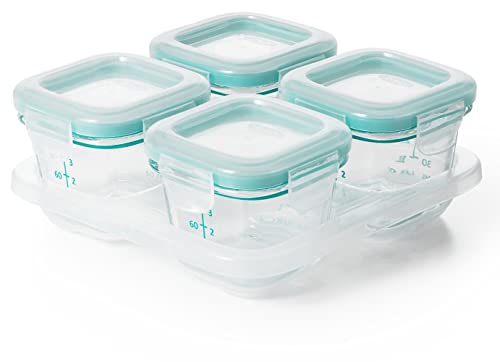
OXO Tot Glass Baby Blocks Food Storage Containers, 4 oz
Portion control is most of what makes feeding a baby manageable, and these four 4-ounce glass containers with measurement markings on the body are the simplest way to do it. Four ounces is roughly a full meal portion for a baby in the middle of their first year, so one container is one meal — which takes the guesswork out of "how much should I make?". OXO states the glass body goes from freezer to microwave or oven without shattering from the temperature change, and the stacking tray keeps a week of meals organised.
- Brand
- OXO Tot
- Category
- Our Pick
Markings on the side mean you stop estimating. You learn what two ounces of squash actually looks like, and then you stop over-making it.

mushie Silicone Baby Food Freezer Tray with Lid, 9 Cups x 1.5 oz
At the very start a baby eats a couple of teaspoons, not a bowl, and this nine-cup tray at 1.5 ounces per cup is sized for that reality. Freeze a batch, pop out one cube, thaw it, and you have served a realistic first-foods portion without throwing away the rest of a jar. Each cup carries ounce and millilitre markings inside, which is how you turn "a little bit" into a number you can track.
- Brand
- mushie
- Category
- Best for Small First Portions
One cube is one meal in the first few weeks. It is the difference between making food twice a week and making food twice a day.

OXO Tot Silicone Bowl
A small weighted silicone bowl with high contoured walls. The reason it belongs in a conversation about amounts is that a baby-sized bowl makes a baby-sized portion look right — serve two tablespoons on a dinner plate and it looks like nothing, which is how parents end up pushing more food than a baby wants. The walls also guide food back onto the spoon, and it is dishwasher and microwave safe.
- Brand
- OXO
- Category
- Best Bowl for Judging Portions
Serving into something baby-sized quietly fixed our habit of over-serving and then worrying that she had not eaten enough.
- 01OXO TotOur PickOXO Tot Glass Baby Blocks Food Storage Containers, 4 oz
- 02mushieBest for Small First Portionsmushie Silicone Baby Food Freezer Tray with Lid, 9 Cups x 1.5 oz
- 03OXOBest Bowl for Judging PortionsOXO Tot Silicone Bowl
Should I give breast milk or formula before or after solids?+
How much water can a 7-month-old have?+
What if my baby refuses solids entirely?+
Sammie Seelbach
Sammie is a mom of two and the lead reviewer at Smart Baby Reviews. Since becoming a parent she has become obsessed with researching the safest, smartest baby gear on the market — testing thermometers at 2 a.m., wrangling baby gates, and sterilizing more bottles than she can count. She shares what actually works so other parents can make confident, informed decisions for their little ones.