The Best Outlet Covers and Plug Protectors for Baby-Proofing

This post may contain affiliate links. Read our policy.
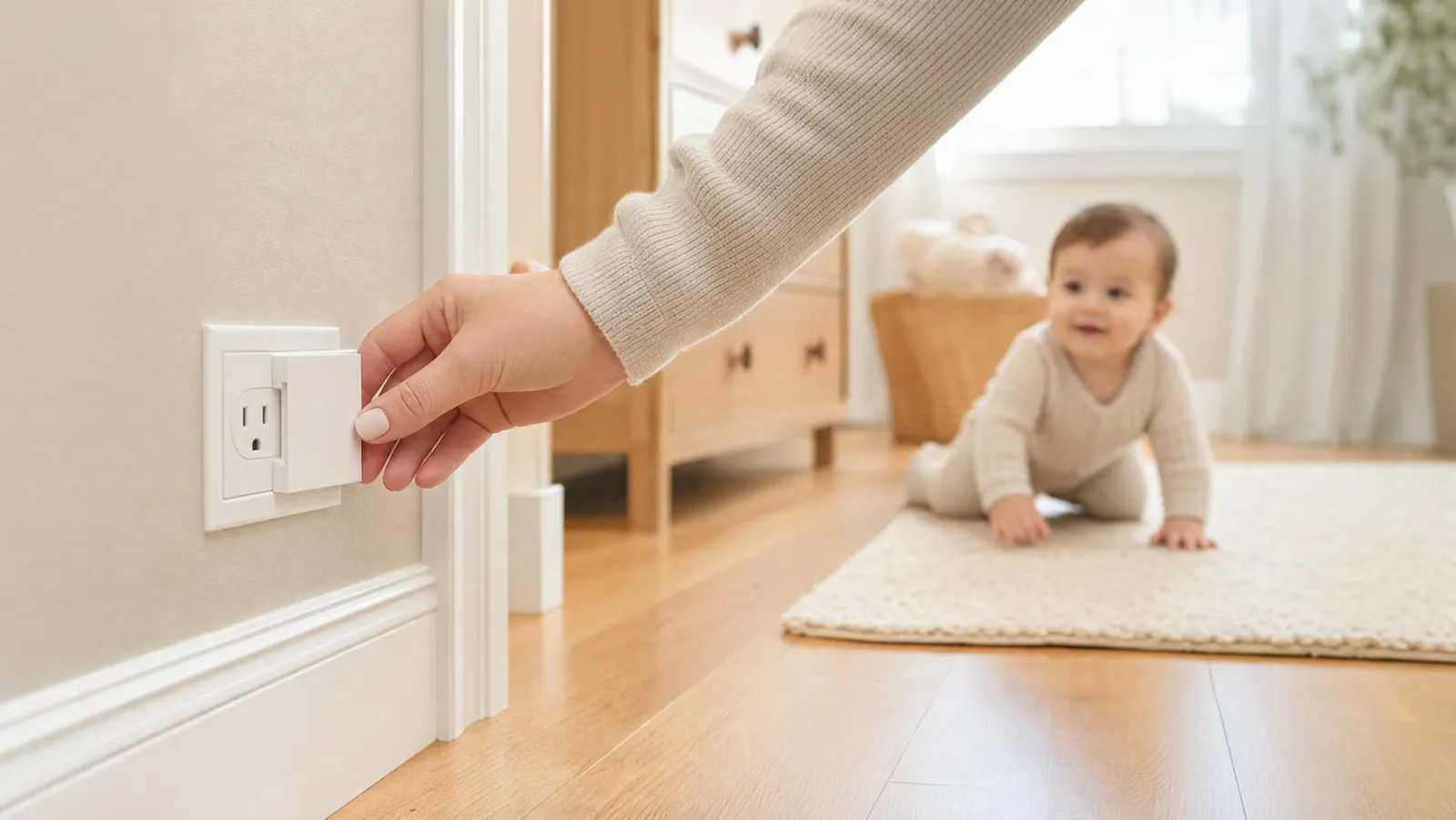
The outlet behind our living room lamp sits about eight inches off the floor. My son found it at ten months old, on his hands and knees, with a plastic baby spoon in his fist. He was not trying to be dangerous. He was trying to put the spoon in the slot, because the slot was there and he was ten months old.
Here is the short version, and yes, some of the links below are affiliate links, and we may earn a small commission — at no extra cost to you — if you buy through them. The best baby proofing outlet covers are the ones that cannot be pulled out and left on the floor: self-closing sliding wall plates for the outlets you actually use, a box cover for anything with a fat adapter hanging out of it, and push-in plug caps only for the outlets nobody touches.
Outlets are usually the first thing people buy when they start baby-proofing your home, and they are also the easiest thing to get half-right. Below is what changed how I shop for them, the four types worth knowing, and the five covers I would put on my own walls.
Check your outlets before you buy anything
Walk over to an outlet and look at the two vertical slots. If you can see little plastic shutters behind them, you already own the strongest protection there is, and the rest of this article is about filling in the gaps.
Those are tamper-resistant receptacles, or TRRs. According to the Electrical Safety Foundation International, the National Electrical Code adopted tamper-resistant receptacles as a requirement in 2008, covering 15- and 20-amp, 125-volt receptacles in residential new construction. The mechanism is simple and it never forgets: spring-loaded shutters stay closed unless something presses both slots at exactly the same time, the way the two blades of a plug do. A hairpin, a key, or one small finger does not qualify.
The reason the code changed is worth sitting with for a second. ESFI's review of Consumer Product Safety Commission data from 1991 to 2001 found that more than 24,000 children under age ten were treated in emergency rooms for receptacle-related incidents, which works out to roughly seven children a day. ESFI's breakdown of that data puts 89 percent of those children under six, and half of them at two or three years old.
So: if your home was built or rewired recently, check for shutters first. If you have them, you can skip plug caps on unused outlets entirely and spend your money on the outlets that have cords in them. If your home is older, everything below still applies, and swapping a few receptacles is a conversation worth having with an electrician.
Why outlet plug covers are the weakest option
The little plastic caps that come thirty to a bag are what most of us buy first. They are cheap, they take two seconds, and they feel like progress. They are also the option safety researchers keep poking holes in.
ESFI cites research finding that 47 percent of the four-year-olds studied could remove one brand of cap, and 100 percent of the two- and four-year-olds could remove a second brand — in many cases within ten seconds. That is the whole problem in one sentence. A cap that a toddler can work out with her fingernails is not a barrier; it is a puzzle with a prize behind it.
Then there is what happens to the cap after it comes out. The American Academy of Pediatrics tells families to put non-choking hazard safety plugs in all unused electrical outlets, and that qualifier is doing real work. A cap small enough to be pried loose by a two-year-old is a cap small enough to end up somewhere you do not want it. If you use plug caps, buy ones that fit your outlets snugly and keep loose spares in a drawer, not on the windowsill.
The second failure mode is us. ESFI also points out that adults forget to reinsert caps after using the outlet, which leaves the socket completely unguarded — often at the exact moment the vacuum comes out and the room is busy. That is the argument for a cover that closes itself.
None of this means caps are useless. For the outlet behind a bookcase in a room your baby is rarely in, they are a reasonable layer that works out to roughly thirteen cents an outlet as of July 2026. Just do not let them be the plan for the outlets that matter.
The four kinds of outlet covers, and when each one fits
There is no single best cover, only the right cover for a particular outlet. Here is the whole landscape of electrical outlet baby proofing in one list.
- Self-closing sliding wall plates replace the existing plate. You slide the cover aside to plug in, and it slides shut by itself when the cord comes out. Nothing to remove, nothing to lose, nothing to remember. This is the default I recommend.
- Classic sliding safe plates work the same way. They are the fix for the outlet that permanently has a lamp or a monitor in it, because the plate protects the unused half of the outlet the whole time.
- Box covers and cord shorteners are hinged or locking cases that go over the entire outlet plus whatever is plugged into it. Some of them also coil up the leftover cord. These are for adapters, chargers, and any plug your toddler has already tried to yank.
- Push-in plug caps are the bag of little plastic pieces. Cheap, portable, and fine for unused outlets in low-traffic rooms — with the caveats above firmly in mind.
Most families need two of these, not one. My own house runs sliding plates in the main living areas, a box cover on the outlet behind the crib, and a handful of caps in the guest room. Sliding outlet covers do the heavy lifting; the rest fills in the corners.
One promise nobody can make you: no cover here is childproof. The Consumer Product Safety Commission's childproofing guidance is blunt that child-safety devices, outlet covers and outlet plates included, only work if they are properly installed and re-engaged after use, and that no device is completely childproof — determined toddlers have been known to overcome or disable them. The CPSC also says to be sure outlet protectors cannot be easily removed by children and are large enough that children cannot choke on them. These products slow a determined toddler down. That is the honest job description, and it is still worth doing.
The best outlet covers for baby proofing
HomeBrella Self-Closing Outlet Covers — our overall pick
If you buy one thing on this page, make it the HomeBrella Self-Closing Outlet Covers. They replace the wall plate entirely, so there is no cap to pry out and no cap to lose. You slide the cover aside, plug in the lamp, and, according to HomeBrella, the moment you pull the cord the cover slides back and re-secures the outlet without you thinking about it. That "without you thinking about it" is the entire value, because the most common failure in outlet safety is a busy adult forgetting.
They fit both Decorator two-screw outlets and standard single-screw outlets, so you do not have to inventory your walls before ordering, and the low profile keeps them from looking like safety gear bolted to your living room. At about 7 dollars for a four-pack as of July 2026, doing the four outlets that actually worry you is genuinely cheap.
Mommy's Helper Safe Plate — best for outlets always in use
The outlet behind the couch with the lamp in it is the one that defeats plug caps completely, and the Mommy's Helper Safe Plate is the old, boring, reliable answer. Take out the single screw, swap in the Safe Plate, put the screw back. According to Mommy's Helper, the sliding cap closes automatically when a plug is pulled, so protection is meant to be continuous instead of conditional.
Mommy's Helper positions it explicitly as an alternative to outlet plugs, with no hard-to-remove caps to pry off, which is exactly the trade you want. It is built for standard outlets and the white finish disappears against a wall. At around 8 dollars as of July 2026, it is my pick for the two or three outlets in your house that are never actually empty.
Safety 1st Outlet Cover with Cord Shortener — best for lamp and appliance cords
Sometimes the cord is the hazard, not the socket. The Safety 1st Outlet Cover with Cord Shortener covers the entire outlet including whatever is plugged into it, and it stores up to four feet of excess cord inside the case. Safety 1st says that prevents entanglement and keeps cords off the floor, and the second half of that is what sold me: a loop of slack cord on the carpet is a toy, a trip hazard, and a handle for pulling a lamp off a table, all at once.
Adults open it with a child-resistant dual-press release, which is easy once you have done it twice and awkward for small hands by design. It is built specifically for outlets that are in use. Around 6 dollars as of July 2026 also makes it the cheapest way to make one messy corner of a room look intentional.
Safety Innovations Twin Door Outlet Cover Box — best for big plugs and adapters
Chunky adapters are where most covers give up. The Safety Innovations Twin Door Outlet Cover Box is an oversized box built for exactly that: AC adapters, baby-monitor plugs, USB chargers, three-prong cables, and power-strip plugs. The interior measures 5 3/8 inches high by 3 3/16 inches wide by 2 3/4 inches deep, which is enough room for the plug brick that would not fit under anything flat.
It uses a double locking system, with buttons at the top and the bottom, so it takes two hands to open — a meaningful step up from a single latch. It installs with a screwdriver in a few minutes and includes screws and faceplates for both single-center-screw and Decora outlets. The underrated benefit is that it also stops a child from unplugging whatever is inside, which matters a lot when the thing inside is the baby monitor.
Vmaisi Outlet Plug Covers — best budget bulk pack
For the unused outlets in the rooms your baby barely visits, Vmaisi's 62-piece pack of plug covers is the practical choice. Sixty-two caps covers a whole house with spares in the drawer, they need no tools, and at about 8 dollars as of July 2026 the per-outlet cost is a rounding error. Vmaisi says they are designed to stay put against babies and toddlers while still coming out for an adult.
Read the company's own caveat, because it is a good one: these are meant for unused outlets that you have not replaced with tamper-resistant receptacles, and you should check that the cap fits your outlet openings. I would add one more use case where caps genuinely shine — travel. A handful in the diaper bag turns a hotel room or a grandparent's guest room into something survivable for a weekend.
Where to start: the outlets that matter most
You do not need to cover every outlet in the house tonight. Work in order of how much time your baby spends near them and you will cover the real risk in one afternoon.
Start at floor level in the rooms where your baby plays. Living room, nursery, and any hallway they crawl through. These are the outlets at eye level for someone on hands and knees, and they are where the spoon-in-the-slot moment happens.
Then do the outlets with cords already in them. Lamps, sound machines, monitors, phone chargers on a nightstand. A dangling cord is an invitation, and a partly pulled plug exposes live blades that no plug cap can help with.
Then think about height. Counter-height outlets feel safe right up until your toddler learns to climb, which is the same week they learn everything else. Those kitchen outlets often have a kettle or a toaster plugged into them too, so they are worth a cover once your child is pulling up on the cabinets. That whole room deserves its own pass, and I walk through it in baby-proofing the kitchen.
Finish with the guest room, the office, and the outlets behind furniture. These are the ones that earn a cheap plug cap rather than a wall-plate swap. Then walk the house once at your child's eye level, actually on the floor, and you will find two outlets you forgot.
What outlet covers do not cover
A covered outlet is a good afternoon's work, but the outlet is only part of the picture. The AAP's guidance on electric shock injuries in children is that the best way to prevent electrical injuries is to cover all outlets, make sure all wires are properly insulated, tuck wires away from your child's reach, and supervise whenever children are around potential electrical hazards. Three of those four have nothing to do with the outlet itself.
Cords are the part people underestimate. The AAP's home safety checklist also says to keep electrical cords out of reach and sight, and to install ground-fault circuit interrupters where appropriate. In practice that means running cords behind furniture instead of across a floor, and finding a real home for the tangle of phone and tablet chargers that accumulates on every low surface in a house with a baby. A drawer or low cabinet with cabinet and drawer locks on it is a much better place for charging bricks and loose cables than the console table your toddler can reach.
Damaged outlets are an electrician's job, not a cover's job. If you pull a wall plate off and find a scorched, cracked, or loose receptacle, do not put a safety cover over it and call it handled. Get it looked at.
And the honest one: a cover buys you time, not certainty. Re-engage every cover after you use the outlet, check them occasionally by tugging the way a toddler would, and keep the layered mindset that makes all baby-proofing work.
The bottom line
If I were doing one house from scratch, here is the order. Check for tamper-resistant shutters first, because if you have them, most of this is already solved. Put HomeBrella self-closing plates on the outlets in the rooms where your baby actually plays. Use a Mommy's Helper Safe Plate on the outlets that permanently have a lamp in them, a Safety 1st cord shortener wherever a loop of cord is lying on the floor, and a Safety Innovations box over the fat adapter behind the crib. Keep the Vmaisi caps for unused outlets, the guest room, and travel.
The reason I rank it that way is not preference. It is that every source I could find on this comes back to the same principle: protection that stays in place beats protection you have to remember. Shutters are better than a plate, a plate is better than a cap, and any of them beat an open socket eight inches off the floor.
For the rest of the house — furniture anchors, gates, cabinets, and the rooms you have not gotten to yet — work through our full baby-proofing guide one room at a time. Outlets are a good place to start, though. It is a few dollars a cover, one nap's worth of time, and you get to stop watching that one spot on the wall every time your baby crawls past it.

HomeBrella Self-Closing Outlet Covers (4-Pack)
Replaces the wall plate entirely, so there is no loose cap to pry out and lose. You slide the cover aside to expose the socket, plug your cord in, and when the cord comes out the cover slides back and re-secures the outlet on its own. It fits both Decorator two-screw and standard single-screw outlets, and the low-profile shape blends into the wall instead of announcing itself. HomeBrella says the design keeps little ones from getting fingers or objects into the socket.
- Brand
- HomeBrella
- Category
- Our Pick
It closes itself the second I unplug the vacuum, which is the whole reason I bought it.

Mommy's Helper Safe Plate Electrical Outlet Covers, White
A replacement wall plate that swaps in with a single screw: remove the one screw, put the Safe Plate on, put the screw back. The sliding cap closes automatically when a plug is pulled out, so the protection is continuous rather than something you have to remember. Mommy's Helper markets it as an alternative to outlet plugs, with no hard-to-remove caps to pry off. It is designed for standard outlets, and the white finish blends with the wall.
- Brand
- Mommy's Helper
- Category
- Best for Outlets Always in Use
We put these on the two outlets behind the couch that always have a lamp in them, and I stopped thinking about those outlets entirely.

Safety 1st Outlet Cover with Cord Shortener
This one covers the entire outlet including whatever is plugged into it, which is exactly the situation a plug cap cannot help with. A built-in cord shortener stores up to four feet of excess cord, which Safety 1st says prevents entanglement and keeps cords up off the floor. Adults open it with a child-resistant dual-press release that is deliberately awkward for small hands. It is also just a tidy way to hide an ugly lamp cord.
- Brand
- Safety 1st
- Category
- Best for Lamp & Appliance Cords
Our lamp cord used to loop across the floor like a jump rope. Now it lives inside the cover and my daughter has lost all interest in it.

Safety Innovations Twin Door Baby Safety Outlet Cover Box (1-Pack)
An oversized box sized for the plugs nothing else will fit over: AC adapters, baby-monitor plugs, USB chargers, three-prong cables, and power-strip plugs. The interior measures 5 3/8 in high by 3 3/16 in wide by 2 3/4 in deep. A double locking system with buttons at the top and bottom means it takes two hands to open. It installs with a screwdriver in minutes and includes screws and faceplates for both standard single-center-screw and Decora two-screw outlets, and it also stops a child from unplugging whatever is inside.
- Brand
- Safety Innovations
- Category
- Best for Big Plugs & Adapters
The monitor adapter was the one plug nothing else would cover, and this box swallowed it whole, brick and all.

Vmaisi 62 Pieces Outlet Covers Baby Proofing Plug Protectors
Sixty-two push-in caps, which is enough for a whole house of unused outlets with spares left over in the drawer. There is no installation and no tools; you press them in and move on. Vmaisi says they are intended to stay in place against babies and toddlers while still being removable by an adult, and the company notes they are meant for unused outlets that you have not replaced with tamper-resistant receptacles. It also advises checking that the cap actually fits your outlet openings.
- Brand
- vmaisi
- Category
- Best Budget Bulk Pack
I keep a handful in the diaper bag for hotel rooms and my parents' house, which is honestly where they earn their keep.
- 01HomeBrellaOur PickHomeBrella Self-Closing Outlet Covers (4-Pack)
- 02Mommy's HelperBest for Outlets Always in UseMommy's Helper Safe Plate Electrical Outlet Covers, White
- 03Safety 1stBest for Lamp & Appliance CordsSafety 1st Outlet Cover with Cord Shortener
- 04Safety InnovationsBest for Big Plugs & AdaptersSafety Innovations Twin Door Baby Safety Outlet Cover Box (1-Pack)
- 05vmaisiBest Budget Bulk PackVmaisi 62 Pieces Outlet Covers Baby Proofing Plug Protectors
Are plug-in outlet caps safe?+
Do I still need outlet covers if my house has tamper-resistant outlets?+
What do I do about an outlet that always has a cord plugged into it?+
How do I baby-proof a power strip?+
At what age can you stop using outlet covers?+
Do I need to turn off the breaker to install a sliding outlet cover?+
Sammie Seelbach
Sammie is a mom of two and the lead reviewer at Smart Baby Reviews. Since becoming a parent she has become obsessed with researching the safest, smartest baby gear on the market — testing thermometers at 2 a.m., wrangling baby gates, and sterilizing more bottles than she can count. She shares what actually works so other parents can make confident, informed decisions for their little ones.