Baby Food Pouches: Useful, and Easy to Overuse

This post may contain affiliate links. Read our policy.
Are baby food pouches bad? No. A pouch is pureed food in a convenient bag, and reaching for one does not mean you have done anything wrong. What turns a useful product into a problem is three habits — sucking straight from the spout, letting purees crowd out texture, and grazing — and all three have fixes that cost almost nothing. Some of the links below are affiliate links, and we may earn a small commission, at no extra cost to you, if you buy through them.
I have fed my daughter pouches in a car park, in a waiting room and on a delayed flight, and I am not embarrassed about any of it. A pouch in the diaper bag is not a moral failure, and squeezing it onto a spoon takes four seconds.
That sentence is most of the article. The rest is what the evidence actually says, where it is thinner than the headlines suggest, and what to buy if you want the convenience without the commercial product. If you are earlier in all this, starting your baby on solids is the wider walk-through.
What Pouches Are Genuinely Good For
This is not a token concession before the telling-off. Pouches solve real problems that nothing else solves the same way.
- Leaving the house. Nothing else is spill-proof, spoon-free and shelf-stable at once: daycare bags, airports, car seats, waiting rooms.
- The weeks when nothing works. Teething, a cold, a stretch of refusing everything. Food your baby will accept beats food that is technically better and goes in the bin.
- Getting iron- and vegetable-forward blends in. If a pouch with lentils, beans or meat is the thing your baby will eat, that is a point in its favour: the CDC lists red meat, iron-fortified infant cereals, and beans and lentils among the iron-containing foods to introduce from around 6 months.
- Reusable pouches you fill yourself. The best answer in this article, and the one most parents never get told.
Habit One: Sucking Straight From the Spout
Two separate problems get mashed together here. Keep them apart and both get easier to fix.
The dental one. Decay is driven by how long and how often teeth sit in fermentable sugar — the same mechanism behind the standard advice against bottles in bed and all-day sippy cups of juice. The Minnesota Department of Health's WIC program, citing the American Academy of Pediatric Dentistry, applies that analogy directly: frequent pouch use presents the same risks as a sippy cup, purees may stay on teeth longer, and prolonged contact of sugar with young teeth can increase decay risk. The German Society for Pediatrics and Adolescent Medicine's nutrition commission said much the same in a 2019 position statement in Molecular and Cellular Pediatrics: pureed foods high in sugar adhere to tooth surfaces more than chewed foods, and sucking them from the packaging exposes enamel over an extended time.
That is a mechanism, not a verdict on your child. Nobody has shown that a pouch decayed your baby's teeth, and if you are worried about teeth you can see, your dentist or pediatrician is the person to ask.
The skills one. A baby sucking from a spout is not using a spoon, a cup, or their own hands.
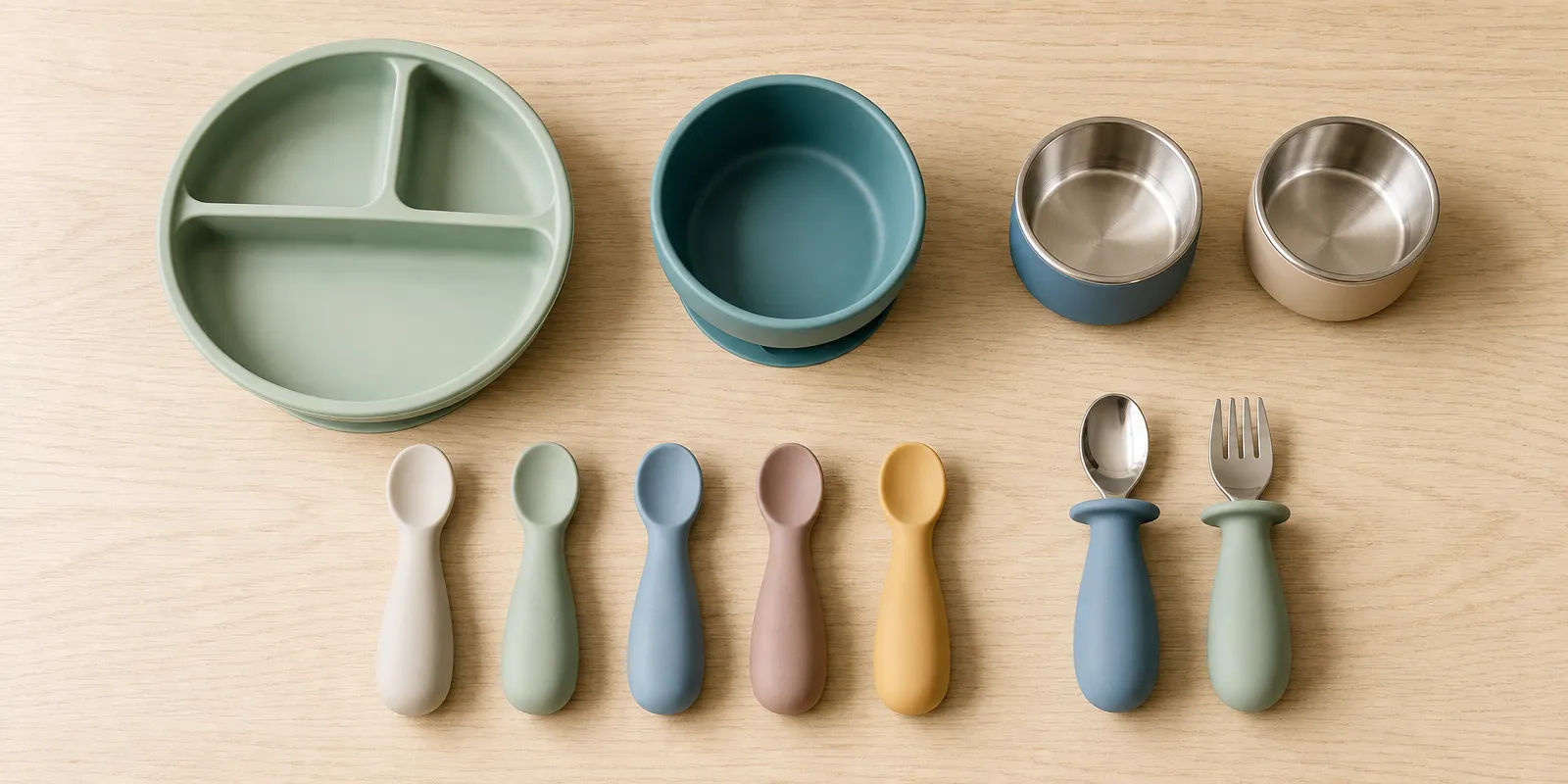
The fix is the same for both, and it is free. The NHS is blunt about it: always squeeze the contents from pouches onto a spoon to feed your baby, and do not let your baby suck the food directly from the pouch, which it says can increase their risk of tooth decay. Squeeze it into a bowl and you have also turned a pouch into a normal meal, which is where decent baby plates, bowls and spoons earn their place.
If your baby is going to self-feed from a spout regardless — and plenty will, loudly — the ChooMee SoftSip Pouch Tops are the paid version of the same idea: 16.98 dollars as of October 2026 for four, about 4.25 dollars a top. They are an accessory, not pouches — four silicone tops that twist onto most store-bought and reusable pouches. ChooMee describes a patented built-in flow control valve that leaves each squeeze to the child. Flow control is the one claim here that maps onto something real — a valve that slows a five-ounce pouch down addresses an actual problem — though that is ChooMee's claim, not a tested outcome.
Habit Two: Letting Pouches Crowd Out Texture
Here is where I have to be careful, because the confident version of this claim is everywhere and the evidence under it is thinner than parenting sites imply.
What we mostly have is expert reasoning. An occupational therapist and a speech-language pathologist at Nationwide Children's Hospital explain that sucking needs only a forward-to-backward tongue motion, while textured food makes a baby move food side to side, gather it on the tongue and start to munch. Their bottom line is carefully bounded: using pouches every now and then when you are on the go will not impact these skills, and the concern is when pouches replace meals. The German statement hedges the same way — pouch feeding may delay or hinder learning to eat from a spoon or from the hand.
The nearest thing to hard data is not about pouches at all. Coulthard, Harris and Emmett followed 7,821 children in the ALSPAC birth cohort and reported that the 18 percent introduced to lumpy solids after 9 months ate less of all ten fruit and vegetable categories at age 7, and had more feeding problems, than those who met lumps between 6 and 9 months. That is a 2009 observational study about texture timing, and it cannot show that a pouch caused anything. It is still why the advice leans the way it does.
So: pouches out of the house, real textures at the table. The NHS puts it positively — try to move on to mashed or finger foods from purees or blended foods as soon as possible, because that is how your baby gets used to different textures and tastes.
Habit Three: Grazing
A pouch is easy to hand over and easy to finish without anyone noticing, including the baby. The Minnesota WIC guidance names it: children can consume a pouch quickly without recognising when they feel full, which can lead to overeating and makes hunger and fullness cues harder to learn. A bowl has a visible bottom. A pouch does not.
The fix is a boundary, not a quantity. A pouch belongs to a meal or a sitting-down snack, not to a toddler wandering the living room. That also sidesteps a separate issue: the AAP's choking prevention advice is to insist children eat at the table or sit down when they eat, and never to let them run, walk, play or lie down with food in their mouths.
What Is Actually In the Pouch
Read the ingredient order. That is the whole skill, and it takes five seconds in the aisle.
The sugar picture here is documented rather than vibes. A study of 2,634 baby food products across ten European countries, carried out with the WHO Regional Office for Europe and published in Maternal and Child Nutrition in 2021, found roughly a third of their energy came from total sugar, and fruit as an ingredient in 7 percent of savoury meals, most often in UK products. The German commission's own search of 100 German pouch products — which it describes as non-systematic — recorded sugar at 40.0 to 88.9 percent of energy content, median 70.1 percent.
The labelling trap follows: "no added sugar" can be entirely true while free sugars are high, because of what pureeing does. The WHO Regional Office for Europe's nutrient and promotion profile model, published 21 November 2022, says sweet purees and snack foods dominate the market, deriving a high proportion of energy from free sugar including fruit juice, or because intense maceration has released intrinsic sugars from within plant cell walls. Pureeing fruit is itself the sugar event.
And the "vegetable" pouch is often mostly fruit. Minnesota's guidance notes that many pouches are fruit-based with apples or pears listed first, that the sweetness can mask flavours like spinach or kale, and that squeezable fruit and vegetables may lack fibre. In the UK, the Oral Health Foundation reported in July 2022 that over a quarter of the pouches examined in a survey contained more sugar by volume than Coca-Cola.
Two caveats: those surveys are European, and US formulations and labels differ. And none of this is about contamination, which is covered in heavy metals in baby food — rice-based and root-vegetable-based products are the categories that matter there, and rotation beats brand-picking.
How Many Pouches a Day? Nobody Publishes a Number
I went looking for a cap and there is not one: no authority I can find publishes a maximum number of pouches a day for a baby or a toddler. If you see a figure, someone made it up.
The guidance is about frequency instead. The NHS says to use food pouches, jars, pots and trays only occasionally, and not to rely on them as everyday food. Minnesota's tips for parents say to limit pouches to occasional use, choose ones with minimal sugar, offer water between meals and especially after a pouch, and brush daily.
So judge the day, not the pouch:
- Did the pouch arrive at a meal or a snack, or in between everything?
- Did your baby also eat something they had to chew today, and pick up with their own hands?
- Is the pouch replacing a meal, or part of one?
If you want volumes rather than a count, how much solid food by age has the sourced numbers — and the thing to carry over is that breast milk or formula, per the CDC, continues to be the main source of nutrition from 6 to 12 months, so a pouch displacing milk matters more than a pouch displacing broccoli.
Reusable Baby Food Pouches: The Actual Fix
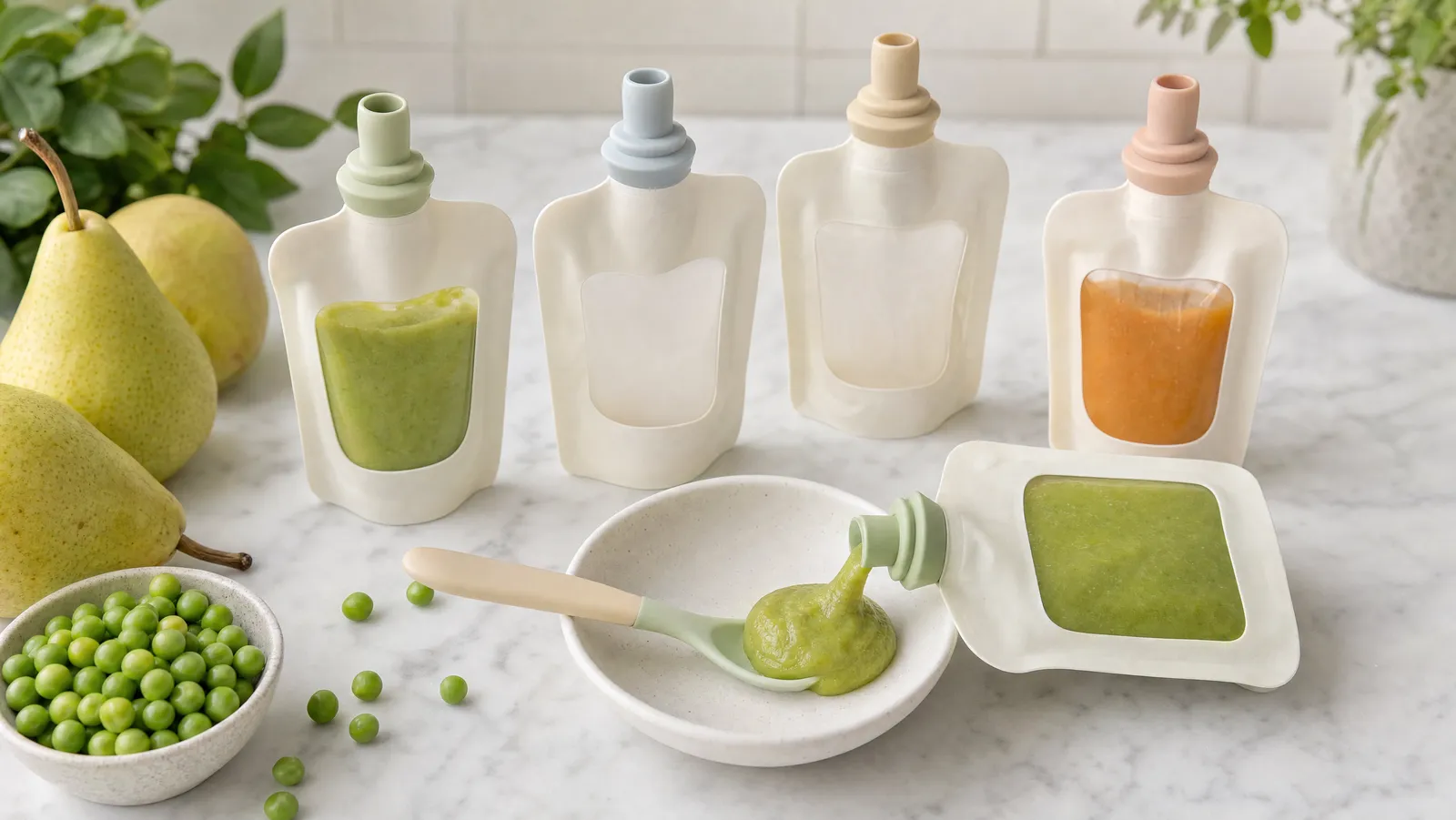
Fill your own and the commercial-product argument evaporates. You control what goes in, there is no fruit-first ingredient list, and you still get a sealed bag in the diaper bag.
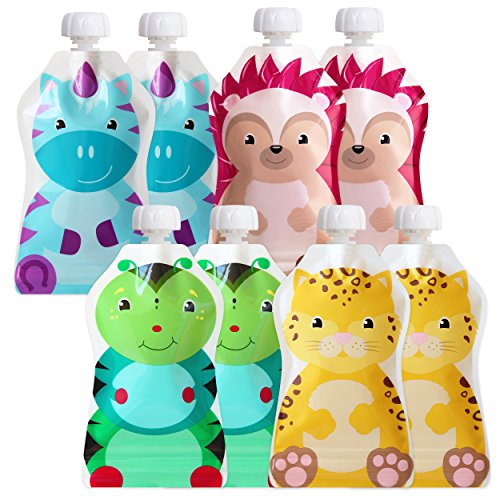
The arithmetic matters, because the packs are wildly different sizes. As of October 2026, the KeaBabies Prep Reusable Pouches are 9.96 dollars for twelve 5 oz pouches, about 83 cents each, while the PandaEar Silicone Pouches are 9.99 dollars for four, about 2.50 dollars each. Near-identical sticker prices, three times the cost per pouch. The ChooMee SnakPack sits between them at 9.98 dollars for eight, about 1.25 dollars each; the Simple Modern Reusable Pouches are 11.99 dollars for ten, about 1.20 dollars each; and the PandaEar Pouches with Handles are 15.95 dollars for seven smaller 4 oz pouches, about 2.28 dollars each, with two collapsible funnels included.
Two things matter more than price. How wide the bottom opening is: ChooMee's is a 3.5-inch opening you can spoon into, KeaBabies describes a wide opening for pouring straight from a food maker, and that is the difference between a two-minute job and a swearing job. And how easy it is to clean: ChooMee says no tight corners to scrub, PandaEar says no hard-to-reach interior corners, KeaBabies includes a brush, and mould in a seam is what ends a set of reusable pouches. All three brands make leakproof or spill-proof claims for their designs; those are the makers' claims, and I would still pack a pouch upright.
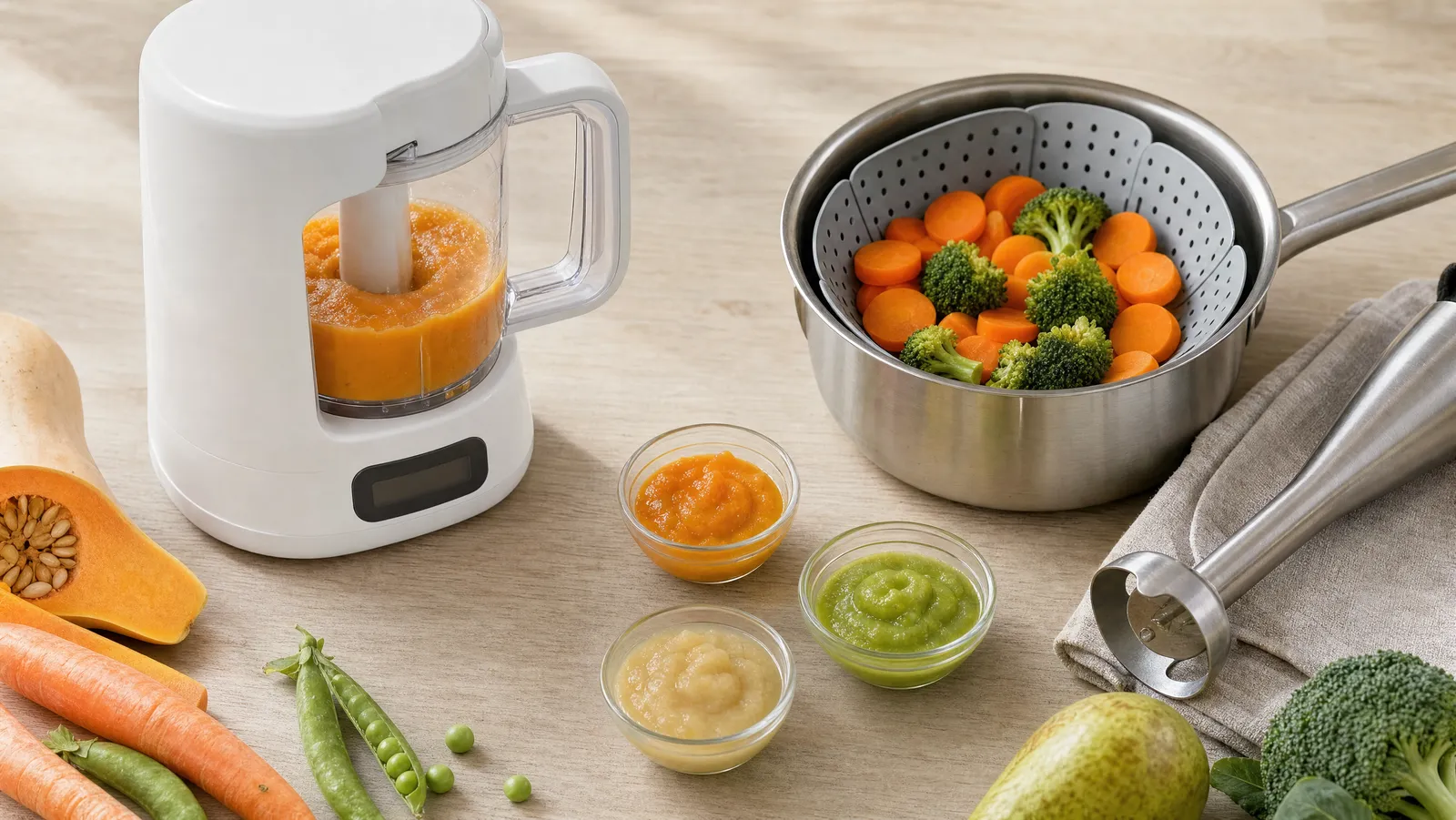
What do you fill them with? Whatever the family is eating, blitzed — you do not need a machine for that, which is the argument in a baby food maker.
How the Five Reusable Sets Compare
| Set | Count and size | Material as listed | Freezer | Microwave | Closure |
|---|---|---|---|---|---|
| ChooMee SnakPack | 8 x 5 oz | BPA, PVC, lead and phthalate free | Can be packed frozen, per maker | Not stated — treat as no | Airtight double zipper |
| KeaBabies Prep | 12 x 5 oz | BPA-free | Freezer-safe | No — maker says do not microwave | Double zip Prep-Seal plus clip |
| Simple Modern | 10 x 5 oz | Made without BPA | Freezer-safe | Not stated — treat as no | Not stated |
| PandaEar Silicone | 4 x 5 oz (150 ml) | Food-grade silicone | Freezer-safe | Microwave-safe per maker | Screw cap, pressed firmly on |
| PandaEar with Handles | 7 x 4 oz (120 ml) | Food-grade silicone | Freezer-safe | Microwave-safe per maker | One-piece snug-fit cap |
Do not generalise across that microwave column: KeaBabies explicitly says not to microwave its pouches, PandaEar describes both silicone sets as microwave-safe, and ChooMee and Simple Modern say nothing, which means no.
Pouch Safety and Hygiene
A part-eaten pouch is not a leftover. Feeding from a spout back-contaminates the contents. Arizona's WIC program states the principle for jars: do not feed your baby directly from the jar unless they will finish all of it, because it transfers bacteria from the baby's mouth to the jar, where it may multiply. Same physics through a spout. Decant into a bowl and the untouched remainder behaves like any opened container — the same Arizona WIC guidance says to keep opened baby food jars and home-prepared baby foods in the refrigerator for no more than 3 days.
Caps and spouts are small parts. Pouches are not a classic choking hazard, but the hardware can be. In February 2015 the CPSC announced a recall of about 6,000 silicone pouch-topper attachments after four reports that the tube could separate from its base, posing a choking hazard; no injuries were reported. Check twist-on tops for splits, keep caps out of reach, and keep your child seated while they eat.
Reusables want the dishwasher — each maker's own rules, top rack where specified, and the brush if one came in the box.
The Bottom Line
Pouches are not bad. They are a convenience food with three predictable failure modes, and you can neutralise all three this week:
- Squeeze it onto a spoon or into a bowl. Four seconds, and it handles the dental exposure and the skills question at once.
- Keep real texture on the table. Pouch in the bag, lumps and finger food at home.
- Serve it at a meal, sitting down. Not a wandering accessory.
And if you buy anything off the back of this, buy reusables and fill them: 83 cents a pouch for the twelve-pack, your own food inside, and an ingredient list that is whatever you cooked on Sunday. For the rest of the first year of eating, how to start your baby on solids is where to go next.
ChooMee SnakPack Reusable Baby Food Pouches (8-Pack, 5 oz)
Eight 5 oz reusable pouches with an airtight double zipper and a wide 3.5-inch bottom opening, so you spoon or pour puree in from the base rather than fighting it through the spout. ChooMee lists them as free from BPA, PVC, lead and phthalates, dishwasher-safe with no tight corners to scrub, and says they can be packed frozen for a day out. The large clear window is the underrated part — you can see what is in there and how much is left.
- Brand
- ChooMee
- Category
- Our Pick
The wide bottom opening is why I reach for these first. Filling a pouch through a 3.5-inch mouth is a completely different job from filling one through a spout.

KeaBabies Prep Reusable Baby Food Pouches (12-Pack, 5 oz)
Twelve 5 oz pouches — the only set here that covers a week of batch-prepping without a mid-week wash. KeaBabies lists them as BPA-free, freezer-safe and dishwasher-safe, with a double zip Prep-Seal closure plus a locking clip, a wide bottom opening for pouring straight from a food maker, and a cleaning brush in the box. Two things to hold on to: KeaBabies says do NOT microwave these, and positions them for babies 6 months and up.
- Brand
- KeaBabies
- Category
- Best Value Multipack
Twelve pouches at this price is what makes filling your own sustainable. The reason most parents abandon reusables is the washing up, not the money.

Simple Modern Reusable Baby Food Pouches (10-Pack, 5 oz)
Ten 5 oz pouches, dishwasher-safe on the top rack and freezer-safe for batch-prepping ahead, made without BPA. Simple Modern sizes them to fit a diaper bag, lunch box or stroller cupholder, which is the daycare case exactly — enough in one set to send a couple out each day and still have clean ones at home. The listing says nothing about microwaving, so treat them as not for the microwave.
- Brand
- Simple Modern
- Category
- Best for Daycare
Sized for a lunch box rather than a countertop, which matters more than it sounds when the pouch has to survive a day in somebody else's bag.

PandaEar Reusable Silicone Baby Food Pouches (4-Pack, 5 oz)
Four 5 oz (150 ml) pouches in food-grade silicone, which PandaEar lists as free of BPA, PVC, lead and phthalates. Silicone is the easy-cleaning option — no hard-to-reach interior corners — and this is one of only two sets here the maker describes as dishwasher-, freezer- and microwave-safe. The trade-off is the price per pouch, which is the highest of the five sets. The cap screws on, and PandaEar advises pressing it firmly into place before use.
- Brand
- PandaEar
- Category
- Best Silicone
This is the version I would buy if cleaning is the thing that would make me quit on reusables, and the per-pouch price is exactly what you are paying for that.
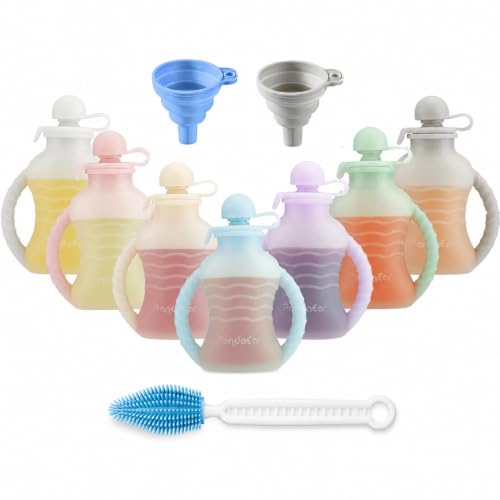
PandaEar Silicone Baby Food Pouches with Handles (7-Pack, 4 oz)
Seven 4 oz (120 ml) silicone pouches with dual easy-grip handles sized for small hands, plus two collapsible funnels for filling. PandaEar lists food-grade silicone free of BPA, PVC, lead and phthalates, a one-piece snug-fit cap, a variable flow opening, and dishwasher-safe (top rack), freezer-safe and microwave-safe use. The handles are the point: a baby holding a pouch with both hands is doing something closer to holding a cup than being fed.
- Brand
- PandaEar
- Category
- Best for Self-Feeding
The two funnels are the detail that stops filling day being a mess, and the handles give a baby something to actually grip instead of a smooth plastic sleeve.

ChooMee SoftSip Food Pouch Tops (4-Pack)
Not pouches — four silicone tops that twist onto most store-bought and reusable pouches, so this is an accessory for whatever you already have in the cupboard. ChooMee describes a patented built-in flow control valve that leaves each squeeze to the child, and soft 100% food-grade platinum silicone over the hard plastic spout. Flow control is the one claim in this category that maps onto a real concern, because a top that slows a pouch down is aimed at the speed problem directly. Free of BPA, PVC, lead and phthalates, with a cap for storage, and it rinses clean or goes in the dishwasher.
- Brand
- ChooMee
- Category
- Best Flow-Control Add-On
If your baby is going to self-feed from a spout whatever you decide, this is the part of the setup worth spending money on.
- 01ChooMeeOur PickChooMee SnakPack Reusable Baby Food Pouches (8-Pack, 5 oz)
- 02KeaBabiesBest Value MultipackKeaBabies Prep Reusable Baby Food Pouches (12-Pack, 5 oz)
- 03Simple ModernBest for DaycareSimple Modern Reusable Baby Food Pouches (10-Pack, 5 oz)
- 04PandaEarBest SiliconePandaEar Reusable Silicone Baby Food Pouches (4-Pack, 5 oz)
- 05PandaEarBest for Self-FeedingPandaEar Silicone Baby Food Pouches with Handles (7-Pack, 4 oz)
- 06ChooMeeBest Flow-Control Add-OnChooMee SoftSip Food Pouch Tops (4-Pack)
How many baby food pouches a day is too many?+
Can I put a half-eaten pouch back in the fridge?+
At what age are pouches fine to start?+
Sammie Seelbach
Sammie is a mom of two and the lead reviewer at Smart Baby Reviews. Since becoming a parent she has become obsessed with researching the safest, smartest baby gear on the market — testing thermometers at 2 a.m., wrangling baby gates, and sterilizing more bottles than she can count. She shares what actually works so other parents can make confident, informed decisions for their little ones.