How to Bottle Feed a Newborn

This post may contain affiliate links. Read our policy.
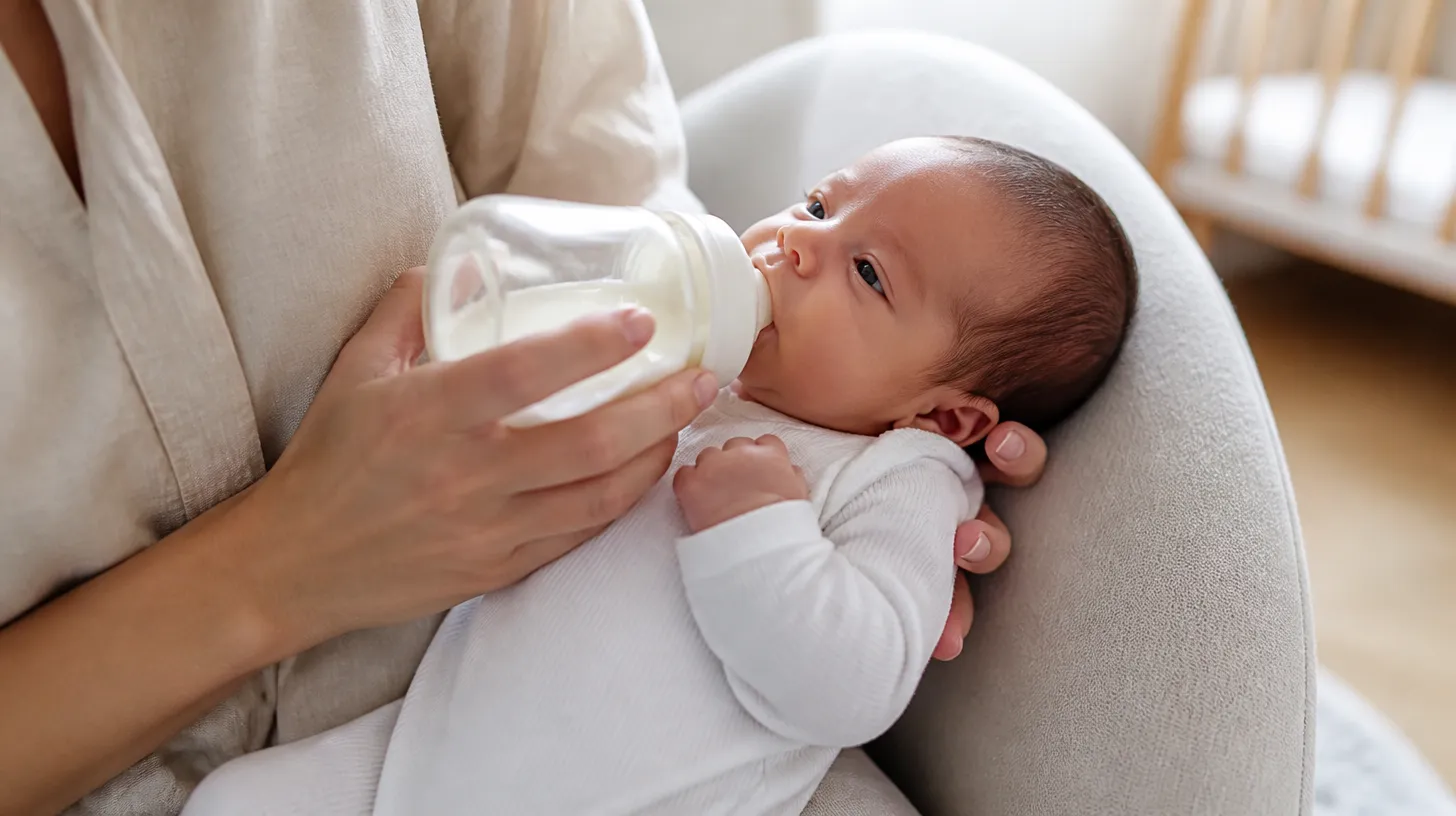
The short version of how to bottle feed a newborn: hold the baby semi-upright rather than flat, keep the bottle close to level so milk does not pour in on its own, start with the slowest nipple in the box, and end the feed when the baby stops rather than when the bottle is empty. That is the technique. We earn a commission from links on this page, at no cost to you.
Everything below is detail, troubleshooting, and the small handful of safety numbers worth knowing by heart. This page is the hub for our bottle-feeding series, so each section is a short, usable answer with a pointer to a deeper one.
A realistic first week, for calibration: HealthyChildren.org, the American Academy of Pediatrics parent site, says babies in the first week after birth should be eating no more than about 1 to 2 ounces (30 to 60 mL) per feed. It also says most bottle-fed newborns eat every two to three hours, with eight feeds generally the minimum in 24 hours. So the first week is roughly a two-ounce bottle, eight to twelve times a day, including the middle of the night. It is a lot of small feeds, not a few big ones.
Paced Feeding: Let the Baby Set the Rhythm
Paced feeding means you control the flow of milk instead of letting gravity do it. It is the single technique that makes everything else easier, and it takes about one feed to learn.
The sequence taught by NHS infant feeding teams is short. Cambridgeshire and Peterborough Children's Health advises holding the baby close in a semi-upright position so you can see their face, gently stroking the bottle teat on the baby's top lip, and guiding the teat in once they open their mouth. The same NHS guidance gives the mechanical half: keep the bottle horizontal so the milk does not flow too fast, and when the baby pauses, stop the flow by gently removing or lowering the bottle.
The rule that matters most is the last one. Cambridgeshire and Peterborough Children's Health says your baby does not need to finish the bottle at every feed, and that pacing a feed this way reduces the chances of overfeeding your baby. The AAP makes the same point from the other direction on HealthyChildren.org: overfed babies can have stomach pains, gas, spit up or vomit and be at higher risk for obesity later in life, and it is better to offer less, since you can always give more if your baby wants it.
In practice, that looks like this:
- Touch the nipple to the upper lip and wait. Do not push it in.
- Keep the bottle level enough that milk covers the nipple but does not stream.
- When the baby pauses or starts gulping, tip the bottle down and let them breathe.
- Watch the baby, not the ounces. Stop when they stop.
One thing we would not do is treat pacing as a stopwatch exercise. There is no magic feed length. There is only a baby who is working steadily, breathing comfortably, and not fighting the bottle.
Our deeper walkthrough of the technique, including what to do with a gulper, is paced bottle feeding.
How Much, and How Often
HealthyChildren.org gives the clearest set of numbers we found, and they are worth copying onto the fridge:
- First week: no more than about 1 to 2 ounces (30 to 60 mL) per feed.
- By the end of the first month: 3 to 4 ounces (90 to 120 mL) per feed, roughly every three to four hours.
- By about 6 months: 6 to 8 ounces (180 to 240 mL) at each of four or five feedings in 24 hours.
- Daily rule of thumb: about 2 and a half ounces (75 mL) of formula a day for every pound of body weight.
- Daily ceiling: usually no more than an average of about 32 ounces (960 mL) in 24 hours.
The AAP frames frequency as responsive rather than scheduled. HealthyChildren.org says babies should in general be fed whenever they seem hungry, which it calls feeding on demand or responsive feeding, and that most bottle-fed newborns eat every two to three hours with eight feeds as a rough minimum per 24 hours.
Hunger cues, per HealthyChildren.org, come well before the crying: licking lips, sticking the tongue out, rooting, putting a hand to the mouth repeatedly, opening the mouth, fussiness, and sucking on everything within reach. The AAP notes that crying is a late sign of hunger. Catching the early cues is also the easiest way to avoid a frantic feed, which is where most of the gulping and swallowed air comes from.
If the number on the bottle and the baby disagree, the baby wins. HealthyChildren.org says to let them tell you when they have had enough, and that a baby who becomes fidgety or easily distracted during a feeding is probably finished. Talk to your pediatrician if your baby consistently wants much more or much less than the ranges above.
We go through the full age-by-age table in how many ounces per feed.
How to Hold the Baby, and the Bottle
If you want one answer on how to position a newborn for a bottle, it is semi-upright, with the head higher than the stomach, and the bottle held by a person. HealthyChildren.org says to support the baby in a semi-upright position with the head cradled in the crook of your arm, and to hold the bottle so that milk completely covers the nipple, so the baby is not swallowing air.
The thing to avoid is equally specific. The AAP says to try not to bottle-feed a baby while she is on her back, because lying down increases the risk that she will choke, and it allows milk to run into her eustachian tubes, a possible cause of middle ear infections.
That rules out propping a bottle against a blanket or a rolled towel, ever. Children's Healthcare of Atlanta lists the reasons: propping forces the baby to keep up with the flow even if he is full, which carries the risk of overeating or worse, choking; it increases the risk of ear infections; and it can cause milk to pool up in the baby's mouth and lead to eventual tooth decay. A propped bottle can also slip, so the baby sucks in air and gets gassy and fussy. Children's Healthcare of Atlanta's advice is to let the laundry wait, and hold your baby during feedings.
Two small habits that cost nothing. Cambridgeshire and Peterborough Children's Health suggests changing which side you feed your baby on, the way you would switch breasts, which gives both of your arms a break and varies the baby's view.
More on holds, including feeding a sleepy newborn and feeding in a carrier, in the best position to bottle feed a newborn.
Introducing the First Bottle
If you are breastfeeding, the first bottle is a scheduling decision rather than a medical one. The AAP's 2022 policy statement, Breastfeeding and the Use of Human Milk, published in Pediatrics, recommends exclusive breastfeeding for approximately six months after birth, and supports continued breastfeeding alongside complementary foods introduced at about six months for two years or beyond, as mutually desired. None of that forbids a bottle. Plenty of families need one for work, for a partner's night shift, or simply so that one adult is not the only person who can feed the baby.
On timing, we would rather be honest than confident. The widely repeated advice is to wait until breastfeeding is established, somewhere around four to six weeks, and then offer a bottle about once a day. That figure comes from hospital and lactation-service patient education rather than from a major pediatric guideline, and we could not find a national body that names a specific week. Nationwide Children's Hospital's patient-education guidance does give one concrete caution: it says it is best to breastfeed a baby exclusively for the first 3 to 4 weeks, and that introducing the bottle for substitute or supplementary feedings before 4 weeks can possibly lead to a decrease in milk production.
For the bottle itself, Nationwide Children's Hospital says babies who get both human milk and bottles may do better with a slower-flowing nipple, which is closer to the flow of human milk during breastfeeding. Beth Israel Deaconess Medical Center suggests choosing a nipple with a wide base that slopes gradually to a short tip, and starting with a slow-flow nipple made of soft, compressible silicone.
The practical version: pick a calm time of day, let someone else do it if that is easier, and treat the first few attempts as practice rather than a meal. Our full guide is introducing a bottle to a breastfed baby.
When the Baby Says No
Refusal is common, it is usually temporary, and it responds better to timing than to persistence.
Beth Israel Deaconess Medical Center's advice is the most concrete we found. Offer the bottle when the baby is at their best, often mid-morning rather than during the five-to-eight-in-the-evening stretch it calls the bewitching hour. Start at early hunger cues rather than waiting until the baby is frantic. Try one bottle feeding per day, and if the baby becomes very upset, stop and try again later or another day. To get the mouth to open, it suggests warming the nipple under running warm water and then stroking the baby's lips with it from top to bottom to trigger the rooting reflex. It also notes that for some babies it works better if the person offering the bottle is not the breastfeeding parent, while others do better with the breastfeeding parent, so both are worth trying.
What we would not do is hold a bottle in the mouth of a baby who is crying and not sucking. Milk sitting in a mouth that is not swallowing is a problem, not progress.
Sudden refusal in a baby who was taking bottles fine is worth a phone call rather than a new technique. Beth Israel Deaconess Medical Center says to keep the pediatrician informed if the baby is not progressing with bottle or cup feeding, and that the pediatrician can decide whether a referral to a feeding specialist is the next step. A baby who is refusing feeds and feels warm is a different conversation again: HealthyChildren.org says a rectal temperature of 100.4°F (38°C) or higher counts as a fever and warrants contacting the pediatrician, and that for a baby 3 months old or younger you should call immediately, even with no other symptoms. That is one of the reasons we keep a rectal thermometer in the nursery drawer rather than in the bathroom cabinet.
More strategies, including the paced-feeding tricks that often work after a few failed attempts, in a baby who refuses the bottle.
Nipple Flow, and When to Size Up
Nationwide Children's Hospital defines flow rate as the rate at which human milk or infant formula moves from the bottle nipple into an infant's mouth, and gives the starting point: most babies born near their due date can use a newborn flow rate, such as level 1 or slow flow, whether they drink human milk or formula.
The important part is what it says next: there is no need to move up a level based on age. If a healthy baby is growing and feeding well, they can stay on the same nipple. Nationwide Children's also notes that almost every bottle brand attaches an age range to its flow rate, and that a baby's own pace may not match the age or size nipple recommended on the bottle packaging. Treat the number on the packaging as a starting suggestion, and the baby as the instrument.
Signs the flow is too fast, per Nationwide Children's: gulping, choking, hard swallowing, coughing, extra drooling, or refusing to eat. Signs it is too slow: the baby takes longer than usual to finish, sucks quickly with few swallows so the nipple may collapse, or gets fussy during feeding.
For a newborn, almost every problem is on the too-fast side, which is why we buy slow-flow nipples and nothing else for the first couple of months. The Tommee Tippee Natural Start anti-colic bottles are a reasonable default here because the maker states the nipple is designed for pace feeding, letting the baby feed at their own pace and stop when full — which is the technique this whole page is built around.
The full sizing-up logic, and why age charts mislead, is in bottle nipple flow rates.
Reflux and Spit-Up
Most spit-up is not a problem, and knowing that saves a lot of 2 a.m. searching. Seattle Children's Hospital calls spitting up a normal symptom in half of young babies, says about 85% of cases start by day 7, and notes that many babies are better by about 7 months. The American Academy of Family Physicians patient handout on gastroesophageal reflux says spitting up is considered normal in most infants, that it is usually worst around four months of age, and that it gets better by one year of age. The AAFP also says most reflux does not need to be treated and that infants and children with reflux usually do not need medicine.
Seattle Children's describes normal spit-up as small amounts, often one or two mouthfuls, with no effort, pain or crying, in a baby who seems hungry, content and well. It also makes a distinction worth holding onto: normal reflux does not cause crying.
The feeding adjustments it suggests for bottle-fed babies are modest and worth trying in order:
- Offer about 1 ounce (30 mL) less per feeding, and keep each feed under 20 minutes.
- Leave at least two and a half hours between formula feeds.
- Burp two or three times during a feed, for under a minute each.
- Keep the baby upright for 30 to 60 minutes after a feed, and hold them at a slant during the feed.
Thickening feeds is a real option but a medical one. The AAFP handout lists adding a thickener such as rice cereal among things to try, and specifically says to discuss changes to your infant's body positioning after feeding with your doctor first. We would not start thickening or change formula without asking your pediatrician, and we are not going to print amounts here.
Sleep position does not change because of reflux. HealthyChildren.org is unambiguous: back sleeping is the best way to reduce the risk of SIDS, and it is the recommended position even for babies with reflux. It adds that elevating the head of a baby's crib is neither effective at reducing reflux nor safe. If you need the rest of the sleep setup, we walk through it in how to set up a safe sleep space.
Finally, the lines that are not negotiable. Seattle Children's says to seek care now for blood in the spit-up, for a baby who choked on milk and turned blue or went limp, for a baby under 12 weeks old whose spitting up becomes forceful or projectile, and for any baby under one month old acting abnormal in any way. It notes that pyloric stenosis, the most common cause of true vomiting in young babies, usually starts between two weeks and two months of age, produces forceful projectile vomiting in a baby who is often hungry right afterward, and is cured with surgery. The AAFP adds that an infant vomiting stomach bile or blood, or with blood in bowel movements, should be seen immediately or taken to the emergency department.
Our deeper piece is bottle feeding a baby with reflux.
Air, Burps, and Colic
Swallowed air is the one gas problem bottle feeding genuinely creates, and it is the one you can do something about. HealthyChildren.org says to burp your baby during, as well as after, each feeding, and the AAP's guidance on infant abdominal pain suggests burping before, halfway through, and after a feed, and feeding before the baby is frantic, since a hungry baby may swallow more air.
On hardware, the AAP is measured rather than enthusiastic. HealthyChildren.org notes that slowing the milk flow reduces swallowed air, that it is worth testing different nipples and bottles, and that special bottles such as those that are vented, angled or collapsible are designed to limit air intake during feeding. That is a description of intent, not a promise of results, and we would read it that way before spending a lot on a vented system.
Two free things the AAP does recommend for trapped gas: laying the baby on their back and gently moving their legs in a cycling motion, and supervised tummy time, which HealthyChildren.org says can put pressure on any gas that is thinking about settling in to be on its way out instead. Keeping the baby upright after a feed helps the stomach empty.
Gas drops are the clearest example of a product the evidence does not support. HealthyChildren.org says the AAP cannot find definitive evidence to show that the effort and expense of infant gas drops pay off, and that for colic specifically, studies suggest that simethicone does not help. It allows that there is usually no harm in trying them, but says to consult your pediatrician first.
Colic itself is a different thing from gas. The AAP's infant abdominal pain guidance describes colic as crying that lasts about three hours at least three times a week, usually starting a few weeks after birth and easing by around three months, and says the pediatrician should rule out other causes of fussiness first. If a baby is inconsolable, HealthyChildren.org advises checking their temperature, with a rectal reading of 100.4°F (38°C) or higher warranting a call. And if you are overwhelmed, the AAP's own advice is to put the baby on their back in a safe crib and step away, or hand them to another adult. Never shake a baby.
The full troubleshooting sequence lives in gas and burping.
Mixing, Warming, and Storing
This is the part of bottle feeding with actual rules, and they are short enough to memorise.
Mixing. The CDC says to wash your hands and clean and sanitize your workspace first, to always measure the water first and then add the powder, and warns that too much water may not meet your baby's nutritional needs while too little can strain the kidneys and digestive system and cause dehydration. For most babies most of the time, the CDC says tap water is fine, filtered or unfiltered, following the container's instructions. For babies under 2 months, born before 37 weeks, or with a weakened immune system, it says to boil the water, wait about five minutes, mix the formula, then let it cool — because very hot water, about 158°F (70°C), is needed to kill germs such as Cronobacter.
Timing. The CDC says to use prepared formula within 2 hours of preparation and within 1 hour from when feeding begins. If the bottle will not be used inside the 2-hour window, refrigerate it right away and use it within 24 hours. Throw out any formula left in the bottle after a feeding, because saliva mixed with formula can allow bacteria to grow.
Warming. Formula does not need to be warmed at all, per the CDC. If you do warm it, hold the bottle under running warm water, keep the water out of the bottle and off the nipple, and test a few drops on your wrist. Never use a microwave — the CDC says microwaves heat milk and food unevenly, resulting in hot spots that can burn your baby's mouth and throat.
Expressed breast milk has its own numbers. The CDC says freshly pumped milk can sit out up to 4 hours at room temperature (77°F or colder), keeps about 4 days in the refrigerator, and lasts about 6 months in a freezer at 0°F or below, with up to 12 months acceptable. Milk thawed in the refrigerator should be used within 24 hours; once it has reached room temperature or been warmed, use it within 2 hours; and it should never be refrozen. Leftover milk from a feeding should be used within 2 hours and then discarded.
Washing. The CDC says to clean baby bottles after every feeding, and to sanitize daily — or more often — if your baby is under 2 months old, was born prematurely, or has a weakened immune system. Boiling means five minutes in covered water; a dishwasher run with hot water and a heated drying or sanitizing cycle means a separate sanitizing step is not necessary. Let everything air-dry thoroughly, and do not use a dish towel to rub or pat items dry, because the CDC says doing so may transfer germs to the items. If you are weighing the appliance, we made the case for a bottle sterilizer and dryer separately — the drying half is the part that earns the counter space.
The full kitchen workflow, including pitcher-batching and travel, is in prepare and store formula safely.
Winding the Bottle Down
The bottle has an end date, and it is earlier than most parents expect. HealthyChildren.org says the transition away from bottles should ideally begin around 6 months, when you offer your child a cup for the first time, and that bottle feedings should be reduced slowly with the switch completed sometime between 12 and 18 months.
The reasons it gives are not just dental. HealthyChildren.org says little ones who sip on bottles during the day often do not feel hungry at mealtimes, and that for many kids, bottles become high-calorie meal supplements and snacks, leading to toddler obesity. It also flags early childhood caries, sometimes called baby bottle tooth decay, as a risk when teeth are constantly exposed to milk, formula, juice or other drinks.
Six months is also when the food side of the equation opens up. The AAP's 2022 policy statement recommends complementary foods introduced at about six months, alongside continued breastfeeding for two years or beyond as mutually desired. In practice the bottle does not get cancelled at six months; it gets gradually outnumbered. If you are at that stage, our guide to starting your baby on solids covers the first month of food, when to start solids readiness signs covers whether your baby is actually ready, and how much solid food by age covers the volumes as milk recedes.
The order of operations we would use: drop the easiest daytime bottle first, keep milk at the table in a cup, and save the most emotionally loaded feed for last. HealthyChildren.org specifically advises eliminating bottle feedings around naps or bedtime, and warns that offering a bottle at bedtime in response to protests is how sleep problems become entrenched.
Our step-by-step plan is when to stop bottle feeding.
Teeth, and the Bottle in the Crib
The risk to a bottle-fed baby's teeth is contact time, not milk itself. HealthyChildren.org describes early childhood caries, sometimes called baby bottle tooth decay, as what happens when teeth are constantly exposed to milk, formula, juice or other drinks. A bottle that goes into a crib and stays in a sleeping mouth is the worst version of that exposure. Children's Healthcare of Atlanta says a propped bottle can cause milk to pool up in the baby's mouth and lead to eventual tooth decay, on top of the ear infection and choking risks.
So the rule is simple and absolute: the bottle comes out of the crib, and the baby goes down without it. That is also the safe-sleep answer, and it is one of several things we cover in what does not belong in the crib.
Once teeth arrive, the AAP's oral health guidance on HealthyChildren.org says to start fluoride toothpaste as soon as the first tooth erupts and to clean the teeth at least twice a day, using a grain-of-rice-sized smear until age 3 and a pea-sized amount from age 3. It says pediatricians start oral health checkups and fluoride varnish at about 6 months, and to see your child's dentist by their first birthday or within six months of their first tooth — which lands in the same window as the bottle wean, conveniently enough.
Nothing here requires special gear. A rice-grain of toothpaste, a soft infant brush, and not sending a bottle to bed covers most of it.
More detail, including what a dentist actually looks for at that first visit, in bottle-fed baby teeth.
Choosing the Bottle Itself
Here is the unsentimental version: the bottle matters much less than the nipple, and the nipple matters much less than how you hold it. Nipple shape preference is also the one variable you cannot predict before the baby exists, which is why buying four of anything before birth is a gamble.
If you are feeding both at the breast and by bottle, Nationwide Children's Hospital says babies who get both human milk and bottles may do better with a slower-flowing nipple, closer to the flow of human milk during breastfeeding. That is the whole evidence-based core of what parents are looking for when they search for the best bottles for breastfed babies — slow flow, and a shape the baby accepts. Nationwide Children's also notes that a baby's own pace may not match the nipple recommended on the packaging.
On materials, both glass and modern plastic are reasonable. The FDA amended its food additive regulations in July 2012 to no longer provide for the use of BPA-based polycarbonate resins in baby bottles and sippy cups, an action it took in response to a petition from the American Chemistry Council noting those uses had been abandoned, and it did the same for BPA-based coatings in infant formula packaging in 2013. Glass avoids the question entirely, is easy to sterilise, and is heavy and breakable. We compared the options in the best glass baby bottle brands.
For a newborn specifically, we would start with a small glass bottle and a slow nipple. The Philips Avent Natural glass bottles come as four 4 oz bottles, each shipping with a slow Flow 2 nipple, in borosilicate glass that Philips Avent says is heat and thermal-shock resistant and safe for fridge storage, warming, washing and sterilizing. Four ounces sounds small until you reread the AAP's first-month figure of 3 to 4 ounces per feed.
If you genuinely do not know what your baby will take — most first-time parents do not — the honest answer is to buy variety instead of volume. A bottle trial pack with five bottles and a pacifier from five different makers, in newborn sizes with mainly slow-flow nipples, costs less than discovering twice that a four-pack was the wrong shape. Once you know what works, buy that one in quantity and stop reading reviews.
Explore the full series
- Paced Bottle Feeding: How to Do It, and Why It Matters — Let the baby set the pace — the upright hold, the level bottle, and the pauses that stop a feed from being a race.
- How Many Ounces Per Feed, by Age — Realistic volumes from day one through twelve months — and why the number on the chart matters less than the cues.

Philips Avent Natural Glass Baby Bottles, Slow Flow, 4 oz (4-Pack)
Premium borosilicate glass, BPA-free and resistant to heat and thermal shock, which Philips Avent says makes it safe for fridge storage, warming, washing and sterilizing. The nipple is a wide, breast-shaped design and every bottle in the set ships with a slow Flow 2 nipple. There is an integrated anti-colic valve that the maker states directs air away from the baby, plus a no-drip nipple. Four bottles at 4 oz each, which is the size a newborn actually empties in the first month.
- Brand
- Philips Avent
- Category
- Our Pick
Glass, 4 oz, and a slow Flow 2 nipple — the size and flow a newborn actually needs, in a material you can sterilise without worrying about it degrading.
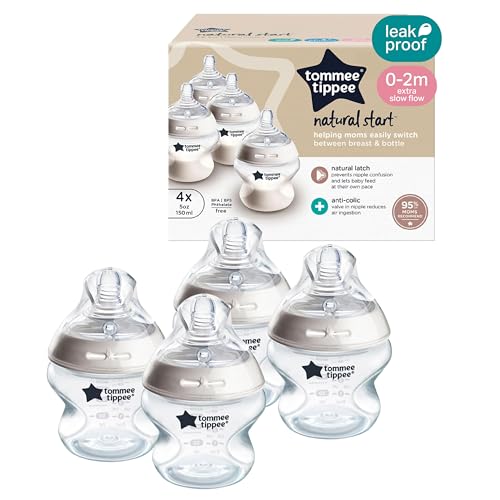
Tommee Tippee Natural Start Anti-Colic Baby Bottles, 0m+, 5 oz (4-Pack)
A silicone nipple with an anti-colic valve that the maker says flexes like a breast. Tommee Tippee states the bottle is designed for pace feeding — the nipple lets the baby feed at their own pace and stop when full — and that the shape encourages a natural latch and reduces air intake. The maker also reports that the bottles self-sterilize in three minutes and are 100% leakproof when the ring, nipple and cap are secured. Four bottles at 5 oz each, rated 0m+.
- Brand
- Tommee Tippee
- Category
- Best Value
The maker explicitly designs this nipple for pace feeding, which is the technique this guide is built around, at roughly half the price of the glass set.

Tiny Trials Baby Bottle Trial Pack Variety Box (5 Bottles + 1 Pacifier)
Five bottles plus one pacifier from BIBS, Lansinoh, Philips Avent, Dr. Talbot’s and Evenflo, in newborn-friendly sizes with mainly slow-flow nipples. Materials are mixed, including BPA-free plastic and glass, and the box covers both anti-colic vented and airless designs. The purpose is narrow and useful: test several nipple shapes before you commit to a full multipack of any one of them.
- Brand
- Tiny Trials
- Category
- Best If You Don’t Know Yet
Nipple preference is the one thing you cannot predict. Five brands in one box is cheaper than guessing wrong twice on a four-pack.
- 01Philips AventOur PickPhilips Avent Natural Glass Baby Bottles, Slow Flow, 4 oz (4-Pack)
- 02Tommee TippeeBest ValueTommee Tippee Natural Start Anti-Colic Baby Bottles, 0m+, 5 oz (4-Pack)
- 03Tiny TrialsBest If You Don’t Know YetTiny Trials Baby Bottle Trial Pack Variety Box (5 Bottles + 1 Pacifier)
How do you bottle feed a newborn correctly?+
How many ounces should a newborn drink per feed?+
How long can a bottle of formula sit out?+
Is it bad to let a baby fall asleep with a bottle?+
Can bottle feeding cause gas or colic?+
Sammie Seelbach
Sammie is a mom of two and the lead reviewer at Smart Baby Reviews. Since becoming a parent she has become obsessed with researching the safest, smartest baby gear on the market — testing thermometers at 2 a.m., wrangling baby gates, and sterilizing more bottles than she can count. She shares what actually works so other parents can make confident, informed decisions for their little ones.