Paced Bottle Feeding: How to Do It, and Why It Matters

This post may contain affiliate links. Read our policy.

Paced bottle feeding means holding your baby close to upright, keeping the bottle close to horizontal so the nipple stays full but milk is not pouring, letting them draw the milk out instead of tipping it in, pausing when they pause, and stopping when they signal they are finished rather than when the bottle is empty. Published feeding guides put a full feed at 15 to 30 minutes. We earn a commission from links on this page, at no cost to you.
That is the whole technique, and it costs nothing. What makes it worth learning is mechanical rather than philosophical. A bottle tipped up with a fast nipple delivers milk whether or not the baby asked for it, so the baby's job shifts from feeding to keeping up. The bottle sets the pace, and the baby's own fullness signal arrives too late to matter. That is how a 4 oz bottle disappears in four minutes, and how a feed ends in back-arching and head-turning that looks like colic.
If you are still sorting out the fundamentals — which bottle, what temperature, how often to burp — read how to bottle feed a newborn first, and treat this as the technique layer on top of it. Below is the step-by-step, how long a paced feed should actually take, the signs you are moving too fast, and the three sentences that get a daycare or a grandparent doing it the same way.
What Pacing Actually Changes
The American Academy of Pediatrics names the problem plainly. On HealthyChildren.org, the AAP's parent site, the guidance is that "infants who are bottle feeding may be more likely to overfeed, because drinking from a bottle is faster and may take less effort than breastfeeding." The same page notes that infants "may not pull away or raise their hands and indicate that they are full," and warns that "overfed babies can have stomach pains, gas, spit up or vomit and be at higher risk for obesity later in life."
Its two pieces of practical advice are the ones paced feeding turns into a routine. First, on pausing: the AAP says "pausing can be helpful to give them a chance to realize when they're full." Second, on volume: "It's better to offer less, since you can always give more if your baby wants it." Offering less is easier once you know what a normal amount looks like at your baby's age, which we have broken down in how many ounces per feed.
So pacing is not a wellness ritual. It is a way of putting the brakes back under the baby's control — and of making their fullness cue arrive while there is still milk in the bottle, where you can act on it.
How to Pace a Bottle Feed, Step by Step
You can run all of this one-handed once it is habit.
- Start before the crying. San Francisco's responsive feeding guidance for caregivers states that crying is a late sign of hunger. Watch instead for hands going to the mouth, tight fists, sucking movements, puckered lips and rooting. A baby who is already furious will gulp, no matter how you hold the bottle.
- Sit them near-upright. San Francisco's responsive feeding guidance says to hold infants upright at a 45-to-90-degree angle, and Nationwide Children's Hospital advises holding the baby in the crook of your arm, close to your body, with the head and back tilted up — which it says helps prevent choking. Support the head and neck rather than letting the head loll, and keep the head above the chest. Not flat on their back, not folded forward.
- Touch, do not insert. Brush the nipple down from the nose across the lips and wait. When the mouth opens wide, let them take the nipple deep rather than resting it on the tongue tip.
- Keep the bottle close to horizontal. Tilt it only enough to keep milk in the tip of the nipple. A nipple that is half full of air means swallowed air; a nipple held straight down means the baby is drinking uphill under gravity.
- Let them draw it. No jiggling, no twisting, no gentle pushing. If milk is not moving, the baby is resting.
- Pause every few swallows. San Francisco's guidance describes the rhythm as offering the infant a break for a few seconds every few sucks, until they are trying to latch again. In practice: tip the bottle down so the nipple drains, count to three or five, then bring it back when they root for it.
- Switch sides. Maryland WIC's baby-paced handout says to change sides so the baby uses both eyes and both sides of the body and is less likely to prefer one side, and the Carolina Global Breastfeeding Institute's responsive-feeding handout likewise says to alternate sides to encourage the development of both eyes. One UK lactation-consultant handout suggests choosing a midway point in the feed to switch. The other reason is mundane: it stops your own wrist from dying.
- Stop on their cue, not the bottle's. Leftover milk in the bottle is not a failure. It is the only evidence you have that the baby, and not the container, decided.
Two habits sit underneath all eight. Hold the bottle yourself for the whole feed, and keep your eyes on the baby rather than on the ounce markings.
How Long a Paced Feed Should Take
Budget 15 to 20 minutes, and treat the clock as a sanity check rather than a target. The USDA's child-care feeding guidance states that a typical feeding session will take 15 to 20 minutes but should be based on the baby's fullness signs. California WIC's paced-feeding handout gives the same 15-to-20-minute range.
Other authorities push the window wider. Colorado WIC suggests feedings should take 15 to 30 minutes, or as long as your baby would normally breastfeed. Maryland WIC's baby-paced bottle feeding brochure says a feeding should take about 15 to 30 minutes. One UK parent handout treats 15 to 20 minutes as a floor rather than an average.
They disagree by a few minutes and agree on the thing that matters: the end of the feed is a cue, not a time. The number worth paying attention to is the short one. A bottle that reliably empties in four or five minutes is telling you the flow is doing the work.
Pacing changes volume too, usually downward at first, and that is expected rather than alarming — see our age-by-age ounce figures. For the broad shape, the CDC advises starting by offering 1 to 2 ounces of infant formula every 2 to 3 hours in the first days of life, and notes that most formula-fed newborns will feed 8 to 12 times in 24 hours. The AAP, on HealthyChildren.org, says that by 6 months babies may take in 6 to 8 ounces at each of 4 or 5 feedings in 24 hours. Both point you to your own pediatrician for your own baby's numbers.
The Signs You Are Going Too Fast
A baby who is overwhelmed by flow does not say so. They work around it, and the workarounds are visible once you know them. Maryland WIC's baby-paced bottle feeding brochure lists several of these as signs that something needs to change, and Children's Wisconsin's cue-based feeding sheet lists the rest among the stress cues to watch for during a feed.
| What you see | What it usually means |
|---|---|
| Gulping you can hear across the room | Flow is faster than the swallow |
| Milk escaping from the corners of the mouth | More arriving than can be swallowed |
| Raised eyebrows, flared nostrils, quick blinking | Effort, not enthusiasm |
| Fingers splayed stiffly, arms or legs braced | Stress posture during a feed |
| Pulling off the nipple, then wanting it back | Taking a pause you did not offer |
| Coughing or choking mid-feed | Milk arriving faster than the swallow can keep the airway clear |
| A 4 oz bottle gone in four minutes | The bottle is setting the pace |
Any of those is a reason to tip the bottle down and wait, not a reason to push on to the end.
Fullness looks different, and much calmer. Responsive-feeding guidance from San Francisco's public health department and from the Carolina Global Breastfeeding Institute at the University of North Carolina's Gillings School between them list: slowing or stopping sucking, turning the head away or refusing to open the mouth, pushing away, relaxed arms that fall away from the body, arching the back, clamping the lips together, and falling asleep during the feed. San Francisco's guidance is blunt about what to do next — stop feeding when the infant shows signs of fullness, and do not force them to finish the bottle.
Flow Rate Is the Variable Nobody Checks
Here is the part that undermines a lot of careful pacing: the words on the nipple packet are not a measurement. A study by Britt Frisk Pados and colleagues, published in MCN: The American Journal of Maternal Child Nursing and indexed by the NIH, measured 26 nipple types representing 15 common brands, ten of each, and found milk flow rates ranging from 1.68 millilitres per minute at the slow end to 85.34 millilitres per minute at the fast end. Their conclusion was that the name of the nipple does not provide clear information about the flow rate.
Consistency varied too. The same study reported a coefficient of variation within a single nipple type ranging from 0.03 for one Dr. Brown's level up to 0.37 for a MAM slow-flow nipple, meaning two nipples of the same type can behave differently. The authors also cautioned that their bench test was not intended to mimic the milk flow rates an infant achieves during oral feeding, and that they applied only one fixed level of suction rather than the varying sucking pressures a real baby uses. So treat flow as something to observe in your own baby rather than to look up.
Practically, that means starting at the slowest nipple your bottle system sells and only moving up when your baby is visibly working too hard — long pauses, collapsing the nipple, falling asleep hungry. Moving up a level because a baby turned three months old is a common mistake. The three nipples below are the ones we reach for when pacing is the goal, and all three are slow by design.
For a standard term newborn, a Level 1 slow-flow nipple is the default. Dr. Brown's states that its vacuum-free design provides a consistent flow so babies can feed at their own pace, and that each nipple level holds a clinically consistent flow rate — the maker's claim rather than an independent finding, though the single most consistent nipple type in the Pados study was a Dr. Brown's one, at a different level from this one. If a Level 1 still produces gulping, the Preemie flow is the slowest the brand makes — intended, per Dr. Brown's, for premature babies or babies with feeding difficulties, which is worth raising with your pediatrician before you switch a term baby down. And for a baby moving between breast and bottle, Lansinoh's NaturalWave slow flow has a flexible tip that the company states stretches and compresses with the baby's sucking motion to support a comfortable pace, and which Lansinoh describes as clinically proven to reduce nipple confusion for breastfed babies. That last phrase is the manufacturer's, not a regulator's.
The Hold, and Why the Bottle Never Gets Propped
Everything above assumes a human is holding the bottle. Propping it against a blanket or a rolled towel destroys pacing completely, because the one thing a propped bottle cannot do is stop.
Strong4Life, from Children's Healthcare of Atlanta, puts the risk in one line: "Bottle propping forces your baby to keep up with the flow, even if he's full." The same page warns that "while the milk keeps coming, your baby runs the risk of overeating — or worse, choking," that "when you prop a bottle for your baby, the risk of ear infections increases," and that "bottle propping can cause milk to pool up in the baby's mouth and lead to eventual tooth decay." Its advice is unglamorous: "Let the laundry wait, and hold your baby during feedings." Oregon's child-care licensing division prohibits the practice in licensed care outright.
The near-upright hold does the quiet work here. It keeps the airway clear, keeps milk from pooling at the back of the mouth, and keeps your baby's face where you can read it.
What Paced Feeding Will Not Do
We would rather say this than let you be disappointed. The published evidence for paced bottle feeding is thin. A clinical trial registry entry for a study of its short-term effects on feeding interactions describes the method as a promising strategy that was first introduced by a lactation consultant to reduce nipple confusion — promising being the operative word. The claims you will see attached to it elsewhere, that it cures reflux or ends colic, come mostly from commercial and educational sites rather than from trials.
What it has going for it is that the AAP's own advice about bottle feeding — pause, offer less, watch for fullness — is essentially a description of it, and that it is free and reversible. If your baby has a persistent feeding difficulty, slow weight gain, frequent coughing during feeds or distress that pacing does not touch, that belongs with your pediatrician or a feeding specialist, not with a technique article.
Brief a Daycare or Grandparent in Three Sentences
Write these on a card and tape it to the bottle bag.
Please keep her sitting up and hold the bottle almost flat, so she has to suck the milk out instead of it running in. Every few swallows, tip the bottle down for a couple of seconds and let her take a breath, then let her come back to it. If she stops, turns her head, or relaxes her hands, that is the end of the feed even if there is milk left — please don't encourage the rest.
Every instruction in there is observable, so nobody has to interpret anything. Adding "a feed should take about 15 to 20 minutes" gives them a benchmark without turning it into a deadline.
The Kit You Actually Need
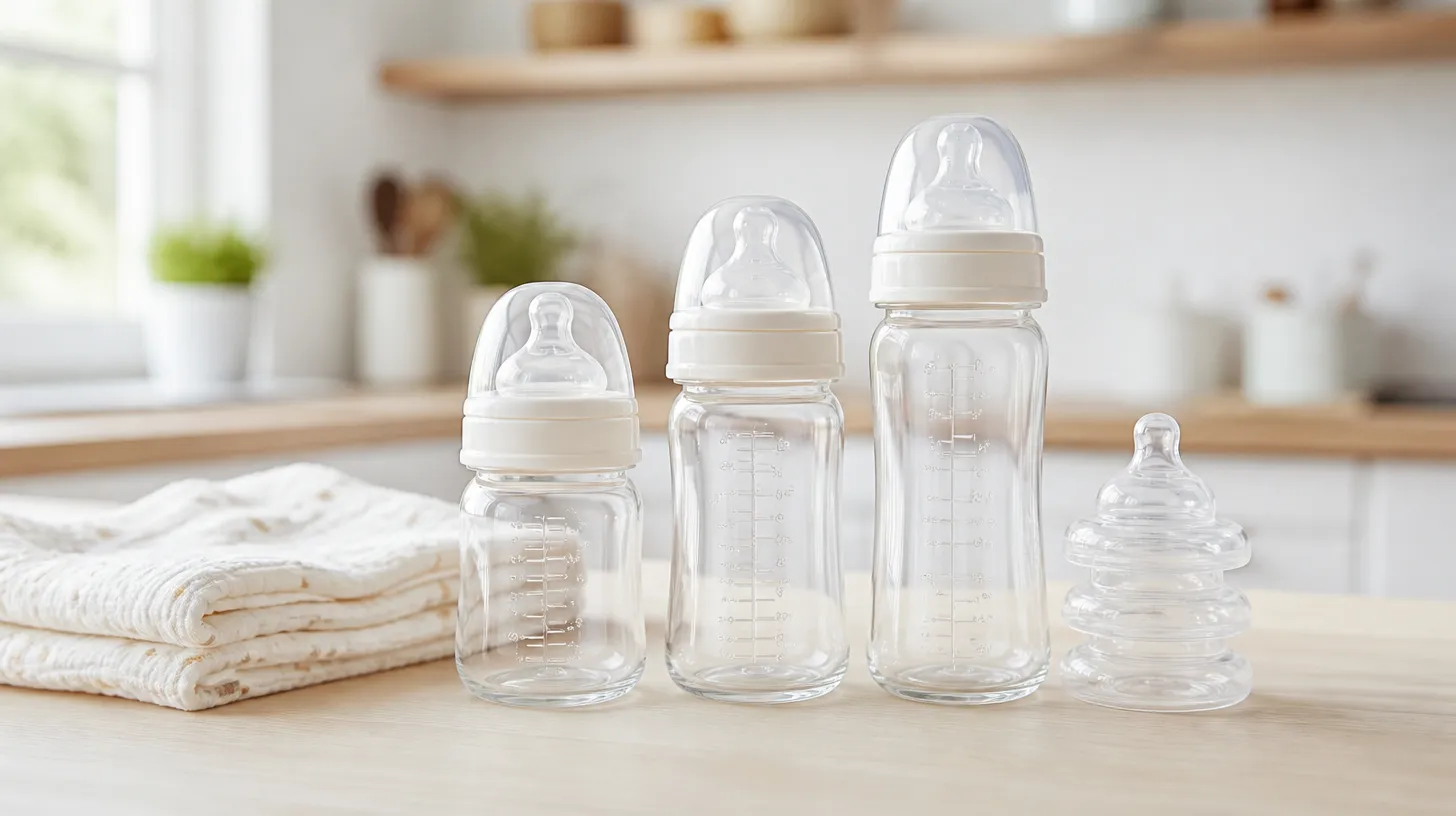
Very little, and nothing special. A slow nipple, a bottle you can hold at a shallow angle without your wrist complaining, and a clean one ready for the next feed. We tend toward glass baby bottles for the first few months because they come apart predictably and do not scratch, though a baby cannot tell the difference. If you are already sterilising bottles in batches, keep the slow nipples in the same rotation so the fast ones never become the only dry option at 3 a.m.
One timing note, since paced feeds run longer than fast ones. Writing for HealthyChildren.org, Hailey Nelson, MD, FAAP, IBCLC, gives prepared infant formula up to 2 hours on the countertop at 77 degrees Fahrenheit or cooler, dropping to 1 hour once your baby has started feeding, and says any prepared formula left in the bottle after a feed should be thrown out within 1 hour. Freshly expressed breast milk gets up to 4 hours on the counter. A 20-minute feed is comfortably inside all of those; a bottle that has been doing the rounds since lunch is not.
The Takeaway
Pacing is four decisions, repeated: near-upright, bottle close to flat, pause every few swallows, stop on the baby's cue. The AAP's bottle-feeding guidance already says to pause so a baby can register fullness and to offer less because you can always give more — pacing is just that advice with a shape. Expect 15 to 20 minutes, expect leftover milk some days, and expect the first few feeds to feel slower than they are.
If you want the rest of the system around this technique — bottles, volumes, burping, night feeds and when to change nipple levels — it is all in our complete guide to bottle feeding. Start with one feed a day done this way, ideally not the 3 a.m. one, and let the habit spread from there.
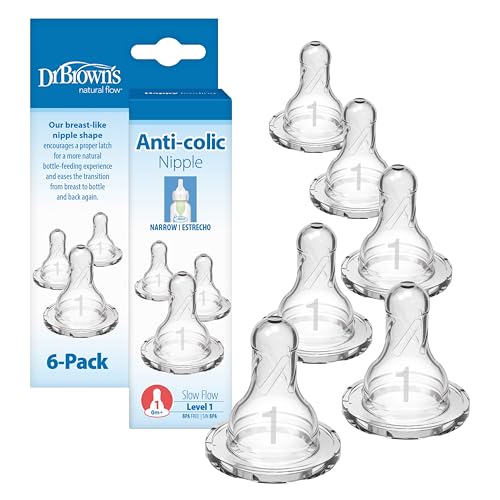
Dr. Brown's Narrow Level 1 Slow Flow Nipple, 0m+ (6-Pack)
Six Level 1 slow-flow silicone nipples that Dr. Brown's intends for newborns, shaped to encourage a proper latch and fitted to the brand's Options+ narrow bottles. The maker states that the vacuum-free design provides a consistent flow so babies can feed at their own pace, and that each nipple level holds a clinically consistent flow rate. The six-pack matters more than it sounds. Pacing falls apart on the night you cannot find a clean slow nipple and reach for whatever is dry.
- Brand
- Dr. Brown's
- Category
- Our Pick
Paced feeding only works if the flow is slow enough to pace. A Level 1 nipple is the default starting point, and a six-pack means you are not rationing them.

Dr. Brown's Narrow Preemie Flow Nipple, 0m+ (6-Pack)
The slowest flow rate Dr. Brown's makes, intended for premature babies or babies with feeding difficulties, in soft silicone that fits all of the brand's narrow bottles. The maker states the consistent flow lets babies feed at their own pace. Dishwasher safe on the top rack, sterilizer and boiling-water safe, BPA free, six to a pack. Ask your pediatrician before stepping a term baby down a level, but a slower nipple is a smaller intervention than it feels like.
- Brand
- Dr. Brown's
- Category
- For a Baby Who Gulps
When a Level 1 still drives a baby to gulp and pull away, the Preemie flow is the next step down rather than a sign something is wrong.

Lansinoh NaturalWave Baby Bottle Nipples, Slow Flow (Size S), 4 Count
Four Size S slow-flow nipples, labelled 1 to 3 months, with a wide textured base, a gentle slope, and ultra-soft flexible silicone. Lansinoh states the flexible tip stretches and compresses with the baby's sucking motion to support a steady flow and a comfortable pace, and that the design is clinically proven to reduce nipple confusion for breastfed babies. An Air Ventilation System is built in to minimise air intake, and the silicone is BPA- and BPS-free.
- Brand
- Lansinoh
- Category
- Best for Breast and Bottle
A nipple that compresses with the baby's own sucking motion suits paced feeding, and Lansinoh positions it specifically for babies going back and forth.
- 01Dr. Brown'sOur PickDr. Brown's Narrow Level 1 Slow Flow Nipple, 0m+ (6-Pack)
- 02Dr. Brown'sFor a Baby Who GulpsDr. Brown's Narrow Preemie Flow Nipple, 0m+ (6-Pack)
- 03LansinohBest for Breast and BottleLansinoh NaturalWave Baby Bottle Nipples, Slow Flow (Size S), 4 Count
How long should a paced bottle feed take?+
Does paced bottle feeding prevent overfeeding?+
Should I take the bottle out of my baby's mouth when I pause?+
What nipple flow rate should I use for paced feeding?+
Is paced bottle feeding only for breastfed babies?+
How long can a prepared bottle sit out during a slow feed?+
Sammie Seelbach
Sammie is a mom of two and the lead reviewer at Smart Baby Reviews. Since becoming a parent she has become obsessed with researching the safest, smartest baby gear on the market — testing thermometers at 2 a.m., wrangling baby gates, and sterilizing more bottles than she can count. She shares what actually works so other parents can make confident, informed decisions for their little ones.