How to Prepare and Store Formula Safely

This post may contain affiliate links. Read our policy.
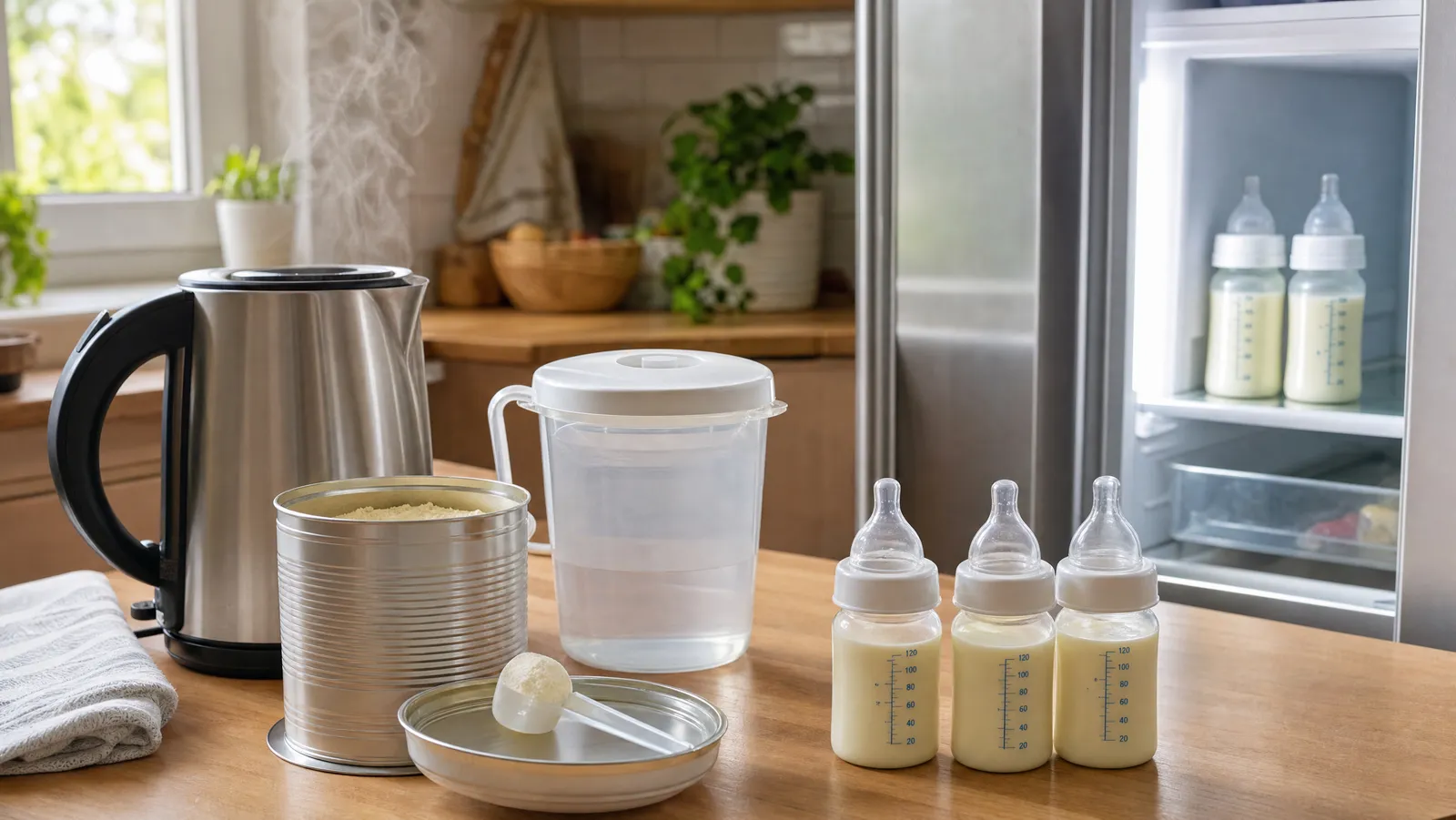
How long can formula sit out? Two hours at room temperature, and one hour from the moment your baby starts drinking from the bottle. Those are the CDC's limits. Unused prepared formula keeps for 24 hours in the refrigerator, and whatever is left in the bottle after a feed gets thrown out. We earn a commission from links on this page, at no cost to you.
Those three numbers answer most 4 a.m. questions. The reason behind them is uncomfortable but useful: powdered infant formula is not a sterile product. The CDC states it plainly — "powdered infant formula is not sterile and can sometimes have germs (such as Cronobacter)." Every rule below exists to stop a germ that may already be in the tin from getting time and warmth to multiply.
If you are still assembling the basics — which bottle, how often, how much — start with how to bottle feed a newborn and treat this as the kitchen-hygiene layer underneath it.
Every Formula Time Limit in One Table
| Situation | Limit | Source |
|---|---|---|
| At room temperature, not fed from | 2 hours from preparation | CDC |
| Once your baby has started feeding | 1 hour from the start of the feed | CDC |
| Left in the bottle after a feed | Throw it out | CDC |
| Refrigerated, not fed from | 24 hours from preparation | CDC |
| In a cool bag with an ice pack | 4 hours | NHS |
| Opened container of powder | Usually 1 month — check the label | CDC |
| Opened ready-to-feed or concentrate, refrigerated | 48 hours | AAP |
The CDC's infant formula preparation and storage guidance is the source for the first four rows: "use prepared infant formula within 2 hours of preparation and within one hour from when feeding begins," and if you have not started within 2 hours, "immediately store the bottle in the fridge and use it within 24 hours." On leftovers it is blunt — "throw out any infant formula that is left in the bottle after feeding your baby."
Two details make those numbers usable. The room-temperature figure assumes a normal room: writing for HealthyChildren.org, the American Academy of Pediatrics' parent site, Hailey Nelson, MD, FAAP, IBCLC, gives prepared formula up to 2 hours "at 77 degrees Fahrenheit or cooler," and 1 hour once your baby has started feeding. And the clock starts when you mix, not when you refrigerate — a bottle put in the fridge at hour two does not get 26 hours.
For the powder itself, the CDC says to store an opened container "in a cool, dry place with the lid tightly closed," explicitly "do not store it in the refrigerator," and that "most infant formulas need to be used within 1 month of opening the container." Write the open date on the lid. For liquids, Steven A. Abrams, MD, FAAP, writing for HealthyChildren.org on behalf of the AAP Committee on Nutrition, says opened ready-to-feed or concentrated formula should be covered, refrigerated and discarded after 48 hours.
Why Powdered Formula Is Not Sterile
Powder is a dry product, and drying does not sterilise. The CDC says powdered infant formula "is not sterile and might have germs in it," while "liquid infant formula is made to be sterile (without germs)."
The germ in question is Cronobacter. The CDC describes Cronobacter infections as "rare, but they can be life-threatening in newborns," and notes that infections in infants "usually occur in the first days or weeks of life." The FDA lists the signs in a young infant as poor feeding, irritability, temperature changes, jaundice, grunting breaths or abnormal body movements. If your newborn shows any of that, it is a call to your pediatrician or emergency care, not something to look up.
Three groups carry more risk. The CDC names babies who are younger than 2 months old, were born prematurely before 37 weeks of pregnancy, or have a weakened immune system. For those babies the CDC advises considering sterile liquid ready-to-feed formula, and the FDA agrees that liquid formula "is the safest option for infants not receiving breast milk."
None of this makes formula unsafe. The handling rules just are not optional in the first couple of months. Ask your pediatrician which group yours is in.
What Water to Use for Formula
The CDC's rule is one line: "use water from a safe source to mix your infant formula." If you are unsure whether yours qualifies, it points you to your local health department.
In most of the United States that means the cold tap. Dr. Abrams, writing for the AAP, recommends that "it is best to primarily use safe tap water that is fluoridated," with occasional non-fluoridated bottled water, and defines a safe source as one defined as such "by your state or local government." Families who want to limit fluoride have an option here too: the CDC says that when formula mixed with fluoridated water is a baby's main food there "may be an increased chance for mild dental fluorosis," and that "parents can use low-fluoride bottled water some of the time to mix infant formula to lessen this risk" — the labels to look for are de-ionized, purified, demineralized or distilled.
One limit is worth memorising, because boiling cannot fix it: the CDC states that "water contaminated with harmful chemicals or toxins cannot be made safe by boiling, disinfecting, or filtering." Boiling kills germs and does nothing about lead or nitrates. If you are on a well, or in a house with old plumbing, that is a water test rather than a kettle problem.
You will also meet UK advice online, which differs: the NHS says "bottled water is not usually recommended for making up infant formula feeds for your baby," and applies hot water to every feed. Follow the guidance for where you live.
When the Water Has to Be Boiled, and How Hot
For most healthy term babies the CDC says the simple method is fine: mix with tap water from a safe source, following the container's directions.
The extra-precaution method is for the three higher-risk groups above. The CDC says to "boil the water and then wait about five minutes before mixing with powdered infant formula," because "very hot water (around 158°F/70°C) is needed to kill these germs," and adds that "it is important to mix the formula while the water is still very hot." The FDA gives the same figure for the same group — heat water "to at least 158°F/70°C to help protect against Cronobacter," add the powder, then cool "to body temperature (98.6°F) before feeding your infant."
So: boil, wait about five minutes, pour the water into the bottle, add the exact amount of powder the container specifies, cap it and shake rather than stir — the CDC advises against stirring with a utensil. Then cool it and test it. The CDC says to put "a couple drops of infant formula on your wrist to see if it is too hot," and its Cronobacter guidance phrases the target as "it should feel warm, not hot."
Two caveats. The FDA notes that some specialty and metabolic formulas carry instructions against heating, because "heating the particular product above 100°F could result in a loss of vitamins and nutrients," and says to follow those products' packaging instructions. And formula preparation machines are not a shortcut: NHS guidance warns that these devices often do not deliver water hot enough, at least 70 degrees Celsius, to kill bacteria that may be in the powder.
Water First, Then Powder
The order is not arbitrary, and both authorities agree on it. The CDC: "always measure the water first and then add the powder." The AAP, via Dr. Abrams: "always add the powder to the water that is in the bottle, not the other way around." Water first gives you a known volume, so the bottle lands at the concentration the manufacturer designed. Powder first means topping up to a line, which gives you a weaker bottle than the label intends.
Both directions of error matter. The CDC warns that "too little water may cause your baby's kidneys and digestive system to work too hard." On over-diluting, Dr. Abrams is direct: "formula that is diluted with too much water, for example, can cause serious health and development problems for your baby." Stretching a tin with an extra ounce of water is the version that shows up in a formula shortage, and it is the one to avoid absolutely.
Level scoops, the scoop that came in that tin, the ratio on that label. The CDC adds a hygiene note that is easy to break at 3 a.m. — "keep lids and scoops clean and completely dry," and "don't set the formula scoop on the counter, in the sink, or on any other surface." The age-by-age volumes are a separate question, and they are in how many ounces per feed.
Batch Mixing for the Fridge
The 24-hour refrigerator limit is the one rule that gives you something back. Mix once in the evening and you cover the night and most of the next day: six measuring sessions become one.
This is the only real use case for a mixing pitcher. Dr. Brown's formula mixing pitcher holds, per Dr. Brown's, up to 36 ounces — about four 8 oz bottles' worth — and the maker states that its adjustable stopper keeps the blade below the liquid to reduce the air whipped into the formula. About $10 as of October 2026. If you are not batch mixing, skip it; a bottle and a vigorous shake does one feed.
Three rules make batching safe rather than clever:
- Refrigerate immediately. The CDC's window assumes the bottle goes into the fridge promptly, not after an hour on the counter.
- Write the time on it, not just the date. A pitcher mixed at 9 p.m. Tuesday is finished at 9 p.m. Wednesday.
- Do not extend it. Just One Norfolk, an NHS infant-feeding service, warns that "even keeping a feed in the fridge can cause bacteria to multiply."
If your baby is under 2 months, premature or immunocompromised, this is the scenario where the CDC and FDA both steer you toward sterile ready-to-feed liquid instead.
Warming a Bottle Without the Microwave
Start with the thing nobody mentions: the CDC says "infant formula does not need to be warmed before feeding." Plenty of babies take a bottle straight from the fridge, and a baby who has never been offered a warm one usually does not develop an opinion.
If you do warm it, the method is running water. The CDC says to "place the bottle under running warm water," keeping the water out of the bottle and off the nipple. Dr. Nelson's HealthyChildren.org guidance offers the same approach or a bowl of heated water, and then says, in capitals, never heat prepared formula in a microwave or on the stove. The CDC explains the mechanism: "microwaves heat milk and food unevenly, resulting in hot spots that can burn your baby's mouth and throat." The bottle feels fine on your wrist and the milk in the middle is not.
Warming restarts no clock. The 1-hour limit begins when your baby starts drinking, which matters if you are using paced bottle feeding, where a slow feed takes far longer. Even a long paced feed sits inside the hour; a bottle carried around the house all afternoon does not.
The Cleaning Underneath
A perfectly prepared bottle poured into a dirty one is not a safe bottle. The CDC says to "clean baby bottles after every feeding," and to sanitize feeding items daily, or more often, if your baby is under 2 months old, was born prematurely, or has a weakened immune system. For older healthy babies, it says daily sanitizing may not be necessary if items are cleaned carefully each time.
When you do sanitize, the CDC gives three options: boil the disassembled items covered in water for 5 minutes; steam them in a microwave or plug-in steam system per the manufacturer's instructions; or soak them for at least 2 minutes in 2 teaspoons of unscented bleach per gallon of water, without rinsing afterwards. Drying matters as much as washing — air-dry on a clean, unused towel or paper towel, because the CDC warns "do not use a dish towel to rub or pat items dry because doing so may transfer germs to the items."
That is why a bottle sterilizer and dryer earns counter space in the first couple of months, when you are sanitizing every day anyway. A dishwasher with hot water and a heated drying cycle does the same job, per the CDC. A crowded rack and a tea towel do not.
Formula Away From Home
The safe pattern out of the house is powder dry, water separate, mix on arrival. It avoids the countertop clock entirely, because the feed does not exist until your baby needs it.
A pre-measured formula dispenser is the cheap piece of kit that makes it work: five sealed compartments, about $9 as of October 2026, each holding one portion measured at your own counter with the scoop from the tin rather than estimated in a parking lot. Carry water in a clean bottle, or, if your baby needs the hot-water method, use the NHS approach — a vacuum flask of water that has just been boiled, which the NHS says will stay above 70 degrees Celsius for several hours if the flask is full and sealed, and which needs to be clean but not sterilised. Cool the made-up bottle with the lid on under cold running water before feeding.
Sometimes you cannot mix on the move. Then cold buys the time. The NHS says that if you have to make a feed in advance, make sure it is cold and carry it "in a cool bag with an ice pack, and use it within 4 hours." That is the job an insulated cooler bag does; the Mancro holds six bottles up to 9 ounces and includes an ice pack that, per the maker, needs water injected before its first freeze. About $17 as of October 2026.
Avoid a bottle riding in a hot car, where the 77-degree assumption stops holding, and carrying one made-up bottle around all afternoon just in case.
Handing a Bottle to Daycare
The clocks travel with the bottle, so label every one with your baby's name, the date and the time it was prepared. A fridge full of bottles with no times on them is a fridge full of guesses. The card we would write is three lines long:
Mixed at the time written on the bottle. It is good for 24 hours from that time if it stays cold, and for one hour once she starts drinking. Whatever is left when she stops, please pour out rather than saving it.
The third line is the one that gets resisted and the one worth insisting on. The CDC's cleaning guidance says that if your baby does not finish a bottle within 2 hours, throw away the unfinished formula, and the FDA explains why — leftover formula "now contains the baby's saliva, which can cause bacteria to grow."
When the Label Disagrees
Formula is not one product. Specialty, metabolic and concentrated formulas carry their own ratios and temperature limits, and the FDA's instruction is to "follow the instructions on the product's label." The AAP says the same: mix formula as directed by the manufacturer. Where a tin differs from a general-purpose article — including this one — the tin wins, and your pediatrician wins over the tin.
The Takeaway
- Two hours on the counter, one hour from the first swallow, 24 hours in the fridge — the CDC's numbers, all counted from the moment you mixed.
- Water first, then the exact amount of powder on the label. Never thin it out, never concentrate it.
- If your baby is under 2 months, premature or immunocompromised, boil the water and wait about five minutes so it is still at least 158 degrees Fahrenheit / 70 degrees Celsius when it meets the powder — the CDC and FDA both give that figure — and ask your pediatrician whether that is your baby.
- Nothing goes in the microwave, and nothing that has been drunk from goes back in the fridge.
The kit is modest: a pitcher if you batch, a dispenser if you leave the house, a cooler bag if you hand bottles to someone else. Everything else is habit.
For the rest of the system this sits inside — bottles and nipples, how often a newborn feeds, burping, night feeds and flow levels — it is all in our complete bottle-feeding guide. Start tonight by writing the time on one bottle.

Dr. Brown's Formula Mixing Pitcher
A lidded pitcher with a paddle-style blade that Dr. Brown's says dissolves and blends up to 36 ounces of powdered formula without leaving clumps, which is about four 8 oz bottles' worth in one go. The adjustable stopper is the detail that matters: the maker states it keeps the blade from lifting above the liquid, which reduces the air that gets whipped into the formula. The real argument for it is the refrigerator rule, not the blending. If prepared formula is good for 24 hours in the fridge, one evening of mixing covers the night and most of the next day, and nobody is measuring scoops at 3 a.m. It comes apart in seconds, which matters because it has to be washed as often as a bottle.
- Brand
- Dr. Brown's
- Category
- Our Pick
Mixing once in the evening instead of six times a day is the single change that made night feeds survivable for us, and the stopper means the formula does not come out foamy.

Accmor Formula Dispenser On The Go, 5 Compartments
Five stackable, independently sealed compartments in BPA-free food-grade polypropylene, each holding one pre-measured portion of powder. The point is that it lets you carry the powder dry and the water separately, then mix a feed at the moment your baby needs it rather than carrying a made-up bottle around for hours. The compartments twist apart so you can take two for a short trip and leave the rest at home. They double as snack cups later, which is the only reason this one survives past the formula year in most houses. Measure them at the kitchen counter with the scoop from the tin, not by eye in a car park.
- Brand
- Accmor
- Category
- Best for Out of the House
Pre-measuring five feeds on a Sunday means the diaper bag is always ready, and we are never shaking a tin over a bottle in a restaurant.

Mancro Breastmilk Cooler Bag with Ice Pack (fits 6 bottles up to 9 oz)
An insulated 8.66 by 7 by 8.66 inch bag that holds six bottles up to 9 ounces, built in three layers: a water-resistant polyester shell, a PE foam middle and a leak-proof liner you can wipe out. The included ice pack needs water injected before its first freeze, which is easy to miss in the instructions. Two-way zippers and a detachable buckle handle that clips to a stroller make it a genuine diaper-bag companion rather than a lunch cooler. This is the item to buy if your day involves daycare drop-off or a long outing with pre-made bottles, because cold is the only thing that buys you time outside the 2-hour countertop window.
- Brand
- Mancro
- Category
- Best for Keeping Milk Cold
It swallows a full daycare day of bottles and still fits under the stroller, and the liner wipes clean after the inevitable leak.
- 01Dr. Brown'sOur PickDr. Brown's Formula Mixing Pitcher
- 02AccmorBest for Out of the HouseAccmor Formula Dispenser On The Go, 5 Compartments
- 03MancroBest for Keeping Milk ColdMancro Breastmilk Cooler Bag with Ice Pack (fits 6 bottles up to 9 oz)
How long can formula sit out at room temperature?+
How long does prepared formula last in the fridge?+
Do I have to boil the water for formula?+
Can I give my baby a bottle they did not finish earlier?+
Is it safe to mix a whole day of bottles at once?+
What water should I use for formula, tap or bottled?+
Sammie Seelbach
Sammie is a mom of two and the lead reviewer at Smart Baby Reviews. Since becoming a parent she has become obsessed with researching the safest, smartest baby gear on the market — testing thermometers at 2 a.m., wrangling baby gates, and sterilizing more bottles than she can count. She shares what actually works so other parents can make confident, informed decisions for their little ones.