The Best Baby Bottles for Breastfed Babies

This post may contain affiliate links. Read our policy.
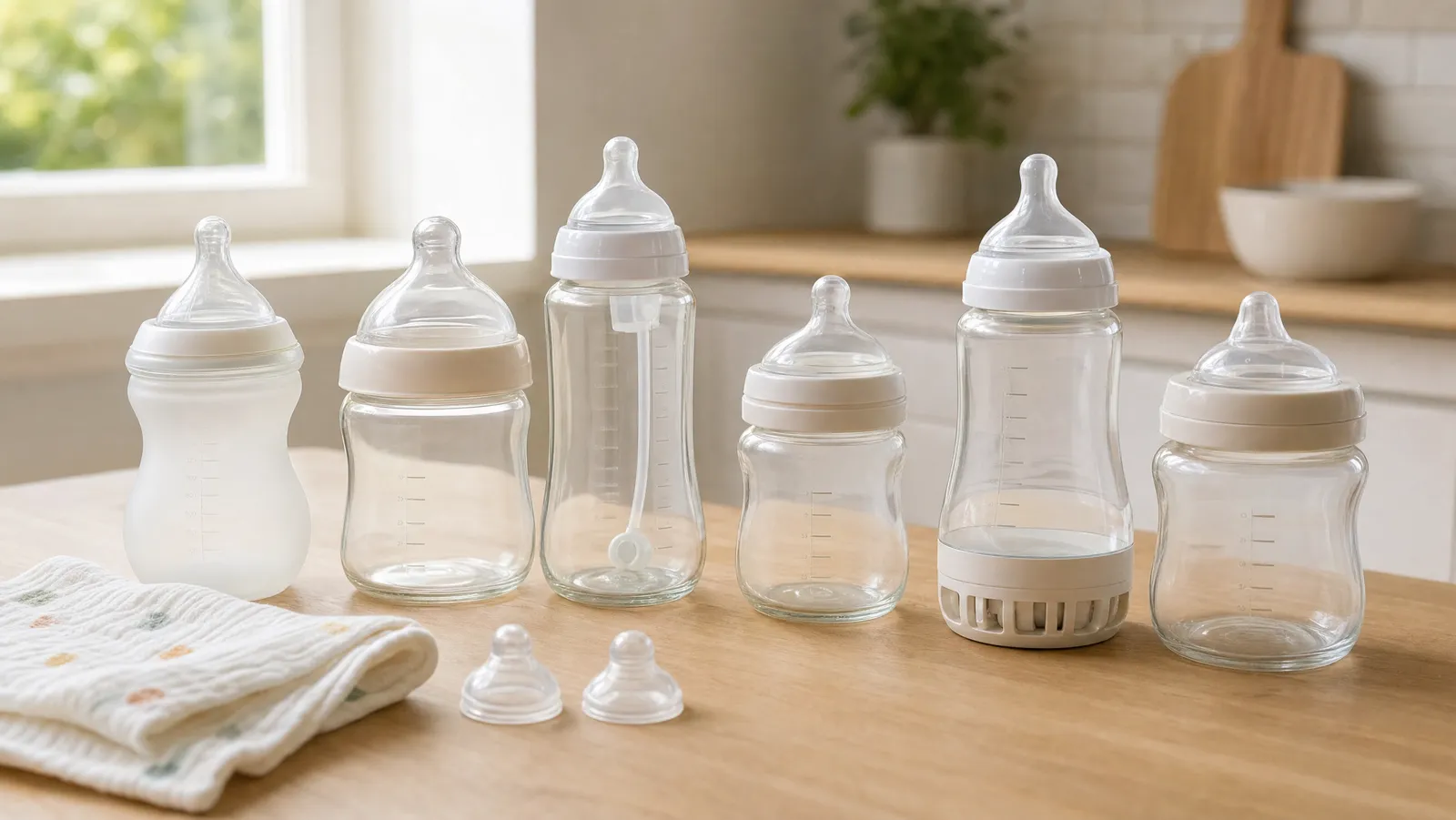
The best bottles for breastfed babies are the ones with the slowest nipple, the widest and most gradually sloping base, and real venting. The bottle body barely matters. Our pick is the Comotomo Gen 2 in 5 oz, because its silicone nipple is soft enough to compress and the maker specifies a true slow flow for newborns. We earn a commission from links on this page, at no cost to you.
Three variables decide whether a bottle works for a baby who also feeds at the breast: nipple shape, flow rate and venting. Everything else — silicone or plastic, wide neck or narrow, five ounces or four — is a washing-up preference. Those three decide whether your baby will open their mouth for it at all, and whether they can pace themselves once they do.
If you are still sorting out the mechanics of bottle feeding a newborn, start there and treat this as the buying decision on top of it.
Flow Rate Is the Variable That Decides Everything
If you only get one thing right, make it this: buy the slowest nipple the system sells, and do not move up on a birthday.
Nationwide Children's Hospital's guidance on choosing a bottle flow rate says babies who get both human milk and bottles may benefit from a slower flowing bottle nipple, because it better matches the flow of human milk during breast or chest feeding, and that most babies born around their due date can start on a newborn flow such as level 1 or slow flow. It adds that a baby's feeding pace may not match the age printed on the packaging, and that there is no need to move up a flow level based on age alone.
The label tells you less than you would hope. A study by Britt Frisk Pados and colleagues, published in MCN: The American Journal of Maternal Child Nursing and indexed by the NIH, tested 26 nipple types from 15 common brands and found flow running from 1.68 mL per minute for the Avent Natural Newborn Flow to 85.34 mL per minute for the Dr. Brown's Standard Y-cut. Their conclusion was blunt: the name of the nipple does not provide clear information about the flow rate to guide parents in decision-making. The authors cautioned that their bench test was not meant to mimic the flow an infant achieves while feeding, so read the figures as a comparison between nipples rather than a promise about your baby.
Which leaves you watching the baby — Nationwide Children's lists the signs both ways.
| What you see | What it suggests |
|---|---|
| Gulping, choking, hard swallowing | Flow is too fast |
| Coughing, increased drooling, refusing to eat | Flow is too fast |
| Taking longer to finish a feed | Flow may be too slow |
| Fast sucking with few swallows, fussing mid-feed | Flow may be too slow |
Start at the bottom of the range and let your baby move you.
Breast-Like Nipples, and What That Phrase Is Worth
Every brand on this page claims some version of breast-like, and none of them is clinically proven to be closest to the breast. There is no such standard to be proven against.
What is worth paying for is geometry you can see. Beth Israel Deaconess Medical Center's guidance for babies who refuse a bottle recommends starting with a slow-flow nipple in soft, easily compressible silicone, and choosing nipples with a wide base that slopes gradually to a short tip. That is a specification rather than a slogan: soft enough that your baby's own compression does some of the work, wide enough that they have to open their mouth rather than purse it. A soft nipple's one failure mode is collapsing under a strong suck; Philips Avent says a screw ring tightened so far that air cannot get into the bottle is the usual cause, and advises unscrewing the ring slightly.
Venting, and Whether Anti-Colic Bottles Do Anything
Every pick here is vented, and venting is cheap — the only real cost is extra parts to wash. The strong claims belong to the manufacturers. MAM states that its vented base is clinically proven to reduce colic symptoms in 80% of babies, Lansinoh describes its air ventilation system as a clinically proven anti-colic system, and Dr. Brown's says its fully vented system provides air-free feeding and helps prevent colic, spit-up, burping and gas.
Those are the makers' own characterisations, not independent findings. Take the venting; ignore the percentages. If your baby is inconsolable for long stretches, that belongs with your pediatrician rather than a different bottle.
What the Research Says About Nipple Confusion
Here is the actual state of it, rather than the marketing line.
Writing in the Jornal de Pediatria in 2018, Emily Zimmerman summarised her lab's 2015 review of the literature, published in the Journal of Perinatology, which found emerging evidence for nipple confusion with bottles and very little evidence for pacifiers. The conclusion she reports is the one that matters: there is insufficient data to determine whether bottles and pacifiers are causing the infant to refuse the breast, or whether they are simply markers of other maternal and infant characteristics. Most of the research, she adds, reports correlation rather than a causal relationship.
So it is a reason to take flow rate seriously, and not a reason to pay a premium for a nipple shape. The American Academy of Pediatrics recommends exclusive breastfeeding for approximately 6 months after birth, and supports continued breastfeeding alongside complementary foods for 2 years or beyond, as long as mutually desired by mother and child. A bottle of expressed milk is usually how a family stays inside that recommendation when someone goes back to work.
How We Picked
We judged all six the same way, in this order.
- Flow rate first. Every pick ships with a slow-flow nipple — slow flow, Level 1, Flow 2 or extra slow — though Philips Avent's newborn flow nipple sits below our Avent pick's Flow 2.
- Nipple shape second. Soft silicone, a wide base, a gradual slope. The one narrow-necked exception earns its place on venting instead, and we say so.
- Venting third, with manufacturer claims treated as manufacturer claims.
- Starting volume. Four or five ounces, not nine — a 2016 study in Pediatrics linked bottles of 6 oz or more to greater weight gain in exclusively formula-fed infants.
- Parts you will wash at 3 a.m. Fewer is better, and a neck wide enough for a hand beats a brush.
Prices below are approximate, as of October 2026.
Our Pick: Comotomo Gen 2 Silicone Bottle, 5 oz
Buy this if you want the best chance of acceptance and are willing to pay for it. The Comotomo Gen 2 is the only bottle here where milk never touches plastic — body and nipple are both food-contact grade silicone, with the flow levels and volume markings printed in silicone ink.
The nipple is why it wins: softer and more naturally tapered than the others, reinforced to resist collapsing, with a laser-punctured opening Comotomo describes as a true slow flow for newborns 0 to 3 months, plus dual anti-colic vents. Gen 2 widened the base by 40% over version one to cut down on tip-overs.
The trade-off is money. Two bottles at about $24 as of October 2026 is roughly $12 a bottle — the most expensive per bottle here, about twice the cheapest. The wide neck compensates: you can get a hand inside, so it washes without a brush.
Versus the Avent below: both are wide, soft and slow. Buy the Comotomo if acceptance is the problem, the Avent if price is.
Best Breast-Shaped Nipple: Philips Avent Natural, 4 oz Slow Flow
Buy this for the classic wide breast-shaped nipple at a sane price. The Avent Natural two-pack runs about $18 as of October 2026 for two 4 oz bottles, and 4 oz is the right starting volume rather than one you grow into.
Philips Avent states that the nipple opening and tip release milk only when the baby is actively drinking, so that when the baby pauses to swallow and breathe no milk flows, and that the design supports the baby's natural drinking rhythm the way breastfeeding does. An anti-colic valve keeps air away from the stomach, and the nipple is built not to drip.
One precise note. The slowest nipple in the Pados study was an Avent Natural Newborn Flow, at 1.68 mL per minute. The nipple in this pack is not that one — these ship with Flow 2, a step up. If your baby gulps on Flow 2, Avent's newborn nipple is the next move down, and the study suggests it is genuinely slow.
Best Extra-Slow Flow: Lansinoh Anti-Colic, 5 oz
Buy this if your baby gulps, coughs or pulls away on a standard slow nipple. The Lansinoh four-pack ships with Size XS, labelled extra slow flow for 0 to 1 month — slower than the default slow nipple in most lines, and at about $28 as of October 2026 for four, roughly $7 a bottle.
The NaturalWave nipple is ultra-soft with a wide, gentle slope that Lansinoh says moulds to the baby's mouth for a secure latch, and a flexible tip the maker says stretches with the baby's sucking motion so milk arrives at a comfortable pace. Three pieces excluding the cap, freezer and dishwasher safe.
The trade-off is the label: XS is marked 0 to 1 month, so you will eventually buy the next size up. Do that on your baby's feeding rather than the calendar.
Best for Gas and Colic: Dr. Brown's Options+ Narrow, 4 oz
Buy this if feeds end in squirming, burping and back-arching. The Options+ three-pack is about $17 as of October 2026 for three 4 oz bottles — the cheapest per bottle here — and is built around a fully vented internal system Dr. Brown's says delivers air-free feeding and helps prevent colic, spit-up, burping and gas.
The design decision we like is that the vent is optional: run the bottle with the insert while feeds are gassy, pull it out later as your baby's feeding matures. Level 1 slow flow nipples for 0 months and up, dishwasher safe on the top rack, steriliser safe, BPA free.
Be clear about the trade-off: this is the one narrow nipple on the list, the opposite of the wide gradual slope the other picks are built around, and it has the most parts to wash. The fastest of the 26 nipples Pados tested was also a Dr. Brown's, the Standard Y-cut, so buy the level rather than the logo.
Best Starter Set: MAM Easy Start Anti-Colic+, 6 Pieces
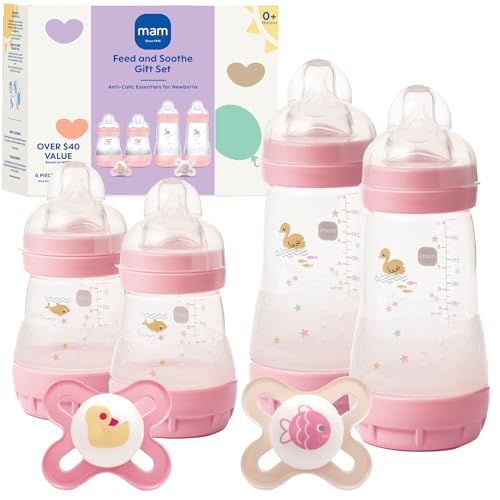
Buy this if you want one box, or if you travel. The MAM starter set is about $30 as of October 2026 and holds two 5 oz bottles with slow flow nipples, two 9 oz bottles with medium flow nipples and two Original Start pacifiers sized 0 to 2 months. The feature that earns the price is unglamorous: the bottles self-sterilise in a microwave in three minutes, which beats packing hardware.
The claims are all MAM's own. The company states that its elongated, pre-compressed SkinSoft nipple was designed with medical professionals to mimic the feel and shape of a mother's nipple and is suitable for preemies, newborns and mixed feeding; that it achieves 94% nipple acceptance; and that the vented base is clinically proven to reduce colic symptoms in 80% of babies. Those are manufacturer figures and we would not treat any of them as independent evidence. The Pados study is a counterweight: the most variable nipple of the 26 it measured was the MAM Nipple 1 Slow Flow, at a coefficient of variation of .37.
Start on the 5 oz slow-flow pair and leave the 9 oz medium-flow bottles in the box. If you do not want the pacifiers, the Evenflo below gets you three usable bottles for less.
Best Budget: Evenflo Balance+ Wide, 5 oz
Buy this as your second set, or your only set if money is tight. Three 5 oz Balance+ wide-neck bottles run about $18 as of October 2026, roughly $6 a bottle for the shape that matters: wide neck, wide nipple base, slow flow nipples for 0 months and up, with Evenflo's silicone ProFlo venting. Dishwasher safe, BPA and PVC free.
On that last point — BPA free is not a feature, it is the law of the land. The FDA amended its food additive regulations in July 2012 to no longer provide for the use of BPA-based polycarbonate resins in baby bottles and sippy cups, noting that the amendment was based on abandonment of the use rather than on safety.
Evenflo publishes less about the nipple than the brands above it, so you are buying geometry rather than a design story. Three of these is the set we would send out of the house, keeping the expensive bottle at home.
If Your Baby Rejects the Bottle, the Bottle Is Rarely the Fix
Expect this. A baby who has only ever fed at the breast has no reason to find a silicone cylinder interesting, and buying a fourth brand is the most expensive answer to it. Beth Israel Deaconess Medical Center's guidance is about circumstances rather than products:
- Offer when your baby is calm and content, not ravenous — for many babies mid-morning rather than the evening fussy stretch, and at early hunger cues rather than after crying.
- Try someone other than the breastfeeding parent. For some babies the opposite works, so try both.
- Feed skin to skin, and warm the nipple under warm water first.
- Offer about once a day, and stop if your baby gets very fussy rather than pushing through.
If the bottle keeps failing, the same guidance offers a different vessel: a small cup holding 1 to 2 ounces, the baby upright on your lap, the cup tilted until the milk just reaches the lips, letting them lap at their own pace rather than pouring it in. Keep your pediatrician informed if neither bottle nor cup is progressing, so they can decide whether a referral to a feeding specialist is the next step.
The sequencing deserves more room than a buying guide gives it, so we wrote it up in introducing a bottle to a breastfed baby.
Silicone, Plastic or Glass?
All six picks are silicone or plastic, which is deliberate: the soft, wide, slow nipples that suit a breastfed baby mostly come attached to light bodies. Material affects you, not the feed. Silicone is squeezable and does not shatter; plastic is cheap and light; glass does not scratch, stain or hold smells, and weighs noticeably more in one hand at 3 a.m. If that last set of properties appeals, we have covered the best glass baby bottle brands separately — the nipple advice here applies unchanged.
Buy One Bottle First, Not a Full Set
The most expensive mistake here is buying four of something your baby has never tried. Buy one, prove it, then buy three more of the same.
How many you need is set by washing-up, not by feeding. The CDC advises cleaning baby bottles after every feeding, and sanitising daily — or more often — if your baby is under 2 months old, was born prematurely, or has a weakened immune system. NHS guidance is to sterilise bottles and teats until your baby is at least 12 months old. So the real question is how many clean bottles you can produce between feeds. One bottle a day while you are out: two is plenty. A caregiver covering a full workday: four. If you are running batches rather than washing one at a time, a bottle sterilizer and dryer turns four bottles into a system instead of a queue.
One more CDC note worth taping inside a cupboard: if your baby does not finish drinking a bottle within 2 hours, throw away the unfinished formula.
Nipples Wear Out, and Moving Up Too Early Undoes the Pacing
Two quiet failure modes, both of which make a carefully chosen slow nipple stop being slow.
The first is wear. Health Canada advises inspecting nipples before and after each use for signs of wear and tear, and throwing out any that show them, because a baby can choke on broken pieces. It says to replace nipples more often while your baby is teething, since they wear out faster then, and that it is not safe to make the holes in bottle nipples bigger, because enlarging a hole can tear the nipple and the fragments are a choking hazard. A stretched nipple also runs faster than it did new, so wear is a pacing problem before it is a safety problem.
The second is you. The packet says 3 months, your baby turns 3 months, and up you go. Nationwide Children's says plainly that there is no need to move up a flow level based on age alone. Absent the too-slow signs in the table above, leave it alone.
The Takeaway
For a breastfed baby, you are buying a nipple and getting a bottle attached to it. Slowest flow in the range, soft silicone, wide base, gradual slope, short tip, vented. Everything else is laundry logistics.
Our pick is the Comotomo Gen 2 for the best shot at acceptance, the Avent Natural for the same shape cheaper, the Lansinoh XS if your baby gulps, the Dr. Brown's Options+ if gas is the problem, the MAM set if you travel, and three Evenflo Balance+ for the bag that leaves the house. Buy one. Prove it. Then buy three.
If the bottle is going in but the feed is not, the fix is usually technique rather than hardware — our guide to how to bottle feed a newborn covers the hold, the angle and the pauses. Anything about your baby's feeding or weight that does not settle belongs with your pediatrician.

Comotomo (Gen 2) Silicone Baby Bottle, 5 oz, 2-Pack
A two-pack of 5 oz silicone bottles in which milk only ever touches food-contact grade silicone, never plastic, with the flow levels and volume markings printed in silicone ink rather than stamped into a plastic wall. The nipple is the reason it is our pick: softer and naturally tapered, reinforced so it is less likely to collapse mid-feed, with a laser-punctured opening Comotomo describes as a true slow flow for newborns 0 to 3 months and dual anti-colic vents. The Gen 2 base is 40% wider than the first version to reduce tip-overs, and the outer ring was redesigned for more secure assembly. The neck is wide enough to wash by hand without a special brush, every part is pre-shrunken, and the whole thing is dishwasher safe.
- Brand
- Comotomo
- Category
- Our Pick
It is the only bottle in the house our daughter would take after four months of breast only, and the wide neck means washing it at midnight takes one hand and no brush.

Philips Avent Natural Baby Bottles, Slow Flow, 4 oz, 2-Pack
Two 4 oz bottles with the soft, wide, breast-shaped Natural nipple, each fitted with a slow flow nipple that Philips Avent labels Flow 2. The maker states that the nipple opening and tip release milk only when the baby is actively drinking, so that when the baby pauses to swallow and breathe no milk flows, and that the design supports the baby's own drinking rhythm the way breastfeeding does. An anti-colic valve is integrated into the nipple to keep air away from the stomach, and the nipple is designed not to drip. The 4 oz size is the right starting volume for a newborn rather than a bottle you grow into.
- Brand
- Philips Avent
- Category
- Best Breast-Shaped Nipple
The wide sloping base was the shape our baby would actually open his mouth for, and the no-drip nipple meant the carrier bag stopped smelling of old milk.

Lansinoh Anti-Colic Baby Bottles, 5 Ounces, 4 Count (Extra Slow Flow, Size XS)
Four 5 oz bottles shipped with the slowest nipple Lansinoh sells, Size XS, labelled extra slow flow for 0 to 1 month. The nipple uses the brand's NaturalWave shape — ultra-soft silicone with a wide, gentle slope that Lansinoh says moulds to the baby's mouth for a secure latch, and a flexible tip the maker says stretches with the baby's sucking motion so milk arrives at a comfortable pace. Lansinoh describes the built-in air ventilation system as a clinically proven anti-colic system intended to limit air intake, which is the maker's characterisation rather than an independent finding. Three pieces to assemble excluding the cap, and the bottles are both freezer and dishwasher safe.
- Brand
- Lansinoh
- Category
- Best Extra-Slow Flow
Our son gulped and pulled away on every standard slow nipple we tried, and the XS was the first one he could keep up with.

Dr. Brown's Anti-Colic Options+ Narrow Baby Bottles, 4 oz, 3-Pack (Level 1 Slow Flow)
Three 4 oz narrow-neck bottles built around a fully vented internal system that Dr. Brown's says delivers air-free feeding and helps prevent colic, spit-up, burping and gas. The useful design decision is that the vent is optional: you can run the bottle with the insert while feeds are gassy and pull it out later as your baby's feeding matures, which is one fewer part to lose. They ship with Level 1 slow flow nipples for 0 months and up, and they are dishwasher safe on the top rack, steriliser safe and BPA free. The nipple is narrow rather than wide, which is the trade-off for the venting.
- Brand
- Dr. Brown's
- Category
- Best for Gas and Colic
The evening feed stopped ending in back-arching once we switched, and being able to drop the vent insert later made washing up faster.
MAM Easy Start Anti-Colic+ Baby Bottle & Pacifier Starter Set, 0+ Months, 6 Pieces
A six-piece box containing two 5 oz bottles with slow flow nipples, two 9 oz bottles with medium flow nipples and two Original Start pacifiers sized 0 to 2 months. MAM states that the elongated, pre-compressed SkinSoft nipple was designed with medical professionals to mimic the feel and shape of a mother's nipple, that it achieves 94% nipple acceptance, and that the vented base is clinically proven to reduce colic symptoms in 80% of babies — all three are the manufacturer's own figures. The feature we rate highest is mundane: the bottles self-sterilise in a microwave in three minutes, which is genuinely useful in a hotel room or at a grandparent's house. Start on the 5 oz slow flow pair and leave the 9 oz medium flow bottles in the box until your baby has outgrown the slow nipple.
- Brand
- MAM
- Category
- Best Starter Set
Three minutes in a borrowed microwave meant we did not have to pack a steriliser for a week away, and the slow-flow 5 oz pair covered the whole trip.

Evenflo Feeding Balance+ Wide Neck Bottles, 0+ Months, Slow Flow, 5 oz, 3 Bottles
Three 5 oz wide-neck bottles with slow flow nipples for 0 months and up, using Evenflo's silicone ProFlo venting, dishwasher safe, BPA and PVC free. This is the cheapest route to the shape that matters for a breastfed baby — wide neck, wide nipple base, slowest flow the line offers — and at three bottles to a pack it is the obvious choice for the spare set that lives in the daycare bag. Evenflo publishes less detail about the nipple than the brands above it on this list, so you are buying the geometry rather than a design story. For a set you expect to lose, scratch or leave behind, that is the right trade.
- Brand
- Evenflo
- Category
- Best Budget
We bought these as the backup set and ended up using them as much as the expensive ones, which told us something about what we had paid for.
- 01ComotomoOur PickComotomo (Gen 2) Silicone Baby Bottle, 5 oz, 2-Pack
- 02Philips AventBest Breast-Shaped NipplePhilips Avent Natural Baby Bottles, Slow Flow, 4 oz, 2-Pack
- 03LansinohBest Extra-Slow FlowLansinoh Anti-Colic Baby Bottles, 5 Ounces, 4 Count (Extra Slow Flow, Size XS)
- 04Dr. Brown'sBest for Gas and ColicDr. Brown's Anti-Colic Options+ Narrow Baby Bottles, 4 oz, 3-Pack (Level 1 Slow Flow)
- 05
- 06
Do breastfed babies need a special bottle?+
Does bottle feeding cause nipple confusion?+
What nipple flow rate should a breastfed baby start on?+
How many bottles do I need for a breastfed baby?+
Do anti-colic bottles actually work?+
When should I replace a bottle nipple?+
Sammie Seelbach
Sammie is a mom of two and the lead reviewer at Smart Baby Reviews. Since becoming a parent she has become obsessed with researching the safest, smartest baby gear on the market — testing thermometers at 2 a.m., wrangling baby gates, and sterilizing more bottles than she can count. She shares what actually works so other parents can make confident, informed decisions for their little ones.