When Your Baby Refuses the Bottle: A Troubleshooting Ladder

This post may contain affiliate links. Read our policy.
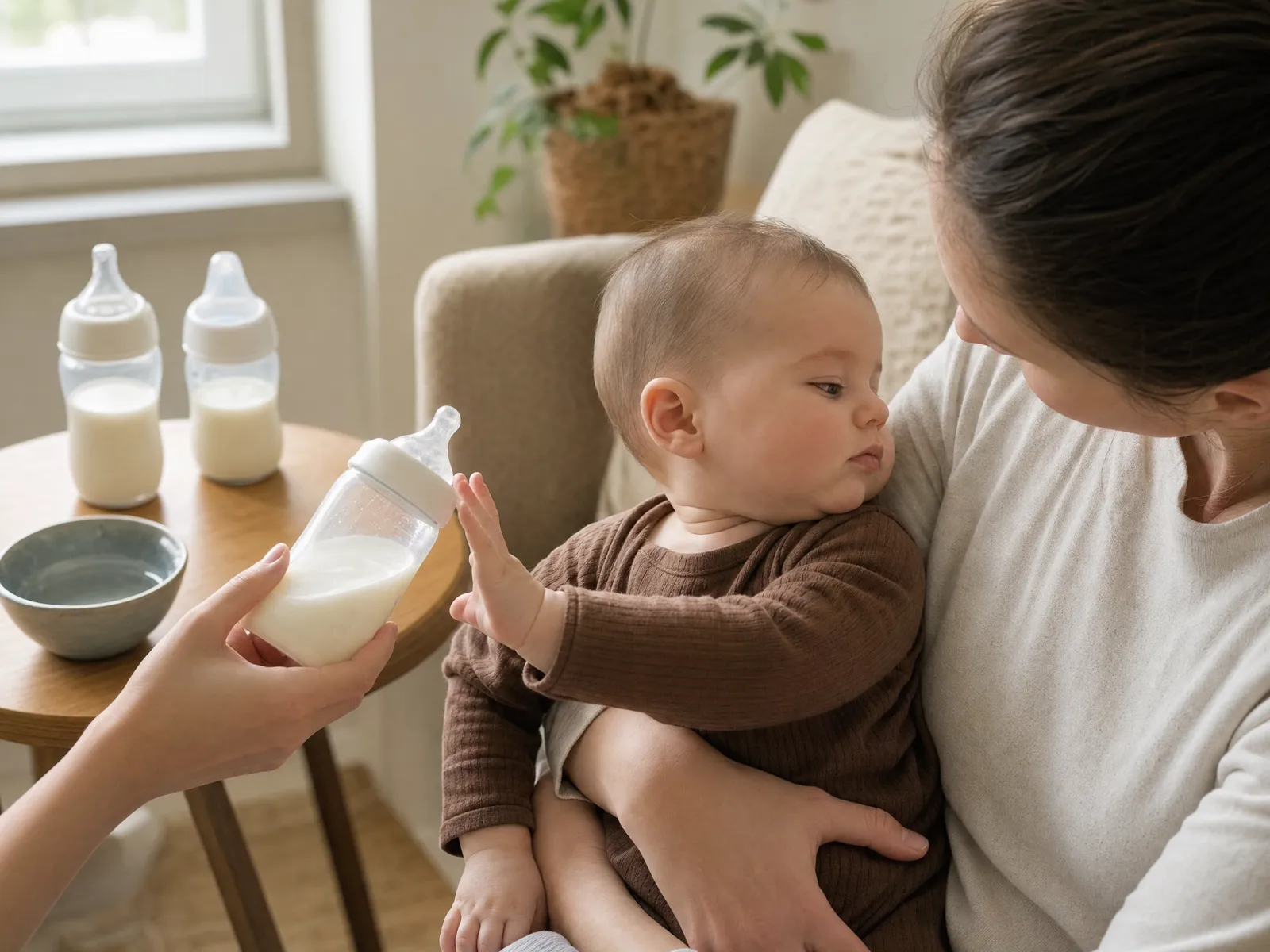
When a baby refuses the bottle, the cause is usually one variable set wrong — hunger state, temperature, the nipple, or who is holding it. Change one of those at a time, and give each change three or four calm offers before you judge it. Most parents change five things at once on a screaming baby and learn nothing. We earn a commission from links on this page, at no cost to you.
Below is the ladder, in order, from the variable most often wrong to the least likely to matter. If the fundamentals are still unsettled, start with how to bottle feed a newborn and treat this as the troubleshooting layer on top.
How to Get a Baby to Take a Bottle: Change One Variable at a Time
A refusal is information, and you only get it if the attempt was clean:
- Change one thing. New nipple or new temperature or new person. Not all three.
- Give it a fair trial. Three or four offers across two or three days, not three minutes. One bad afternoon proves nothing.
- Keep hunger out of it. Test when your baby is calm, and feed them the normal way afterwards if the test fails. The feed is not the experiment.
Write it down — time, who offered, temperature, nipple, ounces taken. A week of one-line notes shows a pattern your memory will not.
Rung 1: Catch Them Calm-Hungry, Not Frantic
Offer the bottle at the very start of a feed, or part-way through one, while your baby is still calm. A starving baby cannot learn a new skill.
The American Academy of Pediatrics makes the timing point directly on HealthyChildren.org: crying is a late sign of hunger, and it can make it hard for a baby to settle down and eat. Aim at the earlier cues the AAP lists — rooting, a hand to the mouth, licking lips. Beth Israel Deaconess Medical Center's bottle-refusal guidance says the same in a line: catch the early feeding cues, and offer before the baby is very hungry. BIDMC also suggests offering when your baby is happiest, often mid-morning rather than the 5 p.m. to 8 p.m. stretch, and trying one bottle feeding a day.
Test both separately: bottle first at the earliest cues, or a few minutes of nursing then a swap.
Rung 2: Temperature, the Variable Most Often Set Wrong
This rung resolves plenty of refusals, and the official guidance is ambivalent about whether it should. The CDC states that breast milk does not need to be warmed and can be served at room temperature or cold, and that infant formula does not need warming before feeding. True — and beside the point for a baby who is refusing. Temperature is free to change, so change it.
How to warm it, per the CDC: place the sealed container in a bowl of warm water, or hold it under warm, but not hot, running water for a few minutes, then test a few drops on the inside of your wrist. BIDMC adds a smaller version — run the nipple itself under warm water first, so the first thing touching your baby's mouth is not cold silicone.
The safety rule that goes with it: never use a microwave. The CDC's formula guidance says microwaves heat milk and food unevenly, resulting in hot spots that can burn your baby's mouth and throat, and its breast-milk guidance adds that microwaving can destroy nutrients. Do not heat milk directly on the stove either.
The clock tightens once milk is warm. The CDC says to use breast milk within 2 hours once brought to room temperature or warmed, and prepared formula within 2 hours of preparation and within 1 hour from when feeding begins. Long standoffs and warm bottles do not mix.
Warming by eye adds noise to your own experiment. A warmer like the Momcozy 10-in-1, about $33.99 as of October 2026, earns its place through repeatability rather than speed: once you know the setting your baby accepts, you stop guessing. Momcozy says it heats to the temperature closest to breast milk — the maker's claim. Test on your wrist regardless.
Rung 3: The Nipple — Shape, Firmness and Flow
Two variables live here, and they fail in opposite directions. Flow too fast and milk arrives before the swallow is ready, so the baby coughs, pulls off, or gulps and refuses to come back. Flow too slow and the baby works hard for little and quits. Both look like refusal from the outside.
| What you see | Which way to move |
|---|---|
| Gulping, coughing, milk escaping at the corners of the mouth, pulling off hard | Flow is too fast — step down a level |
| Long sucking bursts with few swallows, chewing the nipple, quitting after an ounce | Flow is too slow, or the nipple is collapsing |
| Lips clamped before the nipple is even in | Not a flow problem — go back to rungs 1, 4 and 7 |
For what the numbers on the packet do and do not tell you, read bottle nipple flow rates. The label is a rough guide at best.
Shape and firmness come next. BIDMC's guidance is to look for a nipple with a wide base that slopes gradually to a short nipple, and to start with a slow-flow nipple in soft, compressible silicone. That is a shape, not a brand.
To test shape, the Comotomo Gen 2 8 oz 2-pack, about $24.99 as of October 2026, is about as far from a hard narrow bottle as you can get. One caveat: it ships with a medium-flow nipple, the wrong direction for a newborn who is already gulping. To test flow, the cheaper move is a slower nipple in the bottle you already own — MAM Extra Slow Size 0, about $11.39 as of October 2026, which MAM intends for newborns and which fits only MAM bottles. MAM also states that 94 percent of newborn and older babies accept its nipples; that is the manufacturer's claim, not an independent finding.
None of this is a fix on its own. Buy all three picks, change nothing else, and you will still have a refusing baby.
Rung 4: Change Who Offers the Bottle
A breastfed baby will often refuse a bottle from the nursing parent and take it from almost anyone else. It is often the highest-yield change on this list, and it costs nothing.
Nationwide Children's Hospital puts it plainly: if your baby will not take the bottle from you, your partner or someone else may need to give it, and that also helps the baby get used to being fed by other people. Go further than handing it over — leave the room, ideally the floor: out of sight, out of smell range. BIDMC notes that results vary and some babies do better with the breastfeeding parent, so if a grandparent is a disaster, try the other direction before abandoning the rung.
The details of those first offers are in introducing a bottle to a breastfed baby. Nationwide Children's also advises breastfeeding exclusively for the first 3 to 4 weeks where possible, noting that introducing a bottle before 4 weeks can possibly lead to a decrease in milk production.
Rung 5: Change the Position and Add Motion
Most of us offer a bottle in the cradle hold, because that is what feeding looks like in pictures. For a baby who associates that position with the breast, it can be the problem. Try these one at a time: upright and facing out, back against your chest so they are not looking at you; walking or bouncing; in a carrier; or skin to skin, which BIDMC suggests on the grounds that feeding involves touch and eye contact as much as milk.
Whatever the position, support the head and neck, keep the head above the chest, and keep the bottle shallow enough that the nipple stays full of milk rather than air. A baby swallowing air gets a stomach full of gas, which ends a feed early for reasons unrelated to the bottle. Burp part-way through.
Rung 6: Change the Setting, Usually Downward
Some babies take a bottle best in a dark, quiet room. Others want a window, a sibling, a walk. What parents report most often is that the older baby who starts refusing around 4 or 5 months needs less stimulus, not more — feeding stops competing with everything else in the room. Try both directions for a few offers each.
Rung 7: Same Time, Same Person, Every Day
Nationwide Children's suggests offering small amounts from a bottle on most days so it stays a familiar routine, and picking one feeding — the one when you would normally be away — rather than scattering attempts. Same time, same person, same chair, one offer a day. Four offers over four days at 10 a.m. teach your baby more than four in one afternoon.
Rung 8: Stop Fighting the Clock
Short, calm, frequent offers beat one long battle. Ten minutes is a trial. Forty-five minutes is a fight, and what a baby learns from a fight is that the bottle is one.
The AAP's feeding guidance on HealthyChildren.org points the same way: pausing can be helpful to give a baby a chance to realise when they are full, and it is better to offer less, since you can always give more if your baby wants it. A small bottle, offered calmly and taken away without comment, beats a full one you are determined to finish. The technique for the pauses is in paced bottle feeding.
Adjust your volume expectations too. Nationwide Children's notes that some babies take just enough from a bottle to get by and then nurse more when the breastfeeding parent is present — normal, not a failure. For typical intake at your baby's age, see how many ounces per feed, and treat the figures as a benchmark rather than a target.
Never Force a Bottle
Do not push the nipple into a closed mouth, hold or steady the head, keep offering to a crying baby, or pour or squeeze milk in. BIDMC's instruction for cup feeding applies to bottles too — do not pour milk into the baby's mouth, because the baby may sputter and choke; let the baby set the pace and decide when they are finished. Its advice when things go wrong is simply to stop: if the baby becomes very fussy or frustrated, stop and try again later or on another day.
The reason is practical. A baby who learns that the bottle comes with being held down refuses harder and sooner next time, and that is how a two-week problem becomes a two-month one.
Dream feeding deserves an honest mention. Some parents do get a bottle in during light sleep, and it can break a deadlock. But we found no authoritative guidance supporting it as a strategy, it teaches an awake baby nothing, and it cuts against the responsive feeding the AAP describes — watching the baby rather than the clock. A bridge for a hard week, not a plan.
When Bottle Refusal Stops Being a Feeding Problem
Technique is the right answer right up until it is not. If a baby who used to take a bottle fine has suddenly stopped, think illness before technique. Nationwide Children's notes that oral thrush may cause pain while sucking or swallowing and that a child with it may not drink or eat as much as usual. An ear infection, a stuffy nose or teething pain may all make sucking uncomfortable; for congestion, Nemours KidsHealth notes that saline drops with a nasal aspirator can be especially helpful before feeding and sleeping. Sudden refusal in a previously happy bottle-feeder is worth a phone call, not another nipple.
Call your pediatrician the same day if you see any of these:
- Fewer wet diapers than usual. The AAP's dehydration guidance on HealthyChildren.org counts fewer than six wet diapers a day in an infant as a mild-to-moderate sign of dehydration.
- A parched, dry mouth, fewer tears when crying, or a sunken soft spot — also on the AAP's mild-to-moderate list.
- Very fussy or excessively sleepy behaviour, sunken eyes, cool or discoloured hands and feet, wrinkled skin, or urinating only once or twice a day. The AAP lists these as severe dehydration, and says to notify the pediatrician immediately if any of its signs develop.
- Refusing all feeds, not just the bottle. The AAP puts the normal bottle-fed newborn pattern at every 2 to 3 hours, with 8 feeds in 24 hours generally recommended as the minimum.
- Fever in a young infant. The AAP says to call right away for a temperature of 100.4 degrees Fahrenheit (38.0 degrees Celsius) or higher in a baby younger than 3 months.
- Losing weight, or not gaining. The AAP counts how fast a baby gains weight among its clues to whether they are getting enough milk — a scale question, not a technique question.
BIDMC advises keeping the pediatrician informed if there is no progress with bottle or cup feeding, so they can decide whether a feeding-specialist referral makes sense. Thickening feeds, changing formula or treating reflux are clinician decisions, not article experiments.
If Your Baby Won't Take a Bottle and Daycare Starts in Two Weeks
Start now, and start small. Nationwide Children's suggests that a parent returning to work 4 to 8 weeks after birth begin adding a bottle of expressed milk about 1 to 2 weeks beforehand, at the one feeding when you would normally be away, limiting the amount so the baby is ready to breastfeed again in 2 to 3 hours. Someone other than the nursing parent gives it. One offer a day.
And know the fallback. Nationwide Children's notes that a parent returning to work in the second half of the first year may not need a bottle at all, since older babies often do well with a cup or a sipper-type cup. The AAP says to offer a cup when a child starts eating solid foods, usually around 6 months, and that if you have used no bottles at all you can introduce a cup of breast milk then. For a younger baby the fallback is more feeds at home, plus whatever the caregiver manages by bottle, cup or spoon. Tell your daycare the plan, and not to force it either.
A Word on Nipple Confusion
You will hear bottle refusal explained as nipple confusion. It is worth knowing how thin that ground is. A review by Zimmerman and Thompson, published in the Journal of Perinatology in 2015, graded 14 studies on whether bottles and pacifiers impede breastfeeding and found emerging evidence of nipple confusion only as it relates to bottle usage, with very little evidence for pacifier use. Their central caveat was causality: it is unclear whether artificial nipples cause infants to refuse the breast, or whether they are simply markers of other maternal and infant characteristics. A 2016 Cochrane review of two trials covering 1,302 full-term breastfeeding infants found that unrestricted pacifier use did not change the proportion exclusively breastfeeding at 3 or 4 months, rated moderate-quality evidence.
The phrase describes something parents and clinicians do observe. It is not a mechanism you can act on. The variables on this ladder are.
The Takeaway
Pick one rung. Hunger state, then temperature, then the nipple, then who is holding it — that order resolves most cases. Give each change three or four calm offers across a few days, and write down what happened. Never force it, and stop the moment your baby is upset.
Most bottle refusal resolves with technique and patience rather than purchases. A slower nipple or a warmer removes a variable from the experiment, which is useful, but neither is the fix. And if the wet diapers drop off, the refusal spreads to every feed, or a young baby runs a fever, that is a call to your pediatrician today, not another rung.
For the rest of the system — bottles, volumes, positions, burping, night feeds — work through our bottle-feeding guide. Then come back and pick one variable.

Comotomo (Gen 2) Silicone Baby Bottle, Green, 8oz, 2-Pack
A two-pack of 8 oz bottles where the milk only ever touches food-contact grade silicone rather than plastic, with the volume markings printed in silicone ink. The nipple is soft and naturally tapered, reinforced to resist collapsing, and the neck is wide enough to clean without a special brush. Comotomo says the Gen 2 base is 40 percent wider than the original version to reduce tip-overs, with a redesigned outer ring for simpler assembly and fewer leaks, and that dual anti-colic vents help reduce air intake. One thing to know before you buy: this pack ships with a medium-flow nipple, which is the wrong direction for a newborn who is already gulping.
- Brand
- Comotomo
- Category
- Try a Different Shape
The squeeze-soft body and the broad, breast-shaped nipple are a genuinely different mouthfeel from a hard plastic bottle, which is the whole point when shape is the variable you are testing.

MAM Baby Bottle Anti-Colic Extra Slow Nipples, Size 0, 4-Pack
Four Size 0 extra slow flow nipples with a flat, symmetrical mouthpiece, intended by MAM for newborns and fitting all MAM feeding bottles. An air valve is built in to stop the nipple collapsing, and the silicone is BPA free, sterilizer and dishwasher safe, and manufactured in Europe. MAM states that the anti-colic nipple lets air flow freely as the baby drinks so less air is swallowed, that its SkinSoft silicone feels just like mom's skin, and that 94 percent of newborn and older babies accept MAM nipples — those are the manufacturer's claims, not independent findings. They only help you if your baby is already on MAM bottles, since the nipples do not cross brands.
- Brand
- MAM
- Category
- Try a Slower Flow
Stepping down a flow level is the cheapest experiment on this page, and a four-pack means there is always a slow one clean at 3 a.m.

Momcozy Bottle Warmer for Baby, 10-in-1 with Timer and Automatic Shut-Off
A countertop warmer that handles bottles, baby food jars, thawing and a 24-hour keep-warm function, and fits most bottle types and materials. Momcozy says you select milk status, bottle material and volume and it heats to the temperature closest to breast milk, claims a 30 percent faster heat-up, and puts cold to feeding temperature at as little as 2 to 5 minutes — the maker's figures rather than ours. The reason to own one is not speed, it is repeatability. Once you find the setting your baby accepts, temperature stops being a variable you are guessing at in the dark.
- Brand
- Momcozy
- Category
- Try a Different Temperature
Same setting, same result, every feed. We still put a few drops on a wrist before offering it, but we are no longer guessing whether this bottle is like the one she took yesterday.
- 01ComotomoTry a Different ShapeComotomo (Gen 2) Silicone Baby Bottle, Green, 8oz, 2-Pack
- 02MAMTry a Slower FlowMAM Baby Bottle Anti-Colic Extra Slow Nipples, Size 0, 4-Pack
- 03MomcozyTry a Different TemperatureMomcozy Bottle Warmer for Baby, 10-in-1 with Timer and Automatic Shut-Off
How long does it take to get a baby to take a bottle?+
Should I let my baby go hungry until they take the bottle?+
Does warming the bottle actually help?+
Can a baby who refuses a bottle use a cup instead?+
Is my baby refusing the bottle because of nipple confusion?+
When should I call the pediatrician about bottle refusal?+
Sammie Seelbach
Sammie is a mom of two and the lead reviewer at Smart Baby Reviews. Since becoming a parent she has become obsessed with researching the safest, smartest baby gear on the market — testing thermometers at 2 a.m., wrangling baby gates, and sterilizing more bottles than she can count. She shares what actually works so other parents can make confident, informed decisions for their little ones.