How to Introduce a Bottle to a Breastfed Baby: The Handover Week

This post may contain affiliate links. Read our policy.
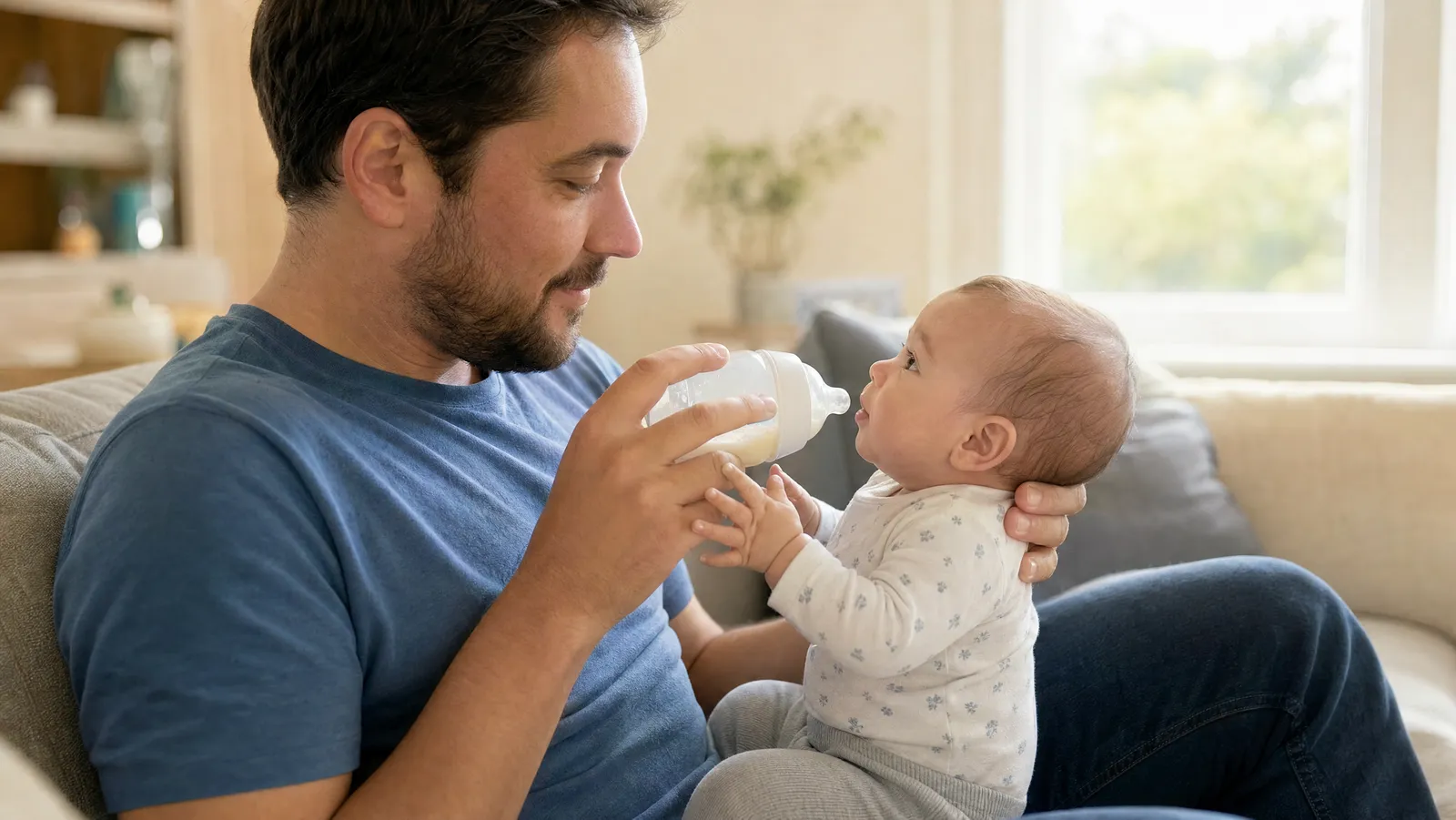
Offer the first bottle once breastfeeding is genuinely going well — hospital guidance clusters that between 3 and 6 weeks — and have someone other than the breastfeeding parent do it. Put about half an ounce of expressed milk in a slow-flow bottle, offer it an hour or two after a normal feed when the baby is alert but not hungry, and stop the attempt if ten minutes pass and the baby has not fed. Those last two figures are the American Academy of Pediatrics'. We earn a commission from links on this page, at no cost to you.
That is the whole procedure, and it is not the hard part. The hard part is that a first bottle is usually a partial success at best: a baby who licks the nipple, chews it, turns away, and feeds from you fifteen minutes later. A plan that assumes rejection is the plan that works. One small offer a day, the same easy time, the same person, no attempts during a hunger crisis, and a week to work with. If the bottle itself is new ground — holds, burping, how often — read bottle feeding a newborn first and treat this as the breastfeeding-specific layer on top.
Below: when the window opens, who should hold the bottle, volume and temperature, the mechanics, a seven-day schedule, the troubleshooting order, and the one thing not to do.
When to Offer the First Bottle
The timing advice from major bodies spans about five weeks, and anyone who gives you a single magic day is overstating what is known.
- Nationwide Children's Hospital advises that it is best to breastfeed a baby exclusively for the first 3 to 4 weeks, because bottles given before 4 weeks can reduce milk production. For a longer maternity leave, it suggests introducing a bottle with your milk by 4 to 6 weeks and then offering small amounts on most days.
- The Children's Hospital of Philadelphia's breastfeeding and lactation program suggests offering your milk in a bottle every couple of days starting at 3 weeks old, at a feeding you would normally be away for.
- The NHS is more conservative but names no number: start once you and your baby have got the hang of breastfeeding, which it says can take several weeks. The often-quoted figure of around 6 to 8 weeks is NHS 111 Wales', and it is about milk supply being fully established before combining breastfeeding with formula.
- The US Office on Women's Health advises waiting at least a month after birth before introducing a bottle.
- The AAP, on HealthyChildren.org, names no age at all — its guidance is about method, not calendar.
Two risks pull in opposite directions: offer too early and you may dent supply before it is established; wait too long and you may be teaching a new skill to a baby with firmer opinions and a less reflexive suck. Neither is a cliff edge, which is why the guidance disagrees.
The practical rule: work backwards from the date the bottle has to work, and leave yourself at least two to four weeks of practice. If you return to work between 4 and 8 weeks, Nationwide Children's suggests adding a bottle of expressed milk about 1 or 2 weeks beforehand. USDA WIC's breastfeeding guidance suggests that in the week or two before you go back, you try giving one or two feedings a day from a bottle. CHOP recommends beginning to pump at least two weeks before you return, pumping at least once a day to build a stored supply.
Who Should Give It, and Where
Not you, at least not first. The AAP states that many mothers find this works better if someone else offers the baby the bottle at first, and suggests doing it somewhere other than where the baby usually breastfeeds. The NHS gives the mechanism: with someone else holding the bottle, the baby will not be near you or able to smell your milk. La Leche League International is blunter, noting that a breastfed baby may be least likely to accept a bottle from his mother, because he knows where he expects the milk to come from. USDA WIC suggests a partner, your mom or another loved one.
In practice that means leaving the room, or better, the house — a baby who can hear you is still negotiating with you. Pick one person and let them own the whole week.
The NHS also suggests the opposite tactic: trying a bottle while holding the baby skin to skin, close to your breasts. It sometimes works on the baby who has rejected three attempts from everyone else.
How Much Milk, and How Warm
Half an ounce. The AAP suggests having that person offer about half an ounce of breast milk an hour or two after a regular feeding, during the first few attempts, when the baby is alert but not very hungry. Nationwide Children's says the same thing less precisely: you may want to limit the amount in the bottle.
Half an ounce sounds like nothing, and that is deliberate. The goal of attempt one is a baby who accepts the nipple, not a baby who takes a feed. A big bottle creates a target, and a target creates pressure to finish it — the exact dynamic you are trying to avoid. It also wastes milk: the CDC says leftover breast milk should be discarded within 2 hours after a feeding, so a refused 5 oz bottle is five ounces gone. Once bottles are routine you can scale up to a real feed, and our figures for how many ounces per feed by age cover what that looks like.
On temperature, the CDC is reassuringly relaxed: breast milk does not need to be warmed and can be served at room temperature or cold. Body temperature is a sensible starting point, but it is a preference to test, not a rule to obey. If you do warm it, the CDC says to keep the container sealed and put it in a bowl of warm water or hold it under warm — not hot — running water for a few minutes, then test a few drops on your wrist. Never thaw or heat breast milk in a microwave, which the CDC warns can destroy nutrients and create hot spots that can burn a baby's mouth. A thermostatic bottle warmer is not necessary, but it makes the temperature repeatable, which matters when you are working out what changed between a good attempt and a bad one.
The Mechanics of the Offer
This is where most first bottles are lost, and it takes about thirty seconds to learn.
- Use the slowest nipple in the box. Stanford Medicine Children's Health notes that a slow-flow nipple can help your baby pace their feeding so they take in the right amount and avoid overfeeding. Nationwide Children's Hospital adds that babies fed by both breast and bottle may benefit from a slower-flowing nipple, because it helps match the flow rate of human milk during breastfeeding.
- Touch, do not insert. Brush the nipple against the lips and wait for the mouth to open. The AAP's wording is the standard: your baby should be allowed to explore the nipple with his mouth, not have it forced past his gums, and the nipple should be introduced slowly and gently.
- Let the baby draw it in. No jiggling, no pushing, no helpful tipping. A baby who pulls the nipple in has agreed to the bottle. A baby who has had it posted into their mouth has not.
- Sit them near-upright and keep the bottle close to level, so the baby has to suck rather than swallow under gravity. That is the whole of paced bottle feeding, and it is the technique that makes a bottle feel less like a flood and more like a feed.
- Stop early rather than pushing. The AAP's instruction is explicit: stop the attempt if he becomes frustrated, or if more than ten minutes pass and he hasn't fed. It is better to end on a positive note and try again the next day. USDA WIC's guidance is the same in a different register — do not force your baby to finish a bottle, and watch for fullness cues.
The ten-minute cap is the single most useful thing on this page. An attempt that ends calmly is a successful attempt, even with a full bottle, because it leaves the bottle neutral instead of something that happens when everyone is upset.
Which Bottle to Start With
Any bottle with a genuinely slow nipple can work, and the bottle is rarely the reason a baby refuses. We have compared the shapes and nipple profiles in detail in the best bottles for breastfed babies; for this specific week, the reason we reach for the Nanobebe breastmilk bottle first is logistical rather than magical. It is one vessel you can pump into, store in, warm and feed from, which removes two transfers from a routine that already involves a pump at 6 a.m.
Nanobebe states that the shape encourages a smooth transition from breast to bottle and reduces nipple confusion, and that the geometry lets milk warm evenly up to twice as fast as a standard bottle, helping prevent hot spots. Those are the maker's claims, not independent findings, and the second one is the one we would actually buy it for. At about $13 as of October 2026 for a twin-pack, it is a cheap experiment — and two bottles is the right number to own before a baby has agreed to the concept. No bottle fixes refusal. Anything sold as the bottle breastfed babies accept is selling you a nipple shape, not an outcome.
A Seven-Day Plan
One small offer a day, same slot, same person, for a week. It is a structure, not a protocol — it keeps you from changing eight things at once.
- Days 1 to 3. Same time daily, ideally mid-morning when the baby is alert and rested. Half an ounce, an hour or two after a normal breastfeed. Someone else offers; you are elsewhere. Ten-minute cap, then breastfeed as usual if they are hungry.
- Days 4 to 5. Same slot, same person, same volume. Change exactly one thing if days 1 to 3 produced nothing: the temperature, or the nipple. The AAP cautions against giving up on any one type of feeding device until you have tried it for several days, so resist swapping nipples daily.
- Days 6 to 7. If the baby is taking an ounce or so, move to a real feed at the slot you will actually need covered. WIC suggests one or two feedings a day from a bottle in the week or two before you go back, and notes that adjusting can take several days.
Expect a partial week. Three sips on day two and an ounce on day six is normal, not a failure.
When the Baby Says No
Bottle refusal is common, it is not a verdict, and the way out is to change one variable at a time rather than all of them. Roughly in this order:
- Temperature. Warmer, cooler, or straight from the fridge. La Leche League International notes that some babies prefer milk warm while others prefer it at room temperature or even cold.
- Nipple. Different shape or base width before different brand. The AAP suggests trying a different kind of nipple if the baby refuses, and Nationwide Children's points out that not all bottle nipples are alike and some babies prefer one type.
- Position. Upright on a lap facing outward, or against a shoulder, instead of the cradle hold that signals breastfeeding.
- Environment. Movement helps a lot of babies: walking, bouncing, a dim room, white noise. A sleepy, just-woken baby is often more willing than a fully alert one.
- A different person. Then, if that fails, the NHS's skin-to-skin version with you.
- A different time of day. Early morning, or the drowsy window at the end of a nap.
- Pacing. Slow the whole thing down and let the baby set the rhythm.
- Skip the bottle. The AAP suggests switching from a bottle to a cup if a baby keeps refusing, and recommends offering a cup once a child starts solids, usually around 6 months. La Leche League notes that even premature babies can drink from an open cup with care and practice. A baby close to 6 months may not need to learn the bottle at all.
The one thing not to do is starve a baby into taking a bottle. Hunger makes refusal worse, not better — a distressed baby cannot learn a new oral skill, and the association you build is between the bottle and panic. The AAP's ten-minute stop exists for exactly this reason. If refusal is affecting how much your baby is taking overall, or their weight gain, or if you are running out of runway before a return to work, that is a conversation with your pediatrician or an IBCLC rather than a technique to push harder on. Nationwide Children's says the same: talk with your baby's doctor or a lactation consultant if you are having any problems introducing a bottle.
Handling the Milk, and Protecting Your Supply
The CDC's storage numbers are worth knowing by heart, because a practice week generates a lot of small portions. Freshly expressed milk keeps at room temperature of 77 degrees Fahrenheit or colder for up to 4 hours, in the refrigerator for up to 4 days, and in the freezer for about 6 months for best quality, with up to 12 months described as acceptable. Milk thawed in the fridge should be used within 24 hours, counted from when it is completely thawed rather than when it left the freezer. Once milk reaches room temperature or has been warmed, use it within 2 hours. Thawed milk should never be refrozen.
Those last two rules are an argument for small portions. Freezing in 1 and 2 oz amounts in flat storage bags rather than 5 oz blocks means a refused practice bottle costs you almost nothing. Lansinoh states its bags are designed to expand as milk freezes and to freeze flatter than leading competitors for faster, more uniform thawing — and flat is what lets you thaw a small portion quickly.
Supply is the better-documented risk, and it is manageable. Nationwide Children's warns that bottles before 4 weeks can reduce milk production. The NHS advises introducing bottles gradually to give your body time to adjust and reduce the risk of engorgement or mastitis, and says to express your breast milk regularly — around eight times a day including once at night — to keep your supply up while you are combining breast and bottle. For a working day, CHOP suggests pumping about as often as your baby feeds when you are together, typically two to three times in an eight-hour day, emptying until the milk stops flowing, usually 15 to 20 minutes.
Going back and forth is normal and not a problem you have to solve. The much-discussed risk of nipple confusion is a hypothesis about oral mechanics rather than a measured outcome, and the closest randomised evidence is about pacifiers, not bottles: a Cochrane review by Jaafar and colleagues of restricted pacifier use in healthy term breastfeeding infants found no significant effect on the prevalence or duration of breastfeeding up to four months. The question is not settled, but supply, not confusion, is the thing to actually watch.
What to Do Tomorrow
Pick the slot — mid-morning, an hour after a feed, when everyone is rested. Thaw or pump about half an ounce. Hand it to someone else, go for a walk, and give them two rules: let the baby pull the nipple in, and stop at ten minutes if the baby has not fed. Then do it again the next day.
If the bottle becomes routine from here, the rest of the mechanics are in our complete bottle-feeding guide. And if it does not, after a week of calm daily offers, that is the point to call your pediatrician or a lactation consultant rather than to try harder. Nobody fixes bottle refusal by raising the stakes.

Nanobebe Breastmilk Bottle, Twin-Pack
A wide, shallow, breast-shaped bottle that you can pump into, store, warm and feed from without decanting — which is the reason it belongs in a handover week, since every transfer is another vessel to wash and another two hours on the clock. Nanobebe states that the geometry lets milk warm evenly up to twice as fast as a standard bottle and helps prevent hot spots, and that the shape encourages a smooth transition from breast to bottle and reduces nipple confusion. The nipple is triple-vented to limit air intake, the materials are BPA-, phthalate- and lead-free, and the squat shape stacks in a fridge door. Two bottles is the right starting quantity: a first bottle only ever holds an ounce or two, so a six-pack is money spent on a baby who has not agreed to the plan yet.
- Brand
- NANOBEBE
- Category
- Our Pick
Pumping into the same thing you will feed from removes a whole step at 6 a.m., and the shallow shape genuinely does come up to temperature faster than a tall bottle in the same cup of warm water.

Lansinoh Breastmilk Storage Bags, 6 Ounce, 75 Count
Pre-sterilised 6 oz bags with double-sealed side and bottom seams, a double zipper and a tamper-evident tear-away top, made without BPA or BPS. Lansinoh states that they are designed to expand as the milk freezes and that they freeze flatter than leading competitors for faster, more uniform thawing. The practical value during a bottle week is portion control — freeze in 1 and 2 oz amounts rather than 5, because the CDC gives you two hours to use warmed milk and a refused bottle is milk you pour away. Most major pumps can be pumped into directly with a pump-into-bag adapter, sold separately.
- Brand
- Lansinoh
- Category
- Best for Stashing Milk
Freezing in small flat portions is the single change that stopped us dumping milk. Thawing a 2 oz bag for a practice bottle costs almost nothing if the baby says no.

Momcozy Bottle Warmer for Baby, 10-in-1
A countertop warmer with fast-warm, thaw, steam, food-heating and 24-hour keep-warm modes that fits most bottle shapes and materials. You select the milk state, the bottle material and the volume, and Momcozy states it then heats to a temperature the company describes as closest to breast milk, with a 30 percent faster heat-up that brings cold milk up in as little as 2 to 5 minutes. There is a one-touch thaw for frozen milk, a timer and automatic shut-off, and the steam function reaches up to 100 C. We would not call a warmer essential — the CDC's own method is a sealed bottle in a bowl of warm water — but a device that hits the same temperature every time removes one variable from a week where you are trying to change only one thing at a time.
- Brand
- Momcozy
- Category
- Best for Body-Temperature Milk
The repeatability is the point. When a baby takes a bottle on Tuesday and refuses it on Wednesday, you want to be certain the temperature was not the difference.
- 01NANOBEBEOur PickNanobebe Breastmilk Bottle, Twin-Pack
- 02LansinohBest for Stashing MilkLansinoh Breastmilk Storage Bags, 6 Ounce, 75 Count
- 03MomcozyBest for Body-Temperature MilkMomcozy Bottle Warmer for Baby, 10-in-1
When should I introduce a bottle to a breastfed baby?+
How much milk should go in the first bottle?+
Who should give a breastfed baby the first bottle?+
What temperature should the milk be?+
How long can expressed milk sit out, and how long after warming?+
Will a bottle cause nipple confusion or wreck breastfeeding?+
Sammie Seelbach
Sammie is a mom of two and the lead reviewer at Smart Baby Reviews. Since becoming a parent she has become obsessed with researching the safest, smartest baby gear on the market — testing thermometers at 2 a.m., wrangling baby gates, and sterilizing more bottles than she can count. She shares what actually works so other parents can make confident, informed decisions for their little ones.