Montessori Toys for Babies: What They Are, and What to Give Age by Age

This post may contain affiliate links. Read our policy.
Montessori toys for babies are simple, usually wooden, single-purpose objects a baby can act on without help: a ball to drop, a ring to grasp, a mobile to track. They are not a certified category. The defining traits are real materials, one clear task, no batteries, and no lights or sounds doing the work for the baby.
That definition does a lot of work in this guide. It is also why our advice runs against most Montessori gift lists. A handful of these materials genuinely earn their price. Several are better made from things already in your kitchen drawer. And a few — the AI-enabled toys that arrived this year with Montessori-adjacent marketing — fail the test outright. Below is what each stage is actually for, what we would buy, and what we would not.
What Actually Makes a Toy "Montessori"
Nothing certifies a toy as Montessori. There is no seal, no inspector and no registry, so the question of what makes a toy Montessori is settled by design choices rather than by a label on the box. Any manufacturer can print the word, and in 2026 almost all of them do.
Four traits do most of the sorting.
One purpose, visibly. A Montessori material presents a single problem whose solution is contained in the object. The ball fits the hole, or it does not. The baby gets feedback from the material, not from a parent saying well done or a speaker saying great work.
Real materials. Wood, metal, cotton, natural rubber. Partly that is aesthetics; mostly it is information. A wooden ball and a foam ball of the same size weigh differently and sound differently, which is a distinction a set of identical plastic pieces cannot teach.
The baby does the work. Montessori pedagogy, as taught by training organisations such as the Association Montessori Internationale and the American Montessori Society, treats a child's concentration as the thing to protect. In that view, a toy that activates on its own interrupts attention rather than rewarding it.
Based in reality. Montessori environments for under-threes favour real objects and realistic images over fantasy, on the grounds that a baby is still assembling a model of the actual world.
One honest caveat, since this is where gift guides overreach. These are pedagogical principles, not clinical findings. Open-ended play with simple materials is absorbing, durable and cheap, and that makes it a sensible default. It is not demonstrated to produce measurable cognitive gains, and nobody selling a ninety-dollar wooden stacker can show you a trial that says otherwise. We recommend these objects because babies stay with them and they last — not because they raise anything.
Birth to Three Months: Contrast, Focus, and Movement
Almost all Montessori toys for the first three months are things to look at, because looking is the system the newborn is actually running.
According to the AAP's HealthyChildren.org guidance on vision in the first month, newborns have poor eyesight and little ability to focus beyond roughly 6 to 10 inches, and they are drawn to high-contrast objects — the page names black-and-white bull's-eye patterns, checkerboards and concentric circles of contrasting colours. The same guidance notes that infants probably do not see subtle differences in colour until two to three months of age.
That is the entire design brief for the first Montessori mobile. The Munari — flat black-and-white geometric shapes with a glass sphere, hung still and watched — matches it almost exactly. Nienhuis, which manufactures the AMI-pattern version, says it is usually offered from birth to around the second month. The Gobbi, a graded set of spheres in a single colour, comes later; the same maker places it at about three months, when colour discrimination has arrived. Ages differ between Montessori sources, so treat the sequence as an order of operations rather than a schedule.
What we would not buy at this age: anything rattling, musical or sold as developmental. A newborn does not grasp on purpose yet, so a rattle is a thing that happens to the baby rather than a thing the baby does.
What we would do instead, for nothing: tape a single high-contrast image at the baby's focal distance beside the floor mat, and change it every week or two. Floor time on a firm mat, flat on the back with nothing in reach, is the other half of Montessori infant practice. Freedom of movement counts for as much as the thing to look at.
One caution on placement. Mobiles belong over a movement mat or a changing area, never over the crib. What does not belong in the crib covers why a sleep surface stays bare.
Three to Six Months: Reaching, Grasping, and Mouthing
The defining feature of Montessori toys for three to six months is that the baby can make something happen and then do it again. Reaching becomes deliberate, both hands get involved, and everything goes into the mouth — which is why this is the age where the choking rules stop being abstract.
The federal baseline first. The CPSC's small-parts regulation at 16 CFR 1501 bans toys and other articles intended for children under three that present a choking, aspiration or ingestion hazard, and the test is physical rather than a matter of judgement. Per CPSC small-parts guidance and the rule text at 16 CFR 1501.4, a part is placed in a test cylinder that CPSC describes as about 2.25 inches long by 1.25 inches wide — sized to approximate the fully expanded throat of a child under three — and if it fits entirely inside, in any orientation and without being compressed, it fails. The broader standard is ASTM F963, which section 106 of the Consumer Product Safety Improvement Act made mandatory federal law, codified at 16 CFR part 1250. Per CPSC-approval notices summarised by Bureau Veritas and Intertek, the current version, ASTM F963-23, has applied to toys since April 20, 2024.
In practice that means two checks: nothing that could come loose and pass the cylinder, and nothing with a seam a determined baby can work open.
Three things earn shelf space in this window — a grasping ring or single-material rattle, an interlocking disc or two, and one sensory object whose effect the baby controls. Our illustrative pick for the last of those is the GRESEESM Wooden Rain Stick, a 7.7-inch wooden rainmaker at about $14.99 as of November 2026. Turn it over and coloured beads fall past a translucent window with a rain sound. The maker says it supports visual tracking and auditory sensory development, and notes that adult supervision is required and that it should not be dropped from a height.
Mouthing at this age is normal, thorough and often loud. If the noises your baby makes around objects and, later, food worry you, gagging vs choking when starting solids explains how to tell the two apart.
Six to Twelve Months: Sitting, Crawling, and Problem-Solving
Most Montessori toys for six to twelve months are built around a single problem with a visible solution, because that is suddenly what a baby can attempt. The CDC's 9-month milestone checklist lists sitting without support, getting into a sitting position without help, and moving objects from one hand to the other. A stable trunk, a free hand, and an interest in where things went.
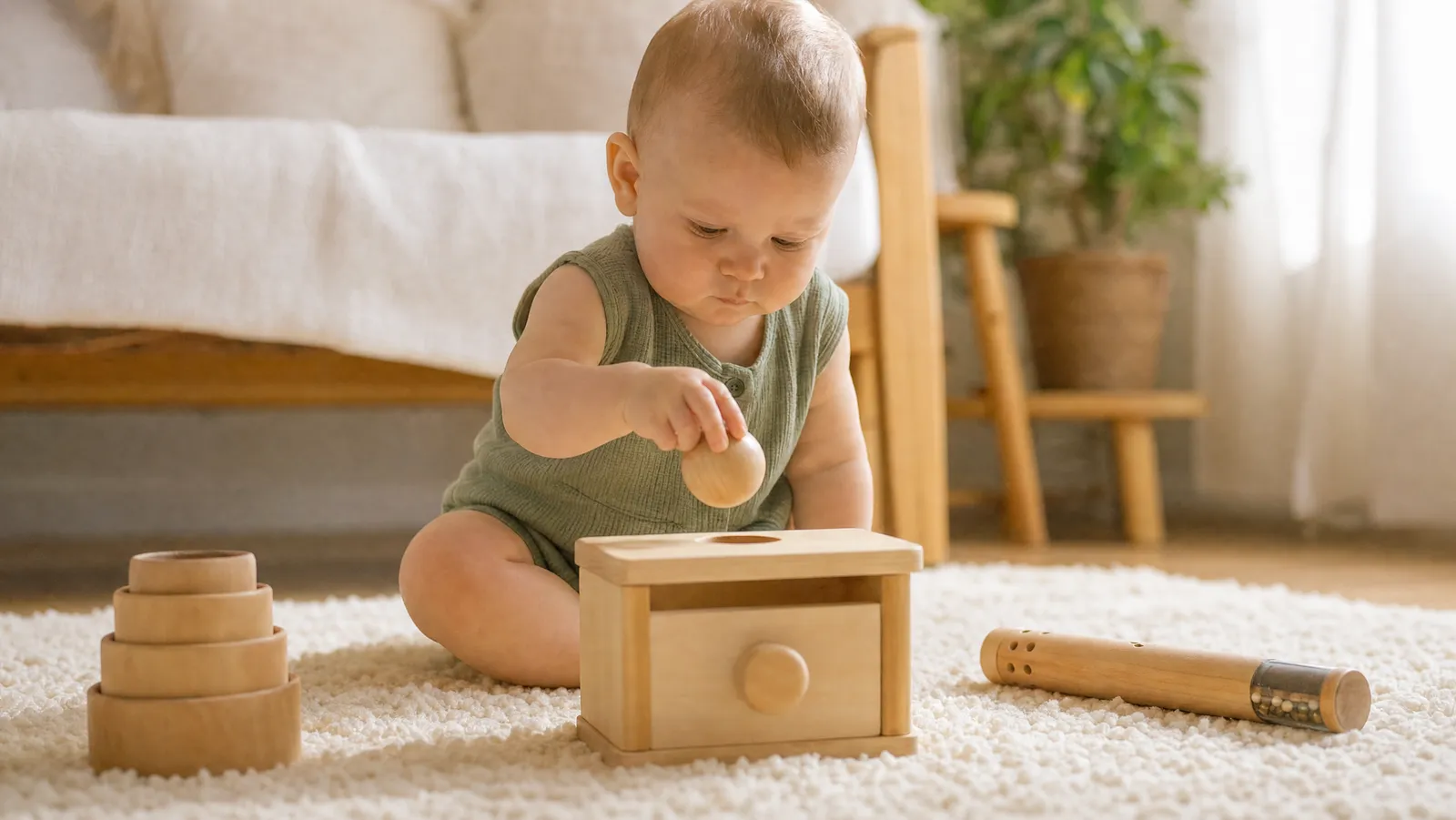
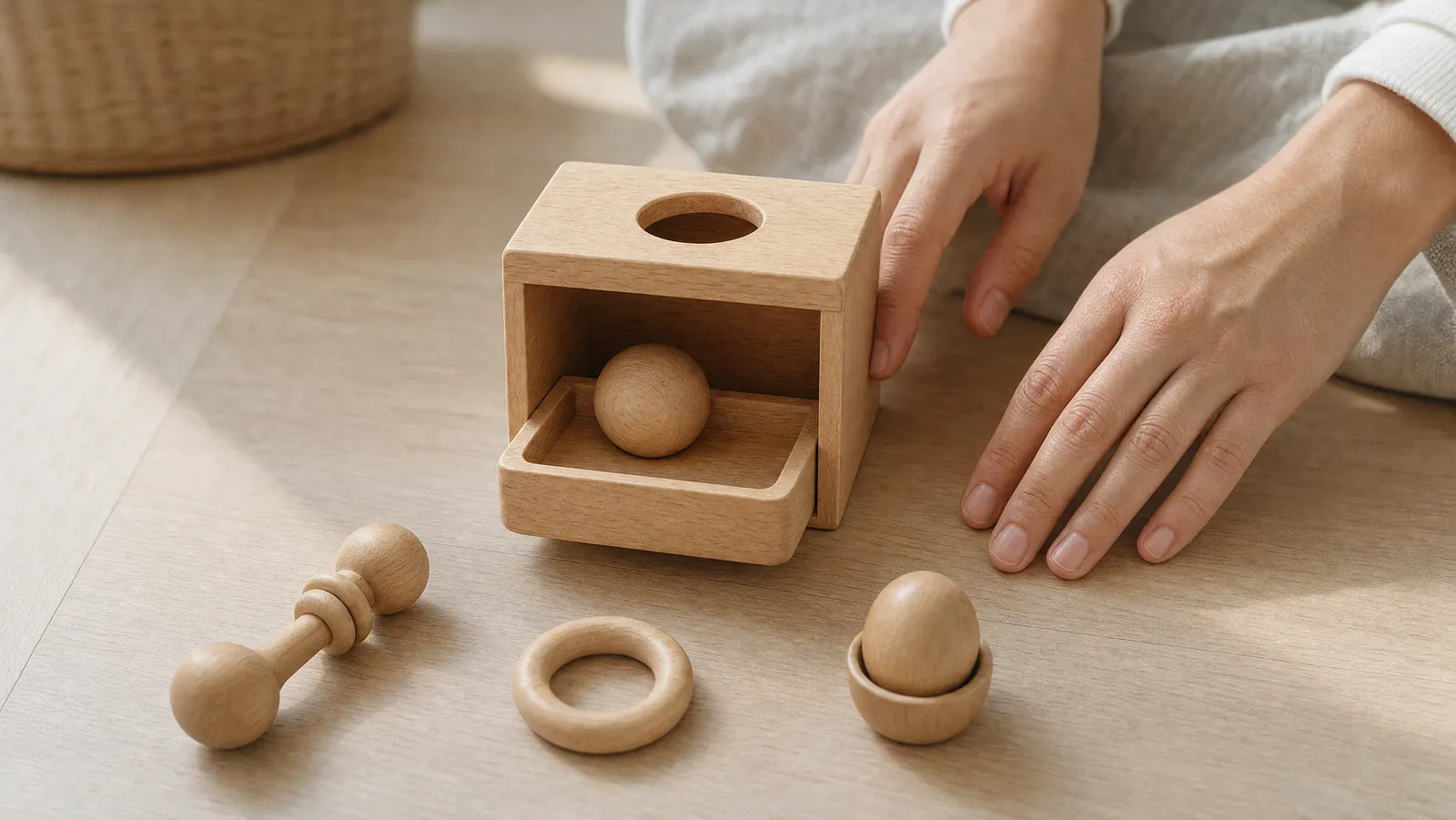
The canonical material for this window is the object permanence box: the baby posts a ball through a hole, the ball disappears, and it rolls out into a tray. It answers a question the baby is already asking. Our illustrative pick is the Adena Montessori Object Permanence Box, about $15.99 as of November 2026, which comes with a tray and three balls in wood, plastic and soft EVA foam, so the same action produces three different weights and sounds. The large ball measures 1.77 inches, and the maker aims the set at 6 to 12 months and says it supports hand-eye coordination, concentration and sensory exploration.
Measure before you hand anything over. A 1.77-inch ball clears the 1.25-inch small-parts cylinder described in the previous section, which is precisely the point of sizing it that way — but a stray smaller ball from a different toy does not, and no-name sets vary.
Also worth having at this stage: a simple ring stacker, a basket of three or four unrelated real objects to empty and refill, and a low shelf the baby can reach unaided. Emptying a container is the dominant game of the second half of the first year, and nothing you can buy does it better than a basket does.
For a wider and less doctrinaire list covering this stage, the best developmental toys for babies includes the non-Montessori options too. And bear in mind that at this stage the shelf is no longer the only thing you are setting up: a baby who can cross a room changes what the room has to be.
Play Gyms and the Montessori Mobiles
A Montessori play gym and mobiles solve two different problems, and most products on the market blur them.
A mobile is for a baby who cannot yet reach. It hangs out of range, it is for watching, and it should be still enough to study. A play gym with hanging objects is for a baby who can reach. It hangs within range and it is for batting, grabbing and pulling. Buying a gym for a three-week-old or a mobile for a six-month-old gets you the wrong object at the wrong moment.
The traditional Montessori sequence runs visual first, then tactile. Mobiles come down somewhere around three to four months in most Montessori sources, replaced by a single object on a short ribbon at arm's length — a wooden ring, a bell, a small figure. One object, not five. The point is a repeatable experiment: swipe, and the thing moves.
What we look for in a gym: a wooden or metal frame that stays put when a baby pulls on it, an adjustable bar height, and detachable hanging pieces so you are not stuck with whatever five toys it shipped with. What we skip: integrated lights, music, projectors, and the printed vinyl mat with a cartoon scene. An arch with a dozen dangling plush shapes is visually noisy for a four-month-old and nearly impossible to simplify.
A frame is optional, too. A clothes drying rack, a curtain rod across two chairs, or a hook in a ceiling joist does the same job for nothing. If you improvise, keep the ribbon short enough that it cannot loop around a neck, hang it over a floor mat rather than a sleep surface, and stay in the room while it is up.
One note on the rain stick above: we would not hang it. It is heavy enough that it belongs on the floor beside the gym, not on a ribbon over a baby's face.
Materials: Wood, Finishes, and What Goes in the Mouth
Shopping for non-toxic wooden baby toys comes down to two questions: what the wood is finished with, and what happens when the toy breaks.
Finish first. Anything a baby mouths should be bare sanded wood or coated in something food-safe that the maker will name — beeswax, carnauba, a plant oil, or a water-based paint with a stated composition. Non-toxic on a product listing is a marketing phrase, not a standard. The standard that does exist is ASTM F963, which the CPSC enforces as mandatory federal law under 16 CFR part 1250; per Intertek's summary of the U.S. framework, separate CPSC rules cover lead and small parts. If a seller cannot tell you what the finish is, treat the silence as the answer.
Then breakage, which is the part most guides skip. A wooden toy fails differently from a plastic one. It splits along the grain, raises splinters, and occasionally sheds a piece that now passes the 1.25-inch small-parts cylinder. Check painted wooden toys monthly for chipping, and retire anything that has begun to split. Glued-in dowels and glued-on wheels are the usual failure points.
A few specifics we go by:
- Untreated hardwood — maple, beech, birch — is the default for anything that will be mouthed. Softwoods dent and splinter sooner.
- Bamboo is often laminated with adhesive. Fine as a tray, less ideal as a teether.
- Silicone and natural rubber are legitimate here for teething, provided the piece is one solid part with no seam to open.
- Felt and wool shed fibres. Acceptable on a mobile that stays out of reach; not for a mouther.
- Magnets we skip entirely before three. A magnet is both a small part and the last thing you want swallowed.
Secondhand wooden toys are a genuine bargain, with one rule: if you cannot establish what it was painted with, keep it for a toddler who no longer mouths, not a baby who does.
The Shelf, and Why Rotation Matters More Than Quantity
Montessori toy rotation is the part of this system that saves you money, and it is the part almost nobody implements.
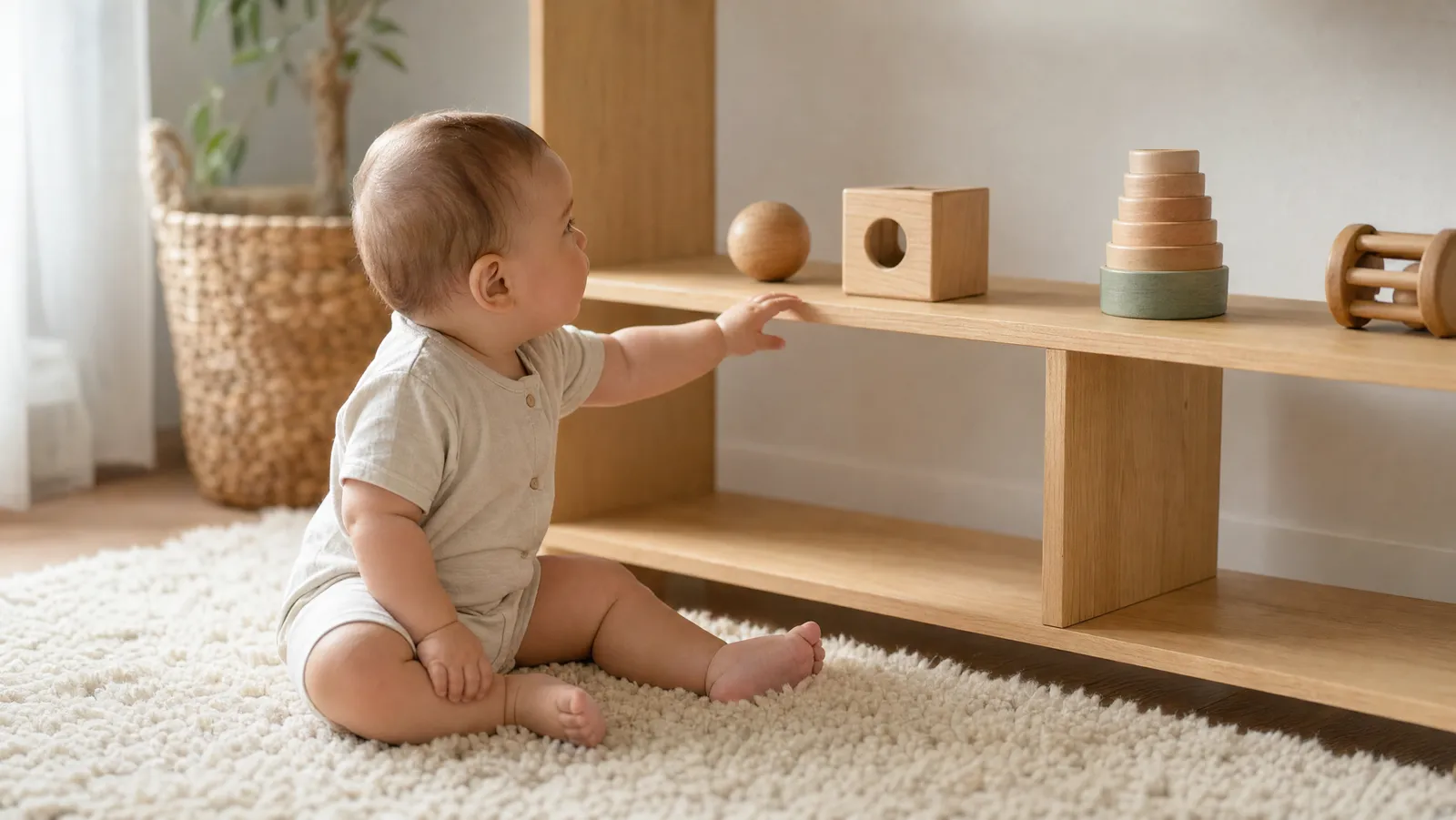
The arrangement is a low open shelf the baby can reach from the floor, holding six to eight items, each with its own clear space — ideally on a small tray or in a shallow basket, so that one object reads as one activity. Everything else goes in a closet. No toy box. A box of forty things is a pile to be excavated, and babies tend to sweep through a pile without settling on any of it.
Then you swap. Every week or two, take out two or three items and bring back two or three others. What guides the swap is observation rather than the calendar: watch which objects got picked up and which were stepped over, and retire the ones that have stopped earning their space. An object a baby has mastered is finished for now, and an object a baby cannot yet attempt will be interesting in a month. Both come off the shelf.
Two effects are worth the trouble. The first is attention — with six visible choices, babies tend to choose one and stay with it, which is the whole point of the prepared environment in Montessori practice. The second is budget. Rotation makes a set of six objects behave like a set of twenty, which is why the Montessori households we have seen generally own fewer toys than average rather than more.
Practical details: keep the shelf under about two feet so a baby can see the top of every tray, weight it or anchor it before the pulling-to-stand stage, and keep the floor in front of it clear. If you want a second, slightly older category to rotate in later, logic toys that give your baby a head start is a reasonable next shelf.
AI and Connected Toys: Why They Fail the Montessori Test
The argument against AI toys and babies begins with pedagogy and ends with data, and both ends are now documented.
Pedagogy first. A Montessori material supplies feedback from the material itself. A toy that answers questions, praises, chats or redirects supplies that feedback from outside the child, which is the precise thing Montessori practice is built to avoid. For a baby under one the conversational layer is wasted anyway. Relevantly, the AAP's policy statement Digital Ecosystems, Children, and Adolescents, published online January 2026 in Pediatrics, treats television, the internet, social media, video games and interactive assistants as a single digital ecosystem, and replaces the AAP's prior guidance on communications and media with a framework its release summarises as five C's: the individual child, the content of media, calm or self-regulation, what media crowds out, and communication. Crowding out is the one that applies to a nursery shelf. A talking toy occupies the hours a basket of real objects would have.
Then safety and data. Common Sense Media published a risk assessment of AI companion toys in January 2026 and, in its own release, advised against AI toys for children 5 and under while urging caution for ages 6 to 12. Its testers evaluated three such toys and reported that more than a quarter of the toys' outputs included inappropriate content, alongside design features that build emotional attachment in young children, extensive data collection, and unreliable performance.
On the data side, the FTC's amended COPPA Rule added biometric identifiers to the definition of protected personal information, and voiceprints are expressly among the examples the final rule lists, alongside fingerprints, handprints, retina and iris patterns, facial templates and genetic data. The amended rule took effect June 23, 2025, with full compliance required by April 22, 2026. A toy with a microphone in a nursery is a data product as well as a toy, and the regulatory picture around it is still moving.
Our line is blunt: no microphones, no speakers and no companion app for a baby under one. Nothing recommended in this guide needs a battery.
Making Your Own: Household Montessori Toys
The best DIY Montessori toys are already in your house, and this is the section where we would have you spend nothing.
Before the list, the rule that governs all of it. A household object has not been safety-tested as a toy, so you have to run the test yourself. Per the CPSC small-parts rule described above, anything intended for a child under three that fits entirely inside a cylinder about 1.25 inches across and up to 2.25 inches deep counts as a choking hazard. An empty kitchen-roll tube is a serviceable home gauge: if an object drops through it, it does not go near a baby. Then check for anything that can shed a piece, splinter, unscrew or crack, and stay in the room while it is in use.
With that applied, the things that work:
- A basket of real objects. Four or five unrelated items, each too large to pass the tube: a wooden spoon, a metal measuring cup, a silicone basting brush, a large wooden napkin ring. This is the single best substitute for a thirty-dollar sensory set.
- A posting box. A lidded plastic container with a slot cut in the top, plus large wooden discs or coasters. Not bottle caps or coins — both fail the cylinder.
- Nesting measuring cups. Excellent for in-and-out, with the smallest one or two cups removed first.
- A floor mirror. Acrylic or shatterproof only, laid flat or fixed firmly to the wall at floor level, never propped where it can tip.
- A muffin tin plus oversized balls. A ready-made sorting problem with no instructions required.
- A fabric pull. An empty tissue box with short fabric squares inside — squares, not long scarves, and only with an adult sitting there.
What we would still buy rather than improvise: the object permanence box, because the ball-returns-to-tray mechanism is hard to replicate, and a stacking ring set, because the graded sizes are the lesson.
First Steps: Push and Pull Toys
Montessori push and pull toys are the one category where the object exists to serve movement rather than hands, and the distinction that matters most is not Montessori versus not. It is pushed-behind versus sat-in.
The AAP is unambiguous about the sat-in kind. Its HealthyChildren.org article Baby Walkers: A Dangerous Choice says the AAP has called for a ban on the manufacture and sale of baby walkers with wheels, that walkers send thousands of children to hospitals every year, that rolling down stairs is how most children get hurt in them, and that walkers can actually delay when a child starts to walk. The underlying count comes from a 2018 study in Pediatrics, which estimated 230,676 children under 15 months treated in US emergency departments for walker-related injuries between 1990 and 2014 — about 2,000 of them in 2014 alone, with 74.1 per cent of the injuries caused by falling down stairs in a walker. The alternatives the AAP suggests are stationary activity centres without wheels, and play yards.
A push walker is a different object. The baby stands behind it, holds the bar and pushes, and it moves only when the baby moves. It suits a baby who already pulls to stand and is cruising along furniture. Our illustrative pick is the Pithfor Wooden Push Walker at about $56.99 as of November 2026, against a $59.99 list price — a wooden sit-to-stand frame with anti-slip rubber wheels and eight activity elements, including a mirror, rolling drum, bead maze, xylophone, spinning gears, shape sorter, drum and zig-zag track, marketed from 10 to 12 months and up. It is explicitly a walker the baby pushes, not one the baby rides in.
Two caveats we would apply to any push walker. It wants flat, uncarpeted floor and a closed stair gate, since stairs are the hazard in the AAP's walker data. And a purist would point out that eight activity panels are exactly the multi-purpose clutter the first section argues against — fair enough. We would treat it as a pushing frame and ignore the xylophone.
Furniture is free, too. A low weighted sofa or a heavy dining chair gives the same cruising support. How to baby-proof your home covers which furniture will take a pull and which will come over.
Are Montessori Toys Worth the Money?
Which brings us to the only question that matters: are Montessori toys worth it, at the prices the label now commands? Our answer splits into three piles.
Worth buying. Objects whose mechanism you cannot replicate at home. The object permanence box, a graded stacking ring set, a set of interlocking discs, a well-built wooden push walker, and — if you want one — a mobile set for the first three months. Total outlay is roughly $100 to $150 across the first year, which is less than most nursery toy budgets, and these resell.
Worth making. The treasure basket, the posting box, the nesting cups, the muffin-tin sorter, the floor mirror, the hanging object on a ribbon. These are the majority of what a baby under one actually uses, and buying them is paying a wood-and-branding premium on a kitchen drawer.
Not worth it. The ninety-dollar sensory bundle. Anything described as Montessori-inspired with lights and sound, which is a contradiction. Felt food and play kitchens, which are for a much older child. And connected or AI-enabled toys, for the reasons given above.
The thing not to buy is the promise. Montessori materials are well-designed, durable and quiet, and babies stay with them longer than they stay with plastic that performs on its own. That is a real benefit and worth paying something for. It is not a developmental intervention, and the price of a wooden object has no relationship to what it does for your child. If something in this guide costs more than the household version and you cannot articulate what the extra buys, skip it.
Spend the difference on floor space and uninterrupted time. Those are the two parts of a Montessori environment that are genuinely hard to get, and neither one is for sale.
Explore the full series
- What Actually Makes a Toy "Montessori" — The seven traits that separate a Montessori toy from a plastic activity center — and the ones marketers borrow without earning.
- Montessori Toys for 6 to 12 Months — Sitting, crawling, and the pincer grasp change what a baby can do with a toy — the objects that match that window.

Adena Montessori Object Permanence Box with Tray and 3 Balls
The canonical 6-12 month Montessori material. The baby drops a ball into a hole, the ball vanishes, and it rolls out into the tray below - object permanence demonstrated by the object itself rather than explained. It ships with three balls in wood, plastic and soft EVA foam, so the same action produces three different weights, sounds and textures. The large ball measures 1.77 inches, which clears the CPSC small-parts cylinder. Wooden construction; the maker aims it at 6 to 12 months and says it supports hand-eye coordination, concentration and sensory exploration.
- Brand
- Adena Montessori
- Category
- Our Pick
She worked out the drop-and-wait sequence in about two days and then did it maybe four hundred times. It is the only toy on the shelf that still gets picked up every single morning.

GRESEESM Wooden Rain Stick Rainmaker Sensory Toy, 7.7 in
A 7.7-inch wooden rainmaker, sized for a baby to hold and for a diaper bag. Turn, shake or roll it and coloured beads fall through a translucent window with a rain sound - visual tracking and cause-and-effect in one object the baby controls. The maker states it supports visual tracking and auditory sensory development, and notes that adult supervision is required and that the toy should not be dropped from a height.
- Brand
- GRESEESM
- Category
- Best for Sensory Play
He turns it over, watches the beads, and turns it over again - it is the first toy that held him for more than a minute. It also lives in the diaper bag and has saved several restaurant meals.

Pithfor Wooden Baby Push Walker with Activity Center
A wooden sit-to-stand push walker with anti-slip rubber wheels and eight activity elements - mirror, rolling drum, bead maze, xylophone, spinning gears, shape sorter, drum and zig-zag track - marketed from 10 to 12 months and up. The important detail: this is a walker the baby stands behind and pushes, not a seated walker the baby rides in. It moves only when the baby moves.
- Brand
- Pithfor
- Category
- Best for New Walkers
She pulled up on it the first evening and was pushing it down the hallway within a week. We gate the stairs and keep it off the rug, and otherwise it just lives in the living room.
- 01Adena MontessoriOur PickAdena Montessori Object Permanence Box with Tray and 3 Balls
- 02GRESEESMBest for Sensory PlayGRESEESM Wooden Rain Stick Rainmaker Sensory Toy, 7.7 in
- 03PithforBest for New WalkersPithfor Wooden Baby Push Walker with Activity Center
What exactly makes a toy Montessori, and is the label regulated?+
Are Montessori toys actually better for my baby's development?+
How do I know whether a toy is a choking hazard for a baby under one?+
Is a push walker safe, or is that the kind of walker pediatricians warn about?+
How many toys does a baby actually need on the shelf?+
Sammie Seelbach
Sammie is a mom of two and the lead reviewer at Smart Baby Reviews. Since becoming a parent she has become obsessed with researching the safest, smartest baby gear on the market — testing thermometers at 2 a.m., wrangling baby gates, and sterilizing more bottles than she can count. She shares what actually works so other parents can make confident, informed decisions for their little ones.