When to Stop Bottle Feeding (and How to Make the Switch)

This post may contain affiliate links. Read our policy.
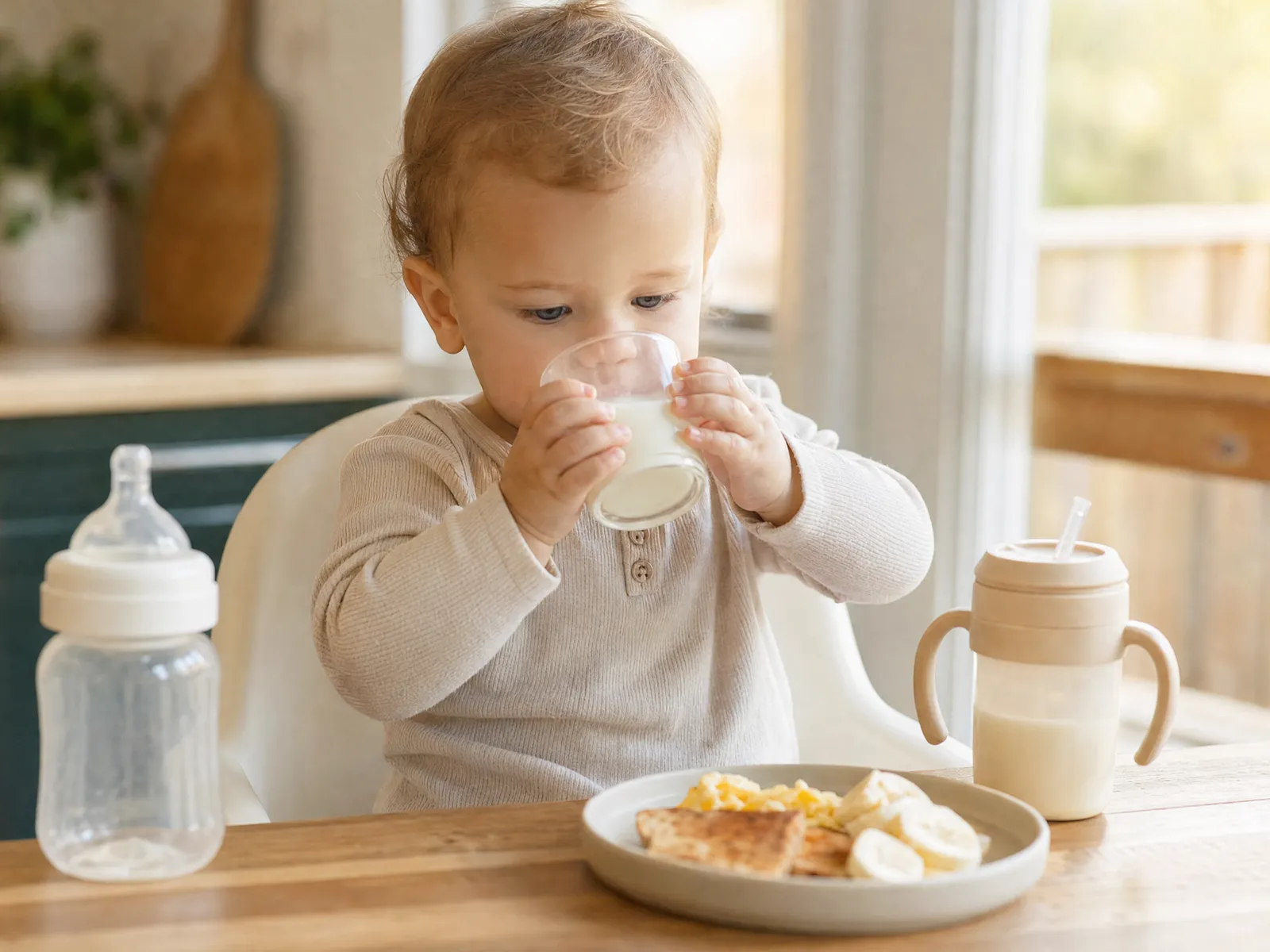
The short answer on when to stop bottle feeding: the American Academy of Pediatrics, writing on HealthyChildren.org, says the move to a cup should ideally begin around 6 months, with parents "completing the transition sometime between 12 and 18 months." Twelve months is the target. Eighteen is the outside edge, not a second deadline. We earn a commission from links on this page, at no cost to you.
That is a container change, not a diet change. A baby under a year who still gets most of their nutrition from formula or breast milk needs that milk, and nothing below is an argument for taking it away. If you are still in the thick of the first year, start with bottle feeding a newborn and come back when the first birthday is in sight.
When Should a Baby Stop Bottle Feeding?
Every major body lands in roughly the same place. We have quoted them rather than averaging them.
| Authority | What they actually say |
|---|---|
| AAP, on HealthyChildren.org | The transition ideally begins around 6 months, "completing the transition sometime between 12 and 18 months" |
| American Dental Association, MouthHealthy | "Encourage your child to drink from a cup by his/her first birthday" |
| American Academy of Pediatric Dentistry, Policy on Early Childhood Caries (revised 2025) | Counselling should emphasise "avoidance of on-demand or nocturnal baby bottle- and breastfeeding beyond 12 months of age" |
| NHS | "Once your baby is 1 year old, feeding from a bottle should be discouraged" |
So: aim for the first birthday, and treat 18 months as the edge of the published window. The AAP sets a later marker that shapes which cup you buy, saying "it's healthiest for kids to drink from an open cup by about 2 years of age."
One thing none of them say is cut the milk. The AAP's recommended-drinks guidance lists cow's milk as "None" for babies 6 to 12 months and says "At 12 months, you can start giving your baby whole or reduced-fat milk." Before a year, formula or breast milk is the job and a bottle is a legitimate way to deliver it. Weaning is about the container, and it gets easier to start precisely because the milk inside is changing anyway.
Reason One: Teeth
The dental case is the best-attributed part of this article, and it is not really about bottles. It is about how long a sugary liquid sits on a tooth.
The American Dental Association's MouthHealthy site names the mechanism: "One common cause is the frequent, prolonged exposure of the baby's teeth to drinks that contain sugar." It adds that "tooth decay can occur when the baby is put to bed with a bottle, or when a bottle is used as a pacifier for a fussy baby," and instructs that "infants should finish their bedtime and nap time bottles before going to bed." The AAP describes the same problem as teeth being "constantly bathed in milk, formula, juice or other drinks."
Milk counts here, not only juice. The NHS puts the behaviour rather than the drink at the centre of it: "comfort sucking from a bottle on sweetened drinks causes tooth decay in young children." The full mechanism, the brushing routine by stage, and what early decay looks like on a front tooth are in bottle-fed baby teeth.
A bottle is unusually good at producing prolonged exposure, because a toddler can carry one around for an hour. That is why the first birthday keeps appearing. The AAPD's 2025 policy aims its counselling point at on-demand and nocturnal feeding past 12 months rather than at bottles as objects.
Reason Two: Food, and the Iron Problem
The second reason is about what the bottle crowds out. The AAP is plain: "Little ones who sip on bottles during the day often don't feel hungry at mealtimes," which "may mean they're getting less of the fiber and rich nutrients found in solid foods."
The numbers make it concrete. The AAP's recommended-drinks guidance for 12 to 24 months advises whole milk with a suggested 16 ounces a day, plus 8 to 32 ounces of water. Cincinnati Children's, writing about iron deficiency anemia in toddlers, tells parents "do not give children more than 16-20 ounces of milk a day," because "drinking too much cow's milk can cause iron deficiency anemia." It gives two mechanisms: milk contains very little iron, and "milk gets in the way of the body's ability to absorb iron from food."
Four 8 oz bottles a day is 32 ounces, double the AAP's suggested figure for a 13-month-old. For normal intake across the first year see how many ounces per feed; the solid-food side is in how much solid food by age. Iron testing and any supplement is your pediatrician's call, not ours.
Start the Cup at 6 Months, Not at 11
In our experience the biggest thing in your favour is that the cup is not a new object by the time it has a job.
The AAP says to "offer your child a cup when they start eating solid foods, usually around 6 months," and the NHS gives the same timing with an instruction attached: "introduce your baby to drinking from a cup or beaker from around 6 months and offer sips of water with meals."
Put water in it, not milk. It is cheaper to spill, and the AAPD's caries policy encourages children between 6 and 12 months "to drink 4 to 8 ounces of water per day" while abstaining from all juice.
Treat the 6-month cup as skill practice at one meal a day. The 12-month cup is a delivery system.
Which Cup: Straw, Open, or Spout
Here is the honest version, including the part the internet overstates.
The NHS prefers a cup "with a free-flow lid (without a non-spill valve)" over "a bottle or beaker with a teat as it will help your baby learn how to sip rather than suck." Cleveland Clinic pediatrician Jason Sherman, DO, goes further, suggesting you "consider starting with a plastic or silicone cup with no lid." The Cleveland Clinic article adds, in its own voice rather than his, that "you may even want to skip the sippy cup phase altogether," and that spill-proof cups "can also promote unhealthy drinking patterns, like jaw protrusion and unusual tongue placement."
The professional preference is consistent: open and straw cups good, hard-spout no-spill cup a step sideways. A spout the child sucks on recreates the bottle's action, which is the thing you are retiring.
What we will not tell you is that a sippy cup will delay your child's speech. We looked for a published trial on cup type and speech outcomes and did not find one. The AAP does say little ones "who drink from bottles well into their second year may also have tooth alignment problems and even speech delays" — but that is about prolonged bottle use, not about cup type. The well-attributed problem is the dental one above, and it applies to any container a toddler sips milk or juice from all day — a no-spill cup just makes all-day sipping easier.
You need one or two cups, not a collection, and a 2 oz glass you already own plus a kitchen towel is a legitimate free way to practise open-cup drinking. The rest of the self-feeding kit is in baby plates, bowls and spoons.
If you already own Dr. Brown's bottles, start there. The narrow sippy straw lid with handles is about $8 as of October 2026 and, according to Dr. Brown's, fits all of the brand's Options+ 8 oz bottles and sippy spout bottles, so the baby keeps the bottle body they recognise and only the top changes.
Otherwise the standalone straw cup is about $6 as of October 2026, which is roughly the right amount to spend on a first cup, and its weighted silicone straw means a tipped cup still delivers a drink. For open-cup practice, the ezpz Tiny Cup is about $11 as of October 2026 and is sized to a baby's hands with a weighted base. ezpz states that it was designed and tested by a pediatric feeding specialist, and claims open-cup drinking supports oral and speech development and may help prevent tooth decay. Those are the manufacturer's claims, not independent findings.
The Drop Order: Easiest Bottle First
Most weaning plans fail because they start with the hardest bottle. Reverse it.
The daytime bottle your baby cares least about goes first. The bedtime bottle goes last, because that one is doing a comfort job as well as a milk job, and comfort takes longer to replace than calories.
How to spot the easy one:
- The bottle they wander away from half-finished.
- The one a different caregiver usually gives, since the association is weaker.
- The one closest to a meal, where solid food can take up the slack immediately.
Then go one bottle at a time and hold each new normal for three or four days. Dr. Sherman describes the same gradual shape — "start by gradually dropping their sippy cups and bottles from the feeding schedule" — and the Cleveland Clinic adds that doing it cold turkey only works, without risking dehydration, if you "have already spent a good while introducing them to open cups."
If a day goes badly, hold where you are. Do not hand back a bottle you already dropped; that teaches a toddler that enough protest restores it.
A Three-Week Schedule for a Four-Bottle Baby
The shape, not a prescription. Shift the days to fit your week.
| Days | Morning | Midday | Late afternoon | Bedtime |
|---|---|---|---|---|
| Starting point | Bottle | Bottle | Bottle | Bottle |
| Days 1 to 4 | Bottle | Milk in a cup with lunch | Bottle | Bottle |
| Days 5 to 8 | Bottle | Cup | Cup with the afternoon snack | Bottle |
| Days 9 to 12 | Cup with breakfast | Cup | Cup | Bottle |
| Days 13 to 16 | Cup | Cup | Cup | Milk in a cup with dinner, then bath, book, bed |
If one bottle has become non-negotiable, shrink it rather than delete it: an ounce less every couple of days until what is left is not worth the fuss.
For most babies this switch and the formula-to-whole-milk switch land in the same fortnight, since the AAP says "at 12 months, you can start giving your baby whole or reduced-fat milk." Doing both at once saves a second round of protest, but keep mixing and storing formula properly for the days you still need it — the limits are in how to prepare and store formula safely.
What Goes in the Cup
Two drinks, both unusually well sourced.
Whole milk and water. The AAP's recommended-drinks guidance says "children ages 12-24 months are advised to drink whole milk, and children 2 and older nonfat (skim) or low-fat (1%) milk," with a suggested 16 ounces of milk and 8 to 32 ounces of water a day. Ask your pediatrician before deviating from whole milk between one and two.
Not juice. The AAP states that "infants less than 1 year of age should not drink juice" and limits it to "no more than 4 ounces per day in 2-3 year-olds." The AAPD sets the same 4 ounce daily ceiling for ages 1 to 3. Juice in a cup all afternoon reproduces the problem you just spent three weeks solving.
Milk at meals and snacks, water in between, satisfies all of the above.
The Bedtime Bottle
Keep the ritual and remove the bottle from the middle of it. The sequence that works is milk in a cup with dinner or before the bath, then bath, teeth, books, bed. The order matters more than the words: the last thing in your child's mouth before sleep should be a toothbrush, not milk.
Never put a baby to bed with a bottle. The AAP's bottle-feeding guidance gives the safety reason, that "lying down increases the risk that she'll choke" and that "it allows milk to run into her eustachian tubes, possibly causing middle ear infections." The ADA gives the dental one, that "tooth decay can occur when the baby is put to bed with a bottle," and says bedtime and nap time bottles should be finished before bed.
The fear here is about sleep, and there is no trial for us to quote at you. Most families find the first two or three nights are the hard ones. If the bottle is genuinely the only thing that gets your child to sleep, raise it with your pediatrician.
The First Week Is the Hard Part
Plan for three to seven rough days per bottle dropped. That is our expectation from doing this rather than a published figure, so hold it loosely. Rough usually looks like:
- More fussing at the old bottle time for a few days, then less.
- Drinking noticeably less milk for about a week.
- Asking for more solid food, often at the meal next to the dropped bottle.
Total milk going down is the expected outcome, not a failure. The AAP's suggested 16 ounces a day for 12 to 24 months is well under what four bottles delivered, and solids are meant to be carrying more of the load by now. Worth a phone call rather than patience: far fewer wet diapers than usual, refusing all drinks, or any worry about weight.
When the Baby Refuses the Cup
Cups often get rejected on the first several attempts. The fix is almost always exposure, not a different purchase.
- Hand it over empty. A cup that has been a toy for a week is not a threat.
- Drink from one in front of them. Toddlers copy.
- Offer water first. Lower stakes, and spills cost nothing.
- Change the cup type before you change the plan. A baby who fights a straw often takes an open cup immediately.
- Keep it at every meal without making it a contest. Offer, wait, move on.
What not to do is hand the bottle back as a reward for refusing the cup. One bottle at the right moment resets a week of work.
What Not to Do
- All the bottles at once, especially during another big change — new daycare, a new sibling, teething, illness or travel. Pick a boring fortnight.
- Swapping bottles for all-day cup sipping. It keeps the dental problem the ADA and NHS describe and adds a toddler who never arrives at a meal hungry.
The Bottle-Attached Toddler Over 15 Months
If you are reading this with a 16-month-old on two bottles a day, nothing above changes. The plan is identical, just slower, because an older toddler has opinions and stamina.
Two adjustments help. Make the cup the only option at a given slot, since a choice between a cup and a bottle is not a real choice. And mention it at the next well visit, along with a look at the teeth, since the AAPD's concern is specifically about on-demand and nocturnal bottle feeding beyond 12 months of age.
The AAP's window closes at 18 months, so a bottle at 20 months is late. It is also common, usually fixable over a few weeks, and not a verdict on your parenting.
The Takeaway
- Aim to be off the bottle by the first birthday, with 18 months the outside edge of the AAP's stated window.
- Start the cup at 6 months with water at one meal, so it is old news by the time it has a job.
- Drop the easiest daytime bottle first and the bedtime bottle last, one at a time, three or four days apart.
- Whole milk and water go in the cup — about 16 ounces of milk a day per the AAP — and no juice before one.
- Never a bottle in bed, for the choking, ear and dental reasons the AAP and ADA name.
Pick the bottle your toddler cares least about and swap just that one tomorrow. Leave everything else alone for four days.
For the rest of the system this sits on top of — bottles, nipples, volumes, positions, storage and night feeds — see the complete guide to bottle feeding a newborn.

Dr. Brown's Milestones Baby's First Straw Cup, 9 oz, 6m+
A 9 oz cup with a soft silicone weighted straw that moves with the liquid, so a baby who tips it sideways still gets a drink instead of a mouthful of air. The side handles come off once they stop helping, and the sliding lid shuts the straw away so it survives a changing bag. Measuring marks on the side are the quietly useful part, because once the bottles start going you will want to know roughly how much milk is actually going in. Dr. Brown's rates it from 6 months, which is about when the AAP suggests offering a cup in the first place.
- Brand
- Dr. Brown's
- Category
- Our Pick
The weighted straw is what makes it work this early, because the baby does not have to hold it level to get anything. It is also cheap enough that losing one under a car seat is not a crisis.
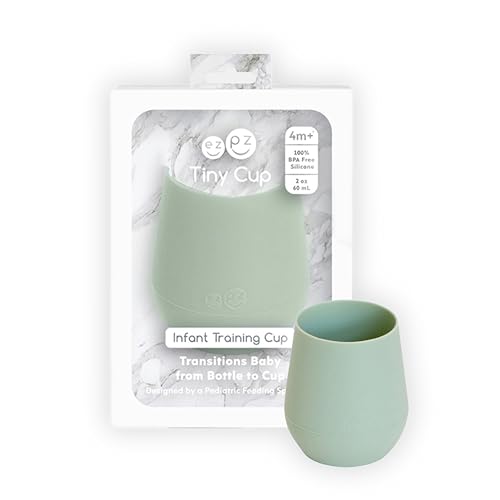
ezpz Tiny Cup (Sage), 4 months+, 100% Silicone Training Cup
A small silicone open cup sized to a baby's mouth and hands, with a weighted base, tactile bumps that resist toppling, and an interior angle that ezpz says meters the flow. This is the cup a feeding therapist tends to hand you, and it builds the skill the AAP wants in place by about age 2 rather than postponing it. ezpz states that the cup was designed and tested by a pediatric feeding specialist, and the company further claims that open-cup drinking supports oral and speech development and may help prevent tooth decay. Those are the manufacturer's claims rather than settled findings, and we would buy it for the sizing and the weighted base instead.
- Brand
- ezpz
- Category
- Best Open Cup
It costs more than a plain silicone cup looks like it should, and it is the only thing here that teaches a new skill rather than repackaging an old one. One is enough.

Dr. Brown's Narrow Sippy Straw Bottle with Handles, 8 oz, 6m+
Less a new cup than a conversion kit, this turns a bottle the baby already drinks from into a straw cup. Dr. Brown's says it fits all of the brand's Options+ 8 oz bottles and sippy spout bottles, which makes it the cheapest honest route to a cup for anyone already in that system. You get the same soft weighted silicone straw as the standalone cup, removable grip handles, a sliding lid for travel, and a straw brush in the box. The familiar bottle body is doing real work here, because the only thing changing for the baby is how the milk comes out.
- Brand
- Dr. Brown's
- Category
- If You Already Own Dr. Brown's
Keeping the bottle shape the baby recognised and changing only the top took most of the fight out of the midday swap. It also means one fewer object in an already full cupboard.
- 01Dr. Brown'sOur PickDr. Brown's Milestones Baby's First Straw Cup, 9 oz, 6m+
- 02ezpzBest Open Cupezpz Tiny Cup (Sage), 4 months+, 100% Silicone Training Cup
- 03Dr. Brown'sIf You Already Own Dr. Brown'sDr. Brown's Narrow Sippy Straw Bottle with Handles, 8 oz, 6m+
What age should a baby stop bottle feeding?+
How do I get rid of the bedtime bottle?+
How much milk should a one-year-old drink from a cup?+
Are sippy cups bad for babies?+
Can I put juice in the cup instead of milk?+
My toddler is 18 months and still on the bottle. Is it too late?+
Sammie Seelbach
Sammie is a mom of two and the lead reviewer at Smart Baby Reviews. Since becoming a parent she has become obsessed with researching the safest, smartest baby gear on the market — testing thermometers at 2 a.m., wrangling baby gates, and sterilizing more bottles than she can count. She shares what actually works so other parents can make confident, informed decisions for their little ones.