Bottle-Fed Baby Teeth: Preventing Early Decay

This post may contain affiliate links. Read our policy.
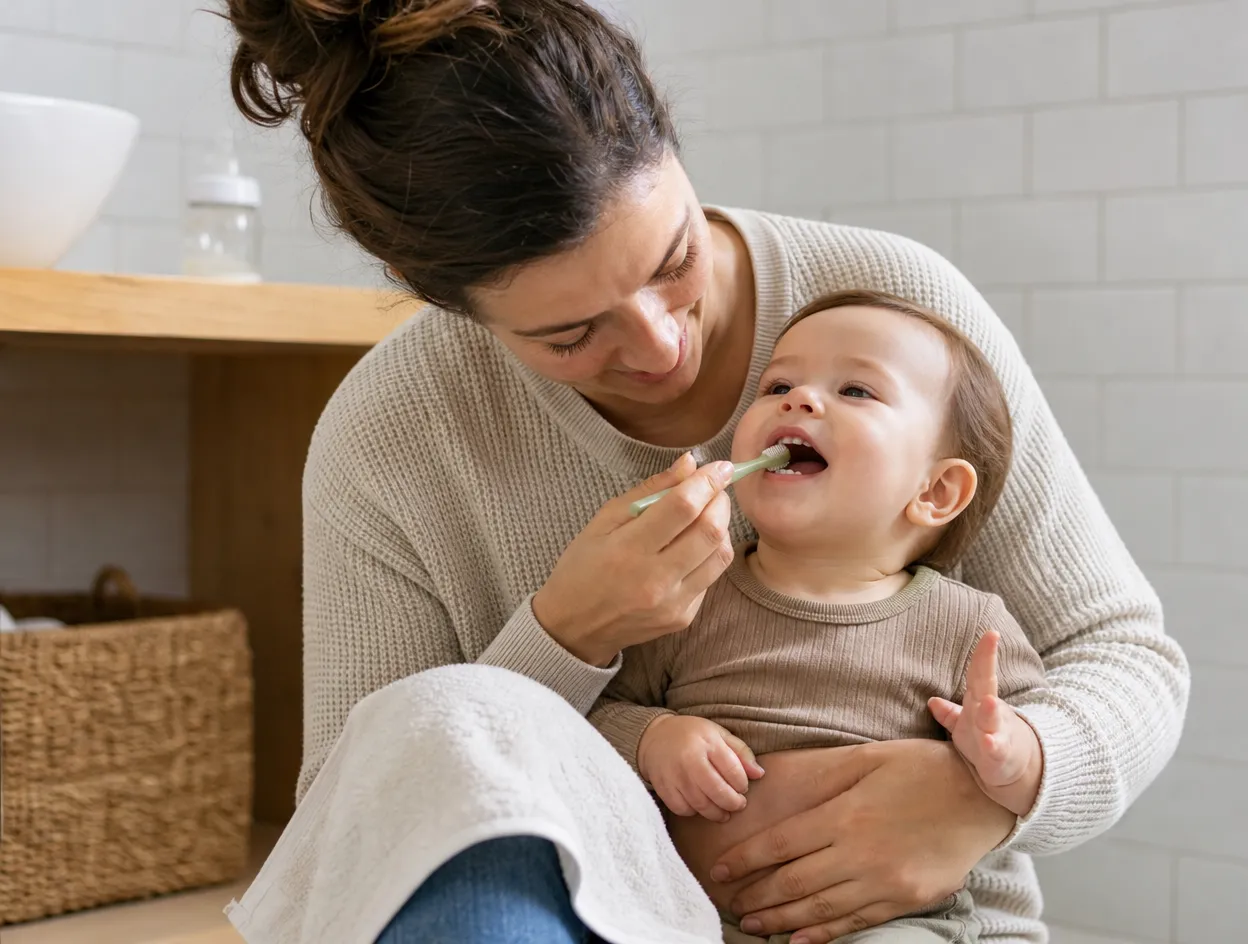
Bottle-fed baby teeth come down to four rules: no bottle in the crib or in bed, the feed finished before sleep, water only if anything goes to bed at all, and the gums wiped or the teeth brushed after the last feed of the day. Only milk, formula or breast milk goes in the bottle. We earn a commission from links on this page, at no cost to you.
The AAP's bedtime guidance, on its parent site HealthyChildren.org, says it in one line: "Remember not to put babies to bed with a bottle filled with breast milk, formula, milk, juice or any other sugary beverage." Its oral-health policy page allows exactly one exception - if you do send a bottle to bed, fill it only with water.
If you are still building the feeding routine itself, start with how to bottle feed a newborn and treat this as the teeth layer on top. Below: the mechanism, why it matters, how to break a bottle-to-sleep habit, brushing by stage, and the chalky white line that means you book a dental appointment rather than waiting for the next checkup.
What Baby Bottle Tooth Decay Actually Is
MouthHealthy, the American Dental Association's consumer site, says tooth decay in infants and toddlers is often referred to as baby bottle tooth decay, or early childhood caries. Parents also call it bottle rot. One process, three names.
It runs in four steps, and none of them need anything unusual in the bottle:
- There is sugar in the bottle already. HealthyChildren.org is blunt - "even the natural sugars in breast milk and formula can kick-start the process of tooth decay."
- Bacteria turn that sugar into acid. The National Institute of Dental and Craniofacial Research, part of the NIH, says that when decay-causing bacteria meet sugars and starches they form an acid, and that repeated acid attacks wear enamel down.
- Sleep removes the defence. Saliva is what clears the sugar, and it largely stops. Dawes and Wong, writing in the Journal of Dental Research in 2019, state that salivary flow rate is virtually zero during sleep, and that people with a low unstimulated salivary flow rate are particularly susceptible to dental caries.
- Minerals leave the tooth. NIDCR describes the result as a white spot where minerals have been lost, and says that if more minerals are lost than can be restored, the enamel weakens and eventually breaks down, forming a cavity.
So the variable is time, not just content. The ADA stresses that it is not just what you put in the bottle that causes decay but how often and for how long, and HealthyChildren.org adds that putting a child to sleep with a bottle lets the sugars in formula and breast milk linger on the teeth.
The upper front teeth go first. MouthHealthy says baby bottle tooth decay most often occurs in the upper front teeth, though other teeth may also be affected, and NIDCR describes early childhood caries as decay that starts in a baby's front teeth and extends to the back teeth. A bottle left in a sleeping baby's mouth, or wedged in place, holds milk against exactly those teeth - one more reason we take a hard line on propping a bottle.
Why It Matters Even Though These Teeth Fall Out
This belongs in the CDC's words. The CDC says untreated cavities can cause pain and infections that may lead to problems with eating, speaking, playing and learning, and that untreated cavities can lead to abscess, a severe infection, which can spread to other parts of the body and have serious, and in rare cases fatal, results. Nor is it rare - the CDC reports that half of children aged 6 to 9 have had cavities in their primary or permanent teeth.
The AAP adds the structural argument. HealthyChildren.org says a child's first teeth are essential to the health of their permanent teeth, and that missing baby teeth leave gaps which cause nearby teeth to shift - which it says can keep the permanent teeth from coming in correctly, and might mean braces later on. Decayed baby teeth, it adds, may need to be taken out by the dentist, which is painful and frightening for a child.
The bad end is treated in an operating room. Schroth and colleagues, reviewing national Canadian data in the Journal of the Canadian Dental Association in 2016, counted 57,249 day surgeries for severe early childhood caries over four fiscal years - 31.0% of all day surgeries performed on children aged 12 to 59 months in Canada, excluding Quebec, which the data did not cover.
Does early decay predict later decay? It depends how far the early decay got, so here is the range. A Hong Kong cohort of 825 children in the International Dental Journal found children with decay in their baby teeth had about 2.8 times the risk of decay in their permanent teeth two years later, 15.4% against 4.9%. A 10-year Brazilian cohort from Brondani and colleagues, published in Caries Research in 2026 under the title "Initial Caries Lesions in Preschool Children Are Not a Risk Factor for Caries in Adolescents," found the smallest early lesions did not carry that risk forward, while the children who had extensive lesions did go on to have more decay in their permanent teeth. One white spot is not a verdict on your child's adult mouth.
Bottle-Fed Baby Teeth: The Rules That Prevent Nearly All of It
Every rule here is somebody's published guidance, not ours.
- No bottle in the crib or bed. HealthyChildren.org says not to put your baby to bed with a bottle at night or at naptime, and that if you do, fill it only with water. A bottle is one of several things that do not belong in a sleep space, which we cover in what does not belong in the crib.
- Finish the feed before sleep. MouthHealthy says infants should finish their bedtime and nap-time bottles before going to bed.
- Only milk, formula or breast milk in the bottle. That is the ADA's list, verbatim.
- Not as a soother. HealthyChildren.org says to avoid using cups or bottles to soothe your child because this exposes little teeth to sugars for long periods. MouthHealthy names the bottle-as-pacifier habit as a cause of decay.
- Nothing sweet on a pacifier. The ADA says provide one that is clean and do not dip it in sugar or honey.
- No juice in a bottle, and none at all before 12 months. The AAP's stated position on HealthyChildren.org is that fruit juice not be given to infants under 12 months of age, and that children should not be given fruit juice at bedtime. Its cavity-prevention page is blunter: "Fruit juice literally bathes teeth in sugar. It is especially harmful in a sippy cup."
- Water is the drink that helps. HealthyChildren.org calls regular tap water, which usually contains fluoride to strengthen enamel, the healthiest drink for your child's teeth.
- Clean the mouth after the last feed. The AAP's bedtime guidance: the last thing to touch the teeth before bed is the toothbrush.
One rule is about the bottle rather than its contents. MouthHealthy encourages children to drink from a cup by their first birthday, and HealthyChildren.org has the transition finishing between 12 and 18 months. If weaning is the live question, read when to stop bottle feeding.
How to Get the Bottle Out of the Crib Without a Week of Screaming
If you have been feeding to sleep for months, those rules arrive as an accusation. They are not one - a bottle at bedtime is the thing that works at 4 a.m. when nothing else does.
The AAP's own taper is gradual and we would not improve on it. HealthyChildren.org suggests you tell your child they can drink from a bottle at mealtimes, then gradually eliminate bottle feedings at other times, especially naps or bedtime, and offer extra comfort - snuggles, songs or bedtime stories - so your child can learn to self-soothe. A pacifier may also help, it notes. In practice the bedtime bottle moves earlier, ahead of the book and the brushing.
Then the part nobody writes down: the first few nights are worse than the status quo. The AAP says only this about it, and it is the sentence to hold onto - temporary sleep problems can turn into serious struggles if you give in to your child's protests.
If anything does go in the crib, the AAP's exception is water only. And we could not find a pediatric authority that either endorses or rejects diluting the bedtime bottle a little more each night, so ask your pediatrician rather than taking a ratio off the internet.
When to Start Brushing Baby Teeth, Stage by Stage
Before any teeth. MouthHealthy and HealthyChildren.org give the same instruction in the same words - after each feeding, wipe your child's gums with a clean, damp gauze pad or washcloth.
From the first tooth. HealthyChildren.org: "As soon as your baby's first tooth erupts, it's time to start using fluoride toothpaste," brushing at least twice daily. MouthHealthy pairs that with a child-size toothbrush. The NHS says to start as soon as the first milk tooth breaks through, usually at about 6 months.
The amount. HealthyChildren.org says to use a tiny smear, the size of a grain of rice, until age 3, then a pea-sized amount at 3. MouthHealthy gives the same smear under 3 and pea-sized from 3 to 6. The NHS adds a strength as well as a quantity - under 3, a smear containing no less than 1,000ppm of fluoride, and from 3 to 6, a pea-sized amount containing 1,000ppm to 1,500ppm.
Supervision, where the sources genuinely disagree. MouthHealthy says to supervise until your child can be counted on to spit and not swallow toothpaste, usually not before 6 or 7 years old. The AAP's cavity-prevention page says to help until about age 8, and its oral-health policy page says to help or supervise until the child masters brushing, usually at around 10. The range is 6 to 10, and the common thread is reliable spitting before you step back.
The Fluoride Amount Matters in Both Directions
Too little fluoride raises decay risk - MouthHealthy says that if your infant or toddler does not receive an adequate amount of fluoride, they may have an increased risk for tooth decay. Too much, too early, causes dental fluorosis. An ADA parent guide describes fluorosis as happening before age 8, caused by too much fluoride while teeth are forming below the gums, says mild fluorosis looks like small white spots, and calls it mostly a cosmetic issue with no negative health effects.
The amount is the lever because of swallowing. The CDC's published recommendations on fluoride note that the swallowing reflex of children under 6 is not always well controlled, particularly under 3, and that children who begin using fluoride toothpaste before age 2 are at higher risk for enamel fluorosis. The same document tells parents to consult a dentist or other health-care provider before introducing a child under 2 to fluoride toothpaste.
Read that against the AAP and the ADA, who both start a rice-grain smear at the first tooth, and you have the disagreement that makes the baby aisle confusing. Ask your own dentist or pediatrician for the amount and the start date, then use that amount.
Book the First Dental Visit by the First Birthday
That is where the sources land. HealthyChildren.org says to see your child's dentist by their first birthday or within 6 months of their first tooth. MouthHealthy says that when the first tooth appears, talk to your dentist about scheduling the visit, and treat it as you would a well-baby checkup. The NHS says to go when the first milk teeth appear, or before 12 months old.
Fluoride varnish and fluoride supplements belong to that visit rather than to your cart. HealthyChildren.org says pediatricians start applying varnish at about 6 months and that all infants and children should have it every 6 months until age 5, with higher-risk children possibly every 3 months. Neither is something to buy or dose on your own judgement.
What Early Decay Looks Like: Lift the Lip and Look
There is a check that takes a couple of minutes. Writing in Frontiers in Oral Health in 2023, Kotha describes the lift-the-lip examination - raise the lip and visually examine the teeth, which should take no more than a few minutes - and notes that in children under 3, the early stages of dental caries are most frequently observed on the front surface of the front teeth.
What to look for, in order of appearance:
- A chalky white spot or line along the gumline. Kotha describes a white-spot lesion along the margins of the gingiva with a chalky-white appearance, typically with sticky white deposits of plaque, and says that at this stage the surface is still unbroken and the lesion beneath it can be reversed.
- Brown or dark discoloration later. The AAP's symptom guide describes a yellow-brown defect in the enamel, and lists a brown or dark spot in a painful tooth as a reason to contact a dentist within 24 hours.
Do not wait for pain, and do not assume you would spot it. HealthyChildren.org is candid: "It can be difficult to spot warning signs in baby teeth, so your pediatrician's expert eye is especially helpful." A white line you are unsure about is worth a dental appointment - Kotha's guide tells parents to make one within two to four weeks - because the reversible stage does not last.
When to Call the Dentist or Your Pediatrician
These are the published thresholds.
Call now, per the AAP's symptom guidance for toothache: your child looks or acts very sick, fever is present, the face is swollen, or there is severe pain not better 2 hours after taking pain medicine.
Within 24 hours, per the same guidance: a toothache lasting more than 24 hours, a brown or dark spot in the painful tooth, or a red or yellow lump at the gumline of the painful tooth.
Children's Wisconsin's teaching sheet on tooth abscess describes an abscess as an infection inside the tooth, lists swollen gums near the tooth, swollen glands of the neck and a swollen upper or lower jaw among its signs, and says to call your child's doctor, nurse or clinic for a constant throbbing toothache or a fever of 101°F (38.3°C). The CDC's reason for taking it seriously is that an abscess can spread to other parts of the body with serious, and in rare cases fatal, results. Treatment belongs with whoever has examined your baby's mouth.
The Free Fix Comes First
Before any tooth arrives, the entire recommended routine is a washcloth, and you already own one.
The paid version is convenience, not an upgrade. The Papablic disposable gum and tongue cleaners, about $10 for 40 as of November 2026, are individually sealed gauze swabs that Papablic says are CPSIA certified and made of 100% medical skim gauze. They earn a place in a diaper bag, and do nothing a washcloth cannot do at home.
The Toothbrush, and Why the Age on the Box Is Not the Rule
Once there is a tooth you need a soft, small brush and a reliable way to measure a rice grain of paste. The Jordan Step 1 baby toothbrush, around $7.50 for four as of November 2026, does the second part better than most: Jordan says the coloured bristles indicate the amount of fluoride toothpaste to be used, which turns the hardest instruction here into a visual mark. Extra-soft bristles, a soft biting ring, and a short neck Jordan says is intended to prevent swallowing or pricking during brushing.
It also shows why packaging is not the authority. Age labels on baby toothbrushes are inconsistent, sometimes inside one listing. This one is titled 0 to 2 years, one of its own feature lines says dentists recommend starting when the very first tooth appears, and another says 12 months and up. Those cannot all be the rule. The AAP's trigger is the eruption of the first tooth and the ADA's is the same, so that is the trigger - whatever the box says.
The Fluoride Question You Should Not Answer Alone
Colgate Kids Cavity Protection, roughly $7.60 for a 4.6 oz tube as of November 2026, is what a parent gets pointed to when they ask for children's fluoride toothpaste. Colgate states it is clinically proven to fight cavities, that it is an ADA-accepted children's toothpaste, and that it is safe for kids ages 2 and up. Those are the company's claims.
The label says ages 2 and up, the AAP and the ADA start a rice-grain smear at the first tooth, and the CDC says consult a dentist or other health-care provider first. The three read consistently only if you treat that conversation as the missing step. So the instruction is not "ignore the label" - it is to take the question to your dentist or pediatrician at the first visit, get the start date and amount from them, and buy what they tell you to buy. And check whether a toddler training paste contains fluoride at all, because some do not - that makes it a different product solving a different problem.
The Takeaway
Almost all of this is one behaviour. The bottle does not go in the crib, the feed finishes before sleep, and the last thing to touch the teeth is a brush - the AAP's phrasing, not ours. If something has to go to bed, it is water, and if the bottle has been the sleep plan for months, the AAP's taper is mealtimes first and bedtime last.
Two numbers are not yours to set. The amount of fluoride toothpaste and the date you start it come from your dentist or pediatrician, because the AAP and the ADA say first tooth, the CDC says ask first, and the tube says 2 and up. Book that conversation by the first birthday, where HealthyChildren.org, MouthHealthy and the NHS all land.
And lift the lip once a month, which is the interval Vancouver Coastal Health's Lift the Lip handout for parents gives. A chalky white line on an upper front tooth is the stage that can still be turned around, and it is invisible unless you look. For the rest of the system - volumes, nipple flow, night feeds, weaning - see our guide to bottle feeding a newborn step by step.

Jordan* | Step 1 Baby Toothbrush | 0-2 Years, Soft Bristles, BPA Free | Green & Blue | 4 Pack
Four extra-soft baby brushes with a short neck and a soft biting ring, BPA and phthalate free, with a handle Jordan says suits an adult hand and a baby's. Two details earn the pick. The bristles are coloured to indicate how much fluoride toothpaste to use, which turns the rice-grain smear from a guess into a mark on the brush. And Jordan states the short neck and teeth ring are intended to prevent swallowing or pricking while you brush, which is the maker's framing rather than a clinical finding. Treat the age label on the box with more suspicion than the brush itself - the listing is titled 0 to 2 years, one feature says dentists recommend starting when the very first tooth appears, and another says 12 months and up. Those cannot all be the rule.
- Brand
- Jordan
- Category
- Our Pick
The coloured bristles are the part we would not give up, because the hard part of brushing a 10-month-old is knowing you used the right amount. Four to a pack matters more than it should, since one always goes missing.

Colgate Kids Cavity Protection Toothpaste with Fluoride, Helps Fight Cavities, Safe for Ages 2+, Mild Bubble Fruit Flavor, Sugar Free, 4.6 Oz Tube
A 4.6 oz tube of sugar-free, gluten-free children's fluoride toothpaste in mild bubble fruit flavour. Colgate states it is clinically proven to fight cavities, is an ADA-accepted children's toothpaste, and is safe for kids ages 2 and up. That last line is why this pick needs a paragraph. HealthyChildren.org, the American Academy of Pediatrics' parent site, says to start fluoride toothpaste as soon as the first tooth erupts, with a smear the size of a grain of rice until age 3 - earlier than the age on most fluoride tubes - while the CDC's published recommendation tells parents to consult a dentist before introducing a child under 2 to fluoride toothpaste. We are not telling you to ignore a label. We are telling you the disagreement is real, and that your own dentist or pediatrician resolves it for your baby.
- Brand
- Colgate
- Category
- The Fluoride Question
It is a plain, cheap fluoride paste that Colgate says carries the ADA's acceptance, which is all this job needs. Nothing about the tube tells you the amount, so the amount has to come from your dentist and from the brush.
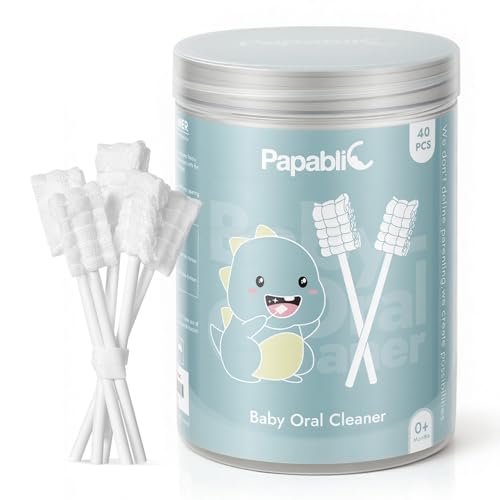
Papablic Baby Tongue Cleaner for Infant Oral Aged 0-2, Disposable, 40 Pack | Baby Oral Cleaner, Disposable Infant Mouth Cleaner Newborn, Upgrade Gum Cleaner with Paper Handle, For Infants Ages 0-2 Years
Forty individually sealed disposable swabs on a flexible paper handle, with ultra-soft all-round gauze heads double stitched around the brush head. Papablic says they are CPSIA certified and made of 100% medical skim gauze, and suggests gently rubbing the gums and tongue after a feed to remove remaining milk and food. That instruction is the one piece of pre-tooth oral care the ADA and the AAP both ask for, which is why this product is on the page. Papablic's further claims about massaging gums and easing teething discomfort are the maker's, not a clinical finding. The honest framing is that a clean damp washcloth or a gauze square wrapped around your finger does the same job for nothing, and this is the version that lives in a diaper bag and never needs washing. Buy it for convenience, not for protection.
- Brand
- Papablic
- Category
- Before the First Tooth
Genuinely useful in the car, in a hotel room, and at 2 a.m. when every washcloth you own is in the machine. It is a convenience purchase and we would not pretend otherwise.
- 01
- 02
- 03
When should I start brushing my baby's teeth?+
Is it ever OK to put a bottle in the crib?+
My baby will only fall asleep with a bottle. How do I stop?+
Can baby bottle tooth decay be reversed?+
The fluoride toothpaste tube says ages 2 and up. Should I use it on a 9-month-old?+
When should my baby first see a dentist?+
Sammie Seelbach
Sammie is a mom of two and the lead reviewer at Smart Baby Reviews. Since becoming a parent she has become obsessed with researching the safest, smartest baby gear on the market — testing thermometers at 2 a.m., wrangling baby gates, and sterilizing more bottles than she can count. She shares what actually works so other parents can make confident, informed decisions for their little ones.