Bottle-Feeding Positions — and Why Never to Prop a Bottle

This post may contain affiliate links. Read our policy.
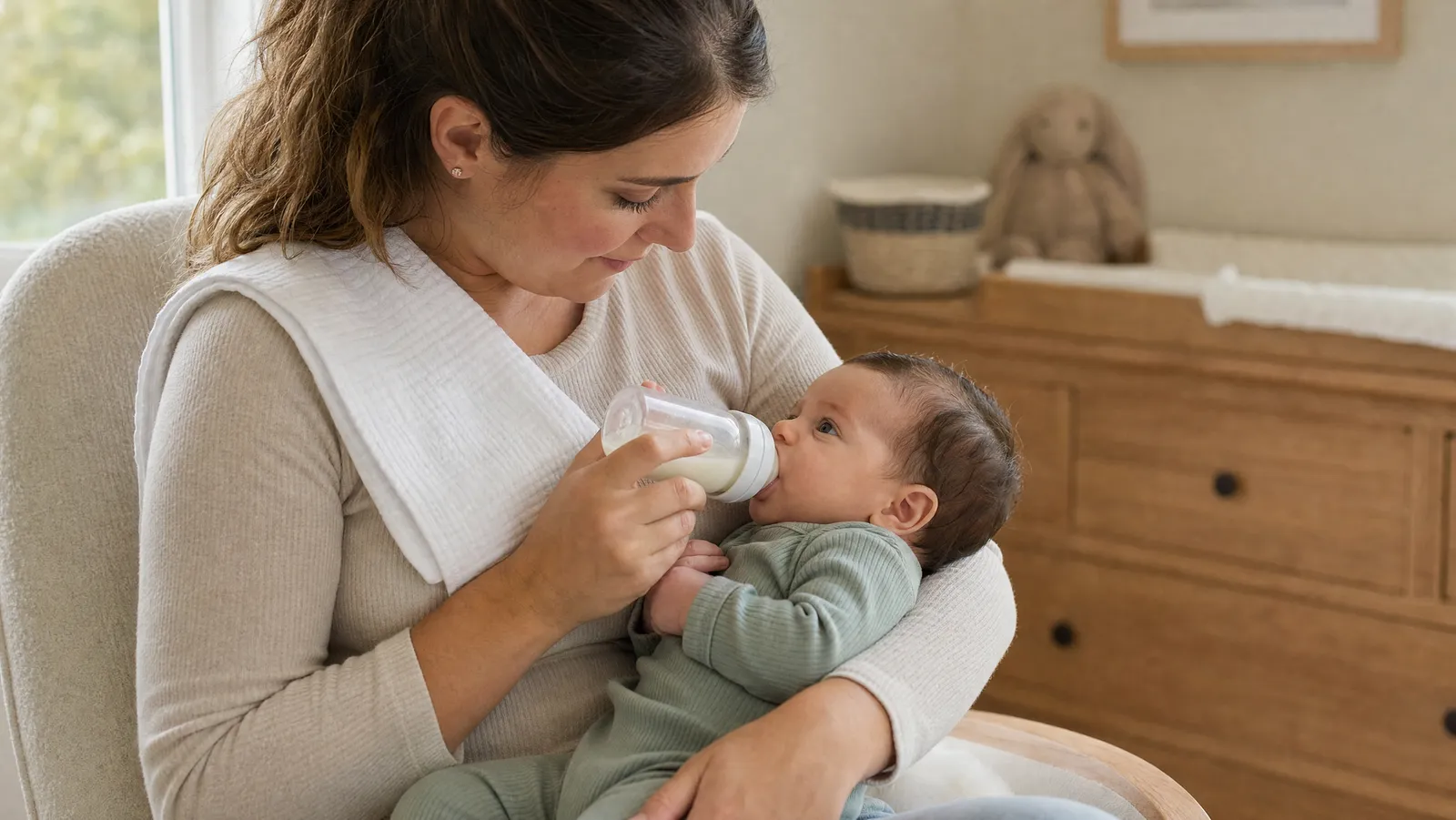
The best position to bottle feed a newborn is semi-upright: the head cradled in the crook of your arm and held higher than the stomach, the back supported and tilted up, and the bottle tilted only far enough to keep milk sitting in the nipple. Not flat on their back. Not propped against anything, ever. We earn a commission from links on this page, at no cost to you.
The American Academy of Pediatrics ranks that hold above the hardware. On HealthyChildren.org, its parent site, the guidance is that "more important than the type of bottle or nipple you use is how you position your baby when she eats," followed by the instruction to "support her in a semi-upright position, with her head cradled in the crook of your arm." You can spend $40 on a vented bottle and undo it by feeding on a flat back.
If you are still assembling the basics, start with how to bottle feed a newborn and treat this as the positioning layer. Below: the hold step by step, the bottle angle, the variations for reflux and for a gulper, and the mechanism that makes a propped bottle dangerous.
The Semi-Upright Cradle Hold, Step by Step
This is the default for a healthy term newborn, and it is the one to teach anyone else who feeds your baby.
- Sit down first. Back supported, feet on the floor or a stool. A hold you cannot keep for 20 minutes is not the right hold.
- Head in the crook of your elbow, higher than the stomach. Nationwide Children's Hospital describes the same hold as the AAP's — the baby "in the curve of your arm close to your body" with "their head and back tilted up" — and says it keeps the baby from choking.
- Keep the head and body in one line. Alberta Health Services' handout for its pediatric eating and swallowing program lists head and hips in line with each other as a marker of good positioning. A chin tucked to the chest makes swallowing harder than it needs to be.
- Support the neck with your forearm, not your fingers. Your forearm runs along the baby's spine; your other hand holds the bottle for the whole feed.
- Keep their face visible. The Alberta sheet makes this explicit — make sure you can see your baby's face, to watch for signs they are handling the milk well.
- Tuck their legs in. Feet against your body, arms and legs slightly bent. A braced, splayed baby is working, not feeding.
Oregon's Department of Early Learning and Care, which regulates licensed child care, reduces it to one line for providers: hold the baby semi-upright in your arms, where the baby can look at you.
Then change arms partway through. WIC's paced bottle-feeding guidance suggests switching the side you hold your baby on about halfway through the feeding, and says this helps them use both eyes and both sides of their body. The mundane reason to do it: a tired arm is the most common reason a parent starts looking for something to lean the bottle against.
What Angle to Hold the Bottle — and How It Changes as It Drains
Tilt the bottle only as far as it takes to keep milk in the nipple, and no further. The CDC's bottle-feeding guidance says to position the bottle at an angle rather than straight up and down "so the milk only comes out when your baby sucks." Nationwide Children's puts it the other way around: hold the bottom of the bottle at an angle so the milk fills the nipple, which stops the baby swallowing air. The AAP's version is that milk should completely cover the nipple, "that way your baby isn't swallowing air."
Those two goals pull against each other, and the resolution is the thing nobody tells you: as the bottle empties, raise the base, not the baby. A full bottle held near-horizontal already has milk at the nipple; a bottle with an ounce left needs a few more degrees. Lift the base in small increments and leave the baby's body where it was. Tipping the baby back to chase the last ounce is how a good hold goes bad in the final two minutes.
A nipple half full of air means swallowed air, which comes back later as a hard burp or a stretch of fussing — the usual gas-and-burping story in bottle-fed babies. A bottle held straight down does the opposite: it floods the nipple and takes the pacing decision away from your baby. The right angle is the one where your baby has to draw the milk out, which is the core of paced bottle feeding.
Positions for a Baby With Reflux or Heavy Spit-Up
More upright, and stay there afterwards. For a baby who spits up a lot, move from semi-upright toward genuinely seated — supported along your chest, or nearly vertical facing out with your hand across their chest and your forearm under their bottom.
The part parents skip is the time after the feed. The AAP's spit-up guidance is to hold your baby upright for at least 20 minutes after meals and to limit active play for about 20 to 30 minutes afterward. The same page advises burping "not only after, but also during meals," and avoiding overfeeding by offering smaller amounts more frequently. Smaller and more often is easier to get right once you know what normal looks like at your baby's age — the figures are in how many ounces per feed.
Position is only part of it; the volume, the flow and the pause afterwards matter just as much, and we work through the whole routine in bottle feeding a baby with reflux.
Two caveats. Upright holding is comfort management, not treatment — the AAP says to contact your pediatrician if your baby vomits forcefully after every feeding, or if there is blood in the spit-up. And "upright after a feed" means in your arms or against your shoulder, not in an inclined sleeper or a swing.
Side-Lying Bottle Feeding: Who It Is Actually For
Side-lying is not a flat-on-the-back feed, and the difference is the whole point. Children's Healthcare of Atlanta teaches an elevated sidelying position: the baby on their side with the head raised higher than the hips, one ear facing the ceiling and the other the floor, supported on a pillow, your hand behind their back and head while the other offers the bottle.
CHOA says this may be especially helpful for premature babies or babies who have a hard time feeding, and that it may help a baby better control the liquid once it is in their mouth, feed calmly for longer, eat, breathe and swallow more easily, and keep their heart rate and oxygen level more stable. Alberta Health Services' handout gives the mechanism that makes it attractive for a gulper: in side-lying, liquid flow is not affected by gravity, so there is less chance of choking or fluid entering the lungs.
Alberta's setup checklist is short — shoulders aligned one over the other, head raised, head and hips in line, feet tucked against your body, face visible. If a later move back to the cradle hold goes badly, and your baby gulps, spills or works harder to breathe, it says to return to side-lying for another week before trying again.
Who this is for matters. Both are clinical handouts, and CHOA says plainly that your baby's feeding therapist can help you get into the position. If your baby has a swallowing, breathing or prematurity concern, ask your pediatrician or a feeding therapist to set it up rather than copying it from an article. For a healthy term newborn who simply gulps, the simpler fixes come first: a slower nipple, a shallower angle, more pauses.
Feeding a Sleepy Newborn Without Propping
Newborns fall asleep mid-feed. The hold is what keeps that from turning into a hazard.
- Sit them up further, not back. In our experience, moving toward seated rouses a drowsy baby better than jiggling the bottle does.
- Use the breaks. The CDC says to let your baby take breaks from drinking when they seem to want them. Burping during one of those breaks, upright with a hand on the back, is also a wake-up.
- Take the bottle out when they stop. The CDC's instruction is to watch for cues that they are full and then stop, "even if the bottle is not empty," and not to force the baby to finish.
- Never leave the bottle in a sleeping baby's mouth. Oregon's child-care rule goes further: children of any age shall not be laid down with a bottle. A baby who falls asleep on the bottle gets moved — bottle out, then to their own flat, firm sleep surface.
Why You Should Never Prop a Bottle
Propping means wedging the bottle with a pillow, a rolled blanket or a strap so it feeds the baby hands-free. Here is the mechanism, which is more specific than "it is unsafe."
A propped bottle cannot stop. Oregon's Department of Early Learning and Care, explaining why propping is prohibited in licensed care, writes that when the bottle is propped, "liquid continues to come out of the bottle, even if the infant is full or has fallen asleep." The AAP describes the same trap from the baby's side: holding the bottle with pillows or other items "makes it hard for your baby to spit the bottle out when she's done, which can make her choke or cause an ear infection," and "can also cause her to keep eating after she's full."
Everything else is downstream of that one failure:
| What propping does | Why it matters |
|---|---|
| Milk keeps arriving after the baby stops | Oregon says the infant can breathe the liquid in rather than swallow it — aspirate — and that choking risk rises because no adult is watching closely |
| Milk pools at the back of the mouth | Oregon notes liquid can enter the ears through the Eustachian tubes and cause infection, and that frequent ear infections can lead to hearing loss |
| Milk sits against the gums and teeth | The CDC says milk can pool around the baby's teeth and cause decay; Oregon notes the sugars that cause cavities include those found in formula and breast milk |
| The baby cannot pace or quit | The AAP and the CDC both warn that propping leads to a baby eating more than they need |
The CDC compresses all of it: "Do not prop or leave the bottle in your baby's mouth. This can increase your baby's risk of choking, ear infections, and tooth decay." Nationwide Children's is blunter — never prop your baby's bottle. And because a propped bottle and a flat back usually arrive together, the AAP's warning applies too: feeding a baby on her back "allows milk to run into her eustachian tubes, possibly causing middle ear infections."
Hands-Free Bottle Holders Do Not Make Propping Safe
There is a category of product sold to solve this, and it does not. A strap, a foam wedge or a plush holder changes what is doing the propping, not what propping does: milk still keeps coming when the baby stops, and no one is reading the baby's face.
The AAP's instruction for a baby who cannot hold a bottle is that someone holds it for her and takes it away when she's done — a description of a person. Oregon's rule says it in regulatory language: the child or a caregiver shall hold the bottle.
Never Put a Baby to Bed With a Bottle
Separate rule, same logic, and it holds past the newborn weeks. The CDC says not to put your baby to bed with a bottle, because milk can pool around the baby's teeth and cause tooth decay. Nationwide Children's says not to let your baby fall asleep with a bottle, for the same reason.
The dental end is worse than it sounds. The AAP describes early childhood caries as one of the most common childhood health conditions, notes that the upper front teeth are most likely to be affected, and warns that untreated decay can destroy teeth and damage the root of the tooth. Pooled milk against new teeth all night is the classic route in; the full bottle-fed-teeth story is its own subject, but the bedtime rule is the highest-value piece of it.
Practically: finish the feed, burp, then move your baby to their own sleep space with nothing in the crib — the rest of that setup is in how to set up a safe sleep space.
The Nursing Pillow Caveat Nobody Puts on the Box
A feeding-support pillow genuinely helps. It takes the baby's weight off your arms, which is how you hold a good position in the twentieth minute instead of the fifth. A U-shaped nursing pillow is the cheapest fix for the fatigue that leads people to prop.
It comes with a hard limit, and we are not going to bury it. The Consumer Product Safety Commission says it is aware of 154 infant deaths and 64 injuries between 2010 and 2022 associated with nursing pillows, with most injuries and deaths occurring among infants younger than 3 months old, and that the majority of those deaths involved the pillow being used in or on a sleep product — an adult bed, crib, playpen or couch. The Commission approved a federal safety standard on September 18, 2024, and Commissioner Richard Trumka's statement says sleep deaths are by far the most common way infants have died in nursing pillows.
Three lines of the CPSC's own caregiver guidance are the use instructions for this product:
Only use nursing pillows for nursing/feeding a baby. Never use nursing pillows for infant sleep or lounging. Do not leave babies unattended in nursing pillows on beds, sofas, or other elevated surfaces.
So: awake baby, you in the chair, eyes on the feed, pillow put away the moment the feed ends. A pillow that meets the new standard is still not a place for a baby to sleep.
The Gear That Helps the Hold
Very little of this is a purchase. Positioning is free, and the pillow above is the one item that changes the physics. The bottle design that is genuinely on-topic is an angled one. Playtex's VentAire bends at the neck, so the nipple stays full while the bottle body sits closer to level — the wrist problem solved rather than the baby's position compromised. Playtex states the patented bottom vent keeps air at the back of the bottle so no air mixes with the milk, and that the angled design promotes semi-upright feeding, which it describes as pediatrician-recommended to help prevent ear infections. It also says the vent and angle are doctor-recommended to help reduce reflux, colic, gas, burping and spit-up. Those are the maker's claims, not findings from a regulator or a trial; we would buy it for the geometry.
You also want absorbent cotton in reach, because burping upright mid-feed is part of the position and it goes wrong. A ten-pack of large muslin burp cloths at about $20 as of October 2026 is the honest version of this purchase — six layers, 20 inches long, and enough that a clean one is always in reach.
What we would not buy: anything marketed as a bottle holder, an inclined feeding wedge or a hands-free feeding system.
The Takeaway
Four things, in order of how much they matter. Sit the baby semi-upright, head higher than the stomach and head and hips in line. Tilt the bottle just enough to fill the nipple, and raise the base as it drains rather than tipping the baby back. Hold the bottle yourself for the whole feed and stop when your baby signals, not when the bottle is empty. Never prop it, never leave it in a sleeping baby's mouth, and never put a baby to bed with one.
The principle under all four: the parent, not the bottle, decides when milk is flowing. If a good hold still produces coughing, gulping or distress, that belongs with your pediatrician or a feeding therapist rather than with an article.
For the rest of the system — bottles, volumes, temperatures, night feeds and burping — see our bottle-feeding guide. Start with the next feed: sit down, sit the baby up, and keep your hand on the bottle.

Playtex Baby VentAire Anti-Colic Baby Bottle, 9 Ounce, 3 Count
An angled bottle with a vent in the bottom rather than a straw down the middle, which is the part that matters for a semi-upright hold. Playtex states that the patented bottom vent keeps air at the back of the bottle as the baby drinks so no air mixes with the milk, and that the angled shape promotes semi-upright feeding — which the maker describes as pediatrician-recommended to help prevent ear infections. The company also says the vent and angle are doctor-recommended to help reduce reflux, colic, gas, burping and spit-up; treat all of that as the maker's claim rather than an independent finding. The practical argument is simpler: the bend means the nipple stays full of milk while the bottle itself is nearly level, so your wrist is not doing the work of holding a straight bottle at a shallow angle for 20 minutes. Wide NaturaLatch silicone nipple, fewer parts than most vented systems, BPA free, three 9 oz bottles to a pack.
- Brand
- Playtex
- Category
- Our Pick
The angle is the whole point. You can keep the baby sitting up and the nipple full at the same time without cranking your wrist, which is exactly the problem a straight bottle creates at 3 a.m.
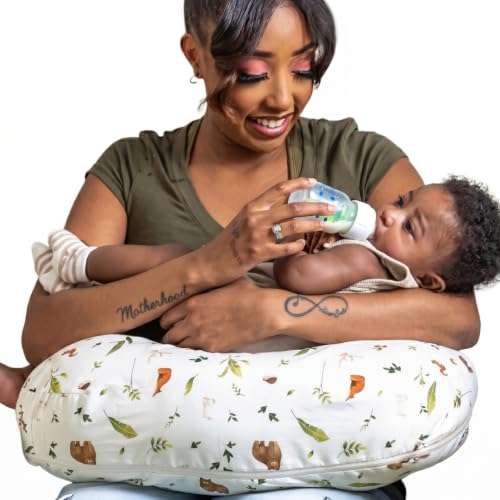
Boppy Nursing Pillow (Neutral Plants and Animals)
A U-shaped pillow, 19 inches wide by 15 inches deep by 8 inches tall, that wraps around your waist and carries the baby's weight so your neck, shoulders, back and arms are not holding a feeding position for 20 minutes. This version uses a softer cushion fill than earlier Boppys while keeping the thick support, and the cover comes off for the washer and dryer, which you will need. Boppy states the pillow is made from non-toxic materials and routinely tested by third-party CPSC-accredited labs, and that it is the first nursing pillow verified by the Baby Safety Alliance for meeting federal nursing pillow standards. One hard rule overrides everything else here: the CPSC's guidance is to use nursing pillows only for feeding, never for sleep or lounging, and never to leave a baby unattended in one on a bed, sofa or other elevated surface.
- Brand
- Boppy
- Category
- Best Feeding Support
It solves the real problem, which is that your arm gives out before the bottle does. We use it for awake, attended feeds and it goes on a shelf the second the feed ends.

Comfy Cubs Muslin Burp Cloths, 20 x 10 inch, 10 Pack
Ten muslin cloths, 20 by 10 inches each, in six layers of 100% breathable cotton. This is the honest cheap item on the page and the one you will reach for most. The 20-inch length is the spec that earns it: it covers a shoulder and the baby's clothing at the same time, which is what you want when you are burping upright mid-feed rather than blotting afterwards. Comfy Cubs notes they also work as a nursing cover-up or a changing-mat cover, which mostly means they will migrate around the house.
- Brand
- Comfy Cubs
- Category
- Best for the Mess
Ten is the right number, because the correct quantity of burp cloths is always more than you own. Six layers means one cloth handles a whole feed instead of two.
- 01
- 02BoppyBest Feeding SupportBoppy Nursing Pillow (Neutral Plants and Animals)
- 03Comfy CubsBest for the MessComfy Cubs Muslin Burp Cloths, 20 x 10 inch, 10 Pack
What is the best position to bottle feed a newborn?+
Is it ever OK to prop a bottle?+
Can I bottle feed a baby lying down?+
How long should I hold my baby upright after a bottle?+
Are hands-free bottle holders and bottle-propping devices safe?+
Can I use a nursing pillow for bottle feeding?+
Sammie Seelbach
Sammie is a mom of two and the lead reviewer at Smart Baby Reviews. Since becoming a parent she has become obsessed with researching the safest, smartest baby gear on the market — testing thermometers at 2 a.m., wrangling baby gates, and sterilizing more bottles than she can count. She shares what actually works so other parents can make confident, informed decisions for their little ones.