Montessori Toys for 6 to 12 Months

This post may contain affiliate links. Read our policy.
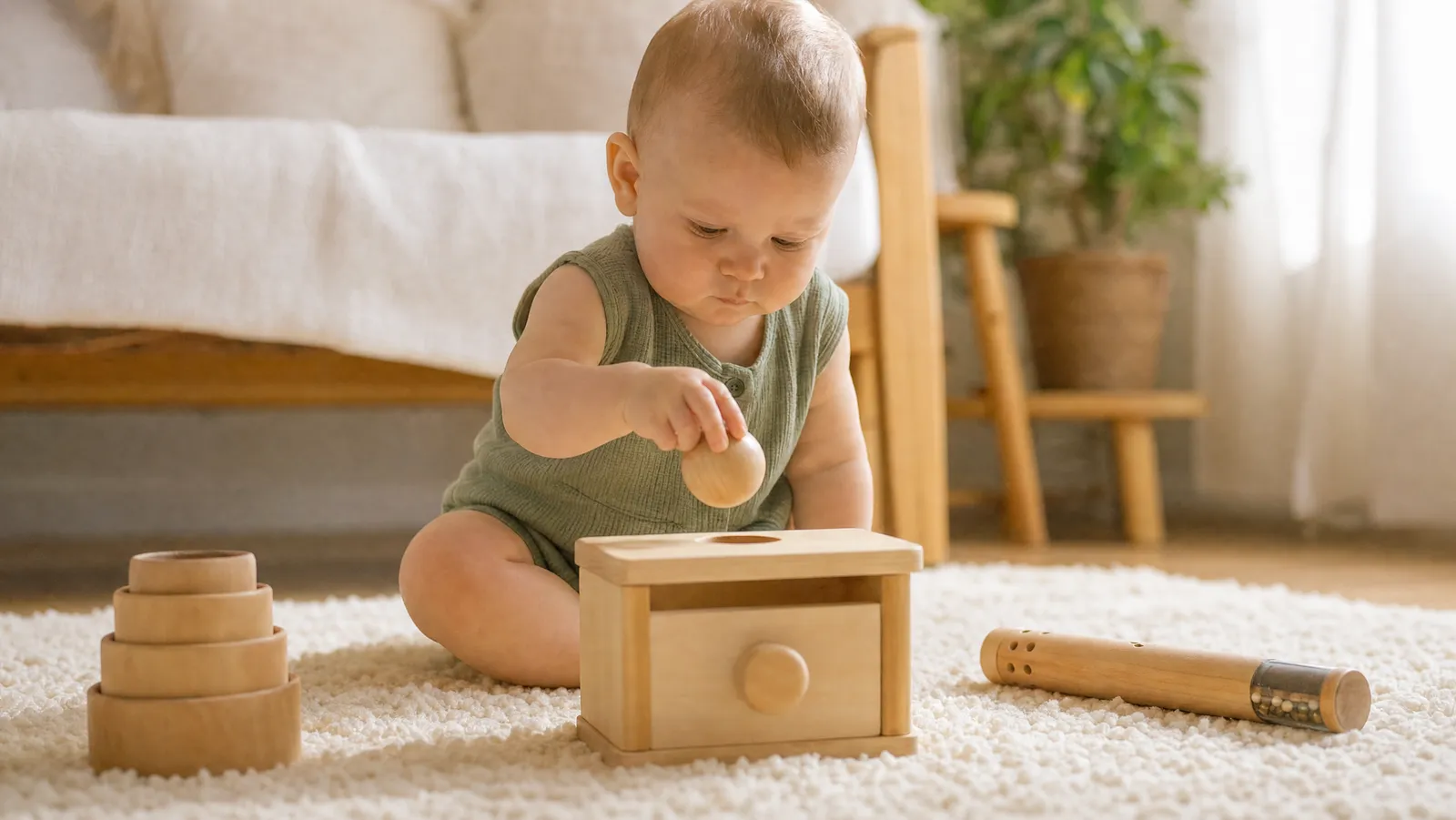
A baby between 6 and 12 months needs four or five objects, not a toy box. Inside this one window they learn that a hidden thing still exists, that thumb and finger can pick up something small, and that furniture can be pulled up on. Materials that serve those three jobs are worth money. Almost nothing else is.
The best Montessori toys for babies 6-12 months are barely toys in the toy-aisle sense. They are single-purpose materials: one object, one action, one problem to solve, with no lights, no batteries and no songs. If you want the underlying test, we set it out in what makes a toy Montessori, and the whole first three years are mapped in Montessori toys, age by age. This page is the 6-to-12-month slice: six picks, each doing a different developmental job, and the safety math you should do before any of it goes on a shelf.
What Actually Changes Between 6 and 12 Months
Buy for the skill that is arriving, not the age printed on the box. The CDC's milestone checklists are the most useful map, and the CDC is explicit that a milestone is something most children — 75% or more — can do by a given age, not a deadline.
According to the CDC's 9-month checklist, most babies by then sit without support, get into a sitting position by themselves, move things from one hand to the other, bang two things together, and — the one that drives this whole article — look for objects when they are dropped out of sight.
By 12 months, the CDC's list adds putting something into a container, looking for things they watched you hide, pulling up to stand, walking while holding on to furniture, and picking things up between thumb and pointer finger. That last one is the pincer grasp, and on the CDC's own timeline it belongs nearer the end of the first year than the middle.
So there are really three shopping windows inside one year:
- 6 to 9 months, sitting and disappearing. A baby who can sit unsupported has two free hands and a torso that stays put. This is the moment for things that vanish and come back.
- 9 to 11 months, containers and fingers. Dropping becomes deliberate. A baby wants to put objects into and out of things, and the fingers get steadily more precise - though the CDC puts both "puts something in a container" and the pincer grasp on its 12-month list, so treat this window as the run-up rather than the arrival. Better fingers do not change the small-parts math below.
- 10 to 12 months, standing and pushing. Pulling to stand reorganizes the whole room. Toys at floor level lose out to anything that offers a handle at chest height.
That last shift is also a baby-proofing event, not just a toy decision. If your baby is pulling up earlier than you expected, it is worth reading when to start baby-proofing before you spend anything on toys, because an ungated staircase outranks a shape sorter.
Do the Choking Math Before You Buy Anything
Everything in this age range goes in the mouth. The AAP's choking-prevention guidance says babies and toddlers are at the highest risk precisely because they explore by putting things in their mouths, and it names balls, balloons, marbles and pieces of toys among the leading causes of choking deaths in children. The AAP's toy-buying advice is correspondingly blunt: make sure toys and their parts are larger than a child's mouth.
Two federal rules do most of the measuring for you.
The small-parts ban. Under 16 CFR Part 1501, the CPSC bans toys and other articles intended for children under three that present a choking, aspiration or ingestion hazard because of small parts. The CPSC defines a small part as any object that fits, without compressing and in any orientation, entirely into the small parts cylinder, a test fixture the agency says approximates the size of the fully expanded throat of a child under three. The CPSC also counts a piece that breaks off during testing that simulates use or abuse as a small part, and the test methods for toys intended for children 18 months or under, set out at 16 CFR 1500.51, are impact, bite, flexure, torque, tension and compression — in other words, a toy has to survive being abused without shedding a choking hazard.
The small-ball rule, which is stricter. Under 16 CFR 1500.18(a)(17), a ball intended for children under three is a banned hazardous substance if it passes, in any orientation, entirely through a circular hole 1.75 inches (44.4 mm) in diameter in a rigid template. For children three and older, 16 CFR 1500.19 requires a choking-hazard warning on any ball that passes through that same 1.75-inch hole.
Hold that number next to the picks below. Both object permanence boxes we recommend use balls their makers list at 1.77 inches — two hundredths of an inch above the federal template. That reads as deliberate design rather than coincidence, and it is the single most important spec on the product page. It also means the margin is thin: inspect those balls for cracks, splinters or bite marks before every session and retire a ball the moment its surface breaks.
The toy standard and the paperwork. ASTM F963 is the US toy safety standard. Section 106 of the CPSIA made it mandatory, and the CPSC incorporates it by reference into 16 CFR Part 1250; the current edition, ASTM F963-23, became mandatory in April 2024. The CPSC requires third-party testing at a CPSC-accepted laboratory for toys designed or intended primarily for children 12 and under, and says the manufacturer or importer is always the party legally responsible for issuing the Children's Product Certificate. So a CPC is a real document rather than a marketing badge — but it is the legal baseline for a toy sold in the US, not a distinction that makes one toy better than another.
The Montessori habit of handing a baby real household objects is a good one, and it is why we keep saying a basket of kitchen items beats a $40 set. But a household object has not been through any of the testing above. Before a measuring spoon, a small wooden bowl, a cloth napkin or a jar lid goes on the shelf, check it against the small-parts standard, assume it will be mouthed and chewed, and supervise. A widely repeated clinical rule of thumb — described by University of Miami Health, among others — is that if an object fits inside an empty toilet-paper roll it is probably too small for a young child; that is not the federal test, but it errs in the right direction. And if you are still learning to tell loud, normal gagging from actual choking, read gagging vs choking first.
Our Six Montessori Picks for 6 to 12 Months
Six picks, one developmental job each. Prices are what we saw in November 2026 and they move constantly.
Our Pick: the Adena Object Permanence Box
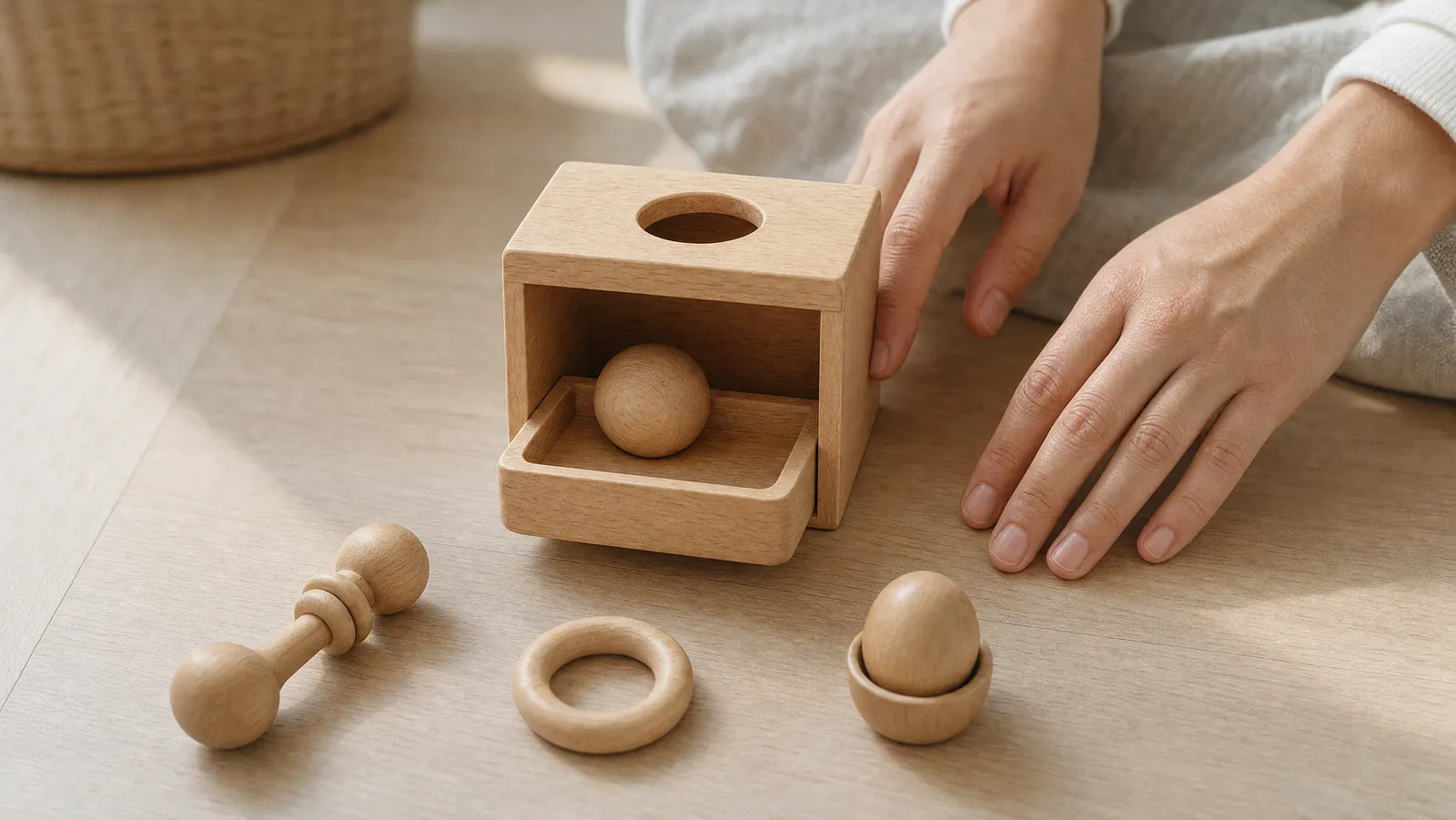
If you buy one Montessori material in this window, buy this one. The baby drops a ball into the hole, the ball is gone, and then it rolls out into the tray — which is the CDC's 9-month "looks for objects when dropped out of sight" turned into an object a baby can operate alone. The Adena Montessori object permanence box comes with three balls in wood, plastic and soft EVA foam, so the identical action produces three different weights and sounds, and Adena lists the large ball at 1.77 inches. About $15.99 as of November 2026. It is the rare toy that gets harder rather than boring: first the drop, then the aim, then the deliberate retrieve and re-drop.
Best Budget: the Busy Edition Wooden Ball Drop
Same idea, all wood, a dollar less. The Busy edition object permanence box ships with three wooden balls in natural, blue and orange, also specified at 1.77 inches, and the maker describes the wood as smooth, burr-free, moisture and abrasion resistant, and the design as quiet. About $14.99 as of November 2026. Pick it over our main pick if you specifically do not want a plastic ball in the mix, or if the box is going to live near a room where someone is sleeping — a wooden ball lands with a knock instead of a rattle. The trade-off is that you lose the three-materials contrast that makes the Adena box worth its extra dollar.
Best for Sensory Play: the GRESEESM Wooden Rain Stick
Visual tracking deserves its own object, and a rain stick is the cheapest honest version. Turn the GRESEESM wooden rain stick over and colored beads fall past a translucent window with a rain sound, so looking and listening and cause-and-effect arrive in one 7.7-inch object a baby can actually hold. About $14.99 as of November 2026. GRESEESM says it supports visual and auditory sensory development — that is the maker's claim, not a finding — and notes that it requires adult supervision and should not be dropped from a height, which is worth taking at face value for a sealed wooden tube full of small beads.
Best Shape Sorter: the Auezona 5-in-1 Set
Shape sorting arrives late in this window, and for many babies not until after the first birthday — the CDC puts "puts something in a container, like a block in a cup" at 12 months, and a shaped hole is a much harder version of that. The Auezona 5-in-1 Montessori set is built around a shape-sorter bucket with eight blocks, a carry handle and storage inside, with a tissue-box toy, soft stacking rings and stacking blocks alongside. Auezona says the set is independently tested with a U.S. Children's Product Certificate and that the silicone parts are BPA-free and food-grade. About $37.99 as of November 2026.
One caveat to act on, not just read: the set includes a pull-string toy, and the maker rates that element for 18 months and up. Keep it out of the box until then. Strings and cords are not a category to improvise with for an under-one: the AAP's toy-buying guidance says to remove loose ribbons and strings from toys to prevent strangulation.
Best Starter Set: the Somastung 6-in-1, 48 Pieces
Here is the tension, stated plainly: a 48-piece "6-in-1 Montessori set" is close to the opposite of a Montessori shelf. The point of the shelf is few objects, each with a single purpose, visible and reachable. A bin with 48 pieces in it is a bin. We are still recommending the Somastung 48-piece set, at about $35.99 as of November 2026, for one specific reader: the parent who wants to buy one box, once, and be done, and who is willing to put most of it away. Somastung says the set carries a Children's Product Certificate and meets ASTM F963, uses food-grade silicone and ABS plastic, and is BPA- and phthalate-free, and markets it from 5 months.
Used as a rotation library — three or four pieces out, the rest in the storage bag — it works, and 16 wooden sorting blocks plus 8 stacking cups will outlast the year. Dumped on a play mat, it is noise. The curated alternative costs less: the object permanence box, the rain stick, and a basket of household objects.
Best for New Walkers: the Pithfor Wooden Push Walker
Pulling to stand is the headline motor change at the end of the first year, and the CDC lists both "pulls up to stand" and "walks, holding on to furniture" by 12 months. The Pithfor wooden push walker is built for that moment: a wooden sit-to-stand frame on anti-slip rubber wheels with eight activity elements worked into the panels — mirror, rolling drum, bead maze, xylophone, spinning gears, shape sorter, drum and zig-zag track. Pithfor markets it from 10-12 months. About $56.99 as of November 2026.
Now the distinction that matters more than any feature on it. HealthyChildren.org, the AAP's parent-facing site, says the AAP has called for a ban on the manufacture and sale of baby walkers with wheels, that walkers can actually delay when a child starts to walk, that they send thousands of children to hospitals every year, that most walker injuries happen while adults are watching, and that a child in a walker can move more than three feet in one second. The AAP lists stationary activity centers, which look like walkers but have no wheels, among the safer alternatives.
The product the AAP is describing is a seated walker: the baby sits inside a frame on wheels and propels it. The Pithfor is not that. It is a push walker — the baby stands behind it, holds the bar, and supplies their own balance, which is the same thing they are already doing along the edge of the couch. We have not found AAP guidance treating push toys as the same hazard, and the AAP's core objection, that a seated walker carries a baby toward stairs faster than an adult can react, does not transfer cleanly. That is not the same as risk-free: it rolls, so gates go up first and it stays away from steps. Work through how to baby-proof your home before this comes out of the box. Do not read this section as permission to buy a seated walker.
Montessori Toys for a 6-Month-Old, a 9-Month-Old and a 10-Month-Old
| Age | What is arriving (CDC checkpoint) | What belongs on the shelf |
|---|---|---|
| 6-9 months | Working toward the CDC's 9-month list: sits without support, moves things hand to hand, bangs two things together | Object permanence box, rain stick, basket of safe household objects |
| 9-10 months | On the CDC's 9-month list: looks for objects dropped out of sight, gets to a sitting position alone | Object permanence box with all three balls, stacking cups, a container to fill and empty |
| 10-12 months | On the CDC's 12-month list: pulls up to stand, walks holding on to furniture, pincer grasp, puts something in a container | Push walker, shape sorter, stacking rings, low baskets at standing height |
Read the ages as approximate: the CDC's framing is that most children (75% or more) reach a milestone by the listed age, so no row here is a deadline. The household objects in the first row need the same check as a toy: the CPSC's small-parts rule for children under three, and supervision.
What We Would Skip at This Age
- Anything with a screen, or a speaker reading letters aloud. A 10-month-old is learning that objects persist and that hands do things. It is the one category where the toy does the work instead of the baby.
- Toys in the crib. The crib is for sleeping, and the AAP's safe-sleep guidance is to keep soft objects and loose bedding out of a baby's sleep area because they can increase the risk of entrapment, suffocation or strangulation. A mobile or a soft toy in there is a separate safety question with its own answer — see what does not belong in the crib.
- Anything rated above your baby's age because the set was a good deal. The Auezona pull-string element is the live example: the maker says 18 months and up, so it waits.
- A second large set. If you already own 48 pieces, the next purchase should be a shelf, not more pieces.
The Shelf Does More Work Than the Toy
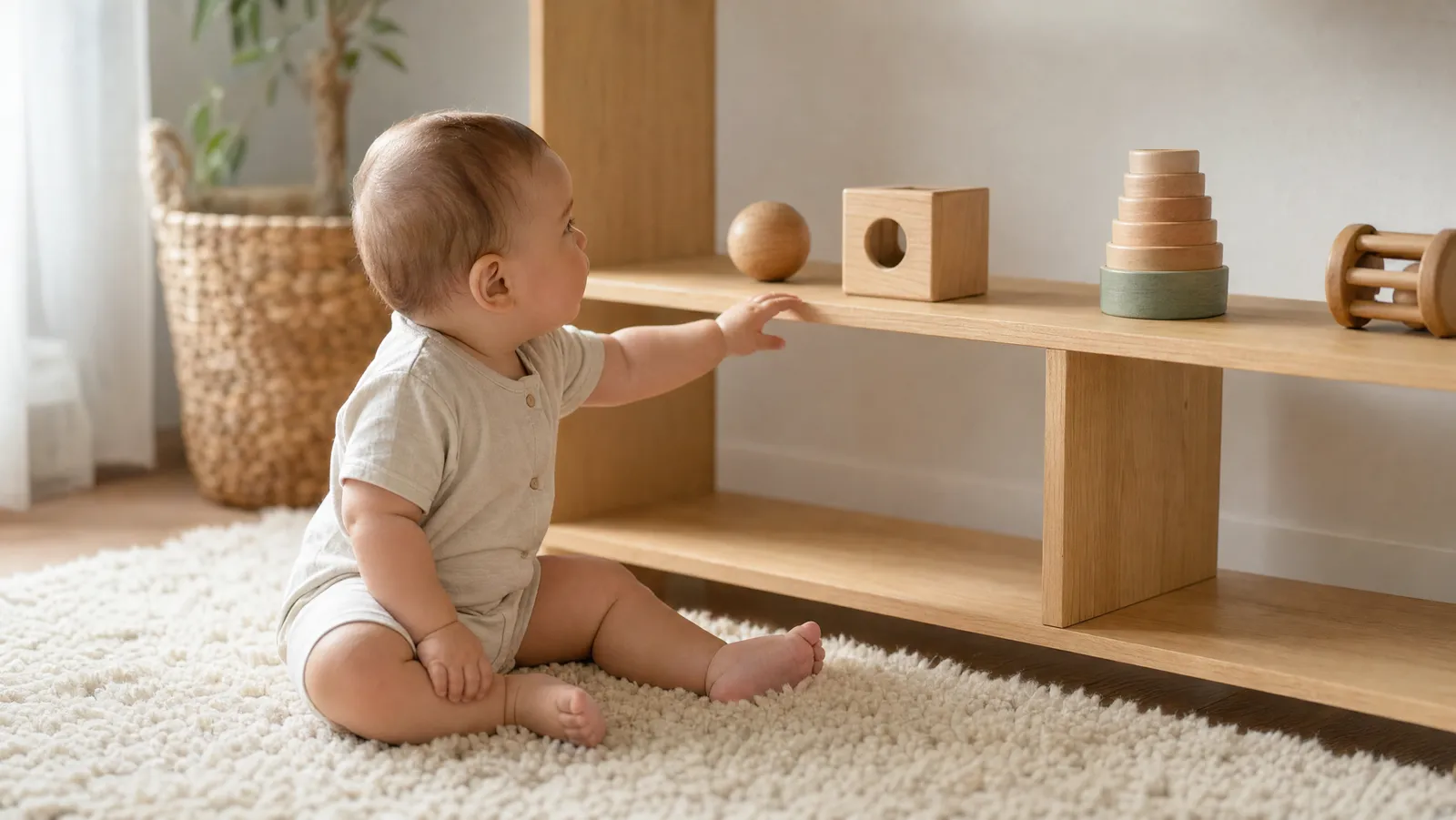
AMI, the organization Maria Montessori founded, describes the prepared environment as one that "contains all the essentials for optimal development but nothing superfluous," and lists simplicity, order, reality and beauty as its attributes, with everything child-sized to support independence. Nothing in that description is about buying. It is about restraint: three to five objects out, spaced so a baby can see each one, the rest stored and swapped in when interest fades.
Be clear about what these materials do not promise. Montessori pedagogy argues for open-ended, single-purpose materials and a calm prepared environment; that is a philosophy of practice, not a proven developmental outcome. The makers' claims above about hand-eye coordination, concentration and sensory development are manufacturer claims, and we have flagged them as such throughout. We would not buy any toy expecting it to raise a baby's abilities — only a few objects that hold attention without a battery.
To compare against the broader category, The Best Developmental Toys for Babies covers the non-Montessori options we think earn their place, and Logic Toys That Give Your Baby a Head Start picks up after the first birthday, where sorting and sequencing get genuinely difficult.
What We Would Buy
For one purchase: the Adena object permanence box, about $15.99 as of November 2026. It maps directly onto the CDC's 9-month cognitive milestone and stays useful for six months.
For two: add the GRESEESM rain stick for visual tracking, and keep the total under $35.
For three, choose by mobility. A baby still sitting gets the Auezona bucket for sorting practice. A baby pulling to stand gets the Pithfor push walker — and you check the gates before it ships.
If you would rather make one decision and stop thinking about it, the Somastung box does cover the year, as long as you treat it as a storage bin you rotate from. Beyond that, a basket of safe, correctly sized household objects does more than anything else on this page, for free.
For picks either side of this window — the mobiles that come before 6 months, the practical-life materials after 12 — work through the full Montessori toy guide for babies. And ask your pediatrician about anything touching your own baby's development, rather than a product page.

Adena Montessori Object Permanence Box with Tray and 3 Balls
The canonical 6-to-12-month Montessori material. The baby drops a ball through the hole, the ball disappears, then rolls out into the tray. Three balls in wood, plastic and soft EVA foam mean the same action teaches three different weights and textures. Adena puts the large ball at 1.77 inches and aims the box at 6-12 months. About $15.99 as of November 2026.
- Brand
- Adena Montessori
- Category
- Our Pick
This is the one material we would buy if we could only buy one. It survives the same drop-and-reappear sequence forty times in a row without a parent having to do anything, and it still gets used the week of the first birthday.

Busy edition Object Permanence Box with Tray (Wooden Ball Drop)
The same object-permanence idea in an all-wood version, with three wooden balls in natural, blue and orange. The maker also puts its balls at 1.77 inches, describes the wood as smooth and burr-free and moisture and abrasion resistant, calls the design quiet, and markets it from 6 months. About $14.99 as of November 2026.
- Brand
- Busy edition
- Category
- Best Budget
If you want the object permanence box without the plastic ball, this is the cheaper way to get it. A wooden ball lands with a dull knock rather than a rattle, which matters when the box lives in the room next to where the baby sleeps.

GRESEESM Wooden Rain Stick Rainmaker Sensory Toy, 7.7 in
A 7.7-inch wooden rain stick. Turn it over and colored beads fall past a translucent window with a rain sound, which is visual tracking and cause-and-effect in one object small hands can hold. GRESEESM says it supports visual and auditory sensory development, and notes that it needs adult supervision and should not be dropped from a height. About $14.99 as of November 2026.
- Brand
- GRESEESM
- Category
- Best for Sensory Play
Babies watch the beads the whole way down, every time, which is exactly the kind of sustained looking you are hoping for at this age. It is also the rare toy that is genuinely one thing doing one thing, and it fits in a diaper bag.

Auezona 5-in-1 Montessori Set: Shape Sorter, Blocks, Stacking Rings, Tissue Box
A five-part set built around a shape-sorter bucket with eight blocks, a carry handle and enough room to store everything inside. The rest is a tissue-box toy with a soft shatterproof mirror, two crinkle tissues and six fabric scarves, soft stacking rings, stacking blocks and a pull-string toy. Auezona says the set is independently tested with a U.S. Children's Product Certificate and that its silicone parts are BPA-free and food-grade. The maker rates the pull-string element for 18 months and up. About $37.99 as of November 2026.
- Brand
- Auezona
- Category
- Best Shape Sorter
The bucket is the part that earns its keep, and it keeps earning it for months after the first birthday. The pull-string toy goes in the closet until the baby is older, which is what the maker's own age rating tells you to do.

Somastung 6-in-1 Montessori Sensory Toy Set, 48 Pieces
Forty-eight pieces: 16 wooden stacking and sorting blocks, 8 stacking cups, 6 soft blocks, 6 soft stacking rings, a sorting cube with four pieces, three suction-cup spinners and a storage bag. Somastung says it uses food-grade silicone and ABS plastic, is BPA- and phthalate-free, carries a Children's Product Certificate and meets ASTM F963, and markets it from 5 months. Buy it for the convenience of one box, not as a Montessori shelf. About $35.99 as of November 2026.
- Brand
- Somastung
- Category
- Best Starter Set
One box covers the whole year if you are willing to rotate three or four pieces onto the shelf at a time and keep the rest in the bag. The suction-cup spinners on a high chair tray buy a parent several minutes of dinner, which is reason enough to keep them.

Pithfor Wooden Baby Push Walker with Activity Center
A wooden sit-to-stand push walker on anti-slip rubber wheels, with eight activity elements built into the frame: mirror, rolling drum, bead maze, xylophone, spinning gears, shape sorter, drum and zig-zag track. Pithfor markets it from 10-12 months. Read this carefully: it is a walker the baby stands behind and pushes, not a seated walker the baby rides in. About $56.99 as of November 2026.
- Brand
- Pithfor
- Category
- Best for New Walkers
A baby who has just started pulling to stand will use the handle to get up, push it a few feet, sit down and play the xylophone, then do the whole loop again. The activity panel is why it still gets used on days when the baby does not feel like cruising.
- 01Adena MontessoriOur PickAdena Montessori Object Permanence Box with Tray and 3 Balls
- 02Busy editionBest BudgetBusy edition Object Permanence Box with Tray (Wooden Ball Drop)
- 03GRESEESMBest for Sensory PlayGRESEESM Wooden Rain Stick Rainmaker Sensory Toy, 7.7 in
- 04AuezonaBest Shape SorterAuezona 5-in-1 Montessori Set: Shape Sorter, Blocks, Stacking Rings, Tissue Box
- 05SomastungBest Starter SetSomastung 6-in-1 Montessori Sensory Toy Set, 48 Pieces
- 06PithforBest for New WalkersPithfor Wooden Baby Push Walker with Activity Center
What Montessori toys does a 6-month-old actually need?+
Is a 1.77-inch ball safe for a baby who mouths everything?+
Is a push walker the same thing as the baby walker pediatricians warn about?+
How many toys should be on the shelf at once?+
Do Montessori toys make babies smarter?+
Sammie Seelbach
Sammie is a mom of two and the lead reviewer at Smart Baby Reviews. Since becoming a parent she has become obsessed with researching the safest, smartest baby gear on the market — testing thermometers at 2 a.m., wrangling baby gates, and sterilizing more bottles than she can count. She shares what actually works so other parents can make confident, informed decisions for their little ones.