What Actually Makes a Toy "Montessori"

This post may contain affiliate links. Read our policy.
Nobody certifies the baby toys sold as Montessori. What makes a toy Montessori is a short list of design choices — one purpose per object, real over make-believe, natural materials, child-powered rather than battery-powered, built-in feedback, sized for small hands — and you can check every one of them in a shop aisle in about ten seconds. The word on the box is not one of the traits.
That matters because the label is doing a lot of commercial work right now. The traits below are the definition the rest of our Montessori coverage leans on, so if you want the shelf rather than the concept, start with our rundown of Montessori toys for babies and come back here when a product description starts sounding suspiciously like a philosophy.
"Montessori" Is Not a Standard, and Anyone Can Print It on a Box
No governing body vets the word "Montessori" on a baby toy. The name itself is not protected: the Hechinger Report, investigating how loosely the label travels, found that "Montessori is not a trademarked name, which means it is a label often given to thousands of daycares and preschools" whether or not they follow the method. Its reporting counted more than 4,000 so-called Montessori schools in the US, of which only 204 were accredited by the American Montessori Society and about 220 recognised by the Association Montessori Internationale.
Those two organisations do run quality programmes — AMS describes accreditation as a staged school-level process in which, to become a candidate, "a school must be verified, meet the prerequisites, and have an approved application," with accreditation itself following a self-study and a visiting team. But that machinery points at schools and teacher training.
One approval scheme does touch objects, and it is narrower than the marketing implies: AMI licenses four manufacturers — Nienhuis Montessori, Gonzagarredi Montessori, Matsumoto Kagaku and Agaworld Montessori — to build materials from its own blueprints, and says catalogue items meeting those specifications are identified "by the official AMI logo." That is a licence held by four named suppliers of classroom apparatus, not a seal any brand can apply for. Nothing in it reaches the infant toy aisle, and no marketplace seller's use of the word has been vetted by anyone.
So treat "Montessori" on packaging the way you would treat "natural" on a cereal box: a hint about intent, not a fact about the product. Here is what to read instead.
The Seven Traits of a Montessori Material
One Purpose per Object
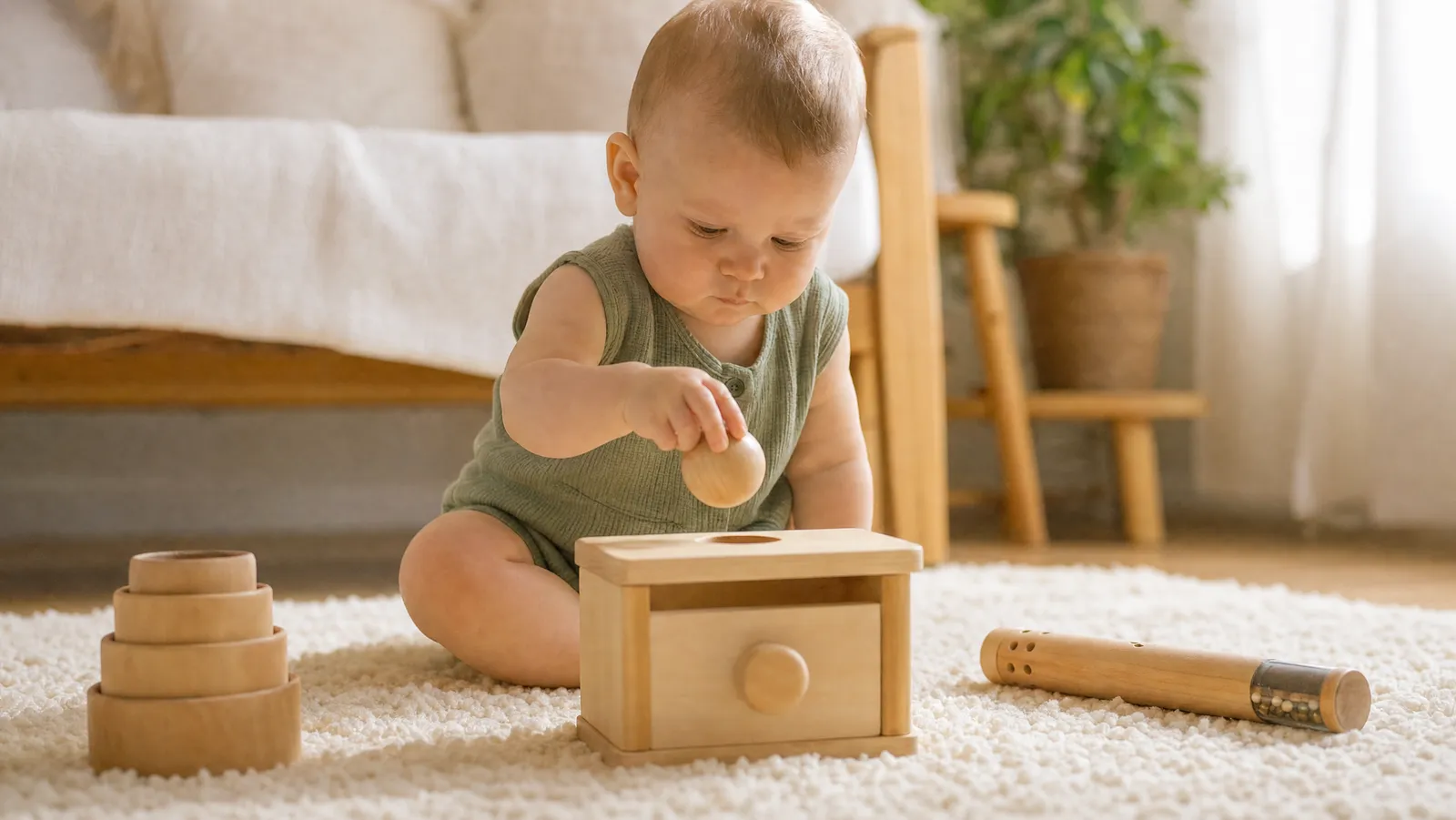
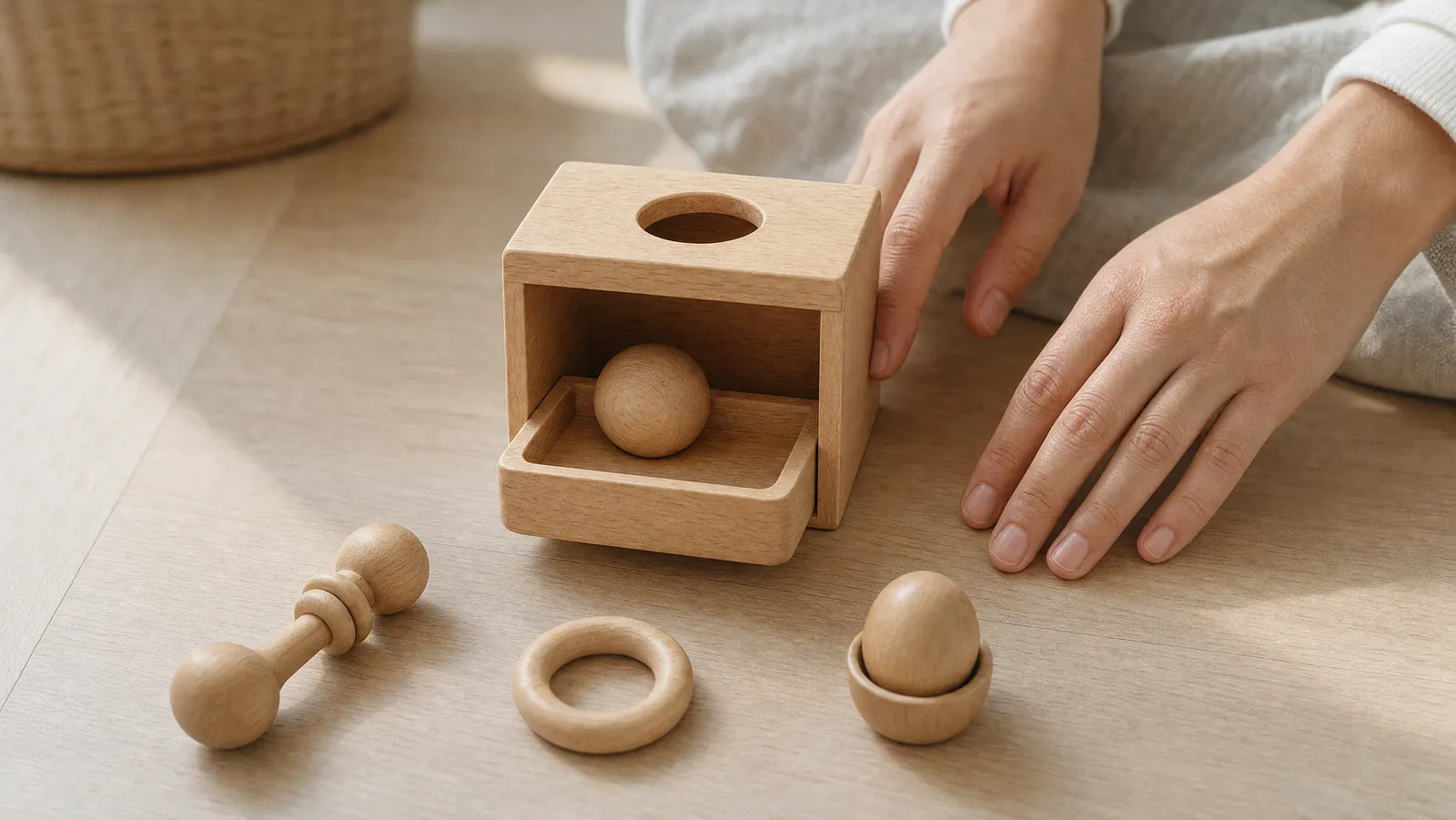
A Montessori material usually does one thing. A set of nesting cups nests. A posting box takes a ball and gives it back. The appeal of the five-in-one activity cube is adult appeal — it looks like value — but it splits a baby's attention across five half-finished ideas.
The test: can you describe what the toy is for in four words without using "and"?
Real Over Make-Believe
Montessori practice favours objects and images drawn from the actual world for the youngest children: real animals rather than cartoon animals, a small working broom rather than a pretend one, photographs rather than fantasy illustration. An American Montessori Society blog post on authentic toys makes the animal case directly, arguing that realistic animal toys inform children's impressions of what animals are like in their natural environments. The reasoning is pedagogical rather than medical — a baby is still assembling a model of how things are, and mixed signals make that job harder — so hold it as a principle of the method, not a proven developmental outcome.
The test: could the thing on the box exist? A lion on all fours passes. A purple lion in a waistcoat does not.
Natural Materials, for Information Rather Than Aesthetics
Wood, cotton, metal, wool and woven fibre carry temperature, weight, grain and sound. Ten identical plastic shapes feel like one thing; ten objects in five materials feel like ten. That is the actual argument for natural materials, and it is a better one than the Instagram palette.
The test: close your eyes and hold two pieces. Can you tell them apart by feel alone?
Child-Powered, Not Battery-Powered
If the toy performs and the baby watches, the roles are backwards. This is the one trait with real clinical support behind it. The AAP's clinical report on toy selection, summarised in the Academy's own announcement, concluded that "the best toys for children's development are those that foster play between a caregiver and child", and that "electronic toys by themselves do not provide children with the interaction and parental engagement that is critical to healthy development." Lead author Aleeya Healey, MD, put it bluntly: "the best toys need not be flashy or expensive or come with an app. Simple, in this case, really is better." The same report cautions that advertised educational claims for interactive media are frequently unsubstantiated.
The AAP also notes that in infancy the most important purpose of toy play is not educational at all, but to support warm, responsive interaction. A toy that holds the baby's attention while you leave the room is solving your problem, not theirs.
The test: take the batteries out. Is there still a toy?
Self-Correcting, So You Can Stay Quiet
Montessori calls this control of error: the material shows the mistake without an adult narrating it. An AMI publication distinguishes a mechanical control of error built into the material's design — its example is the cylinder blocks, where every cylinder has one matching socket — from a perceptual one that relies on the child's developing sensorial perceptions, as with the pink tower. It adds that "sometimes the adult is the Control of Error," and that when an adult sees a material being used in a way that does not support learning, the fix is to re-demonstrate it quietly another time rather than correct in the moment.
In baby terms: a shape sorter where the cylinder only drops through the round hole has mechanical feedback. A light-up panel that says "try again" has an opinion.
The test: if you said nothing, would the baby still find out?
Sized and Weighted for Real Hands
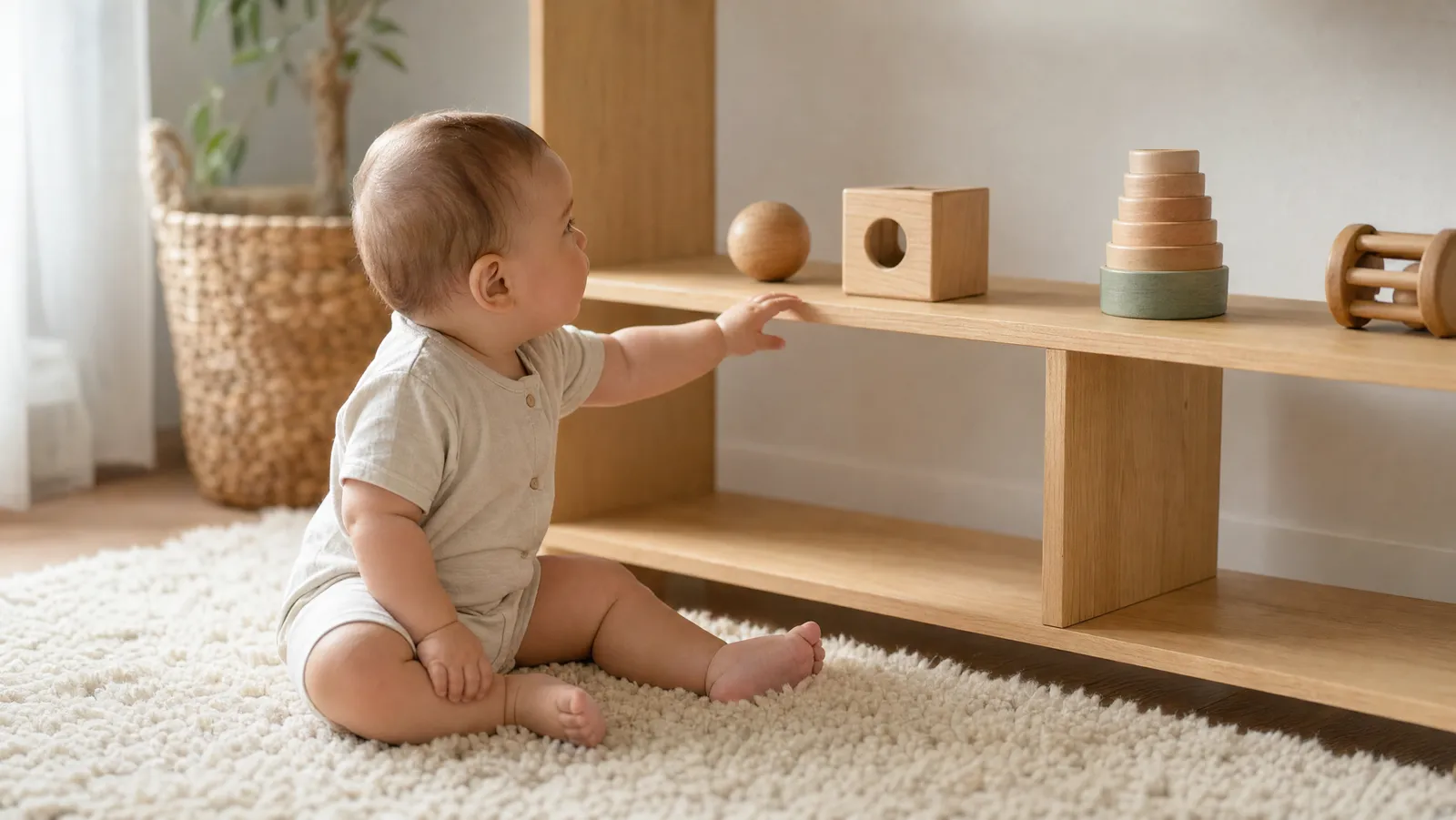
Materials should be liftable, graspable and genuinely usable by the child in front of you, which is why Montessori environments use child-scale furniture and single-portion trays. Match the object to what the hands can currently do. The CDC lists "moves things from one hand to her other hand" among the milestones most children — defined as 75% or more — reach by nine months, which is a reasonable marker for when transferring, posting and container work start to land. Before that, offer one object at a time.
The test: can the baby pick it up, carry it and put it down without help?
Beautiful, and Breakable Enough to Deserve Care
A small glass jug, a ceramic dish, a wooden tray with a visible grain: the Montessori argument is that real, slightly fragile things invite careful handling in a way indestructible ones never do. For babies this is mostly aspirational — and anything breakable should be used with you at arm's length, on a low surface, never left on the shelf for independent access. A broken one is a different object: by the CPSC small-parts definition set out below, any chip or fragment that fits uncompressed into the test cylinder counts as a choking hazard, so under a year old we would keep glass and ceramic to supervised minutes and off the shelf entirely.
The test: would you be happy to have it out in your living room?
| Trait | Shop-aisle test |
|---|---|
| One purpose | Describe its job in four words, no "and" |
| Realistic | Could the pictured thing actually exist? |
| Natural materials | Can you tell two pieces apart by feel? |
| Child-powered | Remove the batteries — is there still a toy? |
| Self-correcting | Would the baby find out without you speaking? |
| Right size | Can they lift it, carry it, set it down? |
| Worth caring for | Would you leave it out in the living room? |
The Safety Rule That Overrides Every Trait Above
Aesthetics lose to airways. For a baby under three, the governing US rule is the Consumer Product Safety Commission's small-parts regulation at 16 CFR 1501, which applies to toys and articles intended for children younger than three. The CPSC explains that a small part is anything that fits "without compressing and in any orientation, entirely into the small parts cylinder," and that the cylinder "approximates the size of the fully expanded throat of a child under three years old." The cylinder's dimensions were set out when the rule was issued: a truncated cylinder with "a diameter of 1.25 inches (31.7 mm.)" and "a depth ranging from 1 to 2.25 inches," per the Federal Register. Note that the regulation carves out specific categories — balloons, paper, crayons, rattles and pacifiers among them — which is why a legal rattle is not a legal bead.
On top of that, the CPSC's toy rule at 16 CFR 1250 requires each toy to comply with ASTM F963-23, the mandatory US toy safety standard, which testing labs such as Eurofins describe as covering products designed, manufactured or marketed as toys for children under 14. Unbranded, imported "Montessori sets" sold through marketplace listings are exactly where that compliance paperwork is hardest to verify, and the hand-finished wooden look is not evidence of it.
Three more practical points, all from HealthyChildren.org, the AAP's parent-facing guidance: "make sure all toys and parts are larger than your child's mouth to prevent choking"; be careful with toys containing button or lithium coin batteries or high-powered magnets, because loose ones put in the mouth, nose or ears "can cause serious injuries"; and take off any loose ribbons or strings to avoid strangulation. That last one rules out most hanging objects for an unsupervised baby — a reason mobiles belong over a play mat you are sitting beside rather than in the sleep space, which we cover in what does not belong in the crib.
Babies also explore by mouthing, which is normal and not the same thing as choking. If the noisy-versus-silent distinction is new to you, our piece on gagging vs choking is the one to read before you put anything new on the shelf.
So Are Montessori Toys Better? What the Evidence Actually Covers
The honest version: the evidence is about classrooms, not objects. The 2023 systematic review by Randolph and colleagues in Campbell Systematic Reviews pooled 32 studies that met its inclusion standards and found Montessori education outperformed traditional education, with a composite effect size of 0.24 on academic outcomes (0.26 for general academic ability) and 0.33 on nonacademic ones such as executive function and creativity. Effects were larger in preschool and elementary settings. Those are modest and real — and they describe trained teachers running a full prepared environment over years, not a wooden toy on a shelf.
Nobody has demonstrated that buying Montessori-styled toys causes cognitive gains in babies. What is well supported is the narrower claim: simple, open-ended, child-powered toys are a better bet than electronic ones, which is the AAP's position, and heavily marketed educational claims deserve suspicion, which is also the AAP's position.
The far end of that spectrum is worth knowing about if you are shopping this season. Common Sense Media's January 2026 risk assessment of AI companion toys recommends that no child aged five or under use them, urging extreme caution for ages six to twelve, after testers found that more than a quarter of the toys' outputs included inappropriate content. A plain wooden ball on a tray has a very short list of failure modes by comparison.
What We Would Buy, Skip, and Borrow From the Kitchen
Skip: anything sold as a Montessori "set" of twelve items, battery-powered toys with a Montessori sticker, and the five-in-one cube. You are paying for breadth where the method asks for depth.
Buy sparingly: two or three objects that match what your baby can do this month, rotated rather than accumulated. Our age-specific picks are in Montessori toys for six to twelve months, and for comparison with the conventional category, The Best Developmental Toys for Babies and Logic Toys That Give Your Baby a Head Start cover the same developmental ground from a different angle.
Borrow: a metal whisk, a wooden spoon, a set of measuring cups, a colander and a basket of fabric squares will out-earn most of what is sold as infant Montessori. One condition, and it is not negotiable — every household object has to clear the small-parts test above. If the item, or any piece that could snap, twist or chew off it, fits uncompressed and in any orientation inside a cylinder 1.25 inches across and up to 2.25 inches deep, it does not go on the shelf. Check lids, handles, rivets and anything that unscrews, and once your baby starts moving, check the room the same way, which is the point at which baby-proofing stops being theoretical.
The through-line is cheaper than the marketing suggests: fewer objects, each doing one real thing, that your baby can act on without you performing. If you want the full shelf built out month by month, that is our complete guide to Montessori play. And on anything about your own baby's development, your pediatrician beats any article, including this one.
Is "Montessori" a certification or a trademark?+
Are Montessori toys actually better for babies?+
Do Montessori toys have to be made of wood?+
Can I use household objects instead of buying Montessori materials?+
At what age do Montessori toys start to make sense?+
How many toys should be out at once?+
Sammie Seelbach
Sammie is a mom of two and the lead reviewer at Smart Baby Reviews. Since becoming a parent she has become obsessed with researching the safest, smartest baby gear on the market — testing thermometers at 2 a.m., wrangling baby gates, and sterilizing more bottles than she can count. She shares what actually works so other parents can make confident, informed decisions for their little ones.