Bottle Feeding a Baby With Reflux or Heavy Spit-Up

This post may contain affiliate links. Read our policy.

Feed smaller amounts more often. Hold your baby as upright as they can manage, with the bottle closer to horizontal than vertical. Use the slowest nipple they will tolerate, burp every 2 to 3 ounces, and then hold them upright, awake and supervised, for 20 to 30 minutes before putting them down. That is bottle feeding a baby with reflux, in full. We earn a commission from links on this page, at no cost to you.
Notice what is not on that list. Technique beats gear here, and no bottle on the market cures reflux. A smaller bottle and a slower nipple may help because they change volume and speed — HealthyChildren.org's framing is that a stomach filled too full, or too fast, sends milk back out. Everything else marketed at spitty babies is a claim, usually the manufacturer's own.
Still assembling the basics underneath this? Start with bottle feeding a newborn and treat this as the adjustment layer. Below: normal spit-up versus reflux disease, the red flags that mean call today, the technique changes in order of how much they do, and the plain truth about anti-reflux bottles.
Normal Spit-Up, Reflux, and Reflux Disease Are Three Different Things
HealthyChildren.org, the American Academy of Pediatrics' parent site, opens its explainer with three words: all babies spit up. The muscle at the top of the stomach is still maturing, and an overfull stomach pushes milk back the way it came. The site's position is that spit-up is usually no cause for concern, and almost never involves choking, coughing, discomfort or danger, even during sleep.
The timeline is the part that helps most at 3 a.m. Writing for HealthyChildren.org, pediatric gastroenterologist Anthony Porto, MD, says reflux typically starts at 2 to 3 weeks of age, peaks at 4 to 5 months in full-term infants, and gets much better after 6 months once a baby learns to sit up. Children's Wisconsin puts the peak at 4 to 6 months and says it resolves spontaneously by 12 to 18 months.
Children's Wisconsin has a name for the common case: a baby who is gaining weight, meeting milestones and generally not irritable with spit-up is likely a happy spitter. That baby has a laundry problem.
Reflux disease is a different conversation. The NIH's National Institute of Diabetes and Digestive and Kidney Diseases describes GERD as a more severe and long-lasting condition, and notes that infants with GERD may have additional symptoms such as irritability, loss of appetite, or vomiting. That is a diagnosis your pediatrician makes, not one you make from the volume on your shirt.
The Red Flags That Mean Call Your Pediatrician Today
If anything on this list is happening, stop reading and call.
The NHS lists these as reasons to get an urgent appointment or call a nurse line: vomiting green or yellow fluid, or vomit containing blood; forceful, projectile vomiting; blood in the stool; a swollen or tender tummy; a very high temperature; vomiting that will not stop; signs of dehydration; crying constantly and seeming very distressed; and refusing to feed.
Children's Wisconsin's list for contacting the pediatrician covers poor weight gain, poor hydration, breathing difficulties, bloody or bright green spit-up, and projectile vomiting. The NHS adds two timing flags: reflux appearing for the first time after 6 months of age, and reflux still happening after the first birthday.
HealthyChildren.org says to always contact your pediatrician if your baby vomits forcefully after every feeding, and explains that forceful vomiting with muscle contractions — where the vomit shoots out with force — may indicate pyloric stenosis. That is something a doctor evaluates, not something to rule in or out at home. The same site says to call right away if there is blood in the spit-up or vomit.
Weight, comfort and breathing are the three dials. If all three look fine, you probably have a technique-and-laundry situation. If any one is off, you have a medical appointment — and that appointment is where treatment belongs. The NIH's National Institute of Diabetes and Digestive and Kidney Diseases notes that if symptoms do not improve with lifestyle changes, doctors may recommend medical tests. A pediatrician may also discuss feeding changes or medication options. We give no doses and name no medicines here, and neither should anyone who has not examined your baby.
Smaller Feeds, More Often, Is the Change That Does the Most
Start here, because it is free and works on the actual mechanism. HealthyChildren.org's first piece of advice for a spitty baby is to feed your baby smaller amounts more frequently, comparing the stomach to a gas tank — top it past full and it comes back out. Children's Wisconsin says the same: feed more frequently, but with smaller amounts.
The principle underneath it, from HealthyChildren.org's guidance on how much babies should eat, is one sentence worth taping to a cupboard: it is better to offer less, since you can always give more if your baby wants it. The same page warns that infants who are bottle feeding may be more likely to overfeed because drinking from a bottle is faster, and that overfed babies can have stomach pains, gas, spit up or vomit.
You are redistributing the same day, not cutting it. If your baby has been taking six feeds of 4 ounces, the same daily total is roughly eight feeds of 3 ounces, about 3 hours apart. Give any change two or three days. HealthyChildren.org's reference figures are worth knowing before you reshuffle: at least 3 to 4 ounces about every 3 to 4 hours by the end of the first month, and 6 to 8 ounces at each of 4 or 5 feedings in 24 hours by 6 months. Ours is not the voice that should set your baby's numbers — the age-by-age breakdown is in how many ounces per feed, and your pediatrician has the growth chart.
One cheap structural trick: buy small bottles. A 4 oz bottle makes the smaller feed the default rather than a decision you make while half asleep.
How to Hold a Baby With Reflux During a Feed
As upright as your baby can manage, head clearly above the stomach. Not cradled flat, not curled chin-to-chest. Think of a baby sitting back against your forearm at a steep angle rather than lying in it.
The bottle then does something slightly counterintuitive. Keep it closer to horizontal than vertical — tilted only enough that milk fills the tip of the nipple. Held straight down, milk pours in under gravity and your baby's only options are to swallow fast or let it escape. Held too flat with an ordinary nipple, the nipple goes half empty and your baby swallows air. The target is a full nipple with no flood behind it.
Swapping arms halfway saves your wrist and avoids compressing the same side every feed. The full set of holds, plus why a propped bottle is never acceptable for any baby and especially not this one, is in bottle-feeding positions.
Flow and Pacing for a Reflux Bottle-Fed Baby
Slow the milk down and let your baby, rather than the clock or the ounce markings, decide when the feed ends.
Start at the slowest flow your bottle system sells — usually labelled Level 1, Flow 1 or Slow — and only step up if your baby is visibly straining. Nipple labels are not measurements, and a baby outrun by the flow may gulp, which can mean swallowed air and more volume coming back later. The technique, including the rhythm of tipping the bottle down for a few seconds every few swallows, is in paced bottle feeding.
Leftover milk is not a failed feed. HealthyChildren.org's point about pausing — that it gives a baby a chance to realize when they are full — only pays off if you act on the signal. Draining the bottle because two ounces are left is how a manageable spit-up becomes the full load.
Burp Early, Burp Often, Burp Gently
Burping a reflux baby is a mid-feed job, not a closing ceremony. HealthyChildren.org's advice for spitty babies is to burp not only after, but also during meals, and gently, when they take breaks. Its general bottle-feeding guidance is to burp after every 2 to 3 ounces, or 60 to 90 mL. Comer Children's Hospital at UChicago Medicine recommends burping in the middle of feedings — after 2 ounces of formula, for instance — as well as at the end, and Children's Wisconsin says to burp several times during a feed.
HealthyChildren.org describes three positions: upright with the baby's head on your shoulder while you gently pat their back; seated on your lap, one hand supporting the chest and head while the other pats; or lying face down across your lap with the head higher than the chest.
Gas, burping and colic in bottle-fed babies is its own subject, and a baby who cries inconsolably is not necessarily a baby with reflux. Here, the burp is just a way to let air out before milk follows it.
The Pause After the Feed — and Why It Is Never a Sleep Position
This is the most underused step, and the one with the clearest sourcing. HealthyChildren.org says to hold your baby in an upright position for at least 20 minutes after a feed, and adds a sentence that is not optional: always closely supervise your baby during this time. Children's Wisconsin advises keeping your baby upright, and explicitly not in a car seat, for 30 minutes after feeding. The NHS says to hold your baby upright during feeds and for as long as possible afterwards.
The same guidance says what to avoid in that window. HealthyChildren.org advises limiting active play for about 20 to 30 minutes afterwards, notes that pressing on a baby's belly right after eating can make spit-up more likely, and suggests postponing tummy time. Practically: no bouncing, no jiggling to settle, no diaper change with the legs folded toward the chest. Change the diaper before the feed instead.
Every upright hold in this article is awake, held and watched. None of it is a sleeping arrangement. Sleep for a baby with reflux is flat, firm, on the back, in a bare crib — not inclined, not propped, not on a side or stomach, not in a swing or car seat, not on a parent's chest. The AAP's parent guide to safe sleep says to place your baby on their back for all naps and at night, that the side position is just as dangerous as the stomach position, that any surface inclining more than 10 degrees is not safe to sleep on, and that even babies with gastroesophageal reflux disease should sleep flat on their backs. If your baby falls asleep in a car seat, stroller, swing, carrier or sling, move them to a firm sleep surface on their back as soon as possible.
Dr. Porto's answer on HealthyChildren.org closes off the usual workarounds. Elevating the head of a baby's crib is not effective in reducing reflux, and he notes it is unsafe because it increases the risk of the baby rolling to the foot of the bed. There is evidence that a semi-inclined position can make a baby's reflux worse. Wedges and sleep positioners are not needed. He also calls the fear underneath all of it — that a baby on their back will choke on spit-up — a total myth, since there is no evidence that healthy babies placed on their backs are more likely to have serious or fatal choking. The NHS agrees: flat on the back, not the side or front, and do not raise the head of the cot or Moses basket.
Regulators went further than advice. Under the Safe Sleep for Babies Act, inclined sleepers are banned hazardous products in the US, a ban the Consumer Product Safety Commission has enforced since November 12, 2022, covering any product with an inclined sleep surface greater than ten degrees intended for infants up to 1 year old. The CPSC's 2021 standard requires a sleep surface angle of 10 degrees or lower, and the agency cited 254 incidents, including 21 fatalities, involving infant sleep products between January 2019 and December 2020. Its summary of where a baby belongs is a flat, bare surface dedicated to the infant. The full setup is in how to set up a safe sleep space.
Does the Best Bottle for Reflux Actually Exist?
Short answer: no. Notice what the pediatric sources recommend. HealthyChildren.org answers heavy spit-up with smaller feeds, mid-feed burping, 20 minutes upright and less active play, and Children's Wisconsin's three instructions are all about how you feed. Neither names a bottle or a vent.
What a bottle can genuinely change is volume and air. Vented and AirFree designs are air-ingestion engineering — built so the nipple stays full of milk rather than milk-and-bubbles. That is a real mechanical difference, and also where the honest assessment stops, because the efficacy claims attached to these bottles are the manufacturers' own rather than independent findings.
So we buy them for mundane reasons. The Dr. Brown's Options+ narrow bottle in 4 oz, about $21 for a four-pack as of October 2026, earns its place because it is small and ships with Level 1 slow-flow nipples. Small bottle plus slow nipple is "feed less, more often" built into the hardware. Dr. Brown's describes its internal vent as clinically proven to reduce colic, says it helps reduce spit-up, burping and gas, and markets the line as the number one pediatrician recommended baby bottle in the US — all claims from Dr. Brown's, repeated here as claims. The useful spec is that the vent lifts out later.
The Philips Avent Anti-Colic bottle with AirFree vent, about $24 as of October 2026, solves the geometry problem from the hold section. Its vent is intended to keep the nipple full of milk rather than air even with the bottle closer to horizontal — exactly the angle a near-upright feed needs. Philips Avent says the design reduces colic, gas and reflux during early feeding; that is Avent's claim, and we would not buy it as a treatment for anything. We buy it because it makes a flat bottle angle practical.
Then the part nobody wants to hear. If you have already bought three bottle systems, stop buying and book an appointment. The next bottle is not the variable. A pediatrician who can weigh your baby and watch a feed is.
The Purchase That Actually Pays Off
Burp cloths. Not three — a stack, in every room you feed in, plus the car and the diaper bag. The bottleneck is never the washing machine. It is having something clean within arm's reach at 2 a.m.
Size is the only spec that matters, and most gift-set cloths fail it. The Burt's Bees Baby organic cotton burp cloths, about $30 for five as of October 2026, are 17 by 11.75 inches of GOTS-certified organic cotton in a 2-ply rib knit — enough to cover a shoulder and the top of your sleeve, which is where spit-up lands. Buy two packs and skip the third bottle system.
The Takeaway
Most spitty babies are fine, and the pediatric sources say so plainly: HealthyChildren.org calls spit-up usually no cause for concern, Dr. Porto says reflux will end for most babies, and Children's Wisconsin expects it gone by 12 to 18 months. The happy spitter is a real category, and the parent of one is running a laundry operation, not a medical case.
What you can change today, in order: smaller volumes more often, a near-upright hold with the bottle closer to flat, the slowest nipple your baby tolerates, burping every 2 to 3 ounces, then 20 to 30 minutes held upright and awake before you put them down — flat, on the back, in a bare crib, exactly as for any other baby.
Then hold onto the three dials. Weight, comfort and breathing are what turn a laundry problem into a doctor's appointment. If any is off, the technique here is not the answer and your pediatrician is. For the rest of the system — bottles, volumes, night feeds, nipple levels — see our complete guide to bottle feeding.
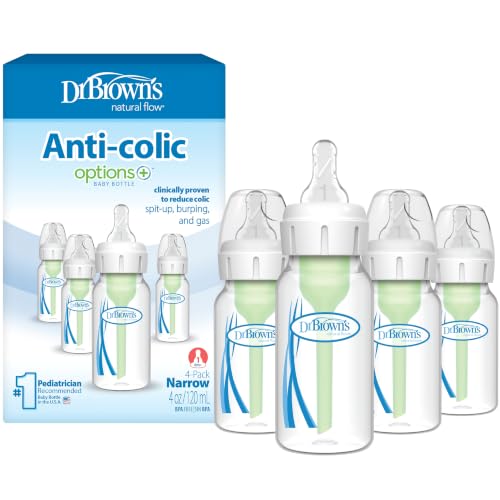
Dr. Brown's Anti-Colic Options+ Narrow Baby Bottle, 4 oz, 4-Pack
Four 120 mL bottles with Level 1 slow-flow nipples, rated 0m+, dishwasher and sterilizer safe, BPA free. The reason this is the pick for a spitty baby is the size rather than the vent system. A 4 oz bottle makes smaller, more frequent feeds the default instead of a discipline you have to remember at 3 a.m. Dr. Brown's states that the internal vent gives vacuum-free feeding with a consistent flow so babies feed without swallowing excess air, and that the vent is clinically proven to reduce colic and helps reduce spit-up, burping and gas. Those are the maker's claims, and we would not buy this expecting it to treat reflux; the vent also lifts out later, so the bottles outlive the phase.
- Brand
- Dr. Brown's
- Category
- Our Pick
The small size is the feature. You stop negotiating with yourself about whether to offer another ounce, because there is no other ounce in the bottle.

Philips Avent Anti-Colic Baby Bottle with AirFree Vent, Slow Flow, 4 oz
A set of four 4 oz BPA-free bottles with Flow 1 slow nipples, rated 0m+, usable with or without the AirFree vent. The vent is intended to keep the nipple full of milk rather than air, which is what lets you hold the bottle closer to horizontal and the baby closer to upright without the nipple going half empty. That is the practical reason it is here. Philips Avent says the design is made to reduce colic, gas and reflux during early feeding, which is the company's claim rather than a clinical finding, and the wide neck has few parts so the one-piece vent washes without special tools.
- Brand
- Philips Avent
- Category
- Best for an Upright Feed
It solves a geometry problem rather than a medical one. The bottle can sit nearly level and the nipple still stays full, so the near-upright hold stops being a wrestling match.

Burt's Bees Baby 100% Organic Cotton Burp Cloths, 17x11.75 in, 5-Pack
Five GOTS-certified organic cotton burp cloths in a thick 2-ply rib knit, 17 by 11.75 inches each, with a three-panel layout. The size is the whole argument. A 17-inch panel covers a shoulder and the top of a sleeve, which is where spit-up actually lands, instead of the palm-sized squares that come in most gift sets. Combed ring-spun cotton and yarn-dyed stripes hold up to the wash cycles a spitty baby generates, and they fold flat enough to keep one in the diaper bag. This is the purchase on this page with a guaranteed payoff.
- Brand
- Burt's Bees Baby
- Category
- The Honest Necessity
Five is not enough and you will want a second pack, which tells you everything about how well they work. They are the only thing here that genuinely reduces the daily misery.
- 01Dr. Brown'sOur PickDr. Brown's Anti-Colic Options+ Narrow Baby Bottle, 4 oz, 4-Pack
- 02Philips AventBest for an Upright FeedPhilips Avent Anti-Colic Baby Bottle with AirFree Vent, Slow Flow, 4 oz
- 03Burt's Bees BabyThe Honest NecessityBurt's Bees Baby 100% Organic Cotton Burp Cloths, 17x11.75 in, 5-Pack
Is there a best bottle for a baby with reflux?+
How long should I hold my baby upright after a bottle?+
Can I raise the head of the crib mattress or use a wedge for reflux?+
When does baby reflux stop?+
Should I thicken bottles with rice cereal for a reflux baby?+
How much spit-up after a bottle is too much?+
Sammie Seelbach
Sammie is a mom of two and the lead reviewer at Smart Baby Reviews. Since becoming a parent she has become obsessed with researching the safest, smartest baby gear on the market — testing thermometers at 2 a.m., wrangling baby gates, and sterilizing more bottles than she can count. She shares what actually works so other parents can make confident, informed decisions for their little ones.