Bottle Nipple Flow Rates: How to Tell When to Size Up

This post may contain affiliate links. Read our policy.
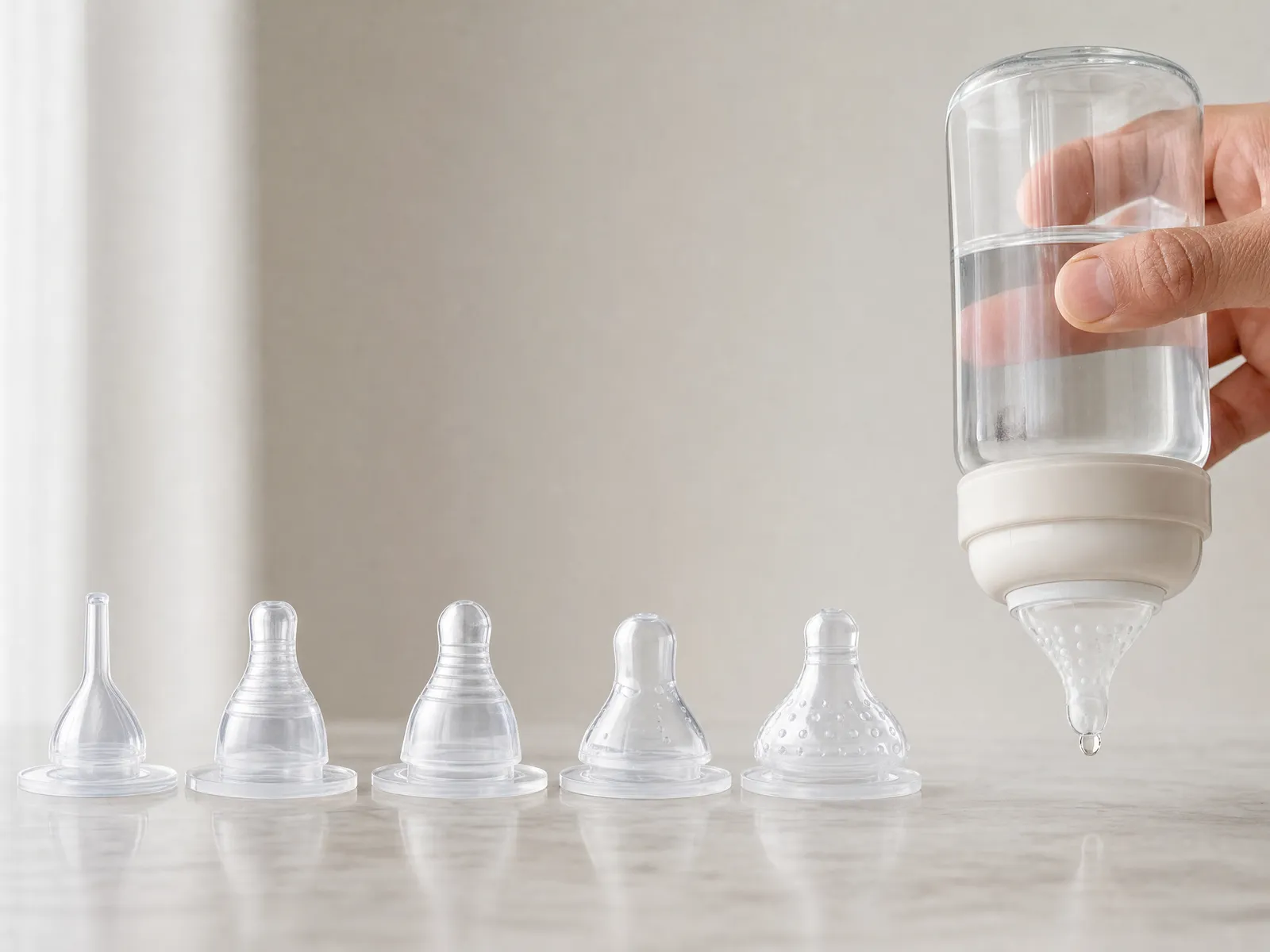
A bottle nipple flow rate is only wrong in two directions, and both are visible from across the room. Too fast looks like gulping, milk escaping the corners of the mouth, coughing, and a bottle gone in under five minutes. Too slow looks like hard sucking with few swallows, a collapsing nipple, and a feed that drags past half an hour. Anything in between needs no change at all. We earn a commission from links on this page, at no cost to you.
That last sentence is the one most buyer's guides leave out. If your baby finishes a bottle calmly in roughly 15 to 20 minutes and comes off relaxed, the right move is to buy nothing. The USDA's Food and Nutrition Service child-care feeding guidance puts a typical feeding session at 15 to 20 minutes, while adding that the length should be based on the baby's fullness signs rather than a timer.
This article exists because the level printed on a nipple packet is a marketing decision rather than a measurement, and the age on the box is a default rather than a prescription. If you are still assembling the fundamentals — which bottle, what volume, how often to burp — start with bottle feeding a newborn and treat flow as the one component worth getting fussy about. Below: what happened when researchers measured flow, the brand ladders side by side, the signs that justify a change in either direction, and how to test a nipple with tap water.
Flow Rate Is a Measurement. The Label Is Not.
Somebody did measure it, and the result is the most useful fact in this article.
A study by Britt Frisk Pados and colleagues, published in MCN: The American Journal of Maternal Child Nursing and indexed by the NIH, tested 26 nipple types representing 15 common brands, ten nipples of each type. Measured milk flow ranged from 1.68 millilitres per minute at the slow end — an Avent Natural Newborn Flow — to 85.34 millilitres per minute at the fast end, a Dr. Brown's Standard Y-cut. That is a fiftyfold spread across nipples sitting on the same shelf.
Consistency varied too. The authors reported a coefficient of variation within a single nipple type running from .03 for the Dr. Brown's Standard Level 3 up to .37 for the MAM Nipple 1 Slow Flow, which means two nipples out of the same bag can behave differently. Their conclusion is worth quoting exactly: the name of the nipple does not provide clear information about the flow rate to guide parents in decision-making.
Two caveats the authors raise themselves. The test applied suction under standardised bench conditions and was not designed to replicate infant feeding, and only one level of negative pressure was used rather than the varying pressures a real baby generates. So these are not the rates your baby achieves. They are evidence about the labels, and on that question they are damning: a "Level 2" from one maker is not a "Stage 2" from another, and neither is a promise.
Nipple Flow Levels by Age: What the Brands Actually Promise
Here is how the four ladders are labelled, using only what the makers publish. Note what is missing: any common unit.
| Brand and line | How the levels are labelled | What the maker says about age |
|---|---|---|
| Philips Avent Natural Response | Flow 1 up to Flow 5 in the US and Canada, up to Flow 6 elsewhere | No age chart. Philips' guidance is to let your baby's drinking style guide you, not their age |
| Dr. Brown's Options+ | Numbered levels from Level 1 upwards, plus a Y-cut — it was the Standard-line Y-cut, labelled 9+ months, that topped the Pados flow table at 85.34 mL a minute | Ages are printed — the Level 2 packaging reads 3m+ — but Dr. Brown's says there is no right time to change the level |
| Pigeon SofTouch | SS, S, M, L, LL, LLL | SS for newborns, S from 1 month, M from 3, L from 6, LL from 9, LLL from 15, offered as a guide |
| MAM | Size 0 extra slow, then sizes 1, 2, 3 and x | MAM lists size 0 as extra small for newborns, size 1 from birth, size 2 from 2 months, size 3 from 4 months, and size x from 6 months for thick liquids |
The companies are more honest than their packaging suggests. Philips' support guidance for the Natural Response line gives no age ranges at all and says to let your baby's drinking style guide you, not their age. Dr. Brown's states that there is no right time to change the nipple level, and that every infant has their own feeding style that is not necessarily a reflection of their age or size. Pigeon publishes a size-by-age chart and then tells you to use it as a guide.
The clearest statement comes from a hospital rather than a brand. Nationwide Children's Hospital, in its guidance on choosing a bottle flow rate, says there is no need to move up a level based on age, and that if your baby is healthy, growing and enjoys feeding, you should continue following your baby's pace.
So plenty of babies stay on a newborn or slow flow for months. Nationwide Children's adds that babies fed by both breast and bottle may benefit from a slower flowing nipple, because it helps match the flow rate of human milk during breastfeeding — and in practice a fast bottle is the path of least resistance, so the breast is what gets refused. That is the reason nipple shape matters as much as flow when you pick a system, which we cover in best bottles for breastfed babies. Size up on a sign, not a birthday.
Signs the Flow Is Too Fast
Nationwide Children's Hospital lists six signs that it is time to try a slower-flowing nipple: gulping, choking, hard swallowing, coughing, increased drooling and refusing to eat.
In a real feed at 2 a.m., those show up as a cluster:
- Swallowing you can hear across the room
- Milk escaping from the corners of the mouth, soaking the bib and the burp cloth
- Pulling off the nipple, then rooting for it again seconds later
- Eyes wide, eyebrows up, or watering
- A 4 oz bottle gone in under five to ten minutes
- Heavy spit-up afterwards
- Over weeks, a baby who has become a reluctant feeder and starts fighting the bottle
That last one is the sneaky one. A baby who has learned the bottle arrives faster than they can manage stops complaining and starts refusing — a bottle-refusal problem with a flow-rate cause.
The serious end is different. Gillette Children's lists colour changes such as looking pale or bluish during or after feeding, apneas, coughing or choking and poor weight gain among the signs of aspiration, and says it is always okay to ask for an evaluation. Those, or distress a slower nipple does not touch, are not things to solve by buying a nipple. They warrant a conversation with your pediatrician.
Two free things to rule out first. A baby lying flat with the bottle tipped vertically is drinking under gravity whatever the nipple is rated — the holds are in bottle-feeding positions. And paced bottle feeding slows a fast nipple considerably, which is worth a few feeds before you blame the hardware.
Signs the Flow Is Too Slow
This is the real reason to size up, and it has nothing to do with the calendar. Nationwide Children's lists the too-slow signals as taking longer to finish eating, fast sucking with not many swallows (and a nipple that may collapse), and getting fussy while eating.
Philips, writing about its own Natural Response nipples, flags three reasons to try a higher flow: the baby is not getting enough milk from the bottle, the duration of the feed is too long — the company's example is longer than 30 minutes — and the baby falls asleep during feeding, gets frustrated, or plays with the nipple instead of drinking.
Put together, the pattern looks like this:
- Working hard with little result: deep sucking, long pulls, not much going down
- The nipple collapsing or flattening mid-feed
- Falling asleep before finishing, then waking hungry
- Feeds that reliably run past 30 minutes
- Frustration, arching, batting the bottle away, then coming back to it
- Chewing or gumming at the nipple instead of sucking
- Giving up while still hungry, taking an ounce or two, then wanting more an hour later
Separate that last pattern from ordinary appetite variation. Babies snack. A baby who consistently quits early and reappears hungry is different from one who takes a small bottle once. For the normal range at your baby's age, our figures are in how many ounces per feed.
When the Answer Is to Change Nothing
Most readers of this article should close the tab and buy nothing.
The target is a calm feed of roughly 15 to 20 minutes, with occasional pauses, that ends with the baby relaxed and the swallowing inaudible from a few feet away. The USDA's child-care feeding guidance gives that 15-to-20-minute figure as typical while insisting the real signal is the baby's fullness signs. Pauses are not a problem to solve — a baby resting mid-feed is regulating. Leftover milk is not a problem either. It is the only evidence that the baby, rather than the bottle, decided the feed was over.
How to Test a Nipple Flow Rate at Home
You need a clean bottle and tap water.
Assemble the bottle with water in it, hold it upside down without shaking it, and watch the tip. Healthwise patient-education material published by Columbia Doctors says the nipple hole should allow liquid to drip slowly, and that milk should drip about one drop a second. A tip that produces a continuous thread of liquid rather than separate drops is running faster than that benchmark — that is the difference between a drip and a stream.
Two honest limits. A manufacturer blog from Evenflo points out that dripping under gravity is not the same thing as flow under a baby's suction, and that warmer liquid drips faster than cool. And the Pados study's point is that nominally identical nipples vary. Use the test to compare two nipples you own, same liquid and same temperature, rather than to certify one in isolation.
Old nipples are not slow nipples. A nipple that has been boiled, scrubbed and run through a dishwasher for months is a different object than it was new, and the fix is replacement rather than guesswork. Nationwide Children's Hospital says nipples that are weak or worn out are more likely to tear or be a choking hazard and must be replaced right away, and lists changing colour, thinning, stickiness or swelling, and cracks, tears or breaks as the signs. Its strength test: pull hard on the nipple, and if it does not return to its original shape, throw it away. Healthwise material adds the mundane fix — buy more nipples than bottles, because nipples crack and leak with repeated use.
Why a Collapsing Nipple Is Usually Not a Flow Problem
A nipple that flattens in the baby's mouth looks like one the baby is sucking too hard, which is why parents size up for it. Check the vent first.
Philips' support guidance for its Natural and Natural Response nipples says a collapsing nipple can mean the anti-colic valve is blocked or stuck together, and advises cleaning the nipples regularly to avoid blockage. For the Natural Response design, its fix is to massage the valve gently between clean fingers to open it up again, with a warning not to pull the nipple tip too firmly in case it breaks. Dried milk in a vent slit, a vent insert that did not seat after washing, or a nipple from one model under another model's collar all produce the same symptom.
Collapse does appear on Nationwide Children's list of too-slow signs, alongside fast sucking with not many swallows, so it is not always a venting fault. But a vent you can clear in ten seconds is the cheaper explanation, and it is free to rule out.
Change One Thing, Then Wait
Nipple changes get judged on a single bad feed, which is how parents end up three levels up in a fortnight.
Change one variable — the flow level, nothing else — and give it three or four calm feeds before you decide. Not the 3 a.m. feed, not the feed after a vaccination. Stepping down is a legitimate move too: if a baby started on a fast nipple because that is what came in the box, slowing the flow is a correction, not a regression.
The Flow Ladder, Made Buyable
These five are the ladder made concrete. Prices are as of October 2026.
Avent Natural Response Slow Flow, Flow 2 — about $13.89 for four. For a term newborn starting bottles, or any baby whose current nipple produces gulping. The opening and tip release milk only while the baby is actively drinking, so flow stops during a pause. Avent describes this as the baby controlling the pace, just like breastfeeding — the company's phrase, not an independent finding.
Pigeon SS Extra Slow Flow — about $21.99 for four. For the baby who still gulps on a nipple sold as slow. SS is the bottom rung of Pigeon's SS-to-LL staging, labelled 0+ months. Pigeon says the shape comes from Japanese research on three natural movements a baby makes while feeding — the company's claim about its own product. The moulded latch-on line is the detail we would pay for, a visible mark for where the lips should sit.
Dr. Brown's Narrow Level 2 — about $10.98 for six. For a baby on Dr. Brown's narrow bottles showing the too-slow signs, whatever their age. Dr. Brown's positions Level 2 as the next step for growing babies and labels it 3m+. The company also states that this nipple with its internal vent system is clinically proven to reduce colic and decreases spit-up, burping and gas, and that each level holds clinical consistency within its flow rate — all manufacturer claims about its own product.
Dr. Brown's Wide-Neck Level 2, 2-pack — about $4.98. For anyone who wants to test a step up before committing, which is most people. A six-pack of the wrong level is money gone; two nipples runs the experiment for a few feeds. Check which neck your bottles have first — wide-neck and narrow are not interchangeable.
Avent Natural Response Medium Flow, Flow 3 — about $13.89 for four. For a baby already on Flow 2 who has shown too-slow signs for a week or more. Same design, one rung up, so the only variable that changed is the flow.
Who should buy none of these: everyone whose baby feeds calmly in 15 to 20 minutes. There is no prize for being on a higher level.
Preemies, Reflux and Bottle Refusers
Babies born early. Slower is the usual direction of travel, and the decision is not yours alone. Nipple choice for a premature baby belongs with the neonatal team or feeding therapist who knows that baby's suck-swallow-breathe coordination. The Pados authors' own recommendation is that both flow rate and variability be considered when guiding parents' choices — precisely the information the packaging withholds. The evidence here is genuinely unsettled, and we would rather say so than manufacture confidence: slower teats are widely used with preterm babies, but we have not seen trial evidence strong enough to claim a slower nipple helps every one of them. Ask before you change anything.
Babies with reflux. Seattle Children's care advice for bottle-fed babies who spit up includes giving smaller amounts per feeding, about 1 ounce less than you have been, keeping total feeding time to less than 20 minutes, and holding the baby upright after meals — while explicitly saying to skip that advice if the baby is under 1 month or not gaining weight well. Note the tension: a slower nipple makes feeds longer. That is a trade-off for your pediatrician, as are thickening feeds or changing formula. We cover both in depth: bottle feeding a baby with reflux, and gas, burping and colic in bottle-fed babies.
Babies who refuse the bottle. Flow is one of the first things to test, in both directions. A baby overwhelmed by a fast nipple may have stopped volunteering for it; a baby working too hard may quit from frustration. Change the flow level and nothing else, offer it when the baby is calm rather than frantic, and give it a few tries. The full troubleshooting ladder is in a baby who refuses the bottle.
The Takeaway
Size up on a sign, not a birthday. The signs that justify it are a feed running past 30 minutes, hard sucking with few swallows, a nipple collapsing after you have ruled out the vent, and a baby falling asleep hungry. The signs that mean slow down are gulping, hard swallowing, coughing, drooling and a bottle gone in five minutes — and Nationwide Children's Hospital puts refusing to eat on that list too.
Everything else is noise, including the level on the box. The Pados study measured a fiftyfold range in flow across nipples sold side by side and concluded that the nipple's name tells parents almost nothing.
The whole system this fits into — bottles, volumes, burping, night feeds — is in the basics of bottle feeding a newborn. And if your baby is feeding calmly today, the correct purchase is nothing at all.

Philips Avent Natural Response Baby Bottle Nipple, Slow Flow (Flow 2), 4-Pack
The opening and tip on these are designed to release milk only while the baby is actively drinking, so the flow stops during a pause instead of continuing to pool in a resting mouth. Avent describes that as the baby controlling the pace, just like breastfeeding — the company's framing rather than an independent finding, but the mechanical behaviour is the one you want from a first nipple. Flow 2 is the slow-flow rung in Avent's own ladder, which runs up to Flow 5 in the US and Canada. There is also a no-drip tip and an anti-colic valve that Avent says keeps air out of the baby's tummy. Four to a pack, which is enough to always have a clean one without over-committing.
- Brand
- Philips Avent
- Category
- Our Pick
The flow genuinely stops when the baby stops, which is the difference between a feed you can pace and a feed that paces you.

Dr. Brown's Narrow Level 2 Medium Flow Nipple, 3m+, 6-Pack
Dr. Brown's positions Level 2 as the next step for growing babies and labels the packaging 3m+, which makes this the default first step up for anyone already on the brand's narrow Options+ bottles. The company states that the nipple paired with its internal vent system is clinically proven to reduce colic and decreases spit-up, burping and gas, that vacuum-free feeding gives a consistent flow so babies feed at their own pace, and that each level holds clinical consistency within its flow rate — all manufacturer claims rather than independent findings. The silicone is shaped to encourage a proper latch and fits the Options+ narrow bottles. Six to a pack is the right buy once you have confirmed the step works, and the wrong buy before that.
- Brand
- Dr. Brown's
- Category
- Best Step Up at 3 Months
Six nipples means the slow ones stop being the only clean option at 3 a.m., which is how babies end up on a faster flow by accident.

Pigeon Extra Slow Flow Nipple (SS) with Latch-On Line, 0+ Months, 4 Count
SS is the slowest rung on Pigeon's ladder, which runs SS, S, M, L, LL and up, and it is labelled 0+ months. Pigeon says the shape comes from research in Japan on three natural movements a baby makes while feeding — the company's own claim — and the moulded latch-on line is a genuinely useful detail, a visible guide for where the baby's lips should sit rather than a marketing stripe. The silicone is soft and flexible, which Pigeon positions for babies moving between breast and bottle, and Pigeon says the venting is shaped to minimise swallowed air. This is the one to try when a nipple sold as slow still produces gulping.
- Brand
- PIGEON
- Category
- For a Baby Who Gulps
The latch-on line settles the argument about whether the baby is on far enough, and the SS flow is slow enough that a gulper has to work for it.

Philips Avent Natural Response Nipples, Medium Flow (Flow 3), 4-Pack
The same baby-controlled Natural Response design one rung up from Flow 2, with the same no-drip tip and anti-colic valve. Buy this only when the signs point to it: long feeds, hard sucking with few swallows, falling asleep still hungry. The wide breast-shaped nipple is the part that matters for a baby splitting time between breast and bottle, and Avent states the design supports combining the two. Four to a pack, same as Flow 2, so stepping up costs the price of one pack rather than a new bottle system.
- Brand
- Philips Avent
- Category
- The Next Step Up
Staying inside one brand's ladder means the only thing that changed is the flow, which makes it obvious whether the step was the right call.

Dr. Brown's Wide-Neck Level 2 Medium Flow Nipple, 3m+, 2-Pack
The wide-neck version of Dr. Brown's Level 2 medium flow, labelled 3m+, in a two-pack rather than a six-pack. That is the entire reason it is on this list. Two nipples is enough to run a step up for a few feeds and find out whether it helps, without a drawer full of the wrong level if it does not. Dr. Brown's makes the same claims for it as for the narrow version — clinically proven to reduce colic with the internal vent system, decreases spit-up, burping and gas, and a consistent flow rate so babies feed at their own pace — all the manufacturer's statements about its own product. It fits the Options+ Wide-Neck bottles, so check which neck you own before ordering.
- Brand
- Dr. Brown's
- Category
- Cheapest Way to Test a Level
Two nipples is the right size of bet on an experiment. A six-pack of the wrong level is just money in a drawer.
- 01Philips AventOur PickPhilips Avent Natural Response Baby Bottle Nipple, Slow Flow (Flow 2), 4-Pack
- 02Dr. Brown'sBest Step Up at 3 MonthsDr. Brown's Narrow Level 2 Medium Flow Nipple, 3m+, 6-Pack
- 03PIGEONFor a Baby Who GulpsPigeon Extra Slow Flow Nipple (SS) with Latch-On Line, 0+ Months, 4 Count
- 04Philips AventThe Next Step UpPhilips Avent Natural Response Nipples, Medium Flow (Flow 3), 4-Pack
- 05Dr. Brown'sCheapest Way to Test a LevelDr. Brown's Wide-Neck Level 2 Medium Flow Nipple, 3m+, 2-Pack
How do I know if my baby's bottle nipple flow is too fast?+
Do I have to move up a nipple level when my baby turns 3 months?+
How do I test a bottle nipple's flow rate at home?+
How often should bottle nipples be replaced?+
Why does my baby's bottle nipple collapse, and does it mean the flow is too slow?+
Should a breastfed baby stay on a slow-flow nipple?+
Sammie Seelbach
Sammie is a mom of two and the lead reviewer at Smart Baby Reviews. Since becoming a parent she has become obsessed with researching the safest, smartest baby gear on the market — testing thermometers at 2 a.m., wrangling baby gates, and sterilizing more bottles than she can count. She shares what actually works so other parents can make confident, informed decisions for their little ones.